You Don’t Mess With the Zohan

Posted on October 7, 2008 at 8:00 am

Somewhere inside this Adam Sandler slacker silliness there is a fierce and provocative little satire trying to get out. Sandler is so busy with his usual shtick that at times it seems that even he hardly notices the subversive political humor bubbling up around him.

Sandler plays Zohan, a top Israeli assassin, who can slaughter terrorists with one hand while he scoops hummus with the other. He is commando as rock star, universally admired and adored by all women. But Zohan dreams of peace and hairdressing. He decides to fake his own death and move to the United States where he can spend his days making hair shiny and silky. Soon he has transformed himself with an 80’s haircut and has a job sweeping up hair in a beauty salon on the Palestinian side of the street in a middle Eastern neighborhood of New York and is happily having sex with all of the elderly patrons and his landlady (all-purpose ethnic hot mama Lainie Kazan).

Comedians most often rely on ineptitude at work or with women to get laughs, but Sandler’s characters are often very successful in both. That leaves only gross-outs and silliness for humor, and that is what Sandler gives us, over and over. Lots of jokes about sex with old ladies (who are all thrilled with his prowess), bare tushes (male and female), the consternation of his landlady’s nerdy son over his mother’s unabashed sexual encounters, the ability to withstand pain, made-up euphemisms for sex, random pop star cameos, and of course one of Sandler’s theme moves — a sharp implement being thrust into the body of someone who feels no pain. We’ve seen most of this before.

But the movie also has moments of surreal humor, some remarkably adept and surprisingly understated political satire, and better roles than usual for Sandler’s frequent co-stars John Turturro and Rob Schneider. Its (almost) even-handed jibes at just about everyone are refreshing. Of course the real bad guy is a white American, but the movie’s notion that this is a place where people may hate and do crazy things but they can all agree on the importance of shiny hair, good Chinese food, and the other things that really matter in life is sweetly hopeful. All the crotch-rubbing and hummus humor feels tired and shrill when we see would-be terrorists put on hold from the bomb-building line, cheerfully reassured by the recorded voice that “we will resume service as soon as negotiations break down” or a bunch of enemies interrupting a confrontation to speculate on the, uh, appeal of Hillary Clinton.

The outrageous stereotyping and stereotype tweaking of characters on the basis of race, culture, religion, and nationality may be softened or even sanitized by the content that falls into the “normally offensive” category, the stereotyping and stereotype tweaking of old ladies (sexually voracious or addled, often both), the constant vulgarity, Sandler’s annoying idea of an accent. Or it may be that it is just a distraction that lets the political satire sneak in under the radar. But this glimpse of something a little more ambitious, a little more substantive adds a level of freshness and interest that is a welcome change from Sandler’s increasingly stale snigger-fests.

Related Tags:


Comedy Satire

Sleeping Beauty

Posted on October 6, 2008 at 6:00 am

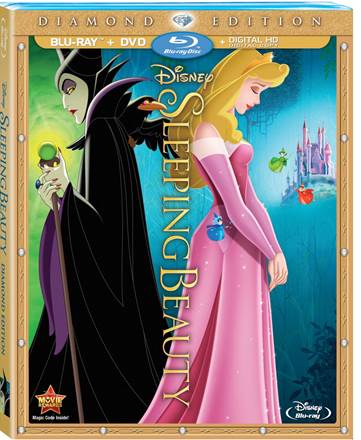
Disney’s gorgeous “Sleeping Beauty” is out in a magnificent new Diamond edition this week. This classic should be in the library of every family and every animation fan.

The King and Queen happily celebrate the birth of their daughter, Princess Aurora. The young Prince who is betrothed to the baby and three good fairies, Flora, Fauna, and Merryweather, join the celebration. But wicked Maleficent, a bad fairy, is enraged when she is not included. She arrives at the party to cast a spell on the baby Princess. When she turns 16, she will prick her finger on the spindle of a spinning wheel, and die.image001

The good fairies cannot remove the spell, but they change it from death to a deep sleep from which Aurora can be awakened only by love’s first kiss. The King and Queen try to protect the princess by sending her off with the good fairies to live in a tiny cottage in the woods until her sixteenth birthday is over. They cannot use their magic powers because it would lead Maleficent to the princess. Aurora (called Briar Rose) grows up. Out in the woods, she meets the Prince, and they fall in love, not knowing they are already engaged. But the fairies prepare for her birthday party and argue about whether the dress they are making for Aurora should be pink or blue, and cannot resist using their magic. Maleficent discovers where they are and is able to make Aurora prick her finger and fall into a deep sleep. Maleficent also captures the prince to make sure he cannot break the spell. After the fairies help him escape, Maleficent turns herself into a dragon to stop him. He kills the dragon and wakes Aurora with a kiss. At her birthday party, they dance, not even noticing that her dress turns from blue to pink as the fairies continue to argue about the color.

In this classic story, as in “Snow White,” a sleeping princess can only be awakened by a kiss from the prince. Psychiatrist Bruno Bettelheim and others have written extensively about the meaning of these stories, and the ways in which they symbolize the transition to adulthood and sexual awakening. Bettelheim’s theory was that such fairy tales begin to prepare children for developments they are not ready to assimilate consciously.

There is no reason to discuss this interpretation with children, of course. But it is worthwhile to talk with them about Maleficent, one of Disney’s most terrifying villains, and why her bitter jealousy makes her so obsessed with vengeance. Is that what she really wants? Isn’t she doing exactly the opposite of what is required to achieve her real goal, acceptance? Children also enjoy the little squabbles of the three good fairies, which may remind them of arguments with their siblings.
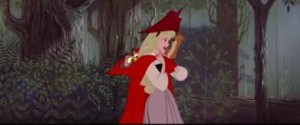
image003Extras on this new edition:

· Art of Evil: Generations Of Disney Villains – This legacy piece spotlights Disney’s favorite villain animator, Marc Davis and his infamous creations of characters such as Maleficent and Cruella. Throughout the piece, we will talk to modern day animators like Andreas Deja and also the new generation of Animators (Lino DiSalvo Animation Director of FROZEN) on how Marc’s designs and characters influenced what they do today.

· DisneyAnimation: ARTISTS IN MOTION (Extended Edition) – Join Walt Disney Animation Visual Development artist Brittney Lee as she goes through the process of creating a three dimensional sculpture of Maleficent, completely out of paper. In this extended edition, go deeper into Britney’s process

· Never Before Seen Deleted Scenes:
o The Fair (With Deleted Character – The Vulture) – In this version of the story, the fairies do not take the Princess to live with them in the forest. Convinced that King Stefan’s order to burn all the spinning wheels in the kingdom will not prevent Maleficent’s curse, the good fairies put a magic circle around the castle and cast a spell: “No evil thing that walks or flies or creeps or crawls can ever pass these castle walls.”
o The Curse is Fulfilled – The three good fairies have just returned Aurora to the castle and give her a crown. They leave the room to give Aurora some time alone…but Maleficent pays her a visit.
o Arrival Of Maleficent (Alternate Scene) – Maleficent arrives uninvited to the christening of the Princess Aurora.

https://www.youtube.com/watch?v=XdJpXFVunJ0&list=UU4IEmIzWf_X4lEPtGm7kgzQ

· BEAUTY-OKE “Once Upon A Dream” – Sing along to this kinetic text video of Aurora’s signature song.

· Classic DVD Bonus Features Include:
o The Sound Of Beauty: Restoring A Classic – This featurette covers the creation of the 7.1 mix of the score of Sleeping Beauty that was done for Blu-ray, using the source tapes from the original recording sessions resulting in an audio experience of superior quality with greater detail and fidelity that you have ever heard before.

o Picture Perfect: The Making Of Sleeping Beauty – Discover the behind-the-scenes magic that transformed a beloved fairy tale into a cinematic work of art. Legendary Animators, actors and film historians reveal the secrets behind Disney’s masterpiece.

o Eyvind Earle: A Man And His Art – Early in his career, renowned American Artist Eyvind Earle worked as a background painter at the Walt Disney Studio. Walt Disney liked his work so much that he entrusted him with the assignment to be the Art Director for Sleeping Beauty. This was the first time that one artist was given the responsibility for the entire look on one of Disney’s animated features. This piece follows Earle’s development as an artist and his years at the Studio.
o Audio Commentary by John Lasseter, Andreas Deja and Leonard Maltin

Related Tags:


Animation Based on a book Classic Comedy For Your Netflix Queue Movie Mom’s Top Picks for Families Musical Romance

A Month of Halloween Horror from The Movie Boy

Posted on October 1, 2008 at 4:00 pm

The Movie Boy Dustin Putman knows horror, and he salutes it this month with a new review every day.
For the entirety of October, TheMovieBoy.com will be updated daily with all-new content, including at least thirty-one full-length reviews of horror pictures–a collection of classics, lesser-known gems, and longtime favorites–that I have never previously covered; an additional smorgasbord of fresh (but not necessarily positive) capsule reviews; and an ongoing blog where I will tackle any number of horror-related subjects. Maybe I can help readers come up with ideas on what’s worth watching this October. Or maybe I can help them get in the mood for a holiday filled with ghosts, goblins, costumes, candy, and things that go bump in the night. Either way, the goal is to entertain and inform both die-hard horror fans, as well as the heretofore uninitiated who are interested in taking that first dip into a too-frequently underappreciated category of cinema. And maybe, just maybe, we’ll all (myself included) learn a little something, too.
I am not a horror fan, but Putman’s first choice is perfect, the silent classic Nosferatu. As he says, it may not be the first horror film, but it is the first influential one. It is essentially “Dracula,” but director F.W. Murnau did not want to pay royalties, so they changed the names. The mysterious Max Schreck starred (there is an urban legend that he really was a vampire — amusingly explored in “Shadow of the Vampire” with Willem Dafoe as Schreck) and it is every bit as creepy as any CGI-enhanced state-of-the-art special effects horror movie made today, nearly 80 years later.

Related Tags:


For Your Netflix Queue Rediscovered Classic

Pastor’s Parables Taken from Movies

Posted on September 4, 2008 at 8:00 am

The Washington Post Metro section has an article about a pastor who uses movies to bring spiritual lessons to his congregation.
For a special series of sermons this summer, Senior Pastor Rob Seagears at Christ Chapel Mountaintop in Prince William County tied his sermons to whatever movie was top at the box office that week, often appearing in costume. This presented him with a daunting challenge as the summer was filled with blockbusters featuring a lot of violence and bad language.


“It’s kind of risky to be watching to see what the number one movie is going to be and figuring out how to flip this thing for God,” he said.

Sometimes, as with “Tropic Thunder,” he was able to tie the movie to an important message but sill ended up recommending that the congregation stay away from the film. For that movie, by the way, he appeared in church as Kirk Lazarus, the white actor portrayed by Robert Downey, Jr. who has medical treatment to darken his skin so he can play a black man on screen. Pastor Seagears began with a joke about being a black man pretending to be a white man pretending to be a black man. While there have been some objections, the pastor’s series proved to be very popular with the parishioners and a draw for new worshipers as well. And it was especially appreciated by teenagers.


If there were an Oscar for sermons, Seagears would be a contender. There’s his “Dark Knight” performance, when he roared up to the pulpit astride a Suzuki motorcycle, dressed like Batman. And his whip-cracking Indiana Jones, and his green-suited Hulk.
Perhaps most memorable was when he bumbled out wearing a ratty wig and a blood-red smile across his face, ranting like a maniac.
“When I went into the church as the Joker, there was complete silence,” Seagears recalled fondly. “People were stunned because I was acting as if I was evil.”

For those who complain,

Seagears responds that preaching through movies allows him to meet people where they are and is similar to Jesus’s use of parables.
“It’s all about engaging your audience,” he said. “That’s what Jesus did, telling stories.”

Related Tags:


Spiritual films Understanding Media and Pop Culture
THE MOVIE MOM® is a registered trademark of Nell Minow. Use of the mark without express consent from Nell Minow constitutes trademark infringement and unfair competition in violation of federal and state laws. All material © Nell Minow 1995-2026, all rights reserved, and no use or republication is permitted without explicit permission. This site hosts Nell Minow’s Movie Mom® archive, with material that originally appeared on Yahoo! Movies, Beliefnet, and other sources. Much of her new material can be found at Rogerebert.com, Huffington Post, and WheretoWatch. Her books include The Movie Mom’s Guide to Family Movies and 101 Must-See Movie Moments, and she can be heard each week on radio stations across the country.

Website Designed by Max LaZebnik