Rated PG for some sequences of scary action and peril
Profanity:
None
Alcohol/ Drugs:
None
Violence/ Scariness:
Extended peril and violence including bees, a tiger, a snake, and fire
Diversity Issues:
A theme of the film
Date Released to Theaters:
April 15, 2016
Date Released to DVD:
August 29, 2016
Amazon.com ASIN:
B01CTNDO58
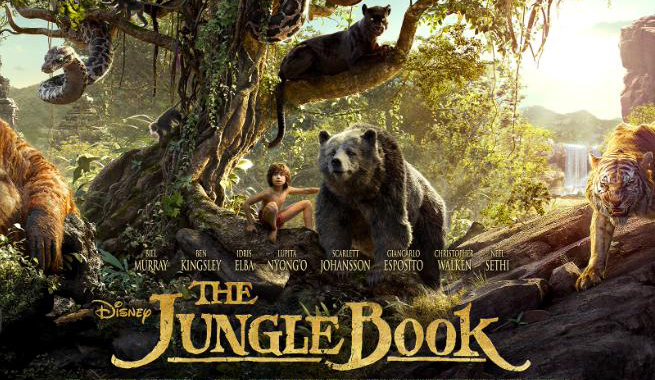
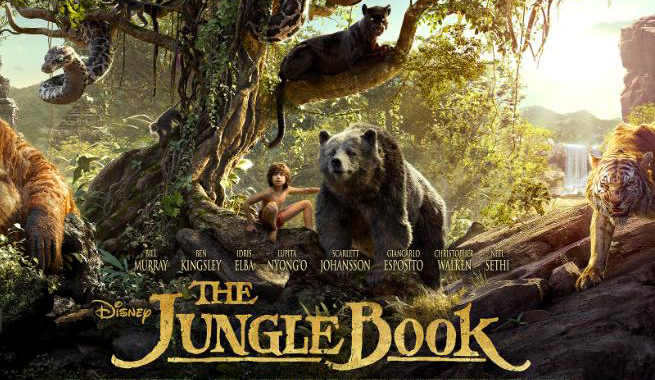
Copyright 2016 DisneyThe camera swoops behind the familiar Disney castle logo to take us to that magical place — you know, like the one that is found second star to the right and straight on ’til morning or through the wardrobe in the attic, down a rabbit hole, or via a house swept up in a Kansas tornado. Just a moment past the castle we are deep, 3D IMAX deep, in the midst of of a lush and luscious jungle, where a mop-headed, big-eyed boy in a red loincloth is running for his life.
The wolves are after him. No, the wolves are with him and a sleek black panther is after him. No, he catches him. No, they are friends. It is Mowgli (newcomer Neel Sethi) and the Bagheera (Sir Ben Kingsley), the panther who discovered him as a toddler and delivered him to the best mother he knew, the wolf Raksha (Lupita Nyong’o) who raised him lovingly along with her other cubs. While he matures more slowly and cannot do some of the things they can to stay safe, he can climb and use tools. Although Raksha tells him not to use “tricks” like pulleys, knots, and scoops, he feels very much a part of the wolf pack and solemnly recites along with the others:
Now this is the Law of the Jungle —
as old and as true as the sky;
And the Wolf that shall keep it may prosper,
but the Wolf that shall break it must die.
As the creeper that girdles the tree-trunk
the Law runneth forward and back —
For the strength of the Pack is the Wolf,
and the strength of the Wolf is the Pack.
When the rainy season ends, a dry spell shrinks the river so that the “peace rock” is showing. According to the well-established rules of the jungle, as long as they can see that rock, everyone may drink together in peace, meaning the predators cannot attack their usual prey. The one-eyed tiger with burn scars named Shere Khan (Idris Elba) sees Mowgli and warns the others that as soon as the rock is submerged again and the truce has ended, he will come for the boy and will do whatever it takes to kill him. Raksha reluctantly agrees to let Bagheera take him to the town, where Mowgli can be with other people. On the way, they have encounters with Kaa the mesmerizing snake (Scarlett Johansson), Baloo the easy-going bear (Bill Murray), and King Louis (Christopher Walken), an enormous ape (based on the extinct Gigantopithecus) who presides over an orangutan kingdom living in an ancient temple.
Fans of the Disney animated musical version will be happy to find some familiar moments within the superb score from John Debney.
But this is very much its own film, with stunning integration of the digital animals and the real-life boy. (Disneyphiles may think of Walt’s earliest short films featuring a real-life girl interacting with hand-drawn characters.) The world of the jungle is enchanting and vital, a Rousseauian dream of an Edenic natural world (in this PG film, while there is peril and some characters are injured and killed, any carnivore behavior happens off-screen). Sethi has an engagingly natural quality that is as important in bringing the digital characters to life as the brilliant work of the many, many artists and technicians whose names appear in the credits.
So does the storyline’s respect for this world and its inhabitants. Mowgli does not have many of the physical gifts of his wolf family or his friends in the forest. He does have some skills they do not, and it is heartwarming to see him develop simple tools like a stone ax and a pulley because they are not presented as superior or used to establish dominance, but to help his jungle community and to give thanks for all they have given him. This is gorgeous, inspiring filmmaking.
Parents should know that this movie includes extended peril with some violence and some disturbing images. A theme of the film is the tiger’s determination to kill Mowgli, and characters are injured and killed (including parents).
Family discussion: Why did the wolves and Baloo have different ideas about Mowgli’s “tricks?” Should Mowgli stay in the jungle or live with other humans?
If you like this, try: Rudyard Kipling’s Just-So Stories and two earlier films based on this story, one starring Sabu and the Disney animated version.
Copyright Mike Zoss Productions 2016 The Coen brothers love old movies, and not just the classics. I remember reading an interview where they discussed their affection for “With Six You Get Eggroll,” which even Doris Day’s most fervent fans do not consider one of her best. With “Hail, Caesar!” they pay loving tribute to the final years of the golden era of the Hollywood studios, in part because it gives them a chance to tell a story about change, and choice, responsibility and irresponsibility, and in part because it gives them a chance to play studio heads themselves, overseeing not just one movie but five. And as Orson Welles said, that’s “the biggest electric train set any boy ever had.”
There really was an Eddie Mannix, the MGM executive who had various titles but who was pretty much a full-time fixer. Whether it was a starlet’s nude photos or a male star’s casting couch encounter with a male director, his job was to keep it out of the courts and especially out of the gossip columns and scandal magazines with names like “Confidential.” This was accomplished with bribes, intimidation, and trading of favors. A reputation would be saved by giving the reporter exclusive access or even a juicy story about a lesser star who could be sacrificed to save the day for someone the studio considered a major asset.
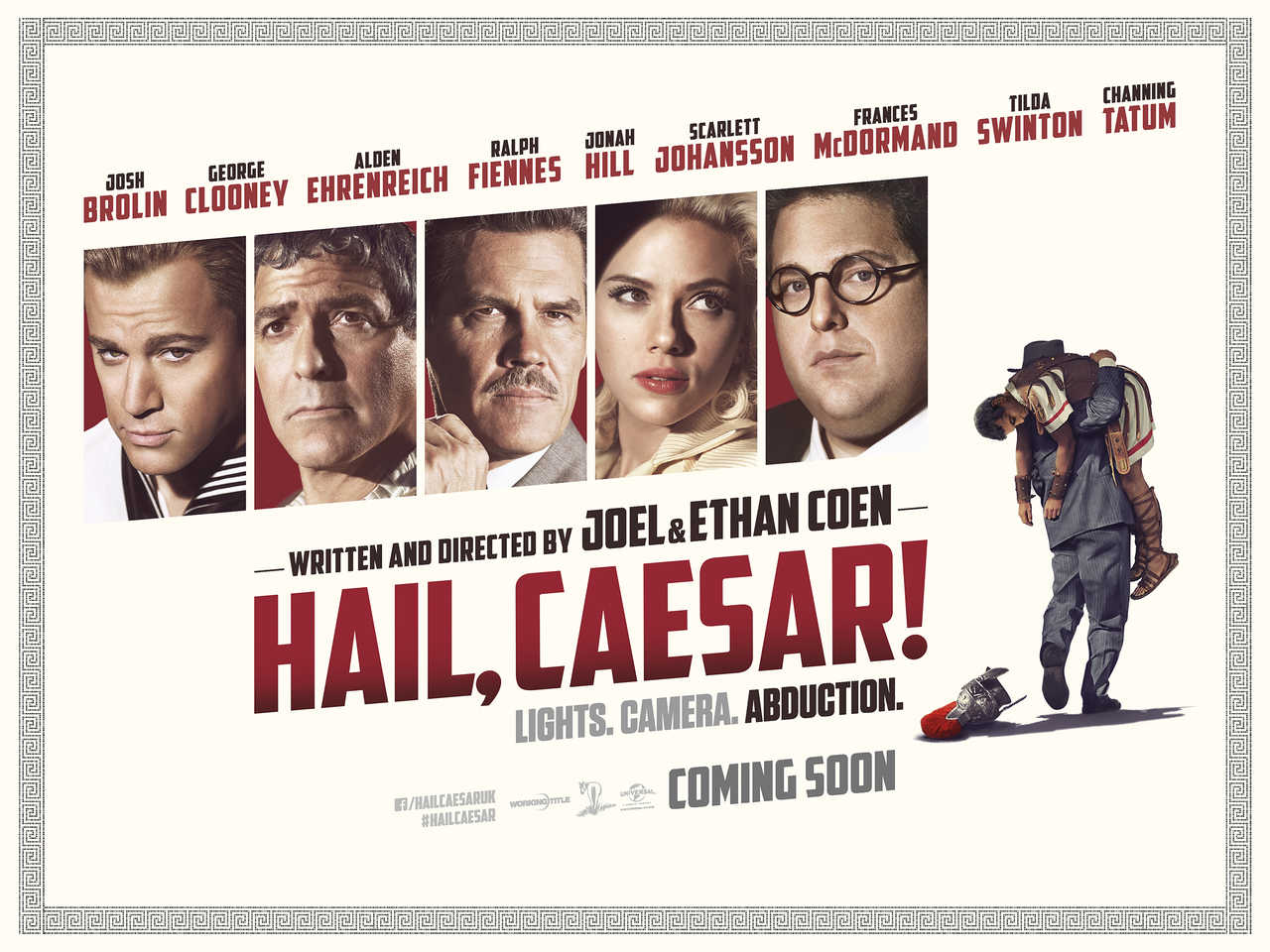
The Eddie Mannix played by Josh Brolin works at a studio called Capitol Pictures, but the issue of capital will arise as well. Eddie is under so much stress he goes to confession every day. He is responsible for keeping the entire studio running smoothly, and that begins before dawn, where he extracts an actress from a compromising situation (paying off the cops), and continues on the studio lot. There he assigns an amiable singing cowboy star named Hobie Doyle (a winning Alden Ehrenreich) to put on a dinner jacket and take over the lead in a high-prestige drawing room drama, even though he’s “a dust guy” and his dialog in previous films was pretty much limited to whistling for his horse, Whitey, and “Hold on, there, partner.” Cleaning him up and putting him in a dinner jacket is not a problem, but the intricate drama he is thrown into requires tricky lines like “Would that t’were so simple,” preceded by a mirthless laugh.
Mannix visits the set of a big-budget musical and sees a water ballet out of Busby Berkeley’s wildest dreams. But the star is pregnant but not married (a career-killer in those days). She’s played by Scarlett Johansson with enough wit and brio to power the massive flume of water that lifts her mermaid character up into the sky.
The biggest studio production is the epic “Hail, Caesar,” about a Roman centurion who becomes a follower of Jesus (oddly similar to the upcoming “Risen”). It stars the studio’s most valuable actor, with the manly name of Baird Whitlock (a wickedly funny George Clooney). Mannix thinks his biggest problem is going to be making sure that the movie does not offend anyone in the audience, and in a hilarious scene, he consults with a focus group of clergy, or tries to. But then a real problem arises. Baird Whitlock is kidnapped and being held for ransom by a group that calls itself “The Future.” They are a group led by the most improbable of 20th century scholars, accurately quoted if not accurately portrayed, and supported by…well, no more spoilers here.
It’s flat-out funny, whether you know the history or not, and I left wishing for a quadruple feature that would include all of the films we see in production (well, maybe not the other “Hail, Caesar”). What keeps it buoyant, even effervescent, is the pure affection for films and filmmaking in every one of what in the pre-digital days we used to call frames. (We see them up close and personal in a hilarious scene with Frances McDormand as an old-school film editor.) The movie touches lightly on issues of story-telling and the inherent chaos and frustration of trying to balance art and commerce, plus the skills and needs of a large group of people. But the love story here is between Mannix, as a stand-in for the writer/directors, and the movies.
Parents should know that this film includes kidnapping, out-of-wedlock pregnancy and paternity issues, some sexual references, drinking and references to alcoholism, and smoking.
Family discussion: Which real-life characters inspired this movie? Should Eddie take the job offer?
If you like this, try: some of the movies that inspired this one like “Million Dollar Mermaid,” “Anchors Aweigh,” “My Pal Trigger,” and “The Robe”