The goal is almost for your work to be invisible, then?
The rule of thumb is: if your work is noticed you did a bad job.The point is to help tell the story, to help the film draw people in and get caught up in the story. So if people are paying attention to the sound, then you really didn’t do a good job because they’re not in the story, they’re not being drawn in. Badly done sound can be much more noticeable than a really good, smooth job.It cuts the suspension of disbelief.A really good movie is going to draw you in, so it’s our job in post-production sound to help the director or the producers achieve that in the final product; it’s all about the experience for the person sitting in the seat.
It was a delight to talk to 10-times Daytime Emmy-nominated Sean Karp for The Credits. who answered my questions about sound editing and sound mixing. An excerpt:
Do our readers a basic service, and describe the difference between sound mixing and sound editing?
Basically, sound editing is taking all your different sound elements or sound files and editing together all the production sound that’s recorded on set when they shoot the film or TV show, which generally is dialogue, and then build a soundscape. That means creating the sound environment, so if stuff is taking place in the city so you will edit in all these background city sounds; the sounds of traffic, the sounds of people walking by, horns honking; that kind of thing. Then you’ll edit in all your specific sounds. Maybe there’s a gunfight, so we’re placing in all those gunshots and the sounds of the shell casings leaving the guns and dropping on the floor. Then of course there’s the music. The composer will create the score, but then a music editor will do some touch-ups to make it work better to picture. So that is sound editing; it’s basically putting to time all the sound elements to the picture.
Sound mixing is mixing all those elements for the final version. I’ve heard it described as almost like when you’re recording an album. Editing is doing all your tracking like I’m tracking my drums, I’m tracking my bass guitar, my lead guitar, my keyboards, my vocals; that’s sound editing, and then the mix is the mix as it would be for a song.
The goal is almost for your work to be invisible, then?
The rule of thumb is: if your work is noticed you did a bad job. The point is to help tell the story, to help the film draw people in and get caught up in the story. So if people are paying attention to the sound, then you really didn’t do a good job because they’re not in the story, they’re not being drawn in. Badly done sound can be much more noticeable than a really good, smooth job. It cuts the suspension of disbelief. A really good movie is going to draw you in, so it’s our job in post-production sound to help the director or the producers achieve that in the final product; it’s all about the experience for the person sitting in the seat.
It’s the climax of the film. The hero and heroine finally kiss. The power of the moment comes from the emotion built up by the story, by the acting talent and screen charisma of the performers, by the heart-tugging swell of the music — and by the sound of the kiss itself, probably so subtle you don’t notice it, but if it wasn’t there, you would notice its absence. That sound was not made by the tender touch of two beautiful movie stars’ lips. It was made by a Foley artist, the “actor of sound,” whose profession is the subject of this documentary.
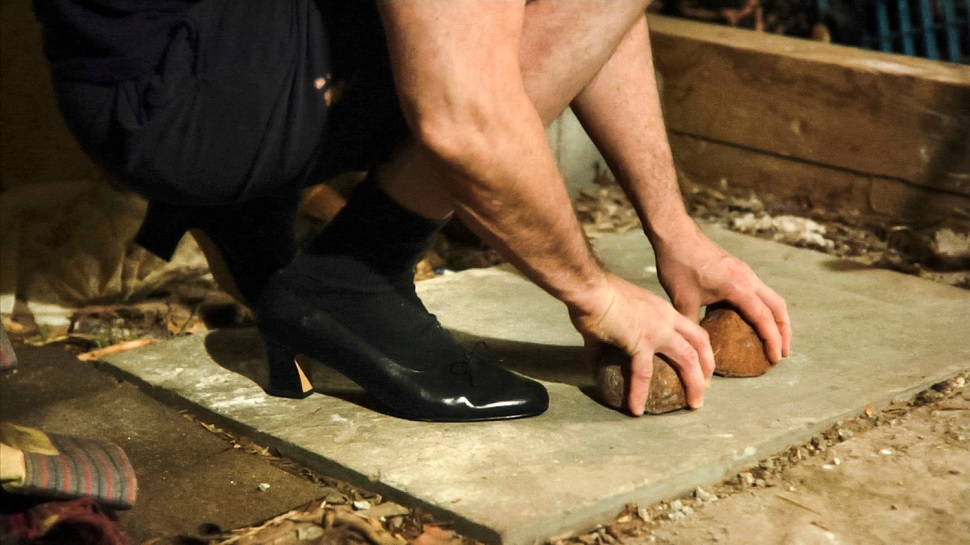
Skip this next part and go to the next paragraph if you want to preserve the illusion: the slight smacky sound you hear is probably some burly guy kissing the back of his hand. And when a beautiful actress walks down a hall or street in high heels, that same burly guy is probably wearing a t-shirt, shorts, and high heels, stepping on one of the dozen or so different surfaces in the studio to match the shot. The sound of the trudging footsteps of the enormous football player in “The Blind Side” was created by a woman, who explains, “I had to become a 300 pound man who was feeling alone and like no one cared about him…I gave myself a sense of heaviness.” Another woman “was” Mr. T in “The A-Team,” at least the sounds of his feet.
The Foley artist is the person who provides everything from hoofbeats on dirt to the clacks of high heels on a wood floor, from the sound E.T. makes when he walks to the sound of Walter White taking off the mask he uses for cooking meth to the sound Robert de Niro makes when he slams a baseball bat into a guy’s head in “The Untouchables.” That last one, we learn in this fascinating and engaging documentary, was made with a combination of a raw turkey (gizzards still inside) and a coconut. We learn about sounds like the snap of Batman’s cape, the flutter of paper floating through the air, and the “hyper-real” coin toss in “No Country for Old Men.”
Foley was a real person, a pioneer in the field. While the technology for recording and editing the sounds has advanced along with most other aspects of filmmaking, the technology for creating the sounds has not. They are still using the same kinds of props — and sometimes even the exact same props — that go back to the heyday of radio. If it’s a period film and someone needs to dial a phone, you’re going to need a dial phone to create that sound. And nothing beats corn starch for the sound of walking on snow.
The documentary includes archival footage showing how sounds were created for some of the most iconic moments in film history. ET’s walk? Let’s just say that when the Foley artists were served Jello at lunch, it gave them a good idea. It also includes Foley artists from around the world and some discussion of how changes in the industry and technology may affect the future of the profession.
All of the participants are wonderfully imaginative and dedicated, and their stories and perspective make this essential viewing for anyone who is interested in film. “The sound has to pan, too,” to help create the illusion of movement. And they will do anything to get the sound just right — even a condom over the microphone.
As one of them says, a Foley artist has to be “an athlete, a musician, and an actor all in one,” and as another says, they are “painting a picture with sound.” So far, no one has been able to produce sounds digitally or via a sound library that feel real, not robotic. Being a Foley artist requires “imagination, tempo, coordination, and love,” and this film is filled with all of that as well, a welcome appreciation for an essential and often overlooked profession.
Parents should know that this film includes brief violent footage from films being discussed.
Family discussion: What movie sounds do you remember? How will this movie make you listen more closely?
The Oscars are about more than office pools, fashion, and celebrities. It’s also a chance to learn more about that most collaborative of art forms, the movies. It took more than 3000 people to make “Avatar,” and only a couple of dozen were on screen. Slate has an excellent explanation of one of the more obscure awards, sound editing. Take a look and pick your favorite to win the award on Sunday night.