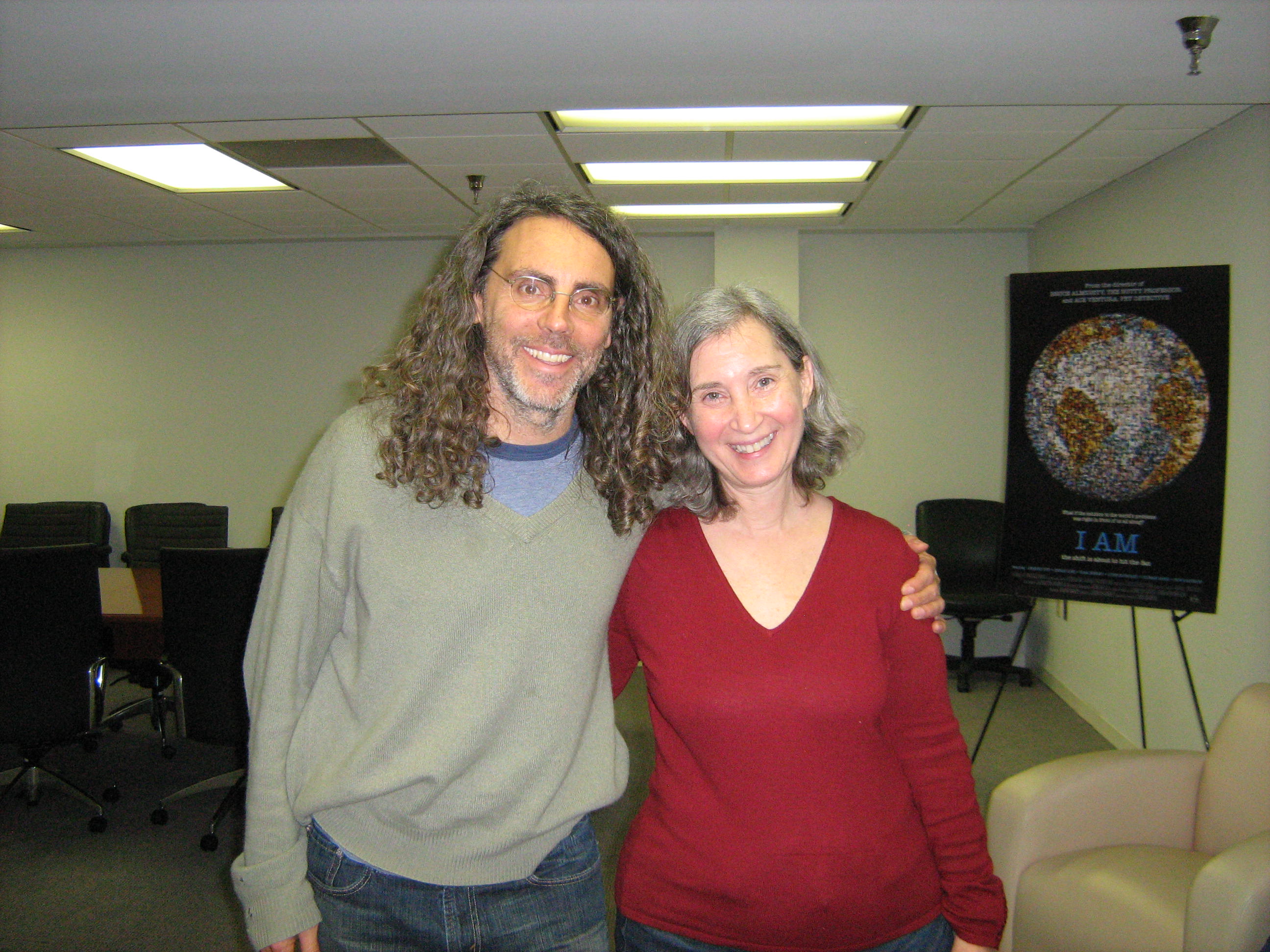
Interview: Tom Shadyac of Life’s Operating Manual

Posted on May 5, 2013 at 3:59 pm

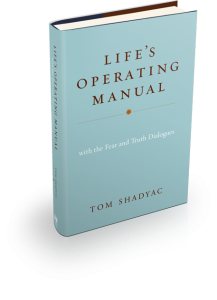
I am always happy to get another chance to talk to Tom Shadyac, the mega-successful Hollywood director (Ace Ventura: Pet Detective, Bruce Almighty) who now devotes his time to exploring the meaning of life and sharing what he has learned. I last spoke to him about his documentary I AM.  Now he has written a book, Life’s Operating Manual: With the Fear and Truth Dialogues, and was nice enough to talk to me about it.

I like your imagined dialogue between fear and truth, especially when fear says you have to own things and truth says “I own this choice.”That was a really meaningful exchange.  Can you to talk a little bit about what ownership means?

We’ve limited ownership to things. And truth is saying is that ownership can be in a much larger context. So our society values ownership of material goods, properties, personal possessions and what I wanted to do is say you also must own the choices you make in your life. And so you must own the fact that you value community more than you value your things. You can own the fact that you value love more than you value profit. So it’s just a way again of looking at some of the concepts that we take as truth and turning them upside down.

If you turn it upside down you at least look what is scaring you right in the face and it’s generally less scary than you think.life's operating manual
That’s all how dragons disappear. Not only in mythology but in our lives. I believe that any fear examines and if it doesn’t dissipate it very well may be a truth. So I don’t run across the freeway because it’s true because I will get hit by a car. If my fear is telling me I can’t have an honest conversation with my spouse or my parents, examine it and you see that it dissipates. You can actually can stand up in your own voice and have a respectful conversation.

It seems we live in a moment in history where it seems very easy to feel despair. How do you maintain a sense of joy when it must feel very frustrating?

Well first of all the results are not up to me. So my job is to share what I’m experiencing and what I am seeing and then feed the results into bigger hands. But I also know that a body kicks the hardest when it’s dying. So fear often peaks when something is about to be lost. So I think we see a lot of that fear even in the way we do business with each other. I think that people can see that it’s built on a house of stone and see that it’s going to fall and so I think that at that point fear begins to peak. So I don’t know where we are in this cycle. But I know that regardless of late in the cycle or early in the cycle of change, the truth remains the truth and you just want to stand on that.

But you feel called upon to deliver the message, so doesn’t it get frustrating when people don’t listen?

Well I’m a human being and I am having human experience so I would be telling you a half-truth if sometimes I don’t become frustrated or sad. But I get a hold on that quickly because I can see the arc of justice, the arc of the universe is bending towards justice and it may a long arc but it is still bending toward justice. So I can imagine how frustrating the first twelve people who started the anti-slavery movement were. Because people just didn’t see that beauty in all races. And now you look back and you say, “Wow.” Because they were standing on a truth it was just a matter of time. The way it is now for the rights for the gay and lesbian and transgendered community. The result to me is already written. The arc is bending toward their justice. And it may be frustrating now in the immediacy of it today but if you look at human history we always move towards justice even though we don’t see it in the present. So if you look at the arc of the human species over time it is an evolving arc. You see these turns. We don’t see them because we stay stuck in the day to day, in the crimes committed today. But we don’t see the acts of love. We don’t see the tending in the overall towards justice. So slavery while it still exists its illegal and while women are no longer considered property in most countries they are gaining more and more right believe it or not wars are happening with less frequency. So I lean on that and I think whoever set this universe up knows what , that energy knows what it’s doing and I do believe that energy makes love more powerful than hate. And if it were the other way around I would have no hope. But because it is so I believe that I trust in that law and that we will eventually wake up.

You write about the idea that DNA somehow knows the difference between joy and negative feelings.  And that a lot of the feelings of isolation are loneliness that people have is because they just don’t open their eyes to see that everything is connected to everything else and that they are a part of that.

If you could use your question as my answer I would be very happy.

What can you say in a book that you could not say in a movie? There so many different ways of getting a message across. Why do a book?

A movie is for visual imagery.  In the book you can get more into the thought process. You can dive a little deeper into an argument and a discussion. A movie is grounded in the term “move” so you’ve got to keep moving from image to image.  In a book you get to move but you move from idea to idea. So they are both moving but one is using visual imagery and that can be expansive but it also can limit you. So in a book I got to expand somewhat on some of the ideas. And also I am creating a lot of questions. I am shaking people’s foundational paradigm. That’s where fear comes in, the dialogue between fear and truth. As I was writing this book I could hear the questions. I could hear them through my own fear and in the questions of others. So that’s why I believe I created and followed that thread and wrote the book, with half of the book in dialogue. Because it’s one thing to read an essay and talk about the economy of the way we educate and fear immediately rises up and tries to stand on what is known and not what could be. And so fear calls everything unrealistic. And I think a book can be a potent tool for answering that. So the conversation is furthered. It becomes furthered inside the book itself. Whereas if I had written this book as simply essays there could have been a million questions arising and I could have written a follow up to answer those questions but I think with this one  we are able to widen the conversation and include the answers or a perspective on some of those questions.

Your research is so far reaching and multidisciplinary. How do you go about it?

I am a layman when it comes to much of this stuff but I read a lot. I am fascinated and curious. So I look for evidence when someone tells me a philosophical trope I know that trope needs to stand in the world or it is a trope. It doesn’t have any bearing on how we live. I found a wealth of evidence that science is discovering. And I have had the fortune of talking with some of the leading thinkers in cellular biology. Or whether it’s in other of the physical sciences that some like Linda Kaggert who is a friend and whose research and she’s a journalist and whose writings have opened me up to, I’ve been fortunate enough to get a sampling across many disciplines. And it makes sense to me. This gives me the philosophical reading and the spiritual reading that I have been doing for my whole life. Those connective ideas that support all the major faiths. Even our laws, that laws that we write are under girded by the same principles that our moral leaders espouse. And now I’m finding that morality inside of nature. And nature can be what we call aggressive and cruel but it’s not how nature thrives. And the moralists are simply coming on to tell us that if you want to live and you want to thrive. If you want to be a system that works well this is what you’ll follow. You’ll follow those moral laws that have been set up inside of life. And I heard that many times from Gandhi and Martin Luther King that they believe the moral principles were actually physical laws like gravity is a law. And just like gravity that law exacts itself whether you believe in it or not. So if I go out and hate today the law will tell me that will somehow diminish my health and my path, the freedom of my path. And we see that all the time in the lives of others. From stories of people who have chosen lives of hate and aggression and murder we see how it breaks down from their cellular biology to their ability to be free if you will. A murderer whether he’s convicted or not is always a murderer. He has to lie he has to create a world of lies and a web of lies that he is now stuck in.

Would you describe yourself today as happy?

Yes but let’s talk about what happiness is.  I’m much happier than ever. But I prefer the word contentment. I don’t walk around 24/7 smiling and with birds chirping around me.

There’s a difference between pleasure and happiness.

Happiness to me as I write in the book is an indication of the system working well. Like you say your computer is happy and it’s working well et cetera. And it’s not up to me to judge whether I am working well. I can tell you that I am working in a more content, efficient and joyous way than I have ever worked before. I embrace the ups and downs.  I am in all kinds of uncertainties now. I have such joy and fulfillment and I have areas of deep sorrow. And I embrace them all. I think that life is symphony and without the low notes you don’t get the base for the explosion of the high notes. I’ve learned to embrace and continuing to learn to embrace all of life’s colors.

We make a terrible mistake if we think that happiness is the essence of all sadness. I don’t think that’s true.  It’s sort of like white is all the colors of light mixed together. Happiness is all the emotions together.

Beautifully said.  Once again I choose your answer.

What’s next for you?

Have you seen the French film “The Intouchables?”  We’re remaking that here. Most of the English speaking world has not seen it. So we are remaking it here and were getting our cast together now.  Iit was a beautiful film. Hopefully we can bring to America and English speaking countries what worked about the French film and then we can add a layer of depth and maybe even humor. Because we get a second crack at their brilliant work.


Related Tags:


Directors Interview Writers
Interview: Tom Shadyac on the DVD Release of ‘I Am’

Interview: Tom Shadyac on the DVD Release of ‘I Am’

Posted on January 2, 2012 at 12:03 pm

I spoke to Tom Shadyac last March about shifting from big Hollywood films like “Ace Ventura: Pet Detective” and “The Nutty Professor II” to a small and very personal documentary about just about everything called “I Am.”   Shadyac was one of the most successful directors in Hollywood when bicycle accident left him in terrible pain, physical and spiritual.  He began to think about the emptiness of his form of success and he began to study two questions: what’s wrong with our world, and what can we do to make it better?  He documented his own journey, including fascinating encounters with people who are questioning some of our most fundamental assumptions about the way we interact with each other and the universe, from cutting-edge scientists to people who study history, culture, and theology.

It’s my DVD Pick of the Week and I am delighted to have a copy to give away.  Send me an email at moviemom@moviemom.com with I AM in the subject line and don’t forget your address.  I’ll pick a winner at random on January 8.

Good to talk to you again!  Tell me what the reception to the film has been since we spoke in March.

We went on a little show called “The Oprah Winfrey Show” with her audience of 20 million.  So that changed the awareness of “I Am” and we began to get a lot of requests for seeing the film because it wasn’t available in every city.  We’re finally meeting that request with the release of the DVD on January 3.  She’s such a powerful voice in media and such a supporter of the film that we decided to have the broadcast debut on her network, OWN.  We’ve continued touring the country and doing Q&A’s and trying to start the conversation wherever we could.

What are some of the questions you get asked by people who have seen the film?

Are you crazy? That’s one I get asked a lot.  No, the most common questions are things like “What do your show business friends think of this?”  As though that’s an indictment!  What do you do when people don’t see what you see?  How do you change those people?  It’s not my job to change anyone.  It’s my job to share what I know and feel passionate about.  Are you a communist?  Are you a socialist?  Those are some of the questions I get asked.  Many people take exception because they think my ideas are utopian and not grounded in reality.  But I did a film about the ultimate reality.  I call it the ultimate reality show.

Have people brought their own stories to you?

Of course!  I hear all the time from people whose lives and perspectives are changed by the film.  Some meet the film by brain injury so they tell me they were suffering from something similar or some other life challenge physically.  I hear from people who are simplifying their life or stepping more into their passion, people who are leaving money for meaning.   There are also some schools creating curriculums around “I Am.”

That’s great!  I especially like exposing students to your integrated approach of looking at issues from the molecular level up to the cosmic level.

It’s all the same.  When I began to explore different disciplines I realized that the academics, the poets, the mystics, the scientists, the spiritualists are all saying the same thing, telling the same story.  Life is life.  Life shows up everywhere, science and poetry.  The truths that undergird life transcend all boundaries.

What are you reading now?

Thomas Merton‘s philosophy was that you can read every book or you can read a handful of books and become those books.  I continue to read the people who light up my soul are writers like Daniel Ladinsky’s translation of Hafiz and Rumi — Coleman Barks’ translation, Mary Oliver, Emerson, Rilke, I just hover in those worlds.  I do dust jacket reading on a lot of things but I keep going back to those.

And what about music?

I’m not the hippest cat in the room, but I love music.  One of my favorite parts of the movie business is scoring — it’s just an opportunity to add a beautiful piece of music to the world.  I even listen to what the young folks are listening to!

What was it like for you, after directing supremely confident performers like Jim Carrey and Eddie Murphy, to step in front of the camera for the first time — as yourself?

It was really awkward at first.  My 20-year history in show business had always been talking to that person in front of the camera.  But we worked so quickly, shooting and then editing, that it was surprising how quickly I could look at that long-haired freak in the film and see him as a character.  Not “I have to protect something here,” but let’s let him be flawed, be unsure, like any character.  Like Jim Carrey or Eddie Murphy minus the brilliant comedic gifts!

Last time we spoke, you talk about the pleasures of filming with a three-person crew.  How has that experience affected you as a director?

I have yet to direct again in the 200-person-crew world but it is very freeing to know you don’t need all the bells and whistles.  You can go out with a couple of people like in film school and do something that has dramatic, comedic, emotional value.  How we make movies in show business is very inflated.  One crew member can move a plant and one can water the plant and one can light the plant.  But when you’re a student the director is doing all of that.  It’s less weighted, more improvisational.

What’s next?

We’ll see.  Let some more people into the conversation.  I’m writing a book, I have a deal with Hay House, and I am deep into that, and we continue to pursue a talk show possibility.  And I’ve got a couple of film comedies and a drama we’re getting up off their feet.  I think a sequel will happen in one form or another, maybe through the book or the talk show rather than a movie.  Of course there were people I wanted to get to talk to that we did not get to include but I don’t think they would have revealed any essentially new or additional points.  But I wanted more color, more diversity, more feminine energy. I wanted to interview Arundhati Roy, author of The God of Small Things, Maya Angelou and Mary Oliver and Vandana Shiva and the Dalai Lama.  I tried to talk to all of them but for one reason or another they were not available at the time.  They are all people who have seen something and what they see parallels very closely what you see in the film.

What do you want families who see this film to talk about afterwards?

Every family will see it from where they are.  Maybe there’s a conversation about possessions, let’s think about where these toys come from, or finding a wealth in sharing, what it means to have enough.  Maybe a conversation about including the greater good in how we do business, about how the family includes all of life.  Love is not an idea but a force.  I don’t see it as okay but essential.  We’re getting there but we haven’t gotten there yet.

Related Tags:


Behind the Scenes Contests and Giveaways Directors Interview
Interview: Tom Shadyac of ‘I Am’

Interview: Tom Shadyac of ‘I Am’

Posted on March 30, 2011 at 8:00 am

Tom Shadyac was one of the most successful directors in Hollywood. He had wealth and fame. He worked with superstars like Eddie Murphy and Jim Carrey. But a bicycle accident left him in terrible pain, physical and spiritual. He realized he was not happy or satisfied. And so he made a small documentary about two questions: what’s wrong with our world, and what can we do to make it better? The movie is filled with fascinating encounters with people who are questioning some of our most fundamental assumptions about the way we interact with each other and the universe, from cutting-edge scientists to people who study history, culture, and theology. It was a great pleasure to speak with him about his literal and spiritual journey.

How are you feeling now?

I feel so much better. I’m 95 percent and if this is as good as I get, I’m beaming. I didn’t think I’d come out of it, so even getting to 70 percent, I’m blessed. The mind-body-spirit is definitely connected for me. Not only did I call in the accident into my life because I didn’t have the courage to get out of my head and speak to my heart. So what better accident than one where I had to leave my head to feel my heart. I had been living this way in the closet and my head said you should not do a film about this or talk about it. and I didn’t have the courage to see outside the box. I believe that when I finally said I would start this conversation and share this story the tension was released in my healing and it improved by leaps and bounds.

The most profound moment for me in the film was when you said that after you had the dream house you realized it didn’t make you happy.

I had that message and I went on my merry way suppressing it, ignoring it. So I accumulated more — I bought a bigger house. I was being pulled along by the way we do things. Maybe the thought was there that this situation will be better, but it was a sleepwalk. That bell or this whistle will fill that emptiness.

Your late father appears in the film and he seems to have happiness figured out. He did meaningful work as the co-founder of St. Jude’s hospital in providing free medical care for sick children.

There was a sadness, though, in my father. I don’t think he saw what he did or how capable we are of creating societies based on compassion. At the end of the interview, he says he doesn’t think mankind can build businesses based on compassion because of who we are. People behave one way on Sunday and then forget about it the rest of the week. But I believe we behave that way, but that is not who we are. We’ve deluded ourselves that those ideas have to stay inside those churches and cannot walk in our daily lives. He didn’t see what he had done. He thought of the world outside St. Jude’s as competitive, angry, always at odds with each other.

The indigenous peoples you describe in the movie are very peaceful but there are others who are very violent, just like more developed societies.

That wasn’t the overriding indigenous way. They had conflicts and no one would suggest that a new society wouldn’t have conflict. But the conflicts were limited. If a person was hurt or a piece of land was taken payment had to be made for that, a warrior against a warrior. But not genocide. Not what’s happening today. There’s an ideology underlying that about our disconnection that’s run amok and it allows us to do all kinds of insane things.

You mention in the film how important it is to you to know your neighbors. That really requires a smaller community like indigenous tribes or small towns, doesn’t it?

It isn’t just the idea of small, the size of it, though that is important. But there are no barriers, no one was isolating themselves, taking all the land. A Native American had a tent; he didn’t get to own a peninsula. What we’ve built out of our society exacerbates the gap between us, between what are called the rich and the poor, though I don’t subscribe to those terms because the rich can be very poor and the poor can be very rich.

There were spiritual elements in some of your big-budget films, like “Bruce Almighty,” in which Jim Carrey gets to exercise God’s powers and learns that sacrificing for others is the most powerful thing he could do.

With my left hand I may have been helping to heal the world but with my own life I was fighting that message. “I want a more just world but not so just I can’t have everything.”

Do you think that there is a way in the context of a blockbuster film to convey the message you want to get across more effectively than with this small documentary?

That’s the kind of linear thinking that is not where I want to live. It’s important for me to do what’s on my heart and if I am called on to make a film that may touch a handful of people, I’ll do that. I do not want to be a servant of what Emerson called “the idolatry of magnitude,” that it has to be big to be important. The only giving mentioned in the Bible is the widow’s mite. She gave a penny but it was all she had and it was important. It was all she had. If a narrative film comes to me and it demands to be served, I will do it. It’s not that I wouldn’t make “Ace Ventura 3.” I would make another comedy because I believe it is sacred, a beautiful experience to bring people together to share laughter. But I would hope to behave differently as the director, not how I treat people — I always treated people respectfully. But in how I do the economy of my life. I don’t want to stand on top of a movie and say, “I am more valuable than you.” I want to say, “I want to be your brother, your sister, and I want you to be my sister, my brother,” and to have that reflected in the way I do the economic drawer of my life. If additional profits come, I want to distribute them to others. It was never mind in the first place.

How did you pick the people who appeared in this movie?

They changed me. Through the course of reading their work, seeing them interviewed, learning about their lives. “The People’s History of the United States” is a beautiful, brilliant work. The poetry of Rumi. The life of Desmond Tutu.

What was it like to meet them?

I walked into Howard’s office and it was as modest an office as I have ever been in. It spoke volumes about his modesty and humility. That is what I call integrity. Emerson says, “If you look in any drawer of a person’s life you know what a person is.” When I saw how he greeted me, when I saw his office, I saw he was open, compassionate, humble. But my economic drawer was taught to me by my society, not by my heart.

What was it like to go from a big budget film to a four-person crew?

Remember when Mel Gibson yelled out “Freedom!” in “Braveheart!?” It was very freeing to be able to see a shot and get the camera out and get the shot and not have to get a permit and a license and get the lighting and bring 240 people out there and the craft services truck. I like traveling light, an artistic extension of what is going on in my life.

Tell me more of what you have learned.

I’m much happier in this walk than I was in the isolated walk. I don’t think it’s about changing who we are; it’s about waking up to who we are. We know external things bring us joy to a certain point, but beyond that it doesn’t. How about competition bringing us together instead of separating us. Ignorance comes from the word “ignore.” We experience heaven when we serve each other. I felt that power with my father. When we feed others, we feed ourselves.

Related Tags:


Directors Interview Spiritual films
I Am

I Am

Posted on March 24, 2011 at 9:52 pm

B-
Lowest Recommended Age: Middle School
MPAA Rating: Not Rated
Profanity: None
Alcohol/ Drugs: References to substance abuse
Violence/ Scariness: Some disturbing images of injuries and historical tragedies, consideration of suicide
Diversity Issues: A theme of the movie
Date Released to Theaters: March 25, 2011
Date Released to DVD: January 2, 2012
Amazon.com ASIN: B005U0ZP46

Tom Shadyac had it all — if “all” means fame, fortune, and professional success.  He directed some of the biggest box-office hits of the 1990’s and early 2000’s, including Jim Carrey’s “Ace Ventura,” “Liar, Liar,” and “Bruce Almighty,” and Robin Williams’ “Patch Adams.”  Careful viewers might have been able to discern a spiritual theme, or at least a spiritual yearning in some of those films.  But what made them successful was wild, outrageous comedy.

Shadyac made a lot of money and bought a lot of things. He realized that contrary to the messages we receive all of the time, the money and the things did not make him any happier. And then a literal hit on the head made him think very hard about what really matters. For probably less than the cost of one craft services table or a star’s limo to the set, Shadyac went on the road with a crew of four in search of some mind-bending conversations about how we can do better.

Shadyac had a serious bicycle accident, followed by months of unremitting, excruciating pain so devastating that he decided to commit suicide. That moment of relinquishing any sense of control was somehow liberating and clarifying. He had to decide what he wanted to say before he died. This film became first that statement and then a reason to stay alive.

It’s less clear, though, that it is a reason to go to the theater. Shadyac, energized by the thrill of engaging on big questions with great minds, has created an earnest if often incoherent patchwork on the subject of life’s purpose and meaning and how we can make things better. There’s a reason we usually address those issues through faith and parable (parables including all forms of story-telling). It is very hard to address them directly without sounding vague, pretentious, or a little weird.

At its best, this is a movie that asks some provocative questions about the assumptions we fail to question and the consequences of our current trajectory and lets us hear from fascinating, passionate people. It is an exploration of what Judaism calls “tikkun olam,” the obligation of each of us to assist in healing the world. At its worst, it feels like a trippy all-night dorm debate, unformed and uninformed, that concludes the Beatles got it right: Love is all you need. Some viewers may conclude that the entire thing is just a function of post-traumatic brain injury.

Shadyac speaks to experts in hard and soft science and specialists in history, religion, and philosophy. While his posture is often grasshopper to their Master Po, he has not quite managed to free himself of worldly pride. He asks them whether they have seen his films. He is both dismayed and energized by all of the “no’s,” almost taking it as reassurance he is on the right path if he has found people who are so unconnected to what sustained him and trapped him before. But he is very happy to find one of them is a fan of “Ace Ventura.”

At times it feels like a 1970’s journey through what we used to call self-actualization or the human potential movement as Shadyac experiments with emotion-detecting yogurt, considers that “reality isn’t an it,” and “science is a story.” He ponders a “participating universe” and learns about generosity in deer. Ha also rhapsodizes about the purity of indigenous people without mentioning that, like economically developed cultures, some of them are very violent. But it is fun to get a glimpse of some cutting edge research that suggests that our hearts may be, after all, wise than our brains, and that anger makes us dumber. And it is thought-provoking to consider the benefits of a less individualistic and competitive society and the concept of “a participatory universe where everything we do is changing it” for better or worse.

I assumed when I first heard about this film that the title was a reference to the name of God. But we find out at the end that it is taken from the answer G.K. Chesterton gave when asked what was wrong with the world. Will this awkward movie inspires anyone to consider that answer and become a little more generous and kind? Or is that more likely to come from another big budget Shadyac comedy? For the answer, see “Sullivan’s Travels.”

(more…)

Related Tags:


Documentary DVD/Blu-Ray Pick of the Week Spiritual films

Trailer: I Am

Posted on January 12, 2011 at 8:00 am

Director Tom Shadyac directed some of Hollywood’s biggest and wildest and highest-grossing (in both senses of the word) comedies: “Ace Ventura,” “The Nutty Professor,” “Liar, Liar,” and “Bruce Almighty.” He had everything money could buy.

And then he almost lost it all. He was severely injured in a bicycle accident. It made him think that what he had was getting in the way of what he really wanted. So he began to give away his money. And he took a four-person crew on a journey to ask the most thoughtful people he could find to ask them the most profound questions he knew.

I Am features Desmond Tutu, Noam Chomsky, Howard Zinn, and many more with their thoughts on our world and what we can do to make life better for everyone. It opens next month.

Related Tags:


Trailers, Previews, and Clips
THE MOVIE MOM® is a registered trademark of Nell Minow. Use of the mark without express consent from Nell Minow constitutes trademark infringement and unfair competition in violation of federal and state laws. All material © Nell Minow 1995-2026, all rights reserved, and no use or republication is permitted without explicit permission. This site hosts Nell Minow’s Movie Mom® archive, with material that originally appeared on Yahoo! Movies, Beliefnet, and other sources. Much of her new material can be found at Rogerebert.com, Huffington Post, and WheretoWatch. Her books include The Movie Mom’s Guide to Family Movies and 101 Must-See Movie Moments, and she can be heard each week on radio stations across the country.

Website Designed by Max LaZebnik