
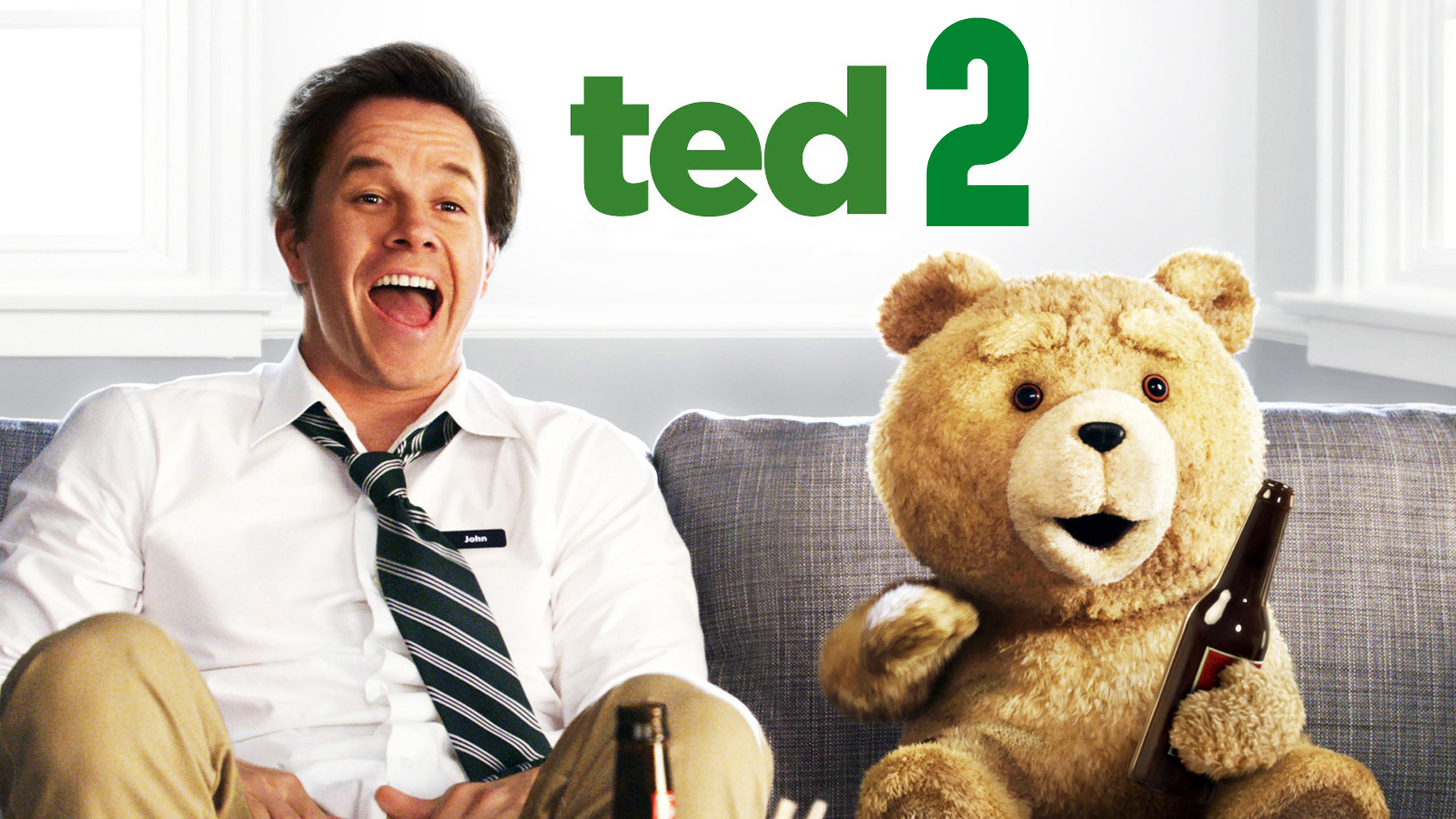
Ted 2

Ted 2

Posted on June 25, 2015 at 5:22 pm

“Subtle” is not a word that naturally comes to mind for a movie that features a bong in the shape of male genitalia (which is more powerful — the longing for weed or the ew-factor of a straight guy who does not want to appear to be sucking on a dong-shaped bong)?  Or for a movie that shows us a fertility clinic accident drenching a character with an output of said body part, followed by a joke insulting African-American men and those with a genetic ailment.  A trifecta!

The raunch-fest “Ted 2” does indeed rely on gross-out, juvenile, misogynistic, homophobic, racist, marijuana-philic, oh-no-they-didn’t humor, though much of it is more humor-ish, fake-funny, outrageousness pretending to be comedy.  It spends most of its running time, too long at almost two hours, on jokes about bodily parts and functions, drugs, the joys of slackerdom, and pratfalls, which I admit pretty much sums up my least favorite kind of comedy.  So if the two examples above strike you as hilarious, kick my rating up a couple of notches and go enjoy yourself.

The parts I did enjoy were the low-key, random, off-beat moments, especially in the performances of Mark Wahlberg and, briefly Liam Neeson.  The gimmick may be the talking teddy bear, but the star of the film in every way is Wahlberg, who in the midst of a slob comedy gives a performance that is so precise and witty it is close to adorable.
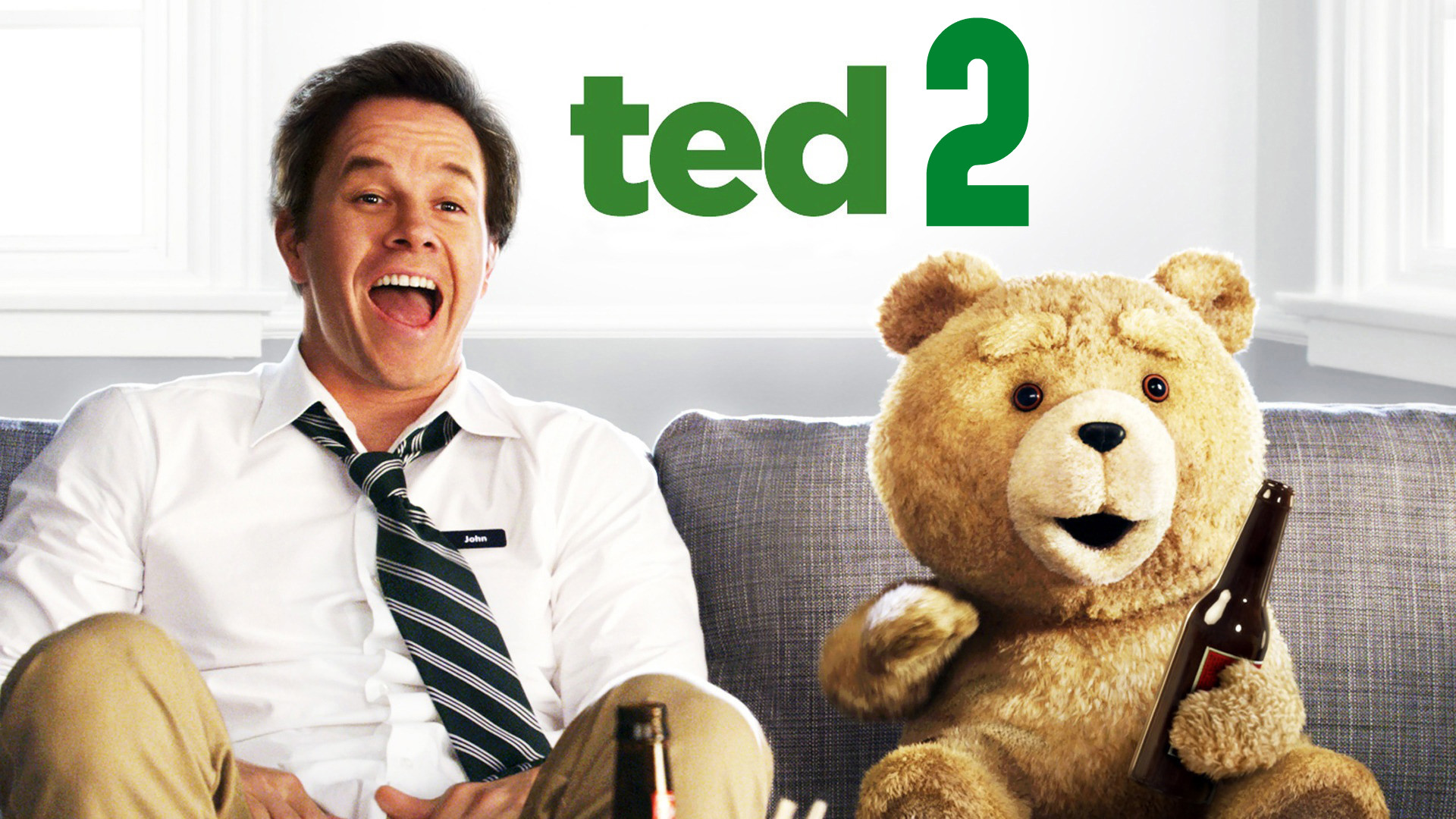
Copyright Universal 2015

“Ted” was an amiably crude film about a boy named Johnny who wished that his teddy bear would come alive, like Pinocchio, or the Nutcracker.  Ted does come to life and decades later, John (Wahlberg) and Ted (voiced by writer/director Seth MacFarlane), are happily still best friends, enjoying the pleasures of adulthood (sex, porn, weed, beer) while happily holding on to childhood when it comes to thunderstorms and responsibility.  The happy ending of course has to be unraveled for a sequel, so we begin with John now divorced from the long-time girlfriend who gently suggested he might want to grow up, and Ted getting married to his girlfriend, Tami-Lynn (Jessica Barth).  After a great musical production number right out of a Busby Berkeley film, we skip ahead a year, and find Ted and Tami-Lynn bickering to the point of not speaking to one another.  So, of course they decide to have a baby.  This requires the assistance of a fertile male human.  Ted’s first choice is, of course, Tom Brady, so he and John come up with a plan to obtain a sample without Brady’s finding out.

It does not end well, so John volunteers to provide the sample himself, leading to the scene described above.  That does not work out well, either, so they try adoption, which brings Ted’s situation to the attention of the authorities.  Apparently, one has to be human to adopt a child.  Ted is classified as property, and is thus ineligible to adopt, work, or even be married.  This being America, they find a lawyer (Sam L. Jackson — get it? played by a very game Amanda Seyfried) to go to court and have Ted declared human.  This leads to a thoughtful exploration of existential ontology.

Kidding!  It’s just a series of dumb situations and dumb jokes made by dumb characters in various locations, including the aforesaid fertility clinic, courtroom, and very lovely home of Tom Brady, plus a pot farm and New York Comic-Con.  Giovanni Ribisi returns as the demented Donny, who conspires with the head of Hasbro (did they really consent to product placement in this film) to kidnap Ted because, oh, who cares.  Certainly not MacFarlane, who makes no attempt at any kind of storyline or character.  He just throws in a gross joke, pop culture shout-out, or surprise cameo (the cast of SNL!  Some “Star Trek” actors!  Liam Neeson, who clearly did not learn anything from his appearance in “A Million Ways to Die in the West!”  Patrick Warburton in a Tick costume!) instead.  Neeson is wonderful.  Wahlberg is terrific. But not enough to overcome the movie’s limp, puerile, vapidity.

NOTE: Stay all the way to the end of the credits for an extra scene.

Parents should know that this film has constant very strong language with crude and explicit sexual references, sexual situations, drinking, extensive drug use, comic peril, and violence.  Some of the humor is intentionally offensive. Some is is just offensive. See the thoughtful discussion of the racist themes and jokes by Wesley Morris in Grantland.

Family discussion: Is Ted human?  Who should decide?

If you like this, try: “Ted” and “Harold and Kumar Go to White Castle”
Related Tags:


Comedy Scene After the Credits Series/Sequel

Trailer: He Named Me Malala

Posted on June 24, 2015 at 8:00 am

Malala Yousafzai, who was targeted by the Taliban and severely wounded by a gunshot when returning home on her school bus in Pakistan’s Swat Valley. The then 15-year-old (she turns 18 this July) was singled out, along with her father, for advocating for girls’ education, and the attack on her sparked an outcry from supporters around the world. She miraculously survived and is now a leading campaigner for girls’ education globally as co-founder of the Malala Fund.

Related Tags:


Documentary Stories about Teens Trailers, Previews, and Clips

Trailer: The Secret Life of Pets with Jenny Slate and Kevin Hart

Posted on June 22, 2015 at 8:00 am

Ever wonder what your pets get up to while you’re away? Jenny Slate, Steve Coogan, Eric Stonestreet, Kevin Hart, Bobby Moynihan, Lake Bell, Ellie Kemper and Louis C.K. will tell you all about it!

Related Tags:


Animation Talking animals Trailers, Previews, and Clips
Inside Out

Inside Out

Posted on June 18, 2015 at 5:53 pm

A-
Lowest Recommended Age: Kindergarten - 3rd Grade
MPAA Rating: Rated PG for mild thematic elements and some action
Profanity: Some schoolyard language
Alcohol/ Drugs: None
Violence/ Scariness: Some peril and anxiety, sad death
Diversity Issues: None
Date Released to Theaters: June 19, 2015
Date Released to DVD: November 3, 2015
Amazon.com ASIN: B00YCY46VO
Copyright 2015  Pixar
Copyright 2015 Pixar

Roger Ebert liked to refer to movies as an “empathy machine.” He said that the great gift of movies, more than any other art form, is the way they can put us inside the world, experiences, culture, and perspective of someone completely outside our own experience. But the best movies do that in a way that helps us understand ourselves as well. “Inside Out” is a rare film that takes us inside the mind of one very particular 11-year-old girl in a way that illuminates the vast breadth of human experience, with deep insights about our own particular quirks, struggles, and emotions. It is exciting, hilarious (two of the funniest jokes you will see on screen this year), and deeply profound, making the most complex concepts accessible in so that children and adults will learn more about who they are and how they got that way.

Riley (Kaitlyn Dias) is in the midst of internal and external turmoil. She was very happy in Minnesota, playing on a hockey team, with lots of friends, and feeling, well, at home. But her parents have just moved to San Francisco, so that her father can take a new job with a start-up. Everything is new and different and scary. Everything she liked about her life, everything she took for granted, is up for grabs. And all of this is happening just as that developmental leap that comes around age 11 is causing her to change from the bright-spirited, optimistic, happy little girl who was confident in herself and in her family.  She is getting old enough to see and feel more of what is going on inside and out. Her parents try to be reassuring, but she knows that her father’s new job is risky. She does not know anyone at school and they do not know her. The old friends from the place she still thinks of as home do not have as much time for someone who is far away.

Of course we have seen this before. There are a lot of movies about people of all ages who are forced to adjust to changed circumstances, or to find a way to make a strange new place feel like home. What is different about “Inside Out” is that Riley is not the character we follow through this story. She has her own adventure, but the story takes place in her mind and it is her emotions who take center stage. They operate the helm of the — yes — Headquarters.

The characters are Joy (Amy Poehler), a pixie-ish blue-haired sprite who is resolutely energetic and upbeat, Anger (Lewis Black), a stocky red fellow who is fiery-tempered and easily outraged, Disgust (Mindy Kaling), green, with a round head, long eyelashes, and a sensitive spirit quick to resist anything new or icky, Fear (Bill Hader), a lean blue creature who usually assumes the worst, and Sadness (Phyllis Smith), who feels everything very, very, very, very deeply. Each of these characters is introduced with what they help Riley do. Anger helps her see unfairness. Disgust helps her to avoid poisonous foods. Fear helps keep her safe. Joy helps her see the world as a place filled with imagination, adventure, and opportunity. And Sadness — we will learn more about what Sadness does later, but for now we will say that it helps her feel empathy. Joy is the leader of the group. She is the most focused and direct and the best able to negotiate with the others. But her goal is to keep all of Riley’s memories happy, and that might not be possible.

As Riley tries to use her mind, her memories, and her emotions to navigate her new community, Joy and Sadness are accidentally transported to where Riley’s memories are stored, and they must make it through an Oz or Wonderland-style land where we learn about everything from abstract thinking to why you CAN’T GET THAT DARN JINGLE FROM THAT STUPID COMMERCIAL OUT OF YOUR HEAD.  A surprising — in every sense of the term — new character shows up to provide support and insight, and to embody the sweet sorrow of growing up.  Co-writer/director Pete Docter told Terry Gross that it was when Mindy Kaling came to talk to him about the film that he understood what it was really about: you have to grow up, and it’s okay to be sad about it.  That applies whether you are the one growing up or just watching it as a parent or friend.  This movie speaks to all of us, whether we have children, are children, were children, or still keep the child we were near our hearts.  A lot of good movies are smart.  But this one is wise.

Parents should know that this movie includes some mild peril, family tension, running away, and a sad death.

Family discussion: Can you think of a time that Joy was steering your mind? How about the other emotions?  When can you feel them working together?  Did you have a Bing Bong? Why did he make that choice?

If you like this, try: “Everybody Rides the Carousel,” “Up,” and “Monsters Inc.”

Related Tags:


3D Animation Comedy Coming of age Drama DVD/Blu-Ray Pick of the Week For the Whole Family
THE MOVIE MOM® is a registered trademark of Nell Minow. Use of the mark without express consent from Nell Minow constitutes trademark infringement and unfair competition in violation of federal and state laws. All material © Nell Minow 1995-2026, all rights reserved, and no use or republication is permitted without explicit permission. This site hosts Nell Minow’s Movie Mom® archive, with material that originally appeared on Yahoo! Movies, Beliefnet, and other sources. Much of her new material can be found at Rogerebert.com, Huffington Post, and WheretoWatch. Her books include The Movie Mom’s Guide to Family Movies and 101 Must-See Movie Moments, and she can be heard each week on radio stations across the country.

Website Designed by Max LaZebnik