
Trailer: Love & Mercy with Paul Dano and John Cusack as Brian Wilson
Posted on February 26, 2015 at 8:14 am
“Love & Mercy” tells the story of Brian Wilson, the brilliant but troubled member of the Beach Boys.
Posted on February 26, 2015 at 8:14 am
“Love & Mercy” tells the story of Brian Wilson, the brilliant but troubled member of the Beach Boys.
Posted on February 19, 2015 at 5:58 pm
B+| Lowest Recommended Age: | Middle School |
| MPAA Rating: | Rated PG for thematic material, some violence and language |
| Profanity: | Some strong language |
| Alcohol/ Drugs: | Drinking |
| Violence/ Scariness: | Some gang-style violence, mostly off-screen, characters injured |
| Diversity Issues: | A theme of the movie |
| Date Released to Theaters: | February 20, 2015 |
| Date Released to DVD: | June 1, 2015 |
| Amazon.com ASIN: | B00UI5CUSM |
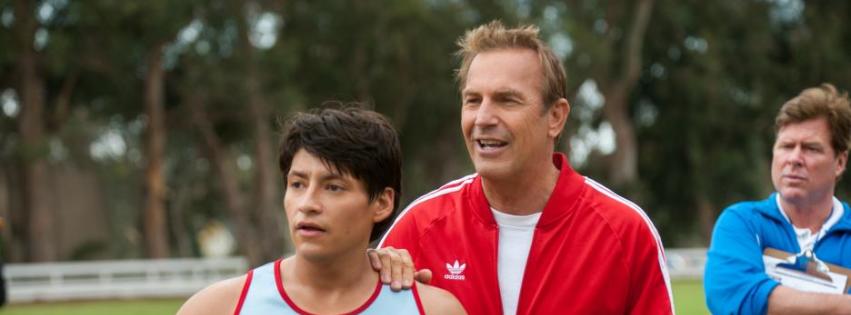
In 1987, Coach Jim White (Kevin Costner), who had never coached or even run cross country, took a team of kids from one of the poorest communities in California to a state championship. Of course that would have to become a Disney movie. But in 2015, it is near-impossible to make a movie about a white coach and his all-Latino team without falling into one of two equally fatal traps. We are no longer in an era when it is acceptable to have a “mighty whitey” movie has a white savior teaching people of color a better way to live. We are also no longer in an era where it is acceptable to have a “magical Negro” plotline, with a person of color teaching a white person a better way to live. We all have people in our lives who teach us important lessons, but presenting these stories in a sensitive way is an almost insurmountable challenge.
“McFarland USA” comes as close as it can to surmounting that challenge by wisely — and honestly — showing what everyone in the story learns from the experience. That comes from warm, sensitive performances by all involved and by telling details. The best is after the team comes in last in their first meet because the coach failed to check out the terrain. The team had never practiced on an incline and the course of the raise included some steep passages. So, for their next practice, Coach White brings them to a place where he and the audience see enormous piles of something under tarps. White knows only that this is a good place to practice running uphill. The team knows what is under the tarps — millions of discarded almond shells, removed by field workers, so supermarkets across the country can stock shelled nuts in little plastic pouches. The symbolism, and White’s growing understanding not just of the challenges faced by his team but of their dedication, perseverance, and strength is un-sappy and touching.
It begins with White getting fired for an outburst at an arrogant high school football captain, and taking a job as an assistant football coach in the small farm town of McFarland in central California. The entire population is Latino and most of them work in the fields as “pickers,” starting at age 10. The kids and teenagers work before and after school. White is quickly relieved of his responsibilities as assistant coach when he takes a player out of the game because he has been injured. He decides to start a cross-country team, even though the principal tells him ‘That’s a private school sport. They breathe different air.” White has no experience. Also, because this is 1987, it would be about a decade before he could just Google how to do it. No one at the school has the time — or the shoes — for distance running. But he can see that they can run, and he gets them to agree to try to compete. At first, he does not even have a stopwatch to time their runs. He uses a kitchen timer.
It is a poor community. No one in the boys’ families has more than a 9th grade education. The high school is next door to the prison, with a barbed-wire fence. The families see sports as “not essential,” a distraction that keeps the boys away from paying work on the fields. “Every hour with you is food off my table,” says one father. But White and the community learn to trust each other, even after a scary encounter.
Director Niki Caro (“Whale Rider”) has a sensitive touch and a trust in her story and characters that gives them space to breathe. The running scenes are vivid and exciting. By the time we get to the end credit sequence, showing the team now in their 40’s and still running every day in McFarland, we see that more than the state championship has been won.
Parents should know that there are a few bad words, some drinking, and some gang-style violence. It is mostly off-screen, but characters are injured and there are brief disturbing images.
Family discussion: Which teachers have made you see that you were capable of more than you thought? How did White and the team demonstrate that to each other? When did the team start calling him “coach” and why?
If you like this, try: “Spare Parts,” “Chariots of Fire,” and “Hoosiers” and this interview with Carlos Pratts
Posted on February 19, 2015 at 5:43 pm
B| Lowest Recommended Age: | Middle School |
| MPAA Rating: | Rated PG-13 for crude and sexual material throughout, some language and teen partying |
| Profanity: | Some strong and crude language, one and a half f-words |
| Alcohol/ Drugs: | Teen drinking |
| Violence/ Scariness: | Bullying |
| Diversity Issues: | A theme of the movie |
| Date Released to Theaters: | February 20, 2015 |
| Date Released to DVD: | June 8, 2015 |
| Amazon.com ASIN: | B00WAEEG7M |
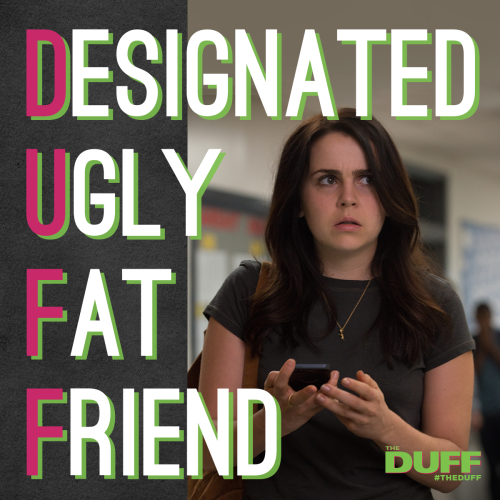
A haiku has 17 syllables. A limerick has five lines. An omelet is made from eggs. And a teen romantic comedy will have our characters visit the mall, a locker room, a classroom, and the school bathroom. There will be a trying-on-clothes montage, a makeover, a house party, and a big school dress-up dance. Nothing wrong with that. We’d be disappointed if they skipped any of these essentials. But because we see those same elements over and over, it can be tough to get it right. For every “Mean Girls” or “10 Things I Hate About You” there are dozens of duds like “Drive Me Crazy” or “Confessions of a Teenage Drama Queen.”
“The DUFF,” based on the book by Kody Keplinger
Bianca Piper (Whitman) has two best friends , fashionista Jess (Skyler Samuels), and hacker/jock Casey (Bianca A. Santos), both gorgeous and talented and loyal. She does not mind too much that she is socially awkward, except when it comes to her inability to say more than two words (literally) to her soulful, acoustic guitar-playing crush, Toby (Nick Eversman). And then Wes, the handsome boy next door, who happens to be the star of the school football team (Amell), tells her that she is the DUFF (designated ugly fat friend), the accessible gateway between her hot friends and the rest of the world. She is hurt. She is humiliated. She is furious. She un-friends Jess and Casey in a funny encounter that involves almost a dozen different kinds of social media entanglements. With no one else to rely on, she decides to ask Wes for advice, in exchange for helping him with his chemistry test. Cue the trip to the mall with the makeover/trying on clothes montage.
Wes has a “strobe light” (off and on) relationship with the school’s uber-mean girl, named, of course, Madison (Bella Thorne, an actual teenager). Madison’s greatest goal in life is to become a reality TV star and she has her own DUFF/acolyte, constantly following her around to film her for her YouTube channel.
Seeing Wes with Bianca makes Madison determined to get him back in time for (of course) the big homecoming dance, where the homecoming king and queen will be announced. Her friend spots Bianca and Wes at the mall, and secretly films Bianca joking about her crush on Toby. Madison edits and uploads the humiliating video, which quickly spreads throughout the school.
Bianca is crushed.
But with the support of Wes, she decides to own it, deciding that the experience is like the acid bath that created Batman villain, The Joker. In a nice touch, even though they are hurt by Bianca’s accusations, Jess and Casey decide to help out behind the scenes by taking the video down. They really are her friends. But Bianca is so colossally embarrassed that what had seemed insurmountable humiliations like saying three or more words to Toby seem trivial. Soon, they have a date for dinner. And she has a beautiful new LBD to wear, courtesy of Wes.
The adults in the story are played by underused top talent (Allison Janney, Ken Jeong, Romany Malco), but the focus here is on the kids and they deliver their lines with a nice confidence and snap. It is not as endlessly quotable as “Mean Girls” but it feels fresh and resilient. There is even a suggestion that a makeover may not be right for Bianca, or, at least, that any makeover should leave her more like herself, in the world of high school movies, positively revolutionary. Whitman makes Bianca so thoroughly herself throughout that anyone would be glad to have her for a BFF.
Parents should know that this movie includes crude sexual references and some strong language, including one and a half f-words. There is a party with some teen drinking.
Family discussion: How does this compare to your school experience? Why did Bianca believe she was a DUFF, even though her friends really loved her?
If you like this, try: “Nick and Nora’s Infinite Playlist,” “Sydney White,” and “Mean Girls.”
Posted on February 12, 2015 at 5:55 pm

“James Bond? Jason Bourne?” Our hero is being asked for the inspiration for naming his dog JB. “No,” he explains, “Jack Bauer.”
This is a cheeky, nasty, meta, po-mo update of the spy genre, self-aware enough to name-check not just Bond, Bourne, and “24,” but also “Nikita,” “Trading Places,” “Pretty Woman,” and “My Fair Lady.” I also caught a reference to the 60’s television show “The Man from UNCLE,” about to get its own big-screen reboot later this year.
Some of the core elements of the sophisticated spy story are here, from the elegant suits to the very specific cocktail order, as well as the super-cool weapons and gadgets we will have the fun of seeing deployed later on. And the villain has an assassin/sidekick who goes one, or maybe two better than iconic characters like Oddjob and Jaws. Spanish dancer Sofia Boutella plays the acrobatic Gazelle, who runs on Oscar Pistorius-style blades as sharp as scalpels. She can slice a man in half lengthwise with one slash of her leg. And does.
Other aspects of the usual spy story are tweaked or outright upended. That old favorite, the talking villain, who has such a profound need to explain the genius of his nefarious plan that it gives Our Hero time to thwart him, is explicitly disposed of. The look of the film is as sleek and sophisticated as the score from Henry Jackman and Matthew Margeson.
Colin Firth is sleekly perfect as Harry, also known as Galahad, part of an elegant, upper-class cadre of international gentleman spies operating in total secrecy and using pseudonyms based on King Arthur and his knights. Their made to order suits are both exquisitely tailored and bulletproof.
He points to a wall of framed newspaper headlines about triviality — political squabbles and celebrity scandals — explaining that while these things were going on, he and his fellow Kingsmen were repeatedly saving the world. The person he is explaining it to is Eggsy (Taron Egerton), a possible new recruit. Eggsy is a smart, tough, brash kid who grew up in what the British call council houses and we call the projects, the son of a widow whose second husband is an abusive thug. Eggsy’s late father sacrificed himself to save Harry and other members of the team, so Harry feels a sense of responsibility — and a suspicion that Eggsy might have inherited his father’s courage and sense of honor.
While they had previously limited themselves to the wealthy upper class, Harry persuades the Kingsman’s leader (Michael Caine as Arthur) to allow Eggsy to compete for a spot on the team. The competition is tough and the tasks are tougher, the most imaginative and entertaining section of the movie. Then of course comes our supervillain, Samuel L. Jackson as Valentine, a lisping technology billionaire whose frustration with the failure of the world to reckon with global warming has led him to devise some drastic plans. Once he gets involved, the self-aware air quotes get less interesting and so does the storyline. “Bond films are only as good as the villain,” he says. True, and he is no Goldfinger.
In the last half hour, things really go off the rails. The carnage is balletic and portrayed as darkly comic but it is still disturbing, particularly the involvement of a specific real-life world leader. The humor is not just dark; it is crude for the sake of being crude and seems rather desperate. A film that began with a confident sense of sophistication, wit, and edge knows what it is not (“This is not that kind of movie”) but not what it is.
Parents should know that this movie is extremely violent, with hundreds of characters injured and killed and many exploding heads. Characters use very strong language and drink alcohol. There are explicit and crude sexual references and brief nudity.
Family discussion: Which of the tests would have been the hardest for you? What did they prove about the candidates?
If you like this, try: the James Bond films
Posted on February 12, 2015 at 5:50 pm
The Fifty Shades of Gray trilogy by E.L. James
I am not referring to the domination in the bedroom — or the red room of pain. I am referring to the fantasy of having a bad boy love you so much he turns into a pliable good boy. As a friend of mine once put it, “A lot of women dream of marrying Han Solo, and then spend the rest of their lives trying to turn him into Luke Skywalker.” From “Beauty and the Beast” to “Jane Eyre,””Wuthering Heights,” “Gigi,” “Jerry Maguire,” and “Pride and Prejudice,” the fantasy is of the female beauty and purity of spirit that are strong enough to tame a cold-hearted man (whose cold heart is of course the result of being lonely, misunderstood, and never having met the right woman, not in any way because he is a psychopath, a sociopath, or just a terrible person).
Beauty and purity are here in the person of the lovely and virginal Anastasia Steele (Dakota Johnson), an English lit major about to graduate from college. The role of The Beast is taken by uber-taker Christian Grey (Jamie Dornan), handsome, wealthy, successful, and equally adept at piloting a helicopter and playing classical piano. Ana arrives at Christian’s office with a list of questions from her roommate, who was scheduled to interview him (for an allotted ten minutes) but who is home with a bad cold. Though she trips over the doorway and forgot to bring anything to take notes with, Christian, a self-described superior judge of people, immediately and accurately spots some, well, steel in Ana. It is not her weakness that attracts him; it is her strength. “I Put a Spell on You” we hear sung over the opening moments, “because you’re mine.”
Who is the “I?”
Ana.
After one “vanilla” sexual encounter and a signed non-disclosure agreement, Christian shows Ana his special chamber stocked with every possible kind of whip, riding crop, handcuff set, and binding material, explaining, “I do this to women, with women, who want it.” He offers her a detailed contract spelling out the duties and restrictions expected of a submissive. Ana shows that, sexual inexperience aside, she and Christian have a lot in common. Their highly charged but playful “negotiation” in an office conference room is more erotic than the many sex scenes.
Ah, the sex scenes. Very Skinemax, very perfume commercial, not very non-vanilla, not, to my mind anyway, very exciting. Dornan never seems particularly passionate or tortured. Even the big whipping scene (six lashes, discreetly portrayed with no images of the whip hitting the skin or any marks left) comes across like another item to be crossed off a busy executive’s to-do list. For most of the movie, the porn-iest parts are the loving depictions of the trappings of wealth. Christian has a spare but luxurious office, staffed with women built like human whippets, all with tight blonde ballerina buns and impeccably tailored grey suits. His cars, his apartment, it’s all like the pages from a glossy shelter magazine. There’s a lot more kink in any given episode of Dan Savage’s podcasts, and more intensity, too.
Dornan has some appeal but never makes Christian seem dangerous. Johnson is the movie’s greatest asset. For a role that requires a lot of lip-biting, she has the two most important qualifications — a lovely lip and the ability to make biting it look natural. She has a natural warmth, intelligence, and humor that come across on screen and go a long way toward making the movie less silly than it could have been.
Parents should know that this movie includes very frank and explicit sexual references and situations including domination, bondage, and infliction of pain, nudity, drinking and drunkenness, and very strong language.
Family discussion: What made Ana different from Christian’s previous girlfriends? What do their names tell us about the characters? How can giving up control feel freeing?
If you like this, try: “9 1/2 Weeks” and the books by E.L. James