To the Wonder

Posted on April 11, 2013 at 5:51 pm

B-
Lowest Recommended Age: Mature High Schooler
MPAA Rating: Rated R for some sexuality/nudity
Profanity: None
Alcohol/ Drugs: Drinking
Violence/ Scariness: Tense confrontations
Diversity Issues: None
Date Released to Theaters: April 12, 2013
Amazon.com ASIN: B00BU22HCQ

Director Terrence Malick has made a movie for those fans who loved “Tree of Life” but thought it was too linear and easy to follow.

“To the Wonder” is an impressionistic story of love and loss.  Theoretically it stars Ben Affleck, Rachel McAdams, Javier Bardem, and Olga Kurylenko, but in reality the star is the sun,.  It seems to be the focus of almost every exquisitely framed shot, with sunlight flaring always just so through the meticulously arranged tree branches behind the beautiful woman who loves to twirl.  This movie has a lot of sunlight and a lot of twirling.  Also a lot of what I will call affectionate rough-housing, which I think — can’t be sure about anything here — is the primary, if middle-school-ish, way these characters indicate that they like each other.

It does not have a lot of dialogue, and what conversations we do overhear are almost incidental.  The talk we hear is mostly the murmured, diary-like narration of a French single mother who falls in love with an American and brings her daughter to live with him in a barren house in a barren landscape that is in sharp contrast with the “wonder” of the rich environment she left behind.  Malick seems to have a devilish pleasure in withholding information.  The daughter, Tatiana, is the only character whose name we are allowed to know.

It is maddeningly opaque at times but undeniably lyrical.  It does not just break free from narrative; it explodes it into an almost-pointillist kaleidoscope of images, whispers, and detours.  Where “Tree of Life” had a dinosaur, “To the Wonder” has a zig into an underwater scene with sea turtles before it zags into a separate segment (I can’t say story) about a sad priest (Bardem).

If is more tone poem than movie, it is an intriguing one, touching on themes of connection and disconnection, love and betrayal, at the level of society and individuals.  At times it is annoyingly opaque, but there are also moments of stunning beauty.  If he continues down this road, Malick’s next movie will be delivered to the theater in individual frames, to be tossed toward the screen in random order, and many of them will feature sun flares.  But I’ll still go to see it.

Parents should know that this movie includes sexual references and situations, briefly explicit, including adultery, nudity, smoking, and drinking.

Family discussion:  Why is the story told through narration instead of dialogue?  How does the issue of contamination of the soil and water relate to the story?  Why is the house unfurnished?

If you like this, try: “Tree of Life”


Parents should know that this movie includes some nudity and explicit sexual situations, including adultery.  Characters drink alcohol.
Related Tags:


Drama Movies -- format

42

Posted on April 11, 2013 at 12:08 pm

B+
Lowest Recommended Age: Middle School
MPAA Rating: Rated PG-13 for thematic elements including language
Profanity: Racist epithets, crude and ugly insults, some additional strong language (s-words)
Alcohol/ Drugs: Drinking, smoking
Violence/ Scariness: Threats of violence, some scuffles, some injuries
Diversity Issues: A theme of the movie, brief homophobic humor
Date Released to Theaters: April 12, 2013
Date Released to DVD: July 15, 2013
Amazon.com ASIN: B009NNM9OA

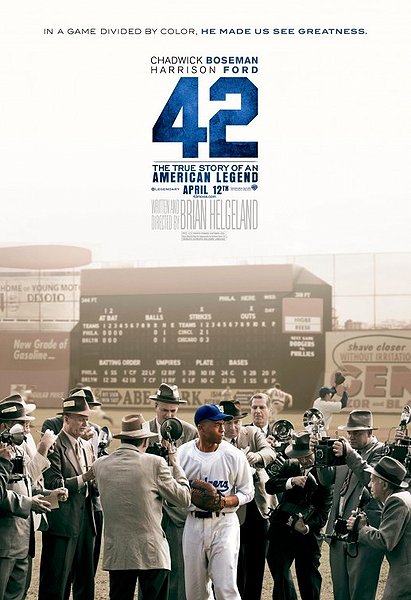
Jackie Robinson was the first black man to play major league baseball. His number, 42, is worn by every player once a year to commemorate his achievements as a baseball player and as a man.  This version of the story of the year the Brooklyn Dodgers broke the color barrier in baseball from writer/director Brian Helgeland is a little superficial, it still packs a lot of power, thanks to an evocative sense of its period and star-making performances by Chadwick Boseman as Robinson and Nichole Beharie as his wife.  If what we see is a small part of the courage and integrity of this extraordinary man in taking on the virulent racism of his era, it is still enough to make this movie deeply moving.

It is just after the end of WWII.  Black soliders returned home from fighting for freedom on behalf of a country that was still segregated, from the separate fighting divisions in the military to the “Whites Only” laws of the Jim Crow South.  Brooklyn Dodgers manager Branch Rickey (a cigar-chomping Harrison Ford, in full growl) decides it is time to integrate baseball.  He needs to find a player who is not only an athlete of unquestionable ability but someone who has the temperament to stay cool despite the constant attacks he will face from his own team, opposing teams, and the fans.  Rickey decides that Roy Campanella was too sweet and Satchel Paige was too old (both would follow Robinson into the major leagues).

Rickey picked Robinson.  He had the skill, he has played with white teammates in college, and he is tough.  He was courtmartialed  for refusing to go to the back of a military bus — and won.  Rickey asks Robinson, “Can you control your temper?” “You want a player that doesn’t have the guts to fight back.” “I want a player who has the guts not to fight back.”  Rickey knows that no matter what the provocation, any show of temper from Robinson will only give ammunition to the bigots.  What would be called “spirit” in a white player will be called something different coming from him.

It is solidly entertaining, delivering all of the expected notes, and if it seems heavy-handed to anyone old enough to remember a time before the Montgomery bus boycott and the passage of the Civil Rights Act, it is perhaps understandable that Hollywood does not take for granted that younger audience members remember there was once a time when segregation was not only legal; it was the law.  It harks back to the Sidney Poitier era of saintly black characters, which is understandable.  But it is a movie about tolerance that cannot resist a homophobic joke about teammates showering together, which is not.

Parents should know that this movie features frank portrayals of bigoted behavior including a stream of racist invective, with crude insults.  There are some sexual references, including adultery.  Characters drink and smoke, and there are some scuffles and injuries.

Family discussion:  Why was Jackie the best choice to be the first?  How did he challenge the beliefs of his teammates?   Read more about Jackie Robinson.


If you like this, try: “The Bingo Long Traveling All-Stars & Motor Kings,” Ken Burns’ “Baseball” series, “Brian’s Song,” and “A League of Their Own”

Related Tags:


Based on a true story Biography Drama DVD/Blu-Ray Pick of the Week Spiritual films Sports

From Up on Poppy Hill

Posted on April 4, 2013 at 6:00 pm

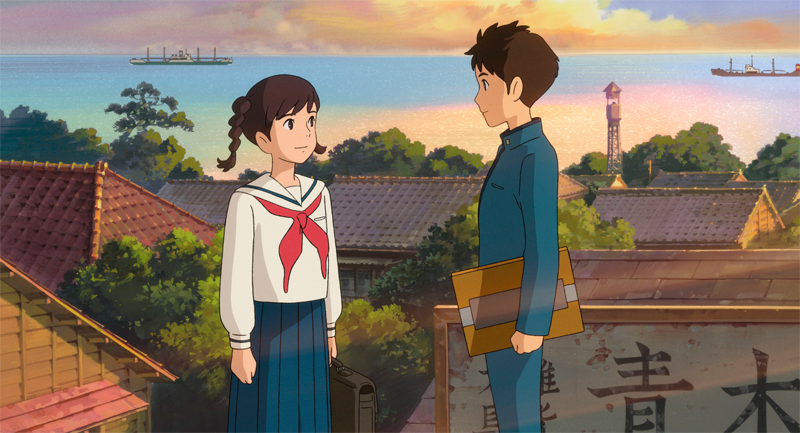
The animated films from Japan’s Studio Ghibli are adored by many American families for their lush and intricate hand-drawn animation and imaginative story lines.  But others, like me, find many of them uneven and inaccessible.  The latest, from Goro Miyazaki, son of  legendary writer/director/animator Hayao Miyazaki (“Spirited Away,” “My Neighbor Totoro,” “Princess Mononoke”), has the gorgeous settings we expect from Ghibli, inspired as much by European fairy tales as by the mid-century Japanese seaside town where the story takes place.  But it also has the inexpressive faces and oddly un-family-friendly storyline of some of the studio’s other productions.  It seems more than a little off that a large part of the plot concerns a disturbing issue of possible paternity, a questionable theme for a movie about and intended to be seen by children.

Hayao Miyazaki co-wrote the film, based on a popular manga comic.  Like many of the Studio Ghibli films, it is the story of a young girl who has had to take on a lot of responsibility.  It is set in the Umi (voice of Sarah Bolger of “In America”), a quiet, respectful girl.  She lives with her grandmother, who runs a boarding house above in the port city of Yokohama.  Umi’s father was lost at sea fighting in the Korean War.  Her mother is studying in America.  Every day, Umi hoists a “safe voyage” signal flag for all the boats.  In her heart, it is also a message to the father she still dreams will someday come back to her.

One day, she meets the outgoing, impulsive Shun (Anton Yelchin).  As she works with him to help restore a dilapidated house Shun and his friends are using for their club meetings.  They hope to persuade local officials not to knock it down.  They never speak about their feelings but it is delicately shown that they are drawn to one another.  And then they discover >they may be siblings.  “I guess we stop feeling how we feel,” Shun says, and they agree to stay friends.  Fortunately, they find a kind and reassuring answer to their question.

It is strange to see so much focus on the details of the backgrounds, which are exquisitely rendered, when there is so little attention to the expressiveness of the characters.  The fluttering of a signal flag conveys more emotion than the impassive faces and delivery of the characters.  The resonance of the story’s context in the years between Japan’s defeat in WWII and its hosting of the 1964 Olympics 20 years later will be lost on today’s children, which leaves the thin storyline inadequate to sustain our interest to the end.


Parents should know that this movie includes references to sad parental losses and separation and war and a discussion about how the two young teens who have romantic feelings for each other might be siblings.

Family discussion: What did Umi and Shun like about each other?  Why was the house important to the kids?

If you like this, try: “Spirited Away”

Related Tags:


Animation Stories About Kids

The Sapphires

Posted on March 28, 2013 at 6:00 pm

B+
Lowest Recommended Age: High School
MPAA Rating: Rated PG-13 for sexuality, a scene of war violence, some language, thematic elements, and smoking
Profanity: Strong language
Alcohol/ Drugs: Drinking, smoking
Violence/ Scariness: War violence
Diversity Issues: A theme of the movie
Date Released to Theaters: March 22, 2013
Date Released to DVD: August 15, 2013
Amazon.com ASIN: B00D2UMHQ0

A very conventional story of a 60’s Australian girl group gains extra power from its context and setting in this fact-based story set to the beat of Motown soul.  Co-written by the son of one of the real-life singers and directed by Wayne Blair, who starred in the play based on their story, “The Sapphires” is clearly a labor of love for all involved and a touching tribute to four women for whom success as performers was just the beginning.

Before it begins, we learn two stark, devastating facts.  Until 1967, the native Australians dubbed “Aborigines” by the British settlers were not classified as humans by the Australian government.  They were considered “flora or fauna.”  And the government had the authority to remove light-skinned native children from their families as part of the program depicted in “Rabbit-Proof Fence” to make them part of the white community.

We meet the future singers as children, three sisters and their cousin, performing at a family celebration in 1958.  The light-skinned cousin is taken to become part of what is now known as the “Stolen Generation,” with no contact with her family.

A decade later, as young women, the sisters still sing together.  Gail, the feisty oldest (Deborah Mailman of “Rabbit-Proof Fence”), the ambitious Julie (pop singer Jessica Mauboy), and the flirty Cynthia (Miranda Tapsell) enter a local competition singing American country and western.  Braving the bigotry of the audience, they sing a Merle Haggard song.

The accompanist/master of ceremonies is Dave (“Bridesmaids'” Chris O’Dowd) is a broken-down mess who seems to have burned every possible bridge that once linked him to music, a job, his home in Ireland, or any semblance of self-respect.  But he still knows the real deal when he hears it.  As amateurish as they are, Dave sees what the sisters can become.  They ask him to come with them to try out for a chance to perform for American GIs in Viet Nam for $30 a week.  Soon they have reconnected with their cousin Kay (Shari Sebbens), switched from country to Motown, and passed the audition under their new name, inspired by a ring — The Sapphires. O’Dowd’s shambling charm plays well against Mailman’s protective ferocity and the wartime background and struggles against bigotry add some heft what might otherwise seem like a lightweight jukebox musical.

A girl group with four members under high-stress touring conditions far from home means many opportunities for romance, adventure, and power struggles, plus the inevitable rehearsal montages. “Can you make it sound blacker?” Dave asks.  He switches lead singers, guides them on stage presence, and suggests some different songs.  Both country and soul music are about loss, he tells them, but in country music the singer has given up.  “With soul, they’re still struggling.”  Dave’s passion for the music and his belief in the girls are scary but exhilarating.  So is being away from home for the first time.

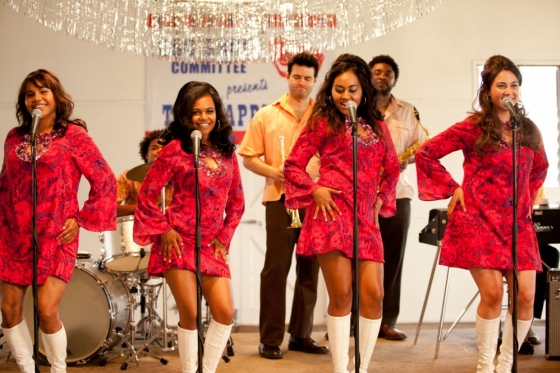
The girls learn that performing is about more than great songs and tight harmonies as they are touched by the valor of the American soldiers.  It is not just that the GIs expect a show; they deserve one.  So, The Sapphires add spangles, go-go boots, rump-shaking and a lot of attitude.

That gives them the freedom to open themselves up to new experiences and new ways of looking at themselves.  And it means that we get to enjoy quite a show as well.  When the storyline starts to feel too close to the familiar “VH1 Behind the Music” soapy sagas of backstage tensions and heartache, those fabulous classic soul songs of the 60’s ring out, thoughtfully matched to what is happening off-stage.  “I Heard It Through the Grapevine,” “What a Man,” “I’ll Take You There,” “Hold On!  I’m Coming,” and many more add tremendous energy and spirit.  They are every bit as entertaining as they were nearly half a century ago.  Equally entrancing is a touching moment when they sing a native song called “Ngarra Burra Ferra.”

The credit sequence updates us on what happened after The Sapphires came home, with an extraordinary record of achievement, photos of the beautiful women who inspired the film, and a concluding line of piercing sweetness.  It would be great to have a sequel, but they deserve a documentary.

Parents should know that this movie includes strong language, sexual references, smoking, drinking, and wartime violence.

Family discussion: How do the racial conflicts portrayed in this film compare to those of the same era in the United States?  What makes them different?  Are you surprised by what the Sapphires did after their tour?

If you like this, try: “Rabbit-Proof Fence” and “Dreamgirls”

Related Tags:


Based on a play Based on a true story Biography Drama DVD/Blu-Ray Pick of the Week Family Issues Music Musical Romance War

The Host

Posted on March 28, 2013 at 6:00 pm

C-
Lowest Recommended Age: Middle School
MPAA Rating: PG-13 for some sensuality and violence
Profanity: Some mild language
Alcohol/ Drugs: Drinking
Violence/ Scariness: Extended sci-fi peril and violence, characters injured and killed, attempted suicide, character shot with gun, some disturbing images
Diversity Issues: A theme of the movie
Date Released to Theaters: March 29, 2013
Amazon.com ASIN: B0090SI4OC

The author of the Twilight series was showing signs of running out of ideas around the middle of the second volume, and this latest story shows more evidence of the pressure of producing a new series than anything approaching inspiration. Howlers that can slide by in print are impossible to ignore in a thuddingly dumb story of an alien takeover and the girl who is able to hold onto her own consciousness as the “host” of glowing millipede from outer space.

Problem #1: If you’re going to make a movie about aliens taking over human bodies, the indicator of possession should not be glowing blue eyes that eliminate a critical element of the actors’ ability to communicate.

Melanie Stryder (Saoirse Ronan) is one of the few remaining humans who have not been overtaken by alien invaders who have inhabited almost every person on earth and eliminated suffering, illness,  and conflict — also passion, independence, innovation, and any notion of the individual.  Everything is smooth and civil and orderly.  It is like the whole planet moves to Muzak.  But they have excellent healthcare.

Melanie is captured by the aliens, led by Seeker, who heal her injuries and implant one of their aliens inside her.  But instead of taking over her consciousness, the invader, known as Wanderer, exists side by side, leading to a series of back-and-forth conversations intended to be touching but are more often mundane.  She’s like a bad ventriloquist with two invisible dummies.  It is clunky and dull when she talks to herself but not much better when the characters talk to one another.  “What’s it like in there?” a character asks Melanie/Wanda.  “It’s crowded.”  “Kiss me like you want to get slapped.”

Ronan is a superb actress, but even she cannot make real the idea of these two equally drippy characters as distinctive individuals, especially after she hides out with a secret rebel group led by Jeb (William Hurt), and in “Twilight” love triangle  fashion becomes involved with two different cute guys, one who loves Melanie and one who loves the Wanderer, now known as Wanda.  “If you could hold me — me — in your hand, you’d be disgusted,” Wanda explains to the guy who wants to kiss her.  When he finally does see what the alien looks like and tries to gaze tenderly at a glowing bug is just silly.

And then things really go nuts as the Seeker (Diane Kruger) goes after the human rebels, insisting, “I am not weak.  I am in control.”  Kruger is more believable as an alien than she usually is as a human, at least until a ridiculous twist near the end.  Melanie had two voices in her head.  I only had one, but it was clearly telling me that this movie is a mess.

This rebel group seems weirdly retro, with almost no women, and a social structure that resembles the 18th century.

Parents should know that this film includes extended sci-fi style peril and violence with some disturbing images, a car crash, aliens, possession, characters injured, some teen kissing and sensual embraces.

Family discussion: Why could Melanie and Wanda exist together?  How do Ian and Jared see her differently?  Why are the aliens able to achieve societal benefits humans have failed to? How does she earn the trust of the humans?  What do you think will happen next?

If you like this, try: “Invasion of the Body Snatchers” and “I Am Number Four” and the book by Stephenie Meyer


Related Tags:


Based on a book Movies -- format Romance Series/Sequel
THE MOVIE MOM® is a registered trademark of Nell Minow. Use of the mark without express consent from Nell Minow constitutes trademark infringement and unfair competition in violation of federal and state laws. All material © Nell Minow 1995-2026, all rights reserved, and no use or republication is permitted without explicit permission. This site hosts Nell Minow’s Movie Mom® archive, with material that originally appeared on Yahoo! Movies, Beliefnet, and other sources. Much of her new material can be found at Rogerebert.com, Huffington Post, and WheretoWatch. Her books include The Movie Mom’s Guide to Family Movies and 101 Must-See Movie Moments, and she can be heard each week on radio stations across the country.

Website Designed by Max LaZebnik