Cirque du Soleil: Worlds Away

Posted on December 20, 2012 at 6:00 pm
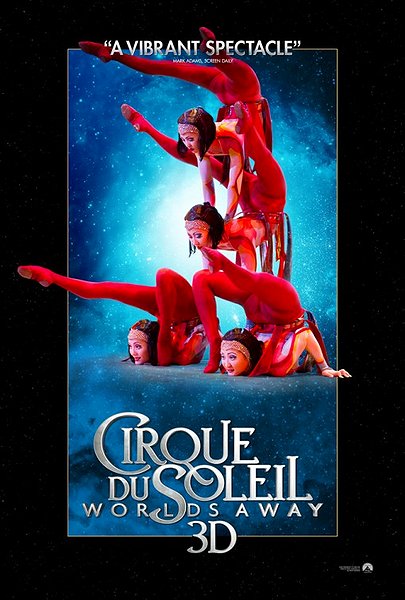
Her curiosity overcoming her shyness, a girl with big eyes and a gamine haircut (Erica Linz) walks through the gate for the “Circus Marvelous.”   She sees “The Aerialist” (Igor Zaripov), first smiling a welcome as he helps install the tent, then on a flier given to her by a clown, and then high above, performing with breathtaking ease and grace.  Suddenly he falls, hitting the sandy ground below, which collapses beneath him like quicksand.  The girl goes after him through an enchanted world of fantasy, splendor and feats of artistry, acrobatics, dance, music, and very firm, lithe bodies jumping, swirling, twisting, and bending, all in very tight costumes.  Plus there is an adorable tricycle powered only by a pair of small yellow galoshes, and a man on fire reading a newspaper.  He is not at all flustered when the flames creep up his body and onto his hat.  The fire is almost a dance partner.

Cirque du Soleil is an international phenomenon with shows on every continent but Antarctica.  Its founding principle is the immediacy and drama of live performance, the exact opposite of a movie.  Anything that can be imagined can be put on film; its very appearance of truth makes us marvel at the technology for fooling us so effectively.  We value Cirque for its old-school reality.  When we sit in the tent, we see performances in real time, with real peril, never to be seen exactly the same way again.  Producer James Cameron (“Avatar”) and director Andrew Adamson (“Shrek”) understand that they cannot replicate that experience and instead give us the chance to marvel by taking us up close and inside the action with immersive 3D.  The seamlessness and grace of the acrobatics adds to the dreamy quality.  In real life, we expect a sense of exertion and anxiety to underscore the sense of risk.  In the movie, the balletic movement adds to the fantasy that we are in a frictionless world unlimited by the laws of physics.

The girl and the aerialist wander, fall,  fly, and are chased through dreamlike — and occasionally nightmarish — scenes from seven of Cirque du Soleil’s Las Vegas shows: O, KÀ, Mystère, Viva ELVIS, CHRIS ANGEL Believe, Zumanity, and in one of the film’s highlights, the Beatles tribute show, LOVE.  An almost mythic inclusion of the four classical elements: fire, water, earth, and air, provide the settings for movement that flows seamlessly between dance, athletics, and stunts that do more than defy the laws of gravity; they transcend them.  In one stunning sequence, an enormous board studded with pins is tilted, distorting our perspective so that the performers swing as though they are weightless.

The costumes and make-up are dazzling, witty, and wildly inventive.  In one scene, a pair of girls are connected by a single Dr. Seuess-style hairdo.  In another, humans shaped like crustaceans skitter across the stage.  Many of the trippy visuals are accompanied by the kind of music they play in spas to relax people getting facials, but things pick up with an Elvis song and a medley of Beatles classics, including “Octopus’ Garden,” “Lucy in the Sky with Diamonds,” “For the Benefit of Mr. Kite,” that unmistakeable first chord from “Hard Day’s Night,” and a resounding “All You Need is Love.”

Zaripov has a striking purity when he performs.  It is beyond ease; it is serenity.  There is no sign of stress or exertion, even when he seems to be holding himself parallel to the ground with just one hand on a rope.  He juggles a giant cube as though he is balancing a prima ballerina.  And when Linz finally catches up, their exquisite aerial ballet is one of the most eloquently romantic moments on screen this year.

Parents should know that there are some mildly scary moments including a snake and a kidnapping.

Family discussion: How is Cirque du Soleil different from traditional circuses?  Which of the settings was your favorite and why?

If you like this, try: See Cirque du Soleil in person or watch the dance videos by LXD online
Related Tags:


3D Based on a play Fantasy For the Whole Family Musical

This is 40

Posted on December 20, 2012 at 6:00 pm

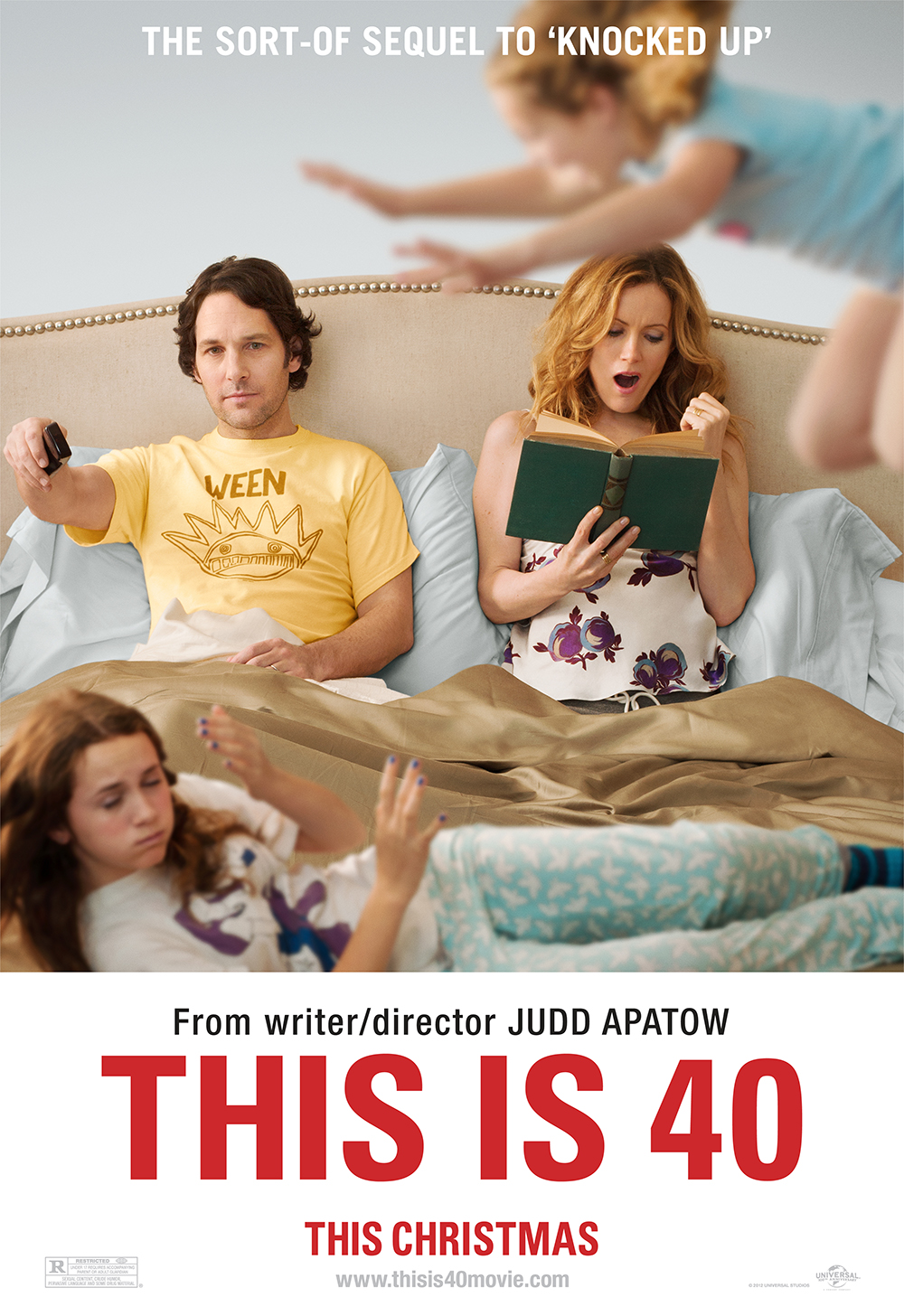
Writer-director Judd Apatow has made the mistake of believing that the audience will find his wife and children and mid-life crisis as relatable and endearing as he does. And there is nothing more fatal to a movie than a gross miscalculation about the appeal of its characters. It’s fine to make a movie about unpleasant people as long as the movie knows they are unpleasant. But this movie asks us to care about the concerns of people who care very little for anything but the most superficial and selfish problems, with no sense at all of how shallow and unappealing they are.

Apatow’s mega-successful “Knocked Up” was the story of a successful professional woman who became pregnant after a one-night stand with a man who was neither successful nor professional.  The pregnant woman’s sister Debbie (Apatow’s real-life spouse Leslie Mann) and her husband Pete (Paul Rudd) provided a comedic counterpoint, coping with marital stress, including two children, played by Apatow and Mann’s real-life children.  In one scene, Debbie and her sister are not permitted into a club because Debbie is too old and her sister is pregnant.  Debbie is devastated by the loss of this important validation.  Debbie is shrill and demanding, constantly blaming her husband.  In one big plot twist, it turns out that the secret he had been hiding from her was not an affair but a fantasy sports group he liked to escape to.

“This is 40” continues the story of Pete and Debbie.  She is still shrill and demanding, still constantly blaming her husband, and still pretty much on board with the idea that her self-worth depends on being attractive to strangers in hot clubs.  In the opening scene, the week of both Pete’s and Debbie’s 40th birthdays, they are having very enthusiastic sex in the shower when he reveals that his performance has been enhanced with medication.  Instead of expressing concern or sympathy or support, she interprets this as evidence that she is no longer as attractive as she was when she was younger.  She whines to her personal trainer (Apatow regular Jason Segal) that she is failing to arouse men and he consoles her by saying that she arouses him.

Debbie insists that she and Pete embark on a course of self-improvement that involves graphic depictions of a mammogram and a colonoscopy, and a lot of resolutions about eating better and unplugging the kids from the internet.  It does not, however, involve any expressions of generosity, humility, compassion, responsibility, or maturity.  Pete and Debbie are aggrieved by the remoteness (her) and dependence (his) of their fathers, but they are not doing much better as parents.  I have a sinking feeling that there will a a future sequel for the girls to work out their issues with their parents.

The movie is overlong and saggy, swooping almost randomly from set-piece scene to set-piece scene, and yet it is all supposed to take place in about one week.  This continually undercuts any sense of forward momentum and Apatow stuffs his films with so many of his friends that we keep having to be reminded of who all the characters are.  And then when we are reminded, we are disappointed all over again.  Segal, Chris O’Dowd (“Bridesmaids”), Lena Dunham (“Girls”), Charlene Yi and Melissa McCarthy (“Bridesmaids”) are all trotted out for short bits and some are quite funny (be sure to stay for McCarthy’s outtakes during the credits).  And Megan Fox is a standout as an impossibly hot and possibly larcenous employee in Debbie’s boutique.  This is Fox’s second top-notch performance this year, following “Friends With Kids” — take that, Michael Bay.  There is even an occasional flash of understanding of the challenges of marriage and getting older, as when Pete and Debbie try (but not very hard) to use obviously therapy-inspired tactics for expressing their complaints and disappointments.

But that is not enough to make up for the  inert plotline and unappealing characters.  For a guy who seems to think about nothing more than the travails of self-absorbed people suffering from arrested development, Apatow has failed to learn that the issue is not growing old — it is growing up.

Parents should know that this film includes extremely graphic and explicit sexual references and situations including fertility issues and an “escort,” constant very strong language, drinking, marijuana, some mild violence (no one badly hurt), family stress, and stealing.

Family discussion:  What do we learn about Pete and Debbie from their relationships with their fathers?  Why was staying young so important to Debbie?
If you like this, try: “Knocked Up” (featuring the same characters) and “The 40 Year Old Virgin”
Related Tags:


Comedy Drama Family Issues Series/Sequel

The Guilt Trip

Posted on December 18, 2012 at 6:00 pm

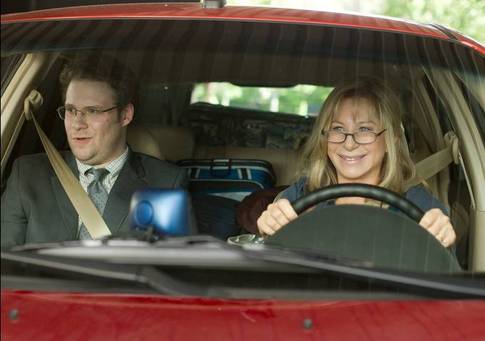
If you know the title, you know the painfully unfunny movie with this dull slog across America that Barbara Streisand inexplicably selected for her first lead role in 16 years.  Seth Rogen plays chemist-turned-cleaning product inventor Andy Brewster, who never returns his mother’s endless calls or responds to her smothering questions but nevertheless impulsively invites her to come with him on a cross-country sales trip in a rental car (she says the SUV is too expensive, even with the coupon she fishes out of her purse).

The inevitable irritations, revelations, accusations, and reconciliations occur, and through it all, Rogen and Streisand almost never change expression.  There’s a reason Rogen’s best work in film has been providing voices for animated characters (“Paul” and “Monsters vs. Aliens”).  He only has two looks, a squinchy pained look and a dull confused look.  Streisand is always an appealing screen presence, but Joyce, her character here, is such a stereotype of a New Jersey Jewish mother that she is stuck in a rut between cutesy-but-annoying and annoying-but-cutesy.  Annoying wins.

Joyce is, of course, the queen over the over-share.  Which must make Andy the champ at the under-share, holding on to all of the details of his life as though allowing his mother to know anything about him might just regrow the umbilical cord.

Much of the intended humor of the story comes from the various ways that Joyce embarrasses Andy by inquiring too deeply into his life, telling him too much about hers (she confesses that he was named after the love of her life, her first boyfriend who did not love her the way she loved him), and infantilizing him by clucking over him as though he was a toddler, buying him underwear and licking her palm to smooth down his hair before an important meeting.  This causes him to act like a petulant teenager, rolling his eyes, shutting her out, and letting her know that he can barely tolerate having her around.

Things that are supposed to be funny, but aren’t: A stripper fixes their car.  Joyce brings along the Oprah-endorsed audiobook Middlesex by Jeffrey Eugenidies, read by Kristoffer Tabori, about a character with both male and female sexual characteristics.  Joyce takes on a challenge to eat a four-pound steak dinner.  Joyce picks up a hitch-hiker.  Joyce gets drunk and talks to a lot of men in a bar.  Joyce is constantly snacking.  Andy is embarrassed.  Andy feels smothered.
Things that are supposed to be touching, but aren’t: Joyce schools Andy about treating her with respect.  Andy begins to appreciate her, especially when he takes her advice and it (highly improbably) works.  Also the ending, but I don’t want to give that away to those who still want to see it.

The movie also wastes the talents of top-notch actors like Colin Hanks, Ari Graynor, and Adam Scott, suggesting that there might be some deleted scenes somewhere.  It’s fair to assume they are better than what stayed in.

Parents should know that this film includes strippers and some humorous but crude sexual references, drinking and drunkenness, brief scuffle with punches, and some strong language (one f-word, several s-words).

Family discussion:  Did the confrontation in the hotel make you see Joyce differently?  Why do adults sometimes have trouble talking to their parents?  Talk to your family about some of their road trips.

If you like this, try:  “Funny Girl” and “What’s Up, Doc?”

Related Tags:


Not specified

The Hobbit: An Unexpected Journey

Posted on December 13, 2012 at 6:00 pm

B
Lowest Recommended Age: Middle School
MPAA Rating: Rated PG-13 for extended sequences of intense fantasy action violence, and frightening images
Profanity: Some strong language
Alcohol/ Drugs: Drinking, smoking
Violence/ Scariness: Extended fantasy violence and peril with swords and arrows, characters injured and killed, scary monsters
Diversity Issues: Diverse characters
Date Released to Theaters: December 14, 2012
Date Released to DVD: November 4, 2013
Amazon.com ASIN: B00E8S2JZ4

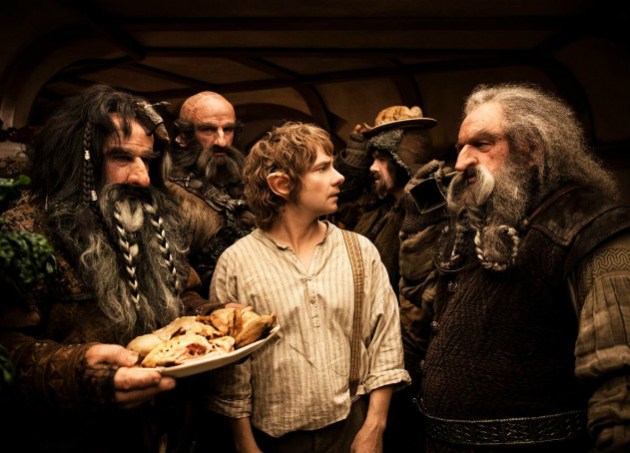
As the second in the Hobbit trilogy is about to be released, The Hobbit: An Unexpected Journey (Extended Edition).  Director Peter Jackson returns to J.R.R. Tolkien’s Middle Earth for this “Lord of the Rings” prequel, the adventure of young Bilbo Baggins, the hobbit we meet in the LoTR trilogy as the middle-aged uncle of the heroic Frodo.  We see many familiar faces, especially Ian McKellan as the wizard Gandalf, the sepulchral Christopher Lee as Saruman, Cate Blanchett as the ethereal Galandriel, Hugo Weaving as the regally gracious Elrond, and Andy Serkis plus CGI as Gollum, and the now-familiar but still marvelously eye-filling New Zealand locations.What is most different here is that Jackson has doubled the frames-per-second for a new hyper-clarity.  The 24 frames per second standard that has been in effect since the beginning of the sound era has been upped to 48, giving the film a depth of detail that is so fresh it can be a little unsettling.  We subconsciously associate the quality of light and focus with the video used for news programs and lower-budget sitcoms (think of the difference between the indoor and outdoor scenes in the old “Monty Python” episodes), so it can take a while to get used to it in a richly imagined fantasy, especially when close-ups reveal the pores of a character’s skin like a magnifying mirror at a department store makeup counter and the quality of light seems chillier and more sterile.  We get so much visual information that it takes a while to re-calibrate our ability to separate the meaningful from the superfluous.

It does not help that Jackson himself seems to miss the forest of the story for the literal trees.  Blowing out the shortest and most accessible of the books to a projected trilogy of nearly nine hours suggests that Jackson has fallen so in love with the project that he has lost touch with what it feels like not to be completely obsessed with it.  Of course, he is enabled by the intensity of the fans, who are famously dedicated to every leaf, twig, and Elvish declension.  But he seems to have lost track of the thread of the story and dulled his sense of how to communicate with those who are not as deeply involved with the story as he is. He glosses over the important discussion of Bilbo’s two competing heritages, one open to adventure, one devoted to home and hearth, which makes it hard to understand why he changes his mind about accepting Gandalf’s challenge.  Since it is a prequel, we are all familiar with the destructive power of the One Ring to Rule Them All, which makes it confusing when we see it 60 years earlier as a simple and benign invisibility ring.  Meanwhile, it takes all of 40 minutes before Bilbo leaves his house as what should have been a 10-minute scene about the unexpected arrival of a bunch of rowdy dwarves is expanded to include two different musical numbers.  And yet, it still does not give us enough of a sense of who the individual dwarves are.

The action scenes are filled with vitality and dynamically staged, but the film assumes a commitment and understanding on our part that it has not earned.  In a story about a quest of honor, that is an unexpected disappointment.

Parents should know that this film includes many battle sequences and scenes of peril, scary monsters, characters injured and killed, some disturbing images, smoking, drinking, and some potty humor.

Family discussion:  Why did Bilbo decide to join the adventure?  Why did Gandalf pick him?  Why didn’t Gandalf use his powers to help the dwarves sooner?

If you like this, try:  The book by J.R.R. Tolkien and the “Lord of the Rings” films

Related Tags:


3D Action/Adventure Based on a book DVD/Blu-Ray Pick of the Week Epic/Historical Fantasy Remake Series/Sequel

Hyde Park on Hudson

Posted on December 13, 2012 at 5:50 pm

When Franklin Roosevelt’s sixth cousin Margaret “Daisy” Suckley (pronounced “sook-lee”) died at age 99, a cache of letters was found in a suitcase under her bed.  Everyone knew she had spent years working near Roosevelt, and most thought he had kindly provided for her by allowing her to act as his cataloger and librarian.  But the letters revealed a close and tender friendship and implied that there was more.  And so, in this fact-based story of the first visit to the United States by a British monarch, Franklin and Eleanor Roosevelt (and Franklin’s redoutable mother) welcomed King George V (that’s “The King’s Speech” king, no longer looking like Colin Firth but recognizable by his stutter) and his wife, Queen Elizabeth, the parents of the current about-to-become-a-great-grandmother Queen Elizabeth II to the Roosevelt’s summer home in New York State.  And fed them hot dogs.

So there are really two movies here.  Bill Murray is superb as Roosevelt, famously described by Oliver Wendell Holmes as having “a second-class intellect, but a first-class temperament.”  Murray gives a beautifully subtle, complex and fully immersed performance as the patrician President whose polio-induced paralysis gave him a deeper understanding and sense of purpose.  The scene where he has an impromptu late-night meeting with the young king is one of the best of the year.

But the movie gets soapy and uncomfortably speculative when it focuses on the relationship between Daisy and the President.  Is it a romance?  Is it a story about Daisy’s spirit enlarging as she goes from adolescent crush to a sort of sister-wife support group with the other women in FDR’s harem, including his secretary and, of course, his wife Eleanor, beautifully played with asperity and an endearing sense of rebellion by Murray’s “Rushmore” co-star Olivia Williams. But the film wavers uncertainly between geopolitics illuminated by personality (well handled) and the schoolgirl longings and skeezy predation of his relationship with Daisy.

Parents should know that this film has frank sexual references and situations (one briefly explicit) including approving depiction of adultery, some strong language, and social drinking as well as a positive portrayal of characters with disabilities.

Family discussion:  Why do the women forgive Roosevelt?  What did the King learn from his conversation with Roosevelt?  What did they have in common?

If you like this, try: “The King’s Speech,” “Sunrise at Campobello,” and the book Closest Companion: The Unknown Story of the Intimate Friendship Between Franklin Roosevelt and Margaret Suckley by historian Geoffrey Ward

Related Tags:


Based on a true story Biography Drama Politics
THE MOVIE MOM® is a registered trademark of Nell Minow. Use of the mark without express consent from Nell Minow constitutes trademark infringement and unfair competition in violation of federal and state laws. All material © Nell Minow 1995-2026, all rights reserved, and no use or republication is permitted without explicit permission. This site hosts Nell Minow’s Movie Mom® archive, with material that originally appeared on Yahoo! Movies, Beliefnet, and other sources. Much of her new material can be found at Rogerebert.com, Huffington Post, and WheretoWatch. Her books include The Movie Mom’s Guide to Family Movies and 101 Must-See Movie Moments, and she can be heard each week on radio stations across the country.

Website Designed by Max LaZebnik