The War Horse

The War Horse

Posted on December 23, 2011 at 12:30 pm

The second Steven Spielberg movie of the week opens on Christmas Day, a grand epic, is big, long, ambitious, and showy.  It is a work by a master, but it is not a masterpiece.  Every detail is carefully considered.  Every leaf on every tree is perfectly aligned so that every sunbeam and shadow fall perfectly across them.  Every equine muscle, every country cottage, every blade of grass, every puff of smoke from a discharged weapon is exquisitely framed and lit, but the visuals outweigh the story.  The result is serviceable but stodgy, stuffy, and static.  The poetry and symbolism of the stage play (with a multi-operator puppet as Joey) is replaced by postcard-picturesque images that are visually rapturous but feel thin in comparison to the movie’s aspirations.

It’s “Black Beauty Goes to War,” the story of a magnificent horse named Joey and Albert (a dull Jeremy Irvine), the boy who loves him.  When World War I begins, Albert’s father sells Joey to a gallant young officer (Tom Hiddleston), who promises Albert he will do everything he can to keep Joey safe and get him back home after the war.  But war has a way of changing everyone’s plans and soon Joey is on his own journey that will take him back and forth between the British and the German forces and, for a short idyllic time, a respite with a frail but brave little French girl and her affectionate Grandfather.  The horse can switch sides in a way that a human cannot, and the movie makes clear the difference between the soldiers who are taken prisoner and shot and the animals who are inherently neutral and thus commoditized.  The brutality of war affects the human characters differently as we see in their responses to the animal.

The sweep and grandeur and tragedy of the film pay homage to majestic WWII-era filmmakers like John Ford, with gorgeous cinematography by  Janusz Kaminski.  One quiet scene of breathtaking power recalling the real-life Christmas truce reminds us of our better angels.  But it also reminds us of Spielberg’s better films.


(more…)

Related Tags:


Action/Adventure Based on a book Based on a play Drama Epic/Historical War
We Bought a Zoo

We Bought a Zoo

Posted on December 22, 2011 at 6:07 pm

B+
Lowest Recommended Age: 4th - 6th Grades
MPAA Rating: Rated PG for language and some thematic elements
Profanity: Some mild crude language, s-word
Alcohol/ Drugs: Some drinking
Violence/ Scariness: Sad offscreen deaths of parent and animal, some mild peril
Diversity Issues: None
Date Released to Theaters: December 23, 2011
Date Released to DVD: April 2, 2012
Amazon.com ASIN: B004LWZW9W

This is a good, old-fashioned family movie grounded in Matt Damon’s best-ever performance, inspired by the real-life story of a young widower who, without knowing a lot about animals or running a business, impulsively decided to buy a zoo.

Benjamin Mee (Damon) is a reporter still mourning the loss of his wife.  His young daughter Rosie (the very gifted and almost impossibly adorable Maggie Elizabeth Jones) is sad.  His teenage son Dylan (Colin Ford)  is angry and sad.  When Mee’s editor tries to reassign him, Mee realizes that the family needs something completely different.  And there is not much as different as a zoo.  At first Dylan is even angrier.  He has already lost his mother and now he has lost everything else that is familiar to  him.  And the zoo, which has been closed down will be very expensive to get into operating condition.  It makes no sense, as Mee’s practical brother (Thomas Hayden Church) keeps reminding him.  But after so much loss, Mee needs to feel that he can help something come alive.

The animals are cared for by Scarlett Johansson, looking sensational without make-up, as Kelly the zookeeper.  Mee survived a lot of dangerous situations as a journalist, covering dictators and hurricanes, but now he must be a participant, not an observer, and people, animals, and his family are depending on him.  Fortunately, he is handy with tools and has a fix-it frame of mind.  Unfortunately, that does not work with teenagers.  But Dylan is befriended by Kelly’s niece, played by Elle Fanning, who shows herself already a masterful actor by creating a distinctly different character from her equally sensitive performance earlier this year in “Super 8.”

This could easily have been sit-com-ish or corny — there is a persnickety inspector who has to sign off on the zoo before it can open and  a group of quirky but lovable staffers, a mostly-humorous search for an escaped animal, and a discreet but sad farewell to one of the big cats.  But director Cameron Crowe (“Jerry Maguire”), who co-wrote the script with “The Devil Wore Prada’s” Aline Brosh McKenna, makes it work with the help of a superb soundtrack by Jónsi.  And Damon’s performance centers the story with such presence and commitment that even viewers who pride themselves in being impervious to the charms of animals and children will find themselves melting.


(more…)

Related Tags:


Based on a book Based on a true story Drama DVD/Blu-Ray Pick of the Week Family Issues
The Adventures of Tintin

The Adventures of Tintin

Posted on December 21, 2011 at 8:00 am

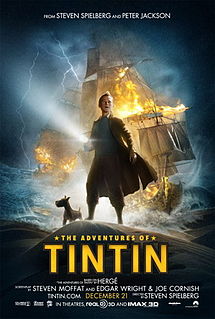
Two box office champion directors and a cult favorite joined forces for a film that was a first for all of them, a 3D motion capture animated story.  It is clear that director Steven Spielberg, producer Peter Jackson (“The Lord of the Rings”) and co-screenwriter Edgar Wright (“Shaun of the Dead”) were thrilled at the total freedom of animation, bringing storyboards to life without any pesky problems posed by weather, local ordinances, camera placement, safety, or the laws of gravity.  And so they have created a film that is non-stop, brilliantly staged action, with every mode of transport and obstacle, half Indiana Jones, half M. Hulot, with a touch of Buster Keaton and Harold Lloyd, turning the entire material world into a giant Rube Goldberg contraption.  Wonderfully cinematic shots and transitions show us how the masters have fun with pure, unleashed movie story-telling.

The comic book stories of the boy reporter Tintin created by an artist/writer known as Hergé  (Georges Remi) are wildly popular in Europe but not well known in the US.  Tintin is brave, capable, inquisitive boy of indeterminate age, probably somewhere around 14.  His excuse for getting involved in all kinds of adventures is that he is a reporter though neither the books nor the movie waste any time on the details of actually writing or filing stories, or, indeed, on any facts about Tintin’s origins or family.  He has a dog, Snowy, who is as intrepid as he is, and their journeys give them many chances to rescue one another in many exotic locations.

Spielberg and Jackson (whose WETA firm did the animation) did not try to copy the iconic linge claire style pioneered by Hergé, though there is a sly nod to it in the delightful opening credits and in a street artist’s sketch of Tintin at the beginning.  Instead it is an intensely detailed motion and performance capture with hyper-real textures and 3D effects that make the vertiginous chase scenes feel very visceral.  Tintin (voice of Jamie Bell) buys a model ship that turns out to be of great interest to a mysterious man named Ivanovich Sakharine (voice of Daniel Craig).  That leads Tintin to an adventure that involves cities, a desert, an opera singer, a potentate, pirates, dim policemen (Simon Pegg and Nick Frost as Thompson and Thomson), as he is drawn into a multi-generational saga involving lost treasure.  Along the way he meets up with Captain Haddock (Andy Serkis), a drunken sailor who is part sidekick, part clue.

It has a lot of alcohol for a PG movie and some parents may be uncomfortable with the repeated references, some intended to be humorous, to drinking and drunkenness.  And some will find the non-stop action overwhelming and just too much to process, even in these frenzied movie-as-video-game days.  Even the exacting eye of Spielberg and the prodigious talent of WETA have not quite mastered the physics of movement with motion capture technology.  The textures are wonderfully vivid and tactile and the angles and velocity are superb and the seas and ships toss convincingly.  But the weight of the bodies when characters leap or fall or objects crash feels strange and somehow off and the faces never find the right spot between the realism of the textures and a more stylized or cartoony look.  This is one element where they should have been more true to the original.


(more…)

Related Tags:


3D Action/Adventure Animation Based on a book Comic book/Comic Strip/Graphic Novel Mystery
The Girl With the Dragon Tattoo

The Girl With the Dragon Tattoo

Posted on December 20, 2011 at 11:21 am

The late Swedish author Steig Larsson created a series of books originally titled “Men Who Hate Women” with a character who was an idealized version of himself — an investigative journalist of impeccable integrity and political correctness who effortlessly appeals to women.  But it was the other lead character in the books who inspired the final titles of the trilogy and who became an international sensation, the dragon-tattooed bisexual computer wizard Lisbeth Salanger, a ward of the state for her violent behavior and anti-social demeanor, with no respect for conventional rules but with a passionate commitment to justice.  “She’s different,” says her employer. “In what way?” “In every way.”

The three books inspired three excellent Swedish films with Noomi Rapace as Lisbeth, and now David Fincher (“Se7en,” “Zodiac,” “The Social Network”) has taken the helm of a big-budget American remake, with Daniel Craig as journalist Mikael Blomkvist and Rooney Mara (briefly glimpsed in “The Social Network” as the girl who breaks up with Mark Zuckerberg in the first scene) as Lisbeth.

Fincher’s version is very true to the book, sharing its strengths and its weaknesses.  Mara’s version is slightly softer than Rapace’s, she still delivers the character’s most intriguing qualities, the combination of blatant punk style with a resolutely inaccessible core, her combination of vulnerability and resilience, her determination, and, above all, her ability to triumph over the most horrifying violations.  As the original title suggests, the weakness of the story is Larsson’s clunky insistence on including every possible form of atrocity, and those who are familiar with the plot may find that there are not enough surprises left.  A superb soundtrack by Atticus Ross and Trent Reznor (who also did “The Social Network”) is interrupted by a jarring version of Led Zeppelin’s “Immigrant Song.”

It begins with a scene that could have come from Raymond Chandler.  Mikael, discredited following a libel suit by a powerful businessman, is invited to meet with an even more powerful figure, Henrik Vanger (Christopher Plummer), the head of one of Sweden’s wealthiest families.  In his huge home in a island that serves as a family compound, Henrik explains that he is haunted by the disappearance of his young granddaughter Harriet  forty years before.  Each year, on his birthday, Vanger received a pressed flower, a symbol of his relationship with Harriet that he believes comes from her killer and is intended to taunt him.  The police and private detectives have tried to find out what happened to Harriet but the mystery is still unsolved.  No body has been found and there seems to have been no way for her to leave the island.  Mikael agrees to see if he can find out what happened.  “You will be investigating thieves, misers, and bullies,” Henrik tells him, “the most detestable collection of people you will ever meet — my family.”

What Mikael does not know is that he has already been investigated by Henrik, whose aide hired a firm to do a background check.  The research was done by Lisbeth Salanger, who hacked into Mikael’s email and has done a very thorough, if not strictly legal, analysis.  The only person Lisbeth trusts, her state-appointed guardian, has a stroke and his replacement is an abusive monster who insists on sexual favors before allowing her to have access to her money.  After some horrifying encounters, Lisbeth extracts some revenge.  Meanwhile, Mikael makes some progress but realizes he needs help.  The aide suggests Lisbeth, and so our two protagonists meet.

Steven Zallian (“Schindler’s List,” co-screenwriter of “Moneyball”) adapted the book well, discarding some distracting subplots.  The soundtrack and production designer Donald Graham Burt superbly convey the frozen remoteness of the setting.  Mikael is not easy to portray because he spends a lot of time watching and listening but Craig makes Mikael thoughtful and lets us see that he recognizes his failures.  Mara’s voice is a little too sweet for Lisbeth but her efficient, straightforward physicality and her watchful but implacable expression are just right for the character who is about to kick the hornet’s nest.

(more…)

Related Tags:


Action/Adventure Based on a book Crime Drama Mystery Remake Series/Sequel Thriller
Sherlock Holmes: A Game of Shadows

Sherlock Holmes: A Game of Shadows

Posted on December 15, 2011 at 7:10 pm

All Sherlockians know that the only villain who could match the most famous and celebrated of all fictional detectives is the fiendish Professor Moriarty.  As we were promised in the postscript to the first Sherlock Holmes movie from Guy Ritchie, Robert Downey, Jr., and Jude Law, this sequel pits the two masterminds against each other in a match to the death.

Watson is about to get married and this produces two responses in Holmes.  He feels abandoned and is jealous of Watson’s fiancée.  This emotion is mostly childish and narcissistic but, as in the first film, there is a frisson of homoeroticism as well.  But he does have moments of generosity and concern for others.  He fears that their association will put Watson and his new wife at risk.  In one of the high-octane film’s best and quietest moments, he visits Moriarty (played by Jared Harris, son of Richard Harris of “Camelot” and the original Dumbledore in the first Harry Potter movies) to ask whether they can agree to let Watson be free of any entanglement in the unpleasantness ahead.  But Moriarty does not play by any rules, which is what makes him so dangerous.

There are silly disguises and wild stunts.  We meet Sherlock’s brother Mycroft (Stephen Fry) — in the books a brilliant recluse, even more eccentric than his violin-playing detective sibling but here a rather foppish quasi-diplomat who calls his younger brother “Sherley” and walks around his home in the nude despite the presence of a young lady.  There is a brief appearance by Rachel McAdams as Irene Adler (“To Sherlock Holmes she is always the woman,” says Watson in “A Scandal in Bohemia”).  Noomi Rapace from the Swedish “Girl with a Dragon Tattoo” series is criminally underused as a gypsy woman trying to find her brother.  Director Guy Ritchie makes the most of the steampunk sensibility by matching analog gears with camera tricks that hyper-rewind and tricked-up slo-mo to show us Holmes’ observations and analysis.  He also draws some parallels to our time.  Anarchists were the terrorists of that era, technology was making possible more devastating destruction, national borders were dissolving, and, as always, money is the great motivator.  “Though politics may divide us, business will unite us,” says a character.

“Come at once if convenient,” Holmes says in a note to Watson.  “If inconvenient, come all the same.”  As we see in the meeting with Moriarty, this is an era on the cusp, the first World War just over 20 years in the future, and Holmes knows that Moriarty is not the only one who will not be willing to abide by a playing fields of Eton-style veneer of gentility.  Like the first film, what holds our interest is Downey, whose vision of Holmes, if not what Conan Doyle had in mind, is arresting.  Today he might be diagnosed as having sensory integration or autism spectrum issues.  “What do you see?” the gypsy woman asks Holmes. “Everything.  That is my curse.”


(more…)

Related Tags:


Action/Adventure Based on a book Drama Mystery Series/Sequel Thriller
THE MOVIE MOM® is a registered trademark of Nell Minow. Use of the mark without express consent from Nell Minow constitutes trademark infringement and unfair competition in violation of federal and state laws. All material © Nell Minow 1995-2026, all rights reserved, and no use or republication is permitted without explicit permission. This site hosts Nell Minow’s Movie Mom® archive, with material that originally appeared on Yahoo! Movies, Beliefnet, and other sources. Much of her new material can be found at Rogerebert.com, Huffington Post, and WheretoWatch. Her books include The Movie Mom’s Guide to Family Movies and 101 Must-See Movie Moments, and she can be heard each week on radio stations across the country.

Website Designed by Max LaZebnik