The Phoenician Scheme

The Phoenician Scheme

Posted on May 29, 2025 at 5:30 pm

C
Lowest Recommended Age: High School
MPAA Rating: PG-13 for violent content, bloody images, some sexual material, nude images, and smoking throughout
Profanity: Some strong language
Alcohol/ Drugs: Drinking and smoking
Violence/ Scariness: Graphic violence with disturbing images, characters injured and killed
Diversity Issues: None
Date Released to Theaters: May 30, 2025
Copyright 2025 Focus Features

You say you want to see a very smart, darkly comic film about the daughter of an unscrupulous businessman who before the story begins has joined a religious order but over the course of the story learns that she can do more to help people in his secular world and becomes drawn to a young professor? Then I suggest you watch the brilliant film “Major Barbara,” starring Wendy Hiller and a young Rex Harrison and with a very young Deborah Kerr, based on the classic play by George Bernard Shaw.

Or, if you would like to see a movie that skitters along the surface of some of those themes without having much to say about them but looks gorgeous, in fact so exquisite that if it starts to drag, which it does, we wish the actors would get out of the way so we could better absorb the beauty of the settings. In other words, we’re in the bento box movie world of Wes Anderson.

What bothers me third-most about Wes Anderson films is the way the characters speak the mildly arcane dialogue in constant near-robotic deadpan. What bothers me second-most is that the dialogue delivered in monotone is not just mildly arcane but pretentiously so, as though the twee-ness indicates both comic sensibility and deeper meaning. There can be humor in saying extreme things with a flat delivery, as though you’re politely asking to pass the butter, can be funny, but not always and not for a whole movie. What bothers me most is the way many people emperor’s-new-clothes the films, believing that the humor and deeper meaning they discern is somehow invisible to the less sophisticated instead of non-existent.

Benicio Del Toro plays Zsa-zsa Korda, a wealthy, powerful, and corrupt businessman, who says his two imperatives are “Who could lick who (or whom)?” (measuring success by beating the competition) and “If something gets in your way, flatten it” (the ends justify even scorched-earth means).

There are those who have similar guiding principles, or lack of principles, and therefore, as we see in the first scene, when an explosion on Korda’s airplane blows a big hole in the hull, and also in one of his aides, slicing his top half from his bottom half. Korda then goes into the cockpit and fires his pilot, in both senses of the word, dismissing him from employment and jettisoning him via ejector seat. Korda survives the crash landing with injuries. He knows more murder attempts are coming, and so he reaches out to his daughter Liesel (Mia Threapleton, daughter of Kate Winslet). She is about to take orders as a nun, and throughout the film she wears a snowy white habit, though as it goes on she also sports colorful eye shadow and bright red nail polish. Korda also has nine young sons, some adopted. His only interest in them is the thought that there are so many of them, odds are one will be brilliant.

Anderson’s two most recent films were episodic, like nested dolls. This one is slightly more linear, but still in chapters as Korda visits a series of characters in very different settings played by stars like Tom Hanks and Bryan Cranston (as American brothers in college sweatshirts), Scarlett Johansson as Korda’s second cousin and possible future wife, Jeffrey Wright as a ship captain, and Benedict Cumberbatch as Korda’s rival and half-brother. There are various murder attempts (the characters refer to them as assassination attempts, but that seems grandiose for a businessman, even one who is rich and powerful and has done evil things, because the term refers to the killing of an important person for political or religious reasons). And Korda and Liesel are accompanied by a character played by Michael Cera, introduced as a tutor brought on to teach them about insects (do not try to make this tie into anything except the overall anemic randomness that translates to “and then this character appears.” He plays a more important role as the story goes on and is the closest the movie comes to having a bright spot. It’s not that it has style and no substance. It has style and anti-substance.

Other than the settings, of course, which are fabulously imagined and entrancingly detailed. (As always with Anderson, look at the titles and covers of the books the characters read.) The movie might work better with no dialogue, just the visuals and the music.

Parents should know that this movie has a lot of peril and violence with some graphic and disturbing images. The movie includes guns, knives, bombs, fire, plane crashes, and quicksand. Characters are injured and killed, including references to a murdered parent. Characters are corrupt and murderous. they behave badly in business and with family, and they drink and smoke. Characters’ religious beliefs are not meaningful or sincere.

Family discussion: Why does Liesel stay with her father? What does she hope to achieve and how does that change? What do we learn from the names of Korda’s projects? From his mottos?

If you like this, try other Wes Anderson Films, especially “The Fantastic Mr. Fox.”
Related Tags:


Comedy Drama movie review Movies -- format Movies -- Reviews
Kinds of Kindness

Kinds of Kindness

Posted on June 27, 2024 at 5:15 pm

C
Lowest Recommended Age: Adult
Profanity: Constant very strong language
Alcohol/ Drugs: Drinking and smoking, characters drugged for abuse
Violence/ Scariness: Explicit, disturbing violence including self-mutilation, suicide, and rape, very graphic and shocking images
Diversity Issues: None
Date Released to Theaters: June 28, 2024
Copyright 2024 Searchlight

Director Yorgos Lanthimos is more interested in shock and sensation than story or character. He reunites with his “Poor Things” stars Emma Stone and Willem Dafoe and his “The Lobster,” “Dogtooth,” and “Killing of a Sacred Deer” co-screenwriter Efthymis Filippou for “Kinds of Kindness,” which is not about kindness at all but about obsession, dominance, and sacrifice. In its almost three-hour run time it features self-mutilation, suicide, murder, rape, a valuable broken tennis racket, and a cult centered around a notion of purity, a sweat lodge, and the possibility of reviving the dead. And it features a repertory cast of actors playing different characters in three otherwise unrelated stories, each appearing with a title referring to “R.B.F.”

Those initials are glimpsed onscreen just once, at the beginning of the film. “Sweet Dreams are Made of This” by Eurythmics intones on the soundtrack, telling us what is ahead: “Some of them want to abuse you. Some of them want to be abused.” There are many symbolic allusions throughout, though most gesture toward meaning rather than attempting it. Like these: There is a street named Perdido (lost). A close-up of two mouths kissing is so extreme it may make you wonder how humans ever got started with it. There is the novel Anna Karenina. That broken tennis racket was smashed during a game by John McEnroe. There’s also a cracked helmet worn in a race by Ayrton Senna. We see a blue pick-up truck, and then two more just like it.

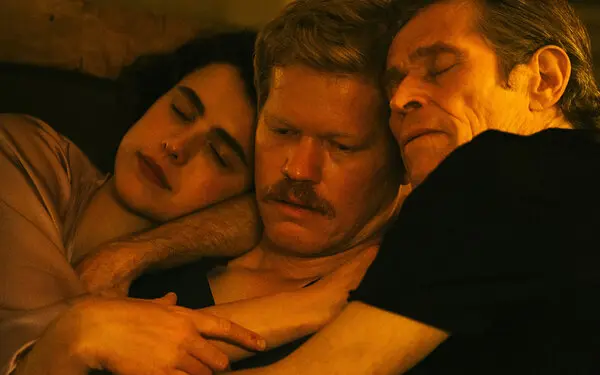
The first story is titled: “The Death of RMF.” A man comes to the door of a luxurious home and is let in by a beautiful young woman (Margaret Qualley) wearing a very short silk robe. She describes what he is wearing to someone over the phone, including the monogram on his shirt: RMF, which she initially mistakes for BMF, explaining that the embroidery is poorly done. The person on the other end of the phone is Raymond (Dafoe), wealthy, powerful, and obsessively concerned with controlling the most intimate details of everyone around him. One of those is Robert (Jesse Plemons), an executive in Raymond’s construction business, who lives in a modern mansion with his wife, Sarah (Hong Chau). Robert receives a hand-written note card with a minute-by-minute description of his day, from the socks, shoes, and suit he must wear to when he must and must not have sex with his wife. Robert for the first time, after ten years, tries to say no to Raymond when his first attempt to complete a dangerous, possibly deadly, task, is unsuccessful. This is when we find out what Raymond is willing to do, how much he is willing to debase himself by pleading, lying, stealing, harming himself, and worse.

“RMF is Flying” is the title of the second story, with Plemons as a police officer named Daniel whose wife, Liz (Emma Stone) is missing with her colleagues who were on a marine research trip. Daniel cannot think of anything else, worrying about what she is eating, imaging that a suspect in the police station looks like her. His partner and best friend is Neil (Mamoudou Athie), married to Martha (Qualley). They do their best to provide comfort and support, but Daniel is inconsolable. And then Liz returns. But Daniel believes something is wrong, and this being who looks and sounds like Liz cannot possibly be his wife.

The title of the third story is “RMF Eats a Sandwich.” This time, Stone plays Emily and Plemons is Andrew. They are testing young women on behalf of a group we will learn about. This is so important to her that she has left her husband, Joseph (Joe Alwyn) and the daughter they just call The Little One (Merah Benoit).

The screenplay relies heavily on the shock value, the performances and the production design by Anthony Gasparro to make the movie seem weightier than it is. And when that’s not enough, it winks at the audience to let us know that it just doesn’t care.

NOTE: Stay into the credits to see a bit more. Stone’s dance is every bit as good as the one that was a highlight of “Poor Things.”

Parents should know that this movie has pervasive adult material including sexual references and explicit situations, nudity, very strong language, alcohol and smoking, and graphic and disturbing images including suicide, murder and police shooting an unarmed man.

Family discussion: Why does Robert do want Raymond tells him to do? Why do Emily and Andrew do what Omi and Aka tell them to do? Why does the tennis racket mean so much to Sarah and so little to the people who buy it? How do you decide who you trust? Who is RMF and why does he matter to these stories?

If you like this, try: “The Lobster” and “Poor Things”

Related Tags:


Drama movie review Movies -- format Movies -- Reviews Satire Thriller
The Card Counter

The Card Counter

Posted on September 12, 2021 at 12:41 pm

A-
Lowest Recommended Age: Mature High Schooler
MPAA Rating: Rated R for for some disturbing violence, graphic nudity, language and brief sexuality
Profanity: Very strong language
Alcohol/ Drugs: Alcohol, smoking
Violence/ Scariness: Intense and disturbing torture violence and some other peril and violence with graphic images, murder
Diversity Issues: None
Date Released to Theaters: September 10, 2021

Copyright 2021 Focus
“We can forgive the Arabs for killing our children. We cannot forgive them for forcing us to kill their children,” said Israeli Prime Minister Golda Meir. “There’s a weight a man can accrue,” William (Oscar Isaac) tells us in “The Card Counter.” “The weight created by his past actions. It is a weight which can never be removed.”

And yet, William may think for a moment that the weight can be lifted. We hope so, even as we learn about the unforgiving weight he bears in the latest from the master of the stories of tortured, lonely men, writer/director Paul Schrader, going back to his screenplay for “Taxi Driver.”

He says his name is William Tell, as in the old story about the archer ordered to shoot an apple balanced on the head of his son. As in the overture to “The Lone Ranger.” And as in the word “tell,” which can mean the narration of a story or, in the poker world William lives in, it can mean the inadvertent gesture that reveals more about the opponent’s hand than he or she wants you to know. We later learn that it is not the name on his birth certificate and prison record. So the choice of the name is significant, though it may be more related to the second meaning of the word than the first.

William says he was surprised to find that being confined to prison was more comfortable for him than he expected. He liked the routine. He liked the simplicity. And it was in prison that he learned the kind of concentration and focus that enabled his life after prison, as a highly skilled card player, blackjack and poker. Card counting is a difficult skill that can be learned and those who do it well can compensate for the odds that favor the house in blackjack. William goes from casino to casino, moving all the time and quitting each game early enough that his winnings do not attract anyone’s attention.

He does nothing else. He has so completely blocked out the normal distractions of life that he will not stay in the casinos. They are too filled with distractions and sensory overload. He stays in nondescript motel rooms. But he makes them even more generic, covering every lamp, every piece of furniture with white sheets, tied with twine. There is nothing in his life but the cards.

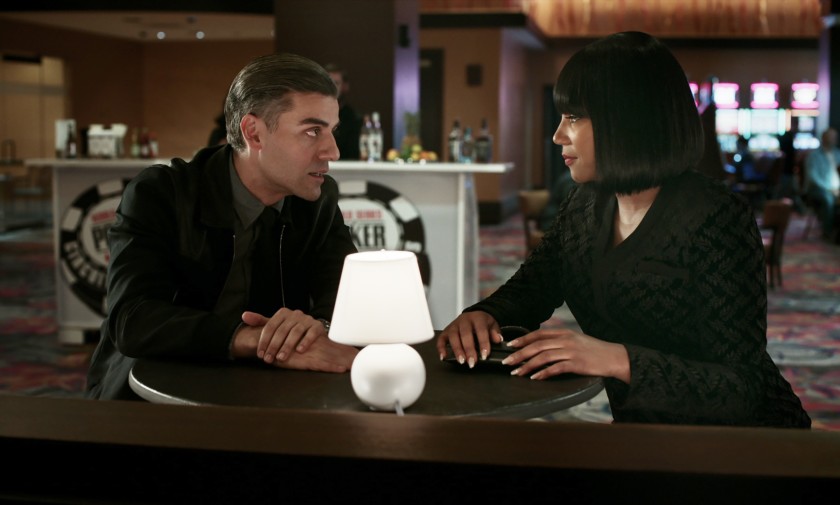
And then he meets two people. The first is La Linda (Tiffany Haddish in a beautifully understated but confident and layered performance). She is an intermediary between investors who stake top-level poker players as an investment, and she wants to add William to her “stable.” He is not interested.

That is, until he meets Cirk, pronounced Kirk (Tye Sheridan), a troubled young man who has a connection to the events that led to William’s prison sentence. William wants to help him, and that means playing poker in the high-end games La Linda can get him into.

Along the way, we learn about the disgraceful atrocities that Cirk’s father and William inflicted and the disgraceful injustice that had them bearing the responsibility while the instigators flourished. Schrader takes on an ambitious set of issues and understands the way to make it work is to give us believable, flawed but intriguing characters, with magnificent performances and stunning visuals. A scene where La Linda and Willam walk through an illuminated display is one of the most stunning of the year.

And can we just admit at last that Oscar Isaac is one of the finest actors in the world? He is mesmerizing here, the coiled control and the flashes of feeling, of longing, a simply gorgeous performance, one of the best of the year. This is a powerful film that fully earns its power.

Parents should know that this film includes some intense, disturbing and graphic violence, with torture of prisoners by US military, a prison fight, and murder, as well as very strong language, smoking, drinking, and sexual references and situations.

Family discussion: Why did William wrap the furniture? Why was it so important to him to help Cirk?

If you like this, try: “First Reformed” by the same writer/director

Related Tags:


Drama movie review Movies -- format Movies -- Reviews

Out of the Furnace

Posted on December 5, 2013 at 6:00 pm

out of the furnace“Out of the Furnace” gets no credit for its good intentions because it collapses under the combined weight of pretentiousness and condescension. This is Hollywood’s idea of a searing drama about life in recession-era heartland, as phony as a painted backdrop.  It is clearly intended to be a sympathetic portrait of two brothers betrayed by America. Russell (Christian Bale) lost his job when the steel mill closed down. His brother Rodney (Casey Affleck) went into the military and came home shattered by what he saw in four tours in Iraq. With no alternatives, their problems get worse. Rodney makes money in bare-knuckle fights, but keeps getting into trouble because he cannot bring himself to take a dive when told to do so by the fight promoter, Petty (Willem Dafoe). As their situations become more desperate, Rodney insists that Petty introduce him to meth dealer DeGroat (Woody Harrelson), so that he can make more money.

Co-writer/director Scott Cooper (“Crazy Heart”) tries to convey a sense of relentless pressure, crumbling infrastructure, and ever-constricting choices that force Russell and Rodney into making decisions with catastrophic consequences. But the film could easily be used to make the opposite points. Over and over, the brothers are told not to do something — like get involved with a murderous meth dealer — and they do it anyway. Russell is losing his job because the economy is bad. But he loses the girl he loves (Zoe Saldana) because he goes to prison. He goes to prison because he goes to a bar, gets drunk, drives, and causes an accident that kills two people. He has a lot of strong feelings and sense of loyalty for his brother and he is very upset about the death of his parents and his girlfriend leaving him for another man. When it comes to the innocent people he killed, he does not seem to have a sense of responsibility. We are supposed to be on his side because he is a decent guy who loves his brother, cares for his dying father, and misses his girlfriend, who married the decent local cop while Russell was in prison. But it is hard to be sympathetic when he — and the film — make no distinction between the limits imposed on him and the bad choices he made. Indeed, the movie ultimately becomes condescending, even contemptuous, in ignoring one of the core principles of narrative, which is respecting just that distinction. We are supposed to be on Rodney’s side because something in him, some core integrity, will not allow him to lose a fight he knows he can win. The metaphor is off-base and heavy-handed.

These are all great actors, and they all work hard to give good performances, but that in itself finally seems distancing. If they understood the essential humanity of the people dealing with these circumstances, the veterans struggling with PTSD, the factory workers whose jobs are gone, they would not distance themselves with such obvious artifice. Harrelson’s over-the-top sociopath seems to be from another movie entirely. Only Dafoe and Forest Whitaker as the sympathetic policeman create characters with any sense of authenticity, with Zoe Saldana relegated to a sad girlfriend role, doubly dreary because it is so tiresomely predictable.  The real Russells and Rodneys deserve better, and so does the audience.

Parents should know that this film has very strong and disturbing violence with graphic images, fatal drunk driving accident, murder, brutal fight scenes, guns, description of wartime violence, constant very strong language, substance abuse, and non-explicit sexual situations.

Family discussion: What does the title refer to? Why do the characters constantly ignore advice that will keep them out of trouble? What does this movie want to say about our economy and political system?

If you like this, try: “Killing Them Softly” and “October Country”

Related Tags:


Crime Drama Tragedy

Are We Finally Going to See ‘Fireflies in the Garden?’

Posted on October 13, 2011 at 8:00 am

Can you believe that a movie starring Julia Roberts, Willem Dafoe, Emily Watson, and Ryan Reynolds has been sitting on a shelf someplace in a studio archive since 2008?   And that Julia Roberts plays Ryan Reynolds’ mother?  The film has been shown abroad, but is now getting its first US release in New York and Los Angeles.

http://www.youtube.com/watch?v=l5e2x6D4xwA

It is called “Fireflies in the Garden,” and it was filmed in 2008.  The studio shut down before it could be released.  It is the story of an unhappy family coming together after the death of the mother (Roberts is seen only briefly and mostly in flashbacks).

The title is from this poem by Robert Frost:

Fireflies in the Garden

Here come real stars to fill the upper skies,
And here on earth come emulating flies,
That though they never equal stars in size,
(And they were never really stars at heart)
Achieve at times a very star-like start.
Only, of course, they can’t sustain the part.

Related Tags:


Commentary Trailers, Previews, and Clips
THE MOVIE MOM® is a registered trademark of Nell Minow. Use of the mark without express consent from Nell Minow constitutes trademark infringement and unfair competition in violation of federal and state laws. All material © Nell Minow 1995-2026, all rights reserved, and no use or republication is permitted without explicit permission. This site hosts Nell Minow’s Movie Mom® archive, with material that originally appeared on Yahoo! Movies, Beliefnet, and other sources. Much of her new material can be found at Rogerebert.com, Huffington Post, and WheretoWatch. Her books include The Movie Mom’s Guide to Family Movies and 101 Must-See Movie Moments, and she can be heard each week on radio stations across the country.

Website Designed by Max LaZebnik