
Interview with Existimatum

Posted on December 13, 2013 at 9:55 pm

Many thanks to “Marcus Julianus” of Existimatum for this lovely interview about how I became a movie critic and how I approach my reviews.

Early Career

EX: Tell us about where you grew up and what kind of childhood you had.

NM: I grew up mostly in the Chicago suburbs, the oldest of three girls. My dad, Newton Minow, was the FCC Chairman under JFK, so I lived in DC for two years when I was 9-10. His work in supporting the development of what became PBS, helping to launch the first telecommunications satellite, and being willing to criticize broadcast television has been a great influence and inspiration, as has my mother’s great work in many civic improvement and cultural organizations. When I was 16, I had a bad case of mononucleosis and was confined to bed for about three months. My parents wheeled a small, black-and-white portable television into my bedroom and in those days before cable TV, videos, and the internet I had just five channels to choose from. I watched every movie that was on instead of just movies I thought I would like and it turned out to be an outstanding education.

EX: What course of study did you pursue?

NM: I studied film at Northwestern University for a year, but my degree in Liberal Arts is from Sarah Lawrence. I also have a law degree from the University of Chicago.

EX: What were your professional ambitions when you were younger?

NM: In my college application essay, I listed five careers I was thinking about. I’ve been lucky enough to do four: writer, lawyer, teacher, and “something to do with movies.” That fifth one may still happen!

EX: How did you first get into reviewing films? Did you think at the time that you could make a career out of it?

NM: I was the movie critic for my high school and college papers and then went to law school and did other things for many years, though I still wrote about film from time to time. When the internet first became available, I was enthralled by it and participated in bulletin boards and early services like The Source before the World Wide Web. Once it was possible for me to create my own website, I did in 1995, just to teach myself how to do it. Impulsively, I decided to post some movie reviews. At the time, there was not one business or publication online. By the time there were, I had an archive of reviews online and Yahoo! asked me to be its movie critic. I did that for several years and then switched to Beliefnet. I had also by that time written my first movie book, The Movie Mom’s Guide to Family Movies, and that led to my being a critic on radio stations across the country.

EX: What was the first movie that you ever reviewed? Do you still have the copy of that review? Do you ever look back on it and if so, is it with pride or embarrassment?

NM: I think it was “The Subject was Roses” for my high school paper. I haven’t seen it in a while, but last time I looked at it, I thought it was not bad for a teenager!

The Movie Mom

EX: You seem to have a unique mission as a film critic, being the “Movie Mom.” Tell us how that came about and how it has evolved.

NM: When I started my website, I wanted to create a distinctive persona to establish my point of view and set me apart from the other critics. I had young children at the time and knew how hard it was to get good guidance on the kinds of issues parents want to know about in deciding whether a movie was appropriate for their families. And I wanted to be able to write about how families could share movies that would bring them together and lead to important conversations. I could not try to be another Kael or Ebert. I had to be myself, and that’s who I was.

EX: What do you find most rewarding about being a film critic?

NM: I love to watch movies and talk about them with other critics and fans. And I love to write and to be on the radio. It is also a great joy to be able to interview actors and filmmakers. So, pretty much the whole thing!

EX: What is the biggest challenge of being a film critic?

NM: Maintaining a freshness of perspective and an openness to each film, despite the overwhelming number of mediocre and formulaic movies we have to watch.

EX: You have quite a body of work, RottenTomatoes lists you as having 4176 reviews to your name, and the true total is surely higher. What tactics do you use to keep the experience of writing a review fresh and relevant after having done it so many times?

NM: I try to put myself in the place of someone who sees only a few films a month—or a year—and has bought a ticket because there is something about this movie that is appealing. But I am very lucky that I never seem to burn out on seeing movies. I still get a thrill every time the lights go down and the projector beam hits the screen.

EX: There are a lot of sites out there that approach movie reviews from a standards-based viewpoint, many religious. Do you find yourself getting pigeonholed into that world? Do you make an effort to distinguish yourself from these other sites?

NM: I don’t think anyone who reads my reviews pigeonholes me. The complaints I get are from people who want me to stick to their own narrow and rigid notions of what the “right” message should be in a film. The only effort I make is to bring my best self to each review and treat each film within the context of its own aspirations for its intended audience. If people want something else, there are many places they can go.

Career Highlights and Inspirations

EX: What has been the biggest moment of your career?

NM: There have been so many wonderful moments, it is hard to say. I loved writing my books. And I was honored to receive Roger Ebert’s “Thumbs Up” award and being one of the “Ebert Voices” on rogerebert.com.

EX: What goals have you set for yourself going forward, after already accomplishing so much?

NM: I want to keep writing reviews and books and helping people find movies that will thrill and inspire them.

EX: Who are your favorite critics to read? Do you draw inspiration from other critics?

NM: I love reading reviews and am always inspired by other critics. Roger Ebert was the all-time best. The critics he selected from all over the world who now write for rogerebert.com are some of my favorites. I browse rottentomatoes every week and read as many as I can.

EX: What is, in your opinion, the best review that you have ever written? Why?

NM: I think the reviews and articles in my books are the best writing I’ve done about movies because unlike a review, which must be written a day or two after seeing the movie, I have more chance to think about the films and I get a chance to talk about my all-time favorites, not just current releases. For my best, well, my favorite would be “Freddy vs. Jason,” for reasons that will be obvious if you look at it. But maybe “National Velvet” is one I am proud of. It would be great if you could link to my books, too.

EX: What is, in your opinion, the worst review that you have ever written? If you could go back and change it, would you? What would you change?

NM: If I change my mind, I go back and change the review. That’s the great thing about being online! For my worst, let’s say “The Cat in the Hat.” I should have been harder on it.

EX: You work a lot in radio. How does that differ from print reviews? Which do you prefer?

NM: I enjoy both very much. No one is easier to talk to than radio people. They are a lot of fun and I love hearing from the listeners.

EX: What advice do you have for aspiring film critics?

NM: See as many movies as possible, especially those on the AFI and Sight and Sound lists. Write as many reviews as possible. It isn’t enough to know movies and have opinions. You have to be able to write better than at least 75 percent of the other people writing about movies if you want anyone to read what you write, and better than 90 percent if you ever want to get paid for it.

Critique Methodology

EX: It seems like your most common grade for a movie is a B+. You don’t give out a lot of A’s or F’s, but you tend to be more forgiving than many critics toward “bad” movies. As a critic, are you tough to please? Do you think you’re simultaneously more forgiving than most?

NM: I don’t think of it as being “forgiving” or “not tough.” As I said, I grade each movie within the context of its own aspirations for its audience. Otherwise every review is just a way of saying, “It’s not ‘Citizen Kane.’” I’m not measuring “Twilight” against “Argo.” I’m measuring it against the expectations of its intended audience. Generally, in order to get an F from me, the movie has to show real contempt for its audience. And the highest grade I give a current film is an A-. A year later, if I still think it is outstanding, I will raise it to an A or an A+.

EX: Your career has spanned more than three decades. How has film criticism evolved since you started working in it, and where do you see it going in the future?

NM: It’s more than four decades! I wrote my first movie reviews in 1969, when I was in high school. Certainly, the biggest change in film criticism has come from the democratization of the internet and the related collapse of print media. The good news is that anyone can be a movie critic; just start a website or blog or self-publish a book. The other good news is that the reader is not limited to local critics; anyone can read any critic from any location. Those trends will continue into the future. The bad news is that the number of professional critics is a fraction of what it once was.

EX: Your reviews include both a recommended minimum age as well as family discussion questions. You include the family discussion questions even in movies whose minimum age recommendation excludes all children. Does this dichotomy ever pose a philosophical problem for you? Are you rewarding parents who ignore your counsel?

NM: Hey, families come in all ages! And those questions are good for any age. I discuss movies with my parents, who are in their 80’s, and my children, who are 27 and 30.

EX: What is your opinion of Existimatum.com?

NM: It’s a great idea! I look forward to seeing how it develops.

EX: What’s your favorite film review that was not written by you?

NM: Listening to Roger Ebert’s shot-by-shot commentary on “Citizen Kane” was one of the most mind-expanding and inspirational film experiences I have ever had. Highly recommended.
Related Tags:


Critics Media Appearances

Saving Mr. Banks

Posted on December 13, 2013 at 5:17 pm

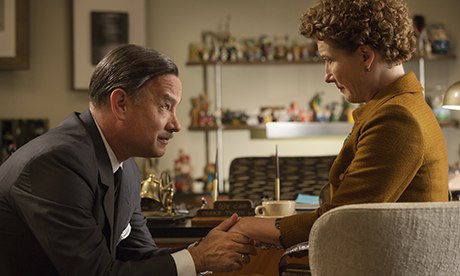
Saving Mr BanksFor most of this story, Walt Disney (Tom Hanks) and P.L. Travers (Emma Thompson) are on opposite sides.  He has been trying for twenty years to persuade her to let him make a movie based on her books about the magical nanny, Mary Poppins.  She needs money, as her agent reminds her, which is why she has very reluctantly agreed to leave home and fly to Los Angeles to talk to him about it.  But she cannot bear the idea of losing control of the characters who mean so much to her and she abhors everything about Disney and California, including sunshine, cheerfulness, twinkling, music, and calling people by their first names.

But there is one moment when, in the midst of some obvious culture clash jokes, there is a quiet moment that shows they are both on the same side.  Disney tells Travers that he was in her position when someone wanted to pay him for Mickey Mouse and he simply could not bear the agony of allowing anyone else to make decisions about a character he had created.  Travers says that Mary Poppins and the Bankses are her family.  But in a very real way, the character these artist created are their own very souls.  “We restore order with imagination,” Disney tells her.  And, engagingly, throughout the film we see the process, the inspiration, the despair, the triumph, the necessity of creating art, from a father soothing his little girl with a story to songwriters puzzling out a way to show Mary Poppins’ upside down world by having the tune go up as she sings the word “down.”

We all know how it turned out.  Disney’s “Mary Poppins,” celebrating its 50th anniversary next year, is one of the beloved and honored family films of all time, with five Oscars (Best Actress, Song, Special Effects, Score, and Editing) and eight more nominations.  But anyone who has read the books knows that there are some major departures from the Travers version, and that the fears she expressed — as documented in tape recordings of her sessions with the screenwriter and songwriting team — were more than justified.

Some people have criticized this film as Disney’s burnishing of its own brand, with its founder portrayed as a decent man who is just trying to keep a two-decade old promise to his daughters to make a movie from one of their favorite books.  Amy Nicholson writes in LA Weekly that “Saving Mr. Banks” is “a corporate, borderline-sexist spoonful of lies.”  She says that Thompson’s “Travers is as unpleasant as a pine needle pillow, and she’s as far away from the actual woman as ‘supercalifragilisticexpialidocious’ is from being a real word” when in fact she was a “a feisty, stereotype-breaking bisexual.”  I think this is a misreading of the film’s attitude toward Disney, Travers, “Mary Poppins” (the movie), and what it means to be a creative person in a world that is very imperfect when it comes to assigning monetary value to art (see also: “Inside Llewyn Davis”).  To come to Nicholson’s conclusion, one has to assume that the movie wants us to believe that Disney somehow outsmarted Travers by improving her work.  On the contrary, the movie makes it clear that the movie Mary Poppins was very different from Travers’ idea of the characters, moving them several decades earlier, for a start, and, crucially, as indicated in the title of this film, transforming an episodic storyline about children’s adventures with a magical nanny into a story about parents discovering the importance of being close to their children.  It is Nicholson who underestimates Travers by suggesting she was somehow snookered.  She made a decision that it was worth it to her to let that happen to get the money she needed to be as financially independent as she wished.  As is shown in the very first scene, she could have made money another way — by writing more books about Mary Poppins, for a start — but she chose to consent to the movie, and then to make absolutely sure that no American would ever touch her characters again.

colin-farrell-saving-mr-banks-gintyWhile the cute culture clashes and Travers’ resistance to Disney’s brand of pixie dust are featured in the movie’s trailers, the film itself devotes a substantial amount of time to Travers’ childhood, clearly taking her very seriously as a woman and an artist.  We see her as a child dearly loved by the father she adored (a superb Colin Farrell), a man of great imagination and charm, but, perhaps in part due to those same qualities, not able to manage life as a banker in the far reaches of Australia. As we see him sink from manager at a bank to manager at a smaller bank to teller, fans of the Poppins books will remember her description of what Mr. Banks did at the office (it is not coincidental that he shares a name with his profession).  He “made money.”  Meaning that, at least in his children’s minds, he sat at his desk cutting out coins each day.  Some days he was able to cut out many, and the family was quite comfortable.  But other days he was not as productive, and there were fewer coins to go around.

We can see the origins of this idea and many other Mary Poppins book details in Travers’ past, a seemingly bottomless carpet bag, a crisp “spit spot” from an imposingly organized woman who arrives to put the household in order.  But the most telling detail from the past is the key to the invention of Travers’ most important character: herself.  Her name is not P.L. Travers at all.  Nor is she Mrs. Travers, despite her insistence that Mrs. Travers is what she prefers to be called.  The Australian girl who would grow up to be the ultra-English P.L. Travers is named Helen Lyndon Goff, called “Ginty” by her dad.  His name was Travers Robert Goff.  She took his first name as her last name and put a “Mrs.” in front of it to create the character she chose to be.  This revelation, and Thompson’s brilliant portrayal of Travers show us a woman whose most important creation was the character she pretended to be — or became.

And of course Disney, too, played a character, the folksy host who was going to entertain you no matter how hard you tried to resist, and very well aware that these qualities were his best assets as a businessman.  He insists on taking Travers to Disneyland (beautifully recreated as it was in 1961).  Disney is persuasive enough to get Travers onto the carousel and canny enough to tell her the truth — that getting her on a ride won him a $20 bet.  And he tells her a story about his childhood, showing that just because he promotes an idealized vision of the world does not mean that he is unfamiliar with its harshness and disappointments.

Thompson gives one of the best performances of the year, showing us the insecurity and humanity and wit of a woman who is far more complex than she wishes to appear.  Jason Schwartzman and B.J. Novak as the song-writing Sherman Brothers and Paul Giamatti as the limo driver are all excellent as characters who underscore the theme of art as a path to meaning.  The glimpses of the “Mary Poppins” movie are so entrancing (okay, I had to come home and watch it again and am still humming “Step in Time”) that it is easy to be temporarily distracted from the bittersweetness of the story.  Hmmm, where have I heard that idea before?

Parents should know that this film includes the very sad death of a parent, substance abuse, a suicide attempt, tense confrontations, and some disturbing images.

Family discussion:  What did Walt Disney and P.L.Travers have in common?  What do you learn about her from her relationship with the driver?  How can you take details around you and make them into a story?

If you like this, try: the Mary Poppins books by P.L. Travers and the Disney musical film and the documentary “The Boys,” about the Sherman Brothers

Related Tags:


Based on a true story Behind the Scenes Drama Family Issues

Geena Davis Can Fix Hollywood Gender Stereotypes in Two Steps

Posted on December 13, 2013 at 3:58 pm

Oscar-winning actress Geena Davis has been a leader in understanding and improving the role of women in media.  The founder of her namesake Institute on Gender in Media wrote a piece for the Hollywood Reporter citing data showing that there are three male characters for every speaking female in family-rated films: “We are in effect enculturating kids from the very beginning to see women and girls as not taking up half of the space.”

She proposes “two easy steps” for change.

Step 1: Go through the projects you’re already working on and change a bunch of the characters’ first names to women’s names. With one stroke you’ve created some colorful unstereotypical female characters that might turn out to be even more interesting now that they’ve had a gender switch. What if the plumber or pilot or construction foreman is a woman? What if the taxi driver or the scheming politician is a woman? What if both police officers that arrive on the scene are women — and it’s not a big deal?

Step 2: When describing a crowd scene, write in the script, “A crowd gathers, which is half female.” That may seem weird, but I promise you, somehow or other on the set that day the crowd will turn out to be 17 percent female otherwise. Maybe first ADs think women don’t gather, I don’t know.

As Davis says, “If they can see it, they can be it.”

Related Tags:


Gender and Diversity Understanding Media and Pop Culture

Contest: Step Dogs

Posted on December 13, 2013 at 10:01 am

stepdogsI’m delighted to have a copy of this cute DVD to give away! Meatball is a carefree, wisecracking country dog. Cassie is Hollywood’s most pampered pet They couldn’t be more different, and when their owners marry and move the entire blended family to the rural north, the claws come out It’s only when two bumbling thieves scheme to break into their house, that these four-legged foes must team up to defend their home. This riotously funny and heartwarming comedy proves that it takes all breeds to make a family.

Send me an email at moviemom@moviemom.com with “Step Dogs” in the subject line and tell me your favorite pet. Don’t forget your address! I’ll pick a winner at random on December 18. Good luck!

Related Tags:


Contests and Giveaways For all ages

The Hobbit: The Desolation Of Smaug

Posted on December 12, 2013 at 6:00 pm

B+
Lowest Recommended Age: Middle School
MPAA Rating: Rated PG-13 For extended sequences of intense fantasy action violence, and frightening images
Profanity: None
Alcohol/ Drugs: None
Violence/ Scariness: Extensive and intense fantasy-style violence with characters in peril, monsters, weapons, and fights, characters injured and killed
Diversity Issues: Diverse characters, some
Date Released to Theaters: December 13, 2013
Date Released to DVD: April 7, 2014
Amazon.com ASIN: B00BEJL75I

The_Hobbit_The_Desolation_Of_Smaug_36556Everybody ups his game in this second of the three-part Peter Jackson version of J.R.R. Tolkein’s The Hobbit; or, There and Back Again.  The first one courageously tried out the new hyper-clear technology with twice as many frames per second that felt disorienting, chilly, and a little thin.  More seriously, it got bogged down in the storytelling.  A book about a journey became a movie that spends 40 minutes at home before anyone goes anywhere (with two different songs).  This second chapter starts right in the middle of the action and never stops.

Here’s a summary of the first film to get you up to date in case you skipped it or don’t remember: Bilbo Baggins (Martin Freeman), the title character, is accompanying a brave group of dwarves on a quest that will take them to the mountain lair of an angry dragon named Smaug who sleeps on an endless pile of stolen gold and jewels.  In part one, they made it part of the way there.  Part two begins in the midst of the action.  They are still far from their destination but every step is treacherous and every stage in the journey brings more trouble.  Middle Earth is deeply troubled by its divisions.  Dwarves and Elves do not trust one another.

Martin Freeman returns as Bilbo, whose epic travels inspire an inner journey toward meaning and purpose.  We see his struggle when he cannot bring himself to tell Gandalf (Ian McKellen) the truth about what he found.  He wants to tell the wizard about the magical golden ring he discovered.  But when the moment comes, and he can only say that what he found in the cave is his courage.  That is an intriguing statement, partly true, partly self-evidently false as he does not have the courage to tell Gandalf about the ring. But as we know from the Ring trilogy, part of the power of that plain gold band is the way it works on those who — at least temporarily — possess it.  Perhaps it is the ring that tells Bilbo to keep the secret.

But Bilbo, reluctant to join the dwarves in part one, is fully committed now, so in that sense he has found his courage, and finding it, now sees himself differently.  And it is that inner journey that holds the story together amidst the arrows and giant spiders and swashbuckling and guy with bird poop on his head and portentous statements like, “The fortunes of the world will rise and fall but here in this kingdom we will endure” (when we know they will) and “This forest feels as though a dread lies upon it” (when we know it does), and “It’s not our fight” (when we know it is).

Purists may object to the insertion of a brand-new character, but Evangeline Lilly as Tauriel, a warrior elf, is such a welcome addition that even Tolkein should be glad to add her to the cast.  And then, finally, there is Smaug, a scary monster who can see where humans, hobbits, dwarves, and elves cannot.  Benedict Cumberbatch, in his fifth major film appearance this year, provides the voice of ultimate predatory evil, and a cliffhanger that leaves us eager for the final chapter.

The intricacy of the detail everywhere you look is more than gorgeous.  It lends a timelessness to the story.  It tells us that there is a history here, that the people who created these structures intended them to be permanent and beautiful.  The fight scenes, staged as well or better than any other this year, are more than graceful violence.  They, too, communicate a seriousness of purpose and meaning that these characters bring to their lives — and inspire in ours.

Parents should know that like the other “Lord of the Rings” films, this one includes intense and sometimes graphic fantasy violence with monsters (dragon, giant spiders), weapons, fights, and constant peril, and characters are injured and killed.

Family discussion:  What title would you pick for yourself?  Why does Bilbo agree to get the Arkenstone?  Why doesn’t he tell the truth about the ring?

If you like this, try: the book by J.R.R. Tolkien and the “Lord of the Rings” Trilogy

Related Tags:


3D Action/Adventure Based on a book DVD/Blu-Ray Pick of the Week Epic/Historical Fantasy Series/Sequel
THE MOVIE MOM® is a registered trademark of Nell Minow. Use of the mark without express consent from Nell Minow constitutes trademark infringement and unfair competition in violation of federal and state laws. All material © Nell Minow 1995-2026, all rights reserved, and no use or republication is permitted without explicit permission. This site hosts Nell Minow’s Movie Mom® archive, with material that originally appeared on Yahoo! Movies, Beliefnet, and other sources. Much of her new material can be found at Rogerebert.com, Huffington Post, and WheretoWatch. Her books include The Movie Mom’s Guide to Family Movies and 101 Must-See Movie Moments, and she can be heard each week on radio stations across the country.

Website Designed by Max LaZebnik