Interview: Kumail Nanjiani and Emily V. Gordon on “The Big Sick”

Posted on June 18, 2017 at 3:45 pm

Emily V. Gordon wants you to know that her father did not cheat on her mother. You might think that he did because in the movie Gordon wrote with her husband, Kumail Nanjiani, about their romance, movie Emily’s father, played by Ray Romano, confesses that he had an affair. But Gordon and Nanjiani explained in an interview that the overall story is true, and Nanjiani plays himself, but some elements were compressed or heightened for dramatic purposes.

This part is true: Gordon met Nanjiani when she was in grad school studying psychology and he was a stand-up comic. Very early in their relationship, she suddenly became critically ill. This is probably the only romantic comedy in history to have its female lead spend half the movie in a medically induced coma. And that’s not even the couple’s biggest obstacle. Nanjiani’s Pakistani immigrant family wants him to marry a girl from their religion and culture. Gordon’s character, Emily Gardiner in the movie, is neither. He hasn’t told her about the parade of eligible girls his mother has “dropping by” the house when he is visiting his parents. Movie Emily, played by Zoe Kazan, breaks up with Nanjiani just before she gets sick, and then he meets her parents (Romano and Holly Hunter) for the first time at the hospital. The second half of the film is a different love story, between Nanjiani and Emily’s parents. “And then we get to really, really play and create these really fun people,” she said. “My parents are lovely but it would have been a more boring movie.”

“This is obviously very, very autobiographical,” Nanjiani continued. “I would say my character is probably closer to how I was then than Emily is.” “I would say your character is pretty clueless, and you’re not as clueless,” Gordon added. “We had a lot of fun arguments like: character Kumail is a lying asshole, but the real Kumail is just a liar.” “Yes, just a liar. And clueless. Judd would ask me what I thought was going to happen, what the plan was when I was dating Emily. And I was like, ‘I don’t know. I haven’t thought about it.’” Gordon, whose terrifically funny and wise book Super You: Release Your Inner Superhero reflects her training as a therapist and her insight as a writer, said, clearly not for the first time, “Not deciding is a decision. People don’t realize that not making a decision is a decision in itself.”

Nanjiani and Gordon worked on the script for three years, sending drafts to Apatow, who guided them on tempo and character. “We would write down the truth of things and then he would advise us: ‘You could really turn up the drama here, you can change the situation here and kind of make this resonate more.’ So we would show him what the truth was and then he would help us figure out ways to make it more cinematic, ways to make it more dramatic, more funny,” Nanjiani said. The biggest departure was in the portrayal of Gordon’s parents. Apatow was especially helpful in providing feedback on the story’s structure. “He was like: ‘this much will be Emily and Kumail, this much should be them separated, this much should be the hospital, this much should be the surgery.’ He just drew these lines separating each section and we took a picture of it. And then when Michael Showalter came on as director, he said, ‘Kumail in Emily’s room, that’s the center of the movie so everything has to come before come after it.’ So we moved everything around that point because that’s the point of no return. That’s when I realize that I’m in love with her and that I had made a huge mistake.”

Gordon described working with Showalter. “He’s all heart, that’s what’s great. And he wears all his emotions on his sleeve. That’s his strength in a way. He is so amazing to watch because he’s passionate and invested in the story. And he was always very open to collaboration. It wasn’t like he was ruling with an iron fist, ever. Everything felt like a collaboration. He had no ego about collaborating. That made me feel so safe and confident in giving him our story.” Nanjiani said that Showalter showed them how he was subtly using different color palettes for the different characters, even different camera movements. “And Mike is very good at guiding you between movements of the movie, with silence or just following a character for a little bit or whatever it, is he’s very, very adept at switching gears for the movie in a seamless way.” Showalter is especially gifted in casting even the smallest roles and because they shot in New York they were able to find superb performers from theater whose faces were not familiar to movie audiences.

Nanjiani said that writing the film helped him to appreciate and understand his parents’ reaction to his wanting to marry Gordon. “When people from a different culture come here you want to hold on to your own culture but you also want to be your own person. It’s a complicated thing and you do lose something going against the wishes of your parents and your culture. But ultimately it has to be a personal decision.”

Nanjiani is an experienced performer, including three seasons as Dinesh on “Silicon Valley.” But this role presented some new challenges for him, with some dramatic moments and with the difficulty of reliving some of his most painful experiences on camera.

“I hadn’t ever taken any acting classes so I started taking acting classes to sort of prepare for this. I just knew that there was this big thing coming up and it was going to be very difficult and challenging. I wanted to take some of the guesswork out of it because what I knew was comedy acting, where you can go on instinct and as long as it feels funny it works. I knew this was going to be different, especially separating the reality from the movie character and also dealing with some very painful memories. I wanted to get the tools to be able to go into different emotions because I knew that this was a very low budget movie and we had to learn work really fast. If I had to be sad in the scene knew I knew that I had to figure out how to do that like quickly.”

“And if may say,” added Gordon, “Old Kumail from the movie would not have done that. He just would have been like, ‘I’ll figure it out.’”
Originally published on Huffington Post.

Related Tags:


Actors Based on a true story Interview Romance Writers
The Journey

The Journey

Posted on June 16, 2017 at 2:56 am

B +
Lowest Recommended Age: Middle School
MPAA Rating: Rated PG-13 for thematic elements including violent images and language
Profanity: Some strong and bigoted language
Alcohol/ Drugs: Drinking
Violence/ Scariness: References to and depictions of historical civil unrest, violence, and murder
Diversity Issues: A theme of the movie
Date Released to Theaters: June 17, 2017
Copyright 2016 IFC

First thing, I’m going to ask you to overlook two obvious problems with this film.  The first is the awful title, pretentious and overused.  The second is the film’s complete distortion of the real-life facts and details in favor of a condensed and heightened portrayal that puts decades of delicate negotiations into one car ride.  Let’s just agree to get past both of those for a moment and we will return to them later, I promise.

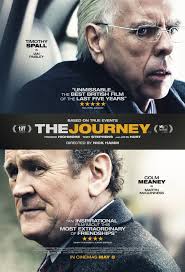
Here is the truth.  Two men who were the bitterest of enemies at the center of The Troubles, one of the worst, longest, and most intractable conflicts in modern history, found a way to create an enduring peace.  One was Ian Paisley (played by Timothy Spall), an evangelical Protestant minister.  The other was Martin McGuinness (played by Colm Meany)  a leader of the Catholics.  Although they despised each other, and blamed each other for the violent attacks that led to thousands of deaths, they were statesmen enough to realize that no one would ever win if they kept fighting each other.  In  2007, when the two men visited the White House to see President George W. Bush, McGuinness said, “Up until the 26 March this year, Ian Paisley and I never had a conversation about anything — not even about the weather — and now we have worked very closely together over the last seven months and there’s been no angry words between us. … This shows we are set for a new course.”

This movie imagines what the first conversation between the two men might have been, placing them in a streamlined, highly artificial, and very heightened dramatic context to have it.  This is not a documentary.  It is not history.  It is intended to be seen by people who have very little notion of the story.  So, the good news is that it is very accessible.  The less good news is that it will confuse the audience into thinking that this is how it happened, so be warned.

But it is a touching, inspiring, beautifully performed and very timely story about finding common ground even under the most bitter partisan circumstances.  And it is a powerful reminder that at the end of the day policy and statecraft and clashing ideologies may give rise to briefing books filled with charts and footnotes, but at the end of the day sometimes it just comes down to two people who agree to acknowledge their common humanity. “These men are anarchy,” one of the government officials says. “They are The Troubles.” But he might just as well say, “They are the answer.”

Parents should know that the theme of this film includes decades of civil unrest and murder during “The Troubles” in Northern Ireland, some graphic and disturbing images and references to sad deaths, and some strong language.

Family discussion: What was the turning point on the journey and why did it make a difference?  Read up on the real relationship between Martin and Ian, which evolved over decades, not one car trip.

If you like this, try: “In the Name of the Father” and “Maeve”

Related Tags:


Based on a true story Movies -- format Politics
The Book of Henry

The Book of Henry

Posted on June 15, 2017 at 5:37 pm

D
Lowest Recommended Age: High School
MPAA Rating: Rated PG-13 for thematic elements and brief strong language
Profanity: Brief strong language
Alcohol/ Drugs: Drinking and drunkenness, drug reference
Violence/ Scariness: Theme of child sexual abuse, attempted murder, suicide, medical issues, sad death, peril
Diversity Issues: None
Date Released to Theaters: June 17, 2017
Date Released to DVD: October 2, 2017
Copyright 2017 Focus Features

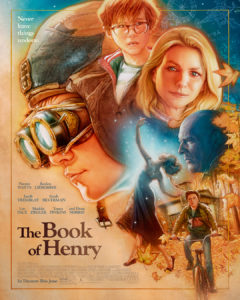
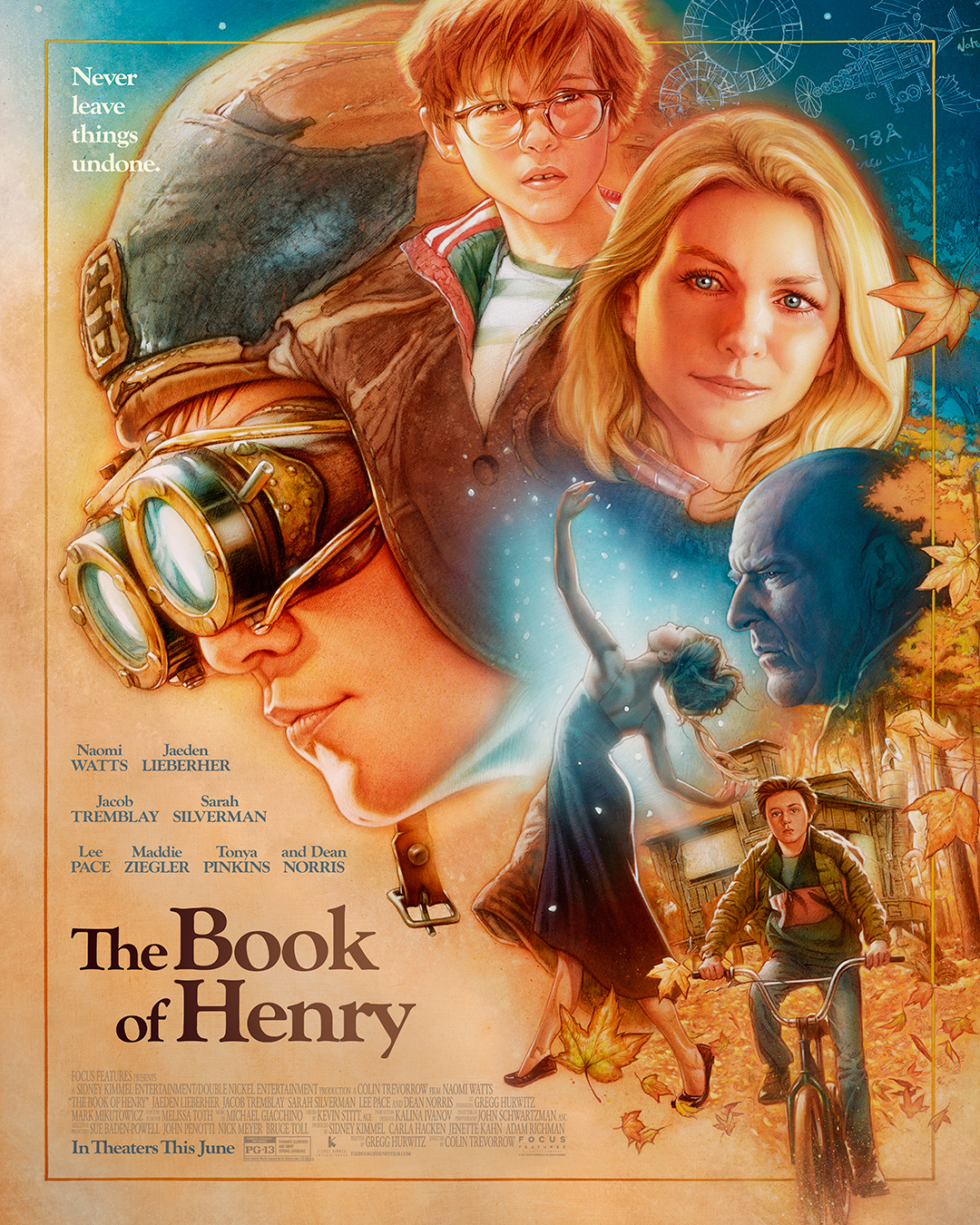
I’ve got a pretty high tolerance for movies, even syrupy ones, about super-gifted kids and am generally willing to give them some leeway as metaphor or fairy tale.  So I’m okay with “August Rush,” “Pay it Forward,” “A Monster Calls,” etc.  But “The Book of Henry” crosses the line from syrupy to smarmy, and where it wanted to be endearing, it was annoying, and then infuriating.

Jaeden Lieberher, who is making a career out of playing preternaturally wise and powerful children, has the title role as Henry, an 11-year old who is the kind of genius only found in movies. Not only is he a total braniac who understands architecture, finance, electronics, existential conundrums, weapons, and engineering, he has a rapier wit and knows the difference between different kinds of tumors and can read an MRI. Furthermore, he is a near-empath who instantly understands the people he cares about. In other words, he is not a character; he is a symbol and his purpose in the story is to give other characters important life lessons.

Henry has a younger brother, Pete (Jacob Tremblay of “Room”), who is in the movie to play the role of Normal Kid. And they have a mother, Susan (Naomi Watts), who is loving and devoted but irresponsible. Henry is the grown-up in the family, stopping at a phone booth after school to place complicated brokerage orders.

Let’s pause for a moment on that last point. Yes, I said phone booth. Even though the movie takes place sort of now (there are cell phones, a coffeemaker, video games, and a super-duper weapon), it has a deliberately retro feel. Henry and Pete use old walkie-talkies, barely a glimpse of a laptop (who needs one; Henry’s a walking Wikipedia). Susan is a waitress at a diner that could be out of the 1950’s, though her boss (“SNL’s” Bobby Moynihan) offers to pay her by direct deposit. You do not need to be Henry to figure out that this is supposed to lull us into cutesy-ness.

Henry has a crush on the girl next door, a classmate named Christina (Sia muse Maddie Ziegler), who lives with her stepfather, Glenn (Dean Norris), the town’s police commissioner. Henry senses that Glenn is abusing Christina. When Glenn’s position of power makes it impossible to protect her through official channels, he comes up with a dangerous plan to keep her safe.

To say more would be to risk spoilers, so I will just note that pretty much everything that happens after that is intended to be touching and poignant but  none of it is .   Lee Pace does his best with the thankless role of Doctor Perfect, who would make Prince Charming look like the guy who gets eliminated in the first episode of “The Bachelorette.” And Sarah Silverman adds some sass as Susan’s best pal, who joins her in wisecracks about how they aren’t rich and in getting drunk.  Christina has a lovely dance number in the school talent show.  And Watts is marvelous as always.  But the story’s preposterousness and manipulation thwarts their best efforts to provide some grounding.

Parents should know that the movie’s themes include child sexual abuse, attempted vigilante murder, and a very sad death of a child, and suicide. There is some strong language, a drug reference, and drinking and drunkenness.

Family discussion: What should Susan have done about the couple in the store? What made Susan change her mind?

If you like this, try: “Phenomenon” and “Disturbia”

Related Tags:


DVD/Blu-Ray Family Issues Stories About Kids
Cars 3

Cars 3

Posted on June 15, 2017 at 5:23 pm

B
Lowest Recommended Age: Kindergarten - 3rd Grade
MPAA Rating: G
Profanity: None
Alcohol/ Drugs: None
Violence/ Scariness: Peril and some violence including fiery car crashes, references to sad death
Diversity Issues: Diverse characters
Date Released to Theaters: June 17, 2017
Date Released to DVD: November 6, 2017
Copyright Disney/Pixar 2017

It’s better than “Cars 2,” but not as good as the first “Cars,” so it continues the saga of the second tier of Pixar movies.  Second-tier Pixar is pretty good. But this time the storyline is unlikely to be of much interest to children.  They’ll enjoy the race scenes (except for the ones that are too scary) and the silly humor.  But the theme of this film is the existential dilemma of an aging athlete.  While “Inside Out” and “Toy Story 3” addressed issues of growing older/up with infinite tenderness and sensitivity, “Cars 3,” with the help of generous samples of Paul Newman’s Doc Hudson character from the first film, has appropriated the plots of many of the “Rocky” movies, with now-champion Lightning McQueen (Owen Wilson) confronted with his own mortality.  I know; they’re machines, but apparently they have parents and childhoods and lifespans.

Lightning is beaten by a super-slick competitor dashingly named Jackson Storm (Armie Hammer), who looks like he is visiting from another Disney movie, “Tron.”  And there’s another blow.  Lightning has loved being sponsored by his friends at Rust-Eze, but the company has been sold and his new sponsor is the smooth, corporate Sinclair (Nathan Fillion), who tells him that if he does not win his next race, he has to stop racing all together.

But racing is all Lightning knows or cares about.  If he can’t race, who is he?

Sinclair has a very high-tech training facility that’s all about cybermetrics. Lighting is assigned a new trainer, Cruz (Cristela Alonzo), who is essentially a stopwatch on wheels.  Everything is about readouts and algorithms.  Lightning takes her out on the beach to show her what real racing is.  And he decides that his mentor, Obi-Wan Kenobi, I mean Doc Hudson, may be gone, but perhaps he can find Doc’s mentor, and gain some wisdom.

Lighting and Cruz end up competing in what they think is a race but what turns out to be a demolition derby (pretty scary for G).  They squabble and make up and Cruz confides that she once dreamed of racing.  They do find Doc’s old friends, led by Smokey (Chris Cooper) and his adorable sidekicks.

It has talking cars, and kids will like that. And it doesn’t have the bombast and over-complexity of “Cars 2.”  But it also does not have the heart we have come to rely on from Pixar, and if we feel disappointed, it is only because they have set the bar so high.

Parents should know that despite the G rating, this film has characters in peril including scary 3D car crashes and fire, many references to a sad death and to the challenges of aging, and a reference to unsupportive parents.

Family discussion: Why did Lou take other children’s toys? Who is your mentor and who can you help as Doc Hudson helped Lightning?

If you like this, try: the other “Cars” movies and “A Bug’s Life”

Related Tags:


3D Animation DVD/Blu-Ray Pick of the Week Fantasy Movies -- format Scene After the Credits Series/Sequel
THE MOVIE MOM® is a registered trademark of Nell Minow. Use of the mark without express consent from Nell Minow constitutes trademark infringement and unfair competition in violation of federal and state laws. All material © Nell Minow 1995-2026, all rights reserved, and no use or republication is permitted without explicit permission. This site hosts Nell Minow’s Movie Mom® archive, with material that originally appeared on Yahoo! Movies, Beliefnet, and other sources. Much of her new material can be found at Rogerebert.com, Huffington Post, and WheretoWatch. Her books include The Movie Mom’s Guide to Family Movies and 101 Must-See Movie Moments, and she can be heard each week on radio stations across the country.

Website Designed by Max LaZebnik