
Interview: Dean DeBlois of “How to Train Your Dragon 2”

Posted on June 13, 2014 at 7:00 am

Writer/director Dean DeBlois is one of my favorite people to interview and it was delightful to talk to him about the wonderful “How to Train Your Dragon 2.”

Just give me the basics just to set the stage. Tell me how much time has gone by since the first film and where we start off.

This is the second installment of a planned of trilogy. It has our characters now 20 years old instead of 15 year olds that were in our first movie. We wanted to introduce Hiccup and the gang at a different crossroads in their life where they are now stepping into adulthood with some uncertainty and a sense that Hiccup isn’t quite cut out to take over his father’s mantle as chief. So instead he is expressing his restlessness by being out there on the edge of the Viking map and charting new lands and finding new dragons. That’s where he comes across the conflict that actually threatens the peace back home. He discovers that there is a group of dragon trappers that are trapping dragons for an ambitious conqueror named Drago Bludvist who on plans on amassing a dragon army. And there is also a vigilante who is out there rescuing dragons and whisking them away to safety.how-to-train-your-dragon-2-poster2-408x600

Now tell me a little bit about what has happened in the technology side since you made the first one and how that has affected making the movie. Were there things you were able to do this time that you couldn’t do last time?

Sure, absolutely! This film is actually the first to roll out a brand new generation of software that has been in development for over five years. And it just reinvents the way that we approach our work and makes it very intuitive and real time so that we don’t have to wait for renders which always impairs creativity. The big improvement is that the software is much faster so you can work with lots of characters on screen but the results are immediate and so animators now work with their hands again. They get to use the stylus and they can manipulate characters instead of using spreadsheets, numeric entries and pull-down menus.

It seems to me that there is a lot more capacity for many, many characters to interact with each other.

That’s exactly it! There are so many shots in this movie that increase the scope and scale which is perfect for our ambition for the film. There were shots that couldn’t have been done before, like where we have thousands of characters on screen rushing the beach and the epic battle of the second act or so many different characters riding their dragons even in the opening during the dragon races. It allows us to be really rich and complex and also allows for incredible subtlety with the animation as well because there is so much going on under the skin with every one of our character.

With every year it seems like technology makes our lives a little bit easier and makes things look a lot better. Five years ago it seems like clouds in particular were very difficult or water, or anything interacting with water was difficult, like ice for example. We have a lot of that in our movie and it was really difficult to light that but now they look spectacular and you can imagine actually what it going to be five years from now. I believe that what we’re doing now which feels very cutting edge five years from is going to look primitive in ten years.

There is a guy name Dave Walvoord who was our head of visual effects who spent a lot of time actually developing the look of that ice. And it really was incredible. They worked really hard, it was difficult but they figured out a formula that seems to allow just the right amount of light to reflect through it and it has just the right opacity and luminosity to it that just makes it jump off the screen. That’s hats off to our effects department, breathing so much life into what lurks beneath the waves has add a really great quality to it
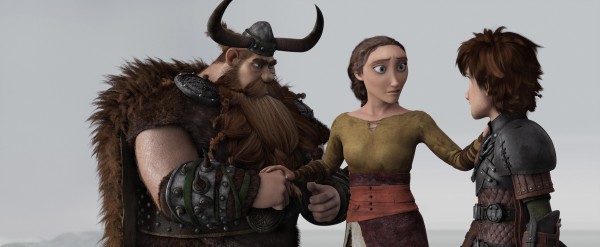
how-to-train-your-dragon-2-hiccupI’m going to try to do this so that we avoid spoilers but we lose an important character in this movie, so what can you say about that?

It was painful but it was a rite of passage and I think that we all knew that Hiccup had a place to go narratively and so long as he had a crutch he wouldn’t step into the role that he needed to step into. So as somebody who suffered a very similar loss as a boy it has a great heroism to it and a nobility to it but also narratively in terms of tracking Hiccup’s coming of age it was a rite of passage that I thought we needed to go through in order to really commit to the person he needed to become.

That was sad but what totally got me was that beautiful song. I cried.  So tell me about the choreography and where the song came from.

I’m really happy to hear that because that was the moment I was most afraid of in the movie and as a result I’m maybe most proud of. The risk for a cringe-worthy experience was high I knew I wanted to have this old Viking ballad that would have been passed down through the generations and something that would have been sung at her wedding to bring her back from this place of regret and remorse and feeling overwhelmed by the realization that people can change and she made the wrong decision and all this time her son who probably needed her feeling like a square peg back in Berk, left to feel like he was the only one that was sympathetic to dragons.

So she is carrying a lot of that burden at the beginning of the scene and Hiccup is so enthusiastic, he’s unaware that he is only overwhelming her more but Stoick realizes that there is another approach and so he uses this song that was a duet to remind her of the person she used to be and who they used to be together. So it was made to be carried out in a very clumsy kind of charming way that used music minimally in order to feel authentic and raw and not a burst into song musical moment. And it sounds like we pulled it off if it made you cry.

I should tell you the song was actually written by Jónsi who was the frontman of an Icelandic band call Sigur Rós and he did our incredible song at the end of our first film. He’s a good friend and I made a concert film for them a few years ago. He joined forces with John Powell to write two pieces for this movie and that’s Hiccup’s introduction song and this song.  Lyrically I had something very specific in mind. Shane McGowan from the Pogues has always written these really heartfelt tender beautiful moments and beautiful lyrics and so we approached him about it.  He jumped at the chance so the lyrics are lyrics are actually from Shane McGowan, John Powell and Jónsi. We even brought in a choreographer to help us with the movements.

The choreography was pretty intricate.

Yes, we used a choreographer from Once, the stage production and America Idiot.   I asked him to make it feel like your parents, sort of bumbling parents dancing around the kitchen instead of Dancing with the Stars. And he incorporated a few fumbles as well in the middle of the choreography to make it feel really authentic and unrehearsed.

I thought that was great. Now I want to go back to the beginning  for a minute because that dragon race was an incredible way to get you very immediately into the film and with the characters.  How do you orchestrate that to keep us on top of so many different things that are happening?

Narratively we had a lot of ground to cover just in terms of recapping it for the audience and helping out the audience who had not seen the first film. So we decided to do it this very kinetic visceral way. Now that the Vikings and dragons are no longer at each other’s throats they needed something to do with all that energy. so they created this obstacle race of sorts that involves finding marked sheep that are all over the island and then returning them to these baskets that contain them. And you have the whole populous of Berk crammed into these stands cheering them on.  This way we could see all of our auxiliary cast aged five years later but also reintroduce them in a fun kinetic way paired with their dragons and seeing how they have become symbiotic flyers in these five years that has passed.

And then another thing is we fly be a lot of the updates that have been installed since the first movie so in places of catapults, and battle stations we now have feeding stations, water reservoir, and aqueducts.  You can really see the ways that the dragons have been integrated into the Vikings’ daily lives and how it’s become a dragon utopia, which also helps to set up the stakes for the movie.  This is what could be lost if Drago Bludvist has his way and conquers their land as well.

Drago is played by Djimon Hounsou.  Tell me about selecting him for the cast and what you saw for that character.

One of my favourite movies is Blood Diamond and I thought Djimon was so powerful in that movie, in particular the scene where he is talking to his son who has been brainwashed by the warlords and has a gun pointed at his father.  It’s this beautiful scene where he is saying, “This is who you are and these are your sisters and this is your mother” and remind him of sort of the daily life of who he used to be and the tears were running down his face.  I thought that  was a great reference for the moment where Hiccup was trying to reconnect with Toothless in the  third act of the movie. So he was high on my list and I also love the fact that Djimon was born in Africa but raised in France and he has a very non specific accent which is what I wanted for this character.  He was from a distant land, a strange land of unknown origin and so it added to his mystique that he is journeyed this long way for this goal of amassing a dragon army.  He’s got a great character to his voice that’s really powerful and intimidating but also textured to indicate that there’s more going on than just the arch villain.  He has limited screen time in this movie but I think there is a sense of wanting to know more about what makes him tick.

And I also really enjoyed the new character that you added, Eret played by Kit Harington.

I started watching Game of Thrones as I was setting up the movie and John Snow quickly became one of my favorite characters. And I loved that sense of youth in his voice, and there’s a nobility there.  Eret is from a completely different land but also in a way a contemporary of Hiccup’s, roughly in that age range. There was a youth and a charm but also playfulness to the voice that Kit brings. And I actually think he did a great job of rising to the occasion because we pushed the character to be much more of an arrogant, cocksure, cowboy of a dragon trapper who loves the sound of his own voice and Kit immediately took to that and packed more accent  to it to make it seem even more amplified. I think he had a lot of fun with the role.

What’s next?

I’m about to start writing that script after I take a little break.  I have an existing outline already that was part of mapping the trilogy was kind of knowing what threads we would be drawing out of the first film and playing out in the second installment but then also what are we setting up for the third? I love the idea that something that Cressida Cowell had mentioned when she was visiting the studio and she is the author of the books from which the first movie was based. She said, “I plan by the end to explain what happens to dragons and why they are no more.” That was so compelling and I thought “Wow, it is such a powerful idea.”  Of course it’s bittersweet but I think it is  so emotionally powerful and fitting to be able to close a chapter on this trilogy with history returning to somewhat as we know it and what happened to the dragons and where did they go and could they come back. These are all mysteries that will be unveiled. But I loved that Hiccup learned stand on his own and made the toughest decisions of all for the betterment of mankind and dragons.
 

Related Tags:


Animation Directors Interview Writers

Interview: “Obvious Child’s” Jenny Slate and Gillian Robespierre

Posted on June 12, 2014 at 1:10 pm

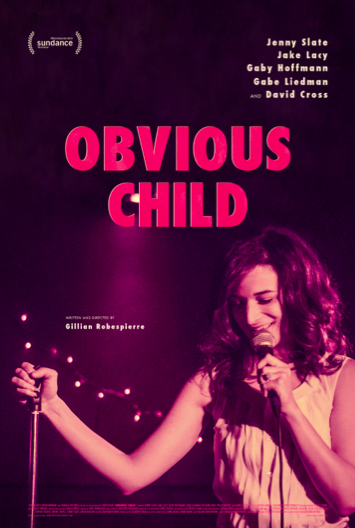
obvious childJenny Slate gives a star-making performance in “Obvious Child,” a romantic comedy about Donna, a young stand-up comic who becomes pregnant and has an abortion. Her decision is not presented in a comic or light-hearted way. What is revolutionary is that it is presented at all. As writer-director Gillian Robespierre points out, in movies women who become unexpectedly pregnant either choose to deliver the child (“Knocked Up,” “Juno”), or miscarry. In this movie, Donna does not question her decision, but that does not mean it is an easy one. She is supported by her best friend, Nellie (Gaby Hoffman), and her mother (Polly Draper). I spoke to Slate and Robespierre about the film.

In the movie you do basically three stand-up performances. I want to talk to you about what I thought the most compelling scene in the film which was the second one, where you are working through some very deep pain on-stage.

Jenny: That was my favorite really, I like them all but I love that one. You know Donna is very, very free on stage and at the beginning of the movie she’s very free, from 0 to 100 in a second and she just keeps it at 100. You’re enjoying it and you’re not really considering whether or not it’s an active job or a passive job that she is doing up there. And I kind of consider it to be kind of the most basic sort of passive that she’s just blasting it out. And the second time she really lets her nature take over. That need to share has just become the most animal that it can be. In my mind that type of stand-up is equivalent of her just kind of like squatting on the ground and just like sorting through the detritus. This is my stuff, just doing it for nobody but herself. There many different things that we can do to ourselves and for ourselves and that one is on the non-helpful side but I find to be hilarious and you know it’s not so painful and cringeworthy where you don’t want to watch, the audience laughs.

The audience in the theater laughs, but the audience in the movie is uncomfortable because it is so raw.

Gillian: That was our intention. All of the extras were wonderful that day so we have a couple of cutaways with reactions that are just great. I’ve seen the movie millions of times but there’s always one guy who just looks so lost and scared, and really perturbed. I really wanted to make sure that the people in the club in the movie were awkward but the audience in the movie theater or at home are laughing.

Jenny: I like that dual thing where the guy leaves and Donna is like, “oh this is not working for you?” It’s a bummer for them but I think I did a thrill ride for us.

Gillian: One of my favorite parts in the movie. I looked forward to that.

You cast two of my absolute favorite actors as Donna’s parents, Richard Kind and Polly Draper.

Gillian:  Well when we were looking for the parents, Jenny was always part of the film, we wanted to find the perfect combination of sort of whimsical and arty and tough. And it could have been either way, the dad could have been tough and the mom could have been whimsical but really the script meant for a fun creative dad and the more uptight mother. And I can picture them in the 80s wheeling down and around in New York City and really being tickled by each other but obviously they could not make it last. And they’re perfect left side/right side and that’s sort of what Donna has. We know that she on one hand tells very sort of body jokes but on the other hand she has a very high IQ, which are mom reminds her of everyday.  And on stage which is sort of relating to the audience, are smart moments in her life that people can relate to even though she does it in a kind of silly way. So we wanted both of those aspects of her brain and her personality to be portrayed in human parents. And I love Polly Draper from Thirtysomething. I watched it when I was little and I obsess about that show.  She and Jenny have the same raspy voice. I think they look alike.  I think Richard Kind and Jenny have these malleable comic faces.  I’m so thrilled they said yes. They read the script, they loved it and they saw that it was a Jenny Slate movie and they said yes immediately.

This was originally made as a short film so tell me a little bit about expanding it to full-length.

Gillian:  Donna didn’t have a career in the short. We had to get in and out pretty quickly. She was a lot younger, she was 25 and she gets dumped, has a one night stand, discovers she is pregnant and then she bumps into the one night stand on the way to the woman’s health center. And we sort of just shot it four days in New York City with no money.  We wanted to really expand in her world, creating her parents. In the short her mom was a character but not anything but a phone call so it was a voiceover. And that voice was acted by my mom.   We expanded on Donna’s world.  It was fun to figure out what is Donna going to be, what’s her job. She’s not a career person but she’s been in this bookstore for five years, it’s very comfortable in there.  Her boss is a sort of  grandpa figure.  They’re friends and she’s really somebody who has a hard time with change and expanding her world. I don’t think there’s anything wrong with that kind of character.  She’s a little meek in life and not a victim but she lets a lot of things happen to her.  “My boyfriend broke up with me and he is cheating on me so I can’t do my comedy anymore.” That’s a very passive way of thinking about life and the easy way until it’s hard.

Jenny:   She thinks, “I’m just chill, I’m just trying to make s**t work and everybody’s just messing with me,” until suddenly just like, “God that just can’t be true because I feel so mad I must have some power in there.”

The movie has a beautiful portrayal of girl friendship, with the character played by Gaby Hoffman.

Jenny :  In the scene where she is trying to say like, “No do your own thing” and Joey has his own opinion, she says, “You guys stop with the crazy jokes” which I think adds a really nice texture. And it just reveals a little bit of what their relationship is, kind of a threesome of friends and you don’t need to know that story but it just adds a bit of realism to it.  Gaby and I are both people that are very eager to share so that made it very easy to connect to each other and then Gillian’s script is so clear.

Gillian:  I feel like that’s a very important relationship in a lot women’s life. I know that I’m a gal’s gal and I have a lot of great friends. I have great female friends and they mean so much to me in my relationship, it’s so important and for Donna I wanted her to have that complex female relationship with her best friend who is not really going to let her get away with everything but also very unconditionally supportive. They’re polar opposites.  Nellie is a little grumpy and a lot more reserved and has a lot more rules while Donna is sort of a wildflower who can’t really control things but they meet up in the middle and have some wonderful balance.  And then three of them together, that’s when I think Joey and Donna sort of regress a little but they’re fun, they like to tell jokes each other, make each other laugh and made her laugh. Nellie won’t have it sometimes and then sometimes she breaks down and she chuckles.

What has the reaction been to the portrayal of abortion in the film?

Gillian:   People are really excited for this story, I think it’s exciting to see a woman in screen who they can relate to and who they can laugh with. Pushback hasn’t really come our way yet and we’re excited for conversation if and when it happens.

Donna has to learn to overcome her prejudices when she meets a guy who does not look like what she is used to.

Gillian:  At first he seems like a dull kind of frat boy muscleman. But like for every other character we wanted to make them complex and dimensional and with him it was like not just peeling away his bro-ness but to show that he’s really excited about this funny woman.  When she tells a joke he laughs really hard and then he tells her one back and he’s a funny guy too. And she doesn’t feel like she deserves to be looked at so that was like a nice subtle layer that in there but also that she would never ever go for a guy who wears boat shoes.

Jenny :   And then she makes fun of him right away. And he’s like, “don’t judge me”, and she’s like, “oh….”

What’s next for you?

Jenny: I’m in a new series on FX called “Married” with Paul Reiser.  I play a woman who has a lot of daddy issues and a tiny, tiny bit of a partying problem.  And she has a three-year-old son. It’s about different couples trying to make their marriages work.


Related Tags:


Actors Directors Interview Writers

Interview: Dave Clark of the Dave Clark Five

Posted on June 10, 2014 at 3:59 pm

daveclarkfiveandbeyond

It was a tremendous thrill to speak to Dave Clark, from the Dave Clark Five, one of the greatest pop groups of all time.  Their string of classic hits include “Glad All Over,” “Bits and Pieces,” “Because,” and “Catch Us If You Can.”  He talked to me about his days with the group and the hit play he created after the group disbanded.

And I am very excited to have a copy of the new DVD Dave Clark Five & Beyond: Glad All Over to give away. To enter, send an email to moviemom@moviemom.com with Dave Clark in the subject line and tell me your favorite song from the 60’s. Don’t forget your address! (U.S. addresses only) I will pick a winner at random on June 20, 2014. Good luck!
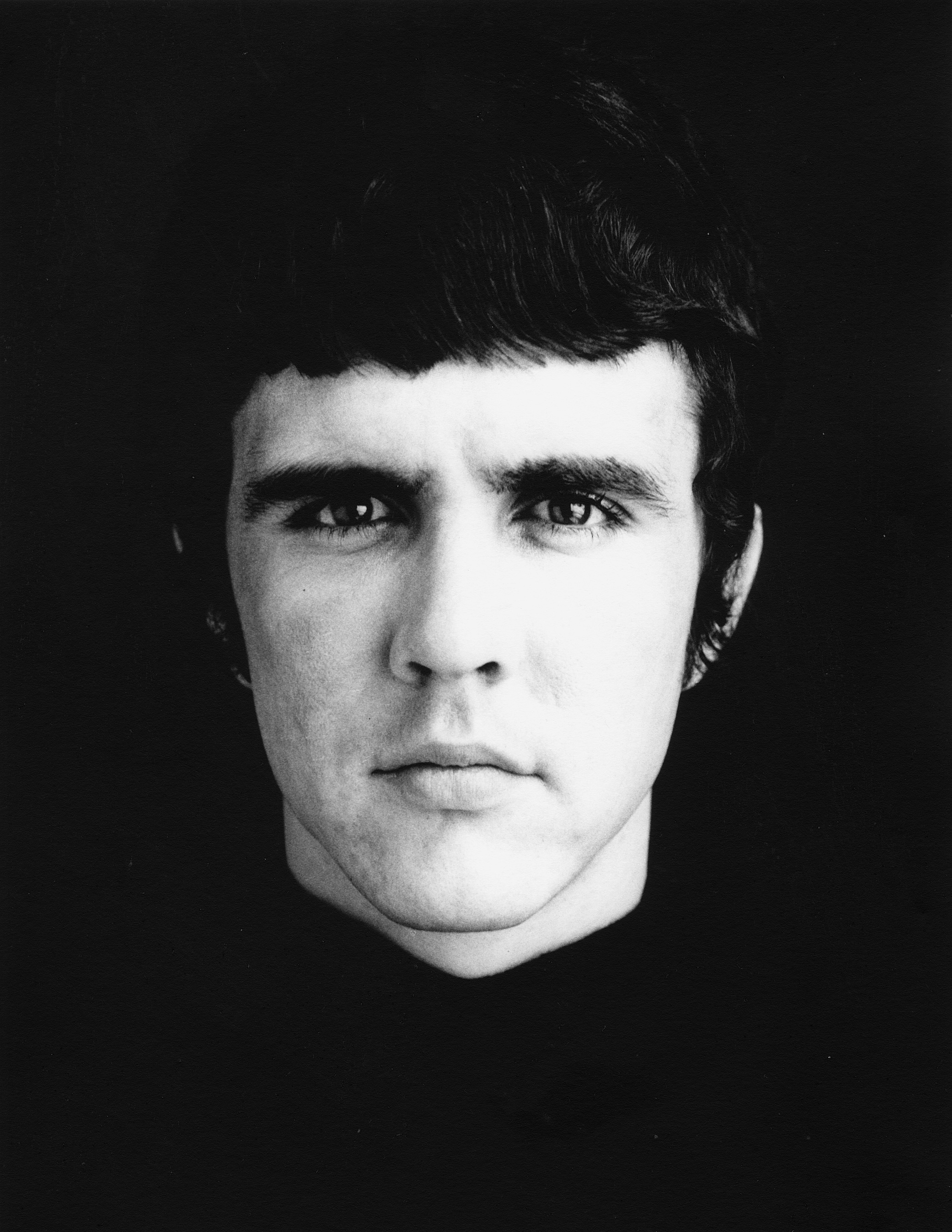
Band portrait (Dave)

The movie you and the group made, Having A Wild Weekend, was on television last night as part of a British Invasion tribute. I was surprised how somber, even melancholy, it was, while the others were all light-hearted, even silly.
It different. We didn’t want to make a musical. It was really about the industry really, about how people are used and exploited sometimes and I thought that was quite exciting to do that.

You were very different from the other groups at the time in the way you approached the business side of pop music. Where did that come from?

I left school at 15 years of age, I wasn’t academic at all. You can say really in a way it was by accident because we started from nothing and then gradually you build up your following and became better. Then we ended doing what they call the Mecca Circuit which was in the documentary, we started from nothing then all of a sudden we were packing in six thousand people a night, three or four nights a week and never repeating a song and doing a lot of our own material and of course we got several offers for recording contract. One of them was with Decca Records and they were the company that turned down The Beatles actually.  We went down and we had to do an audition which we passed it and we were ready to sign an agreement and then they said to me, “We have this new hit producer. Why don’t you come down and see what’s it like to work with him because this is who we will get to produce your records?” So we went down and the first thing he said to me was, “You’re not recording any of your own material, this is what you’re going to do”.  And they were making us into what was the “flavor of the month” which was in those days Cliff Richards and the Shadows in the UK. And I thought “forget it” and I said to the guys, “When we can get some money we’ll make our own records.”  We didn’t have any money, though.

And we were packing in 6000 a night with our own style. Surely any record company could say, “Let’s try something new.  It’s different.”  EMI Records was also one of the handful of people that were chasing us. And I said to them, “Look, if I can produce the records myself I will pay for them,” and that’s what threw them. I didn’t know how I was going to pay for it.  Fortunately I was a Black Belt and I was doing karate and combat and all that since I was about 8 years of age and I got a job to crash a car for three nights as a stunt man and that’s how it came up. It wasn’t monetary, I mean you go and get the best deal you can.  I went in asking for four times the going rate. I found out what the going rate was for independent producers and I thought, “Well, if I ask for four times the rate, and get what everybody else is getting and they won’t think I was a pushover.” And to my amazement, they agreed to pay me that because they didn’t look on the long-term, there was no longevity. You might get one or two hit records and then on to the next person.

And I am sure they felt that about the Beatles and everybody else. In those days, everything was disposable, for the short term. And I think that is how it all happened. But I think it is very important to control your own destiny.  In those days record companies had it deals with publishers so they would publish whatever they got cut off.  We did not want that.

So that’s why it happened. It was in the days when we were selling 180,000 a day and we were still at number two because of the Beatles were at number one.  We would have to sell 1.5 million to knock them off the number one spot because it was their biggest ever selling single, “She Loves You.” And we ended up doing 2.5 million with “Glad All Over.” You could get a number one today on thousands.

I have always said to people and I am not trying to be modest, if “Glad All Over” had been three months earlier or three months later, it might still have gotten number one. But that’s a thing called luck and it’s being in the right place at the right time. It wasn’t planned.  Ed Sullivan phoned me in February of 64. I didn’t know who he was. Who knew? The Beatles didn’t know, we didn’t know. To me, America was the land of dreams. It’s where all our musical icons came from. We were really playing America music. I always believed in putting your own slant on it and making it your own but  without American music there would not have been a British invasion.

https://www.youtube.com/watch?v=HO7I-mQBpYc

What is the difference between the Mersey Sound from Liverpudlian groups like The Beatles and the Tottenham Sound from the London groups like the Dave Clark Five?

In those days all the groups, the Beatles and The Rolling Stones even and all the Mersey groups, it was really three guitars — bass guitar, rhythm guitar, lead guitar, drums. I was always influenced by Fats Domino.  So we had keyboards which in those days was an organ with Mike and Dennis on sax as well as guitar, bass and drums, which gave you a much bigger sound and also gave you more flexibility to do a lot of other things like lots of instrumentals. The sax gave it a sort of like an undercarriage in a way that made it very weighty with the drums.

You appeared on the Ed Sullivan Show more than any other group.

Yeah, 18 times.

Who did you meet backstage, anyone interesting?

Richard Rodgers, one of the greatest composers. In fact, he wasn’t on the show. He came to watch us at rehearsals and he stayed on for the show.  That blew me away. You had all the great American greats: Jack Benny, John Wayne, it was total that mix and match, Richard Burton doing “Camelot” or whatever. 

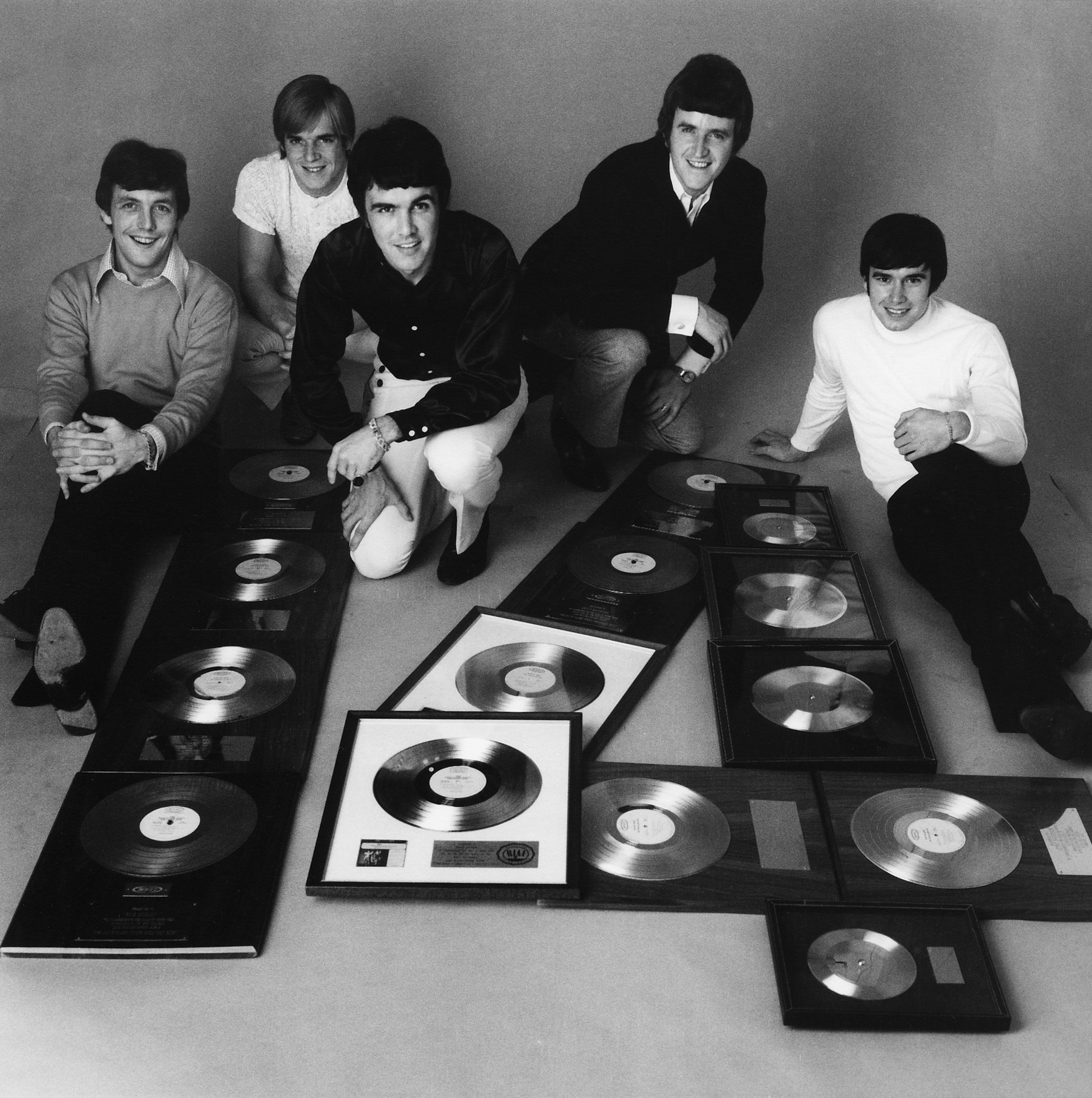
Gold discs picYou can see in the documentary that the group really seem to enjoy live performance.

Oh, we were a live band.

It was actually going out there on stage. It was wonderful! I always had to laugh or smile when you get other big names or contemporaries saying, “What was it like going out on stage?” “Oh, it’s okay”, whatever. To me, it’s like being heavyweight champion of the world for that hour or so that you’re onstage because you have to work the audience. It’s a bit like I suppose a pied piper; you bring them up and know when to bring them down and to bring them up again. It’s exciting and that comes through experience of playing the dives in the early days and getting beer cans thrown at you when you weren’t very good and then you win an audience over.  We ended up on the biggest ballroom circuit in the UK and that covered Wales, Scotland, Ireland and they used to cater for 1 million people a week, which is a lot, over 1 million people and employed over 200 bands a week and we got to the Gold cup in 1963 for being the best live band in the UK which was a great for us! It was really good!

I loved the part in the documentary about your innovative, immersive, four-dimensional production called “Time.”  How did that come about?

Originally in the 60s when the Beatles said it all with it the way we all felt; the answer really and a lot of people think it’s corny but it’s love and peace. I didn’t get into that because The Beatles did it admirably with “All you need is love” and John Lennon with “Imagine” and all those wonderful songs.  We called it a day while we were still selling millions of records.  It’s best if you can stop at the top.  And there were other things I wanted to do.

So I took off and went around the world. And I had this idea of the feeling of peace and love and that there would be another planet billions of light-years away where everything was timeless, ageless, no violence nothing and that’s how it came about. So the most important thing is to write the songs and that started and then to make sure that I wasn’t too close to it, I played it for Stevie Wonder, which it says in the documentary.  And he liked it.  I wanted to make it different. I felt that in those days theater was very straight in a way. I felt the action should be like a movie where it’s exciting and you actually make people a part of the movie so we transformed to the theater so when it like a rock concert. And when the audience got transported up into the universe.  The whole theater changed and became like a planetarium and a flying saucer came out of the air that was 50 feet wide and it exploded. I wanted to do all the things so the audience felt that they were in the movie or in the music.  The most important thing for me was I wanted a godlike figure that wasn’t necessarily God; it is what everybody believed is a loving God, your favorite uncle, giving words of wisdom. That was another high in my life, working with the great Sir Laurence Olivier.  When he spoke, there was 250 little speakers all around the theater.  It was like God, all amazing! It was all around.  And it was very, very spiritual. And to mix the two; if it had just been spiritual, you might have lost your audience but if you could mix the two and make people stop and think and they take the message in, then you’ve done your job. It’s combining the two and it was very enlightening and very rewarding I felt.

I particularly enjoyed in the documentary the scenes with you and Freddie Mercury.  It looks like you had a wonderful friendship.

Oh we did. Sadly I was the only one with him when he passed away; which is very, very sad.  He was great! He had an amazing personality. If you watch DVD 2 and you see the interview, we just hit it off and I didn’t think we would. I wanted Freddie on the album but everybody said he was a nightmare to work with. As I said, I’m a perfectionist and Freddie was, too, but it worked. When you get people like that, you give and take to get to the end result to be good; it’s not egotistical in any way. And I found him an absolute dream to work with and he was the only performer I’ve ever known that I’ve actually worked with you could go for 12 hours and he just gives you 100 percent every take.


Related Tags:


Contests and Giveaways Interview Music

Interview: Don McKellar of “The Grand Seduction”

Posted on June 10, 2014 at 11:06 am

Before we talked about his charming new film, “The Grand Seduction,” I just had to ask Don McKellar about the plans to make the sensational Broadway musical he co-wrote, “The Drowsy Chaperone,” into a film. He assured me that while he wasn’t allowed to give me any details, I would be very happy with the casting. I can’t wait.

“The Grand Seduction” is an English remake of a French Canadian film about a small harbor (that is their term for a fishing village) trying to break out of its severe economic decline after the collapse of the fishing industry. Their best hope is to persuade a recycling factory to come to their community. But they will not come unless there is a doctor. So the harbor conspires, using some blackmail and some “Truman Show”-style legerdemain, to bring a handsome young doctor (played by Taylor Kitsch) and make him think that they have everything he loves and needs — including cricket players and jazz music — in their remote location.

McKellar is a lot of fun to talk to and we discussed the challenges of making a location vivid enough to be a character in the film and taking actors from the US (Kitsch) and England (Brendan Gleeson) and making them sound like rural Canadians.

How did you do that incredible job of creating that sense of place?

That was a big, big goal of mine. I really feel that for a movie like this to be successful–and you don’t see a lot of movies like this–a social comedy set in a specific locale like that, I really felt you had to convince the audience that it was real. It was real but you really had to show the people there, show the real landscape, show the real beauty. That’s a big part of the seduction. So it was all shot on location. There is no sort of CGI-ed landscapes. There is this night shot of them running from the bar to the church and it is illuminated by the moon and reflected on the water and I remember shooting it with my Director of Photography thinking, “No one would even believe that this is possible; to illuminate the scene by the moon.” We actually lit it with the moon. That’s how clear and bright it was. Yeah, I am really proud of that. I really feel that the place is the signpost of the people.

We waited for the sunsets sometimes and panicked to get them in time but it was all real. You really can’t fake that. You can never second-guess natural beauty like that and it’s so unpredictable out there. Yeah, I’m really proud of that. And it is not hard, it is a beautiful place but still I’m glad we captured it.

You have actors from all over the world pretending to be from a very specific place and the accents are as important as the setting. How did you work on that?

You are right. It’s very distinctive. And it’s actually really hard to do and certainly out there, they are really sensitive about that and they feel that it has been butchered by some very fine actors in other films. So it was really important to me and certainly to Brendan Gleeson because it really rested on his shoulders to go for that and make it as authentic as possible.

And I am happy to say that when we screened it, the first response was, “Sir, I have never seen it done by an outsider before but you pulled it off.” Brendan as an actor was actually a plus; a lot of people would just be scared away by that but some of those actors out there in the UK love that kind of challenge; they love working on accents and getting it down. He worked really hard and hung out with the locals. Almost everyone in the cast was from there so that helped a lot but that’s pretty much the way they sound.

Often when you make a film, you have a dialect coach who sort of dictates the sound and people start imitating that and everyone sounds homogenous. One of the things that gave us a little bit of freedom is that from Harbor to Harbor people sound different. The accent has a certain constants across the province but also there is this wide variety. I kept saying to Brandon, “Sometimes a brother does not sound like a sister out here.” People are distinctive.

The music was also very well chosen.TheGrandSeductionPoster

I have to admit at first, I tried to resist it. My producer and I said, “Oh maybe we should just go with the same old Celtic thing.” You can’t fight that in a way and its part of the culture, it’s so deep. Everyone out there plays a musical instrument. It is really astonishing. There is a guy in the film, the accordion player, I found him by just saying to the cast, “Does anyone here play an accordion?” And then the locals put up their hands: “Oh, he’s good, he’s better, he is the best one.” “Okay, we’ll go with him.” It was really like that. And I remember there was sort of an amusing scene in that bar scene where Brendan is playing the fiddle. At one point my assistant director was trying to tell people how to react. Maybe this one would be interested, another would be drinking, another would get up and dance. It was sort of absurd because we were outside telling the people how to respond and then they started playing and the place came alive in a second. We don’t have to tell these people how to respond to music. It’s a big deep part of the culture so I’m really happy that we evote some of that.

How did you choose Taylor Kitsch for the role of the doctor?

I have always thought Taylor was a good actor. I thought he was really very strong in “Friday Night Lights” and I have seen him on a couple of things that showed his range, like a film called the, “Bang Bang Club” where he played a South African and I thought he was a serious actor. He is certainly capable of doing those action films but I thought they never fully exploited his skills. And one of them is his charm; which is which you know is a real rare asset in a movie star these days; they don’t make them like that anymore. I really feel he has classic movie star appeal and it was really important to me that that character had an authenticity and a heart because it sort of flips around and he ends up seducing them as much as they are seducing him and they realize they have genuine empathy for him. Somehow he’s played naïve without seeming gullible. So I think it is a really skillful performance from him actually.

This is a remake of a French language film. Did you ever see the original?

I had seen it and I admired it. I admired it sort of for its classic comedy structure but I hadn’t thought of remaking it to tell you the truth. It was the producer who asked me to do it and I was skeptical just because it is always dangerous to be remaking a successful film, it was very successful in French territories. But then the idea of Newfoundland came in and I thought, “Oh, this is about something.” This is about a real problem out there in these fishing villages that are dying and I also thought it is a beautiful place and the actors out there are brilliant so all of a sudden it came to life for me and so I was on board.

Related Tags:


Directors Interview

Interview: Fred Schepisi of “Words and Pictures”

Posted on June 3, 2014 at 8:00 am

Fred Schepisi is a soft spoken Australian director whose films include “Roxanne,” the charming update of “Cyrano de Bergerac” starring Steve Martin, and the thoughtful drama about connection and disconnection, “Six Degrees of Separation,” starring Will Smith. His new movie is an endearing romance called “Words and Pictures,” starring Clive Owen and Juliette Binoche as teachers in a posh prep school. He talked to me about the challenges of making a movie for and about grown-ups in a world of multiplex fodder and working with Binoche to bring her real-life skill as a painter to her character, an artist and art teacher.

How do you make a smart and witty grown-up romance in the middle of an audience that’s all about superheroes and explosions?

I guess that world doesn’t interest me all that much.

So it’s a challenge to get the financing?

Absolutely. You have to cobble all the money together actually. Curtis Burch did a extraordinary job on this one and in a way that most people don’t manage these days: just find of a whole group of people in Texas who are interested in quality movies and prepared to help finance it. So for once we kind of had the about half the money from private equity and that makes it easier for you to kind of look around for state rebates and what we refer to as foreign sales, you’ve got a real chance then. It was a credit to the Texas investors to go for it. I certainly hope that we will be able to reward them so they’ll keep going for it. There is a quality market out there. All across Europe there are people wanting to see good material as I think there are everywhere and the second challenge is making sure that you get it told there, get the word out there so that people begin to see quickly; which gives you the chance to last.

There are fewer and fewer outlets in terms of theatrical distribution for good material. So it’s kind of important to let the market know that’s where you are and what it’s about. And I think people are starting to discover that there is a whole generation out there that want good movies and will go out and see them.

And what was it like to work with Juliette Binoche on the art created by her character, who is struggling to adapt to physical limitations from rheumatoid arthritis?

I knew that she had painted in another film; I knew that she painted portraits. I did not know the extent of her talent and experience but I figured that if she had a love of art that would help even if she was faking; Which you know I expected we might have to do, as did the art department.

But it became clear to me very quickly that she is an extremely, diversely talented person and that it would be better if she did it all. So we decided together to go on a journey and certainly it’s very freeing that somebody’s actually painting rather than using a lot of trickery to make it look like they are. But she was prepared to go on the same journey the character has to go on, going from being a portrait painter to finding other ways of expressing herself. A few times we had to shift the schedule around as she hits certain points to give her a little more time to develop that, go further with it and get to a point where she and I both agreed that yes, this is the way to go, these are the artists who should be influencing us and then letting her find her own voice; some of which we actually did live on camera. Sometimes she would reach certain stages so then we would re-create them on camera and it was quite a journey and she was fabulous.

What was that rig that actually she took from another artist, that rig that moves the big brushes around?words-pictures-rig

We were excited about that because it was exactly right for somebody who’s got rheumatoid arthritis and can’t really hold a brush. It has no weight and just moves with the slightest touch. It’s the perfect thing to explore for that character and also an interesting way to watch somebody paint.

How do you come down between words and arts? Which side are you on on that?

Sometimes either one expresses something that the other can’t and therefore that makes it more powerful. I’m sure you know that when something is really brilliant in a particular media; whether it’s painting or whether it’s words on a page all words on stage, when it’s really brilliant it’s almost impossible to translate to the other media. It has a power of its own. But sometimes the things together have even more power and then there’s music and dance.

When you were growing up what were the movies where you said, “That’s something I’d like to do.” Did you watch a lot of Hollywood movies?

I was very lucky. Somewhere around the age of 14 or 15 I discovered what people referred to as “continental movies” as we call them in Australia. They were European and British movies. I think I went to them for more prurient reasons in the first place. What I found was these wonderful worlds I was transported to; and these wonderful ideas and that’s when I knew that’s what I would like to do.

And it was the 40’s and 50s, for me mostly it was the 50s but you were still seeing movies from the 40’s and then I belonged to film societies and used go also to what was in fact the oldest film festivals in the world, you’d see films from Japan and from Persia and from India and I was always transported about their ideas and the culture and the experience and the surprising thing for me was I always found something myself in them.

You were working with established, experienced actors and with teenagers on this film. Was that a challenge as a director?

A lot of your work is done in the casting, that’s probably the most difficult part and in a way half your job is done if you get that right. And sort of seeing if the chemistry is going to work between people and what it is that makes it work and encouraging that.

Actually all of the kids in the classrooms are from Canada. We tried not to cast the clichéd way. We used the “cultural diversity” approach and just let them be fresh, led them contribute, let them come up with the youthful way of doing thing. It was quite a lot of fun, it really was. And then we were lucky to get Christian Scheider, Roy Scheider’s son, to play Clive Allen’s son. He’s done stage things but that was his first film and he had just the right soul for the part.

What’s next for you?

I’m going to a film called “Olive Sisters,” set in Australia. It’s an Italian family who have come out and farm and grow olives and do their work and face the prejudices of people in the late 50s; prejudices about how they dressed and what the ate, and who they were. And next year, I am pretty confident we’ll be doing the film of the Broadway musical, “The Drowsy Chaperone.”

Oh, I love that show! Please promise to talk to me again when that one comes out.

Will do.

Related Tags:


Directors Interview
THE MOVIE MOM® is a registered trademark of Nell Minow. Use of the mark without express consent from Nell Minow constitutes trademark infringement and unfair competition in violation of federal and state laws. All material © Nell Minow 1995-2026, all rights reserved, and no use or republication is permitted without explicit permission. This site hosts Nell Minow’s Movie Mom® archive, with material that originally appeared on Yahoo! Movies, Beliefnet, and other sources. Much of her new material can be found at Rogerebert.com, Huffington Post, and WheretoWatch. Her books include The Movie Mom’s Guide to Family Movies and 101 Must-See Movie Moments, and she can be heard each week on radio stations across the country.

Website Designed by Max LaZebnik