
More on Scary Movies — from Christianity Today

Posted on February 24, 2009 at 8:00 am

Christianity Today asked parents what scary movies have “worked” with their kids — scared them enough to be entertaining and instructive but not too much to be truly upsetting.
I found the comments very insightful. Here are some excerpts:
I recently heard Tony Campolo speak, and he was trying to communicate to parents that “safe” is not what we are raising kids to be. Safe kids will not change the world. Instead, we want them to be wise, powerful, courageous, tenacious, furious at injustice, unprotected from reality, totally dedicated to serving Christ and his beloved people.
Pinocchio, The Wizard of Oz, Spirited Away, Mirrormask, even The Lion, The Witch, and The Wardrobe are all fine examples of scary movies for children. Because they are all steeped in the classic fairy tale tradition. These types of well-written, well-made films can provide integral lessons to youth as they journey on the scariest trip of all: the road to adulthood…”Family-friendly” need not mean “intellectually stunted.” These types of films, watched with a discerning eye, teach deep lessons.
Being scared in the moment can produce a teachable moment, but if the kid is prone to nightmares then nothing is being learned.
A little over a year ago, I wrote about why (and how) we like to be scared, and just this month we’ve had a spirited discussion about whether “Coraline” is too scary. I agree with this comment in the Christianity Today story:
Every single child is different, and the parents should know their child best. If your child is 12 and scared of things, I don’t care if a movie is rated G–if it’s going to scare your child, don’t take them. If you aren’t sure, read your child a thoughtful review of the movie and see if they even want to go. Some children of 6 aren’t scared by anything. Some children love the feeling of feeling scared; they’re aware that it’s “just” a movie.
Related Tags:


Commentary Understanding Media and Pop Culture

Coraline’s Special Effects

Posted on February 22, 2009 at 12:00 pm

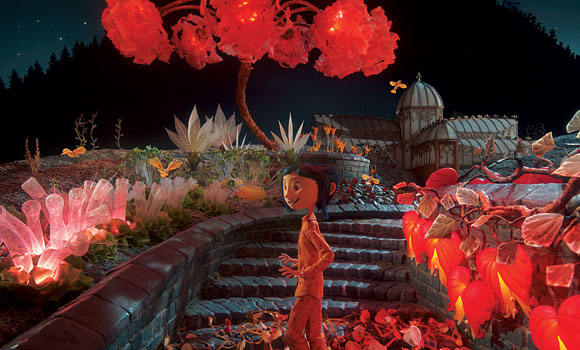
Wired Magazine has a fascinating story about the breathtaking special effects in “Coraline.” In an era when we are used to astonishingly “true” images generated by computers, the old-school charms of this stop-motion movie, where everything you see was actually there being photographed, enhanced with ground-breaking 3D technology, is entrancingly tactile. A painstaking process meant that no more than 2-4 seconds a day were completed, with thousands of tiny adjustments in each scene. The title character’s 200,000 facial expressions, required 350 top plates for her eyebrows and forehead and 700 bottom plates for her mouth.

It’s the stunningly inventive DIY visual effects that director Henry Selick (The Nightmare Before Christmas) used to bring the story to life. A quarter-million pieces of popcorn are transformed into cherry blossoms, superglue and baking soda are whipped into snow, and black fishing line becomes creepy chest hair.

coraline garden.jpg

In all, the crew hand-built 150 sets and 250 jointed puppets, as well as plants and toys with countless moving parts. “What makes this film different,” says Tom Proost, one of the art directors, “is that everything is real and everything moves.”

Every detail is brilliantly imagined and brilliantly executed. I love the way they created the steam from a tea kettle: cotton spritzed with hair spray. I’ve seen the film twice and plan to go back again just to see the extraordinary garden and theater scenes and to catch some of the many details I know I have missed.

Related Tags:


Special Effects Understanding Media and Pop Culture

Oscar Thoughts from Three Top Critics

Posted on February 22, 2009 at 9:27 am

Jeannette Catsoulis tells us the Oscars should embrace the lowbrow in Las Vegas CityLife:
tudios spend all year milking dollars from young people only to turn around at Oscar time, overcome with shame and a newly minted commitment to quality, and nominate a bunch of old-lady favorites. (Only one of this year’s nominees is even set in this century.) Am I — gasp! — arguing for award by populism? Damn right I am: If Hollywood wants support for its sickeningly expensive, annual display of onanism, it needs to be proud of what it does best. Leave the recognition of Art to the Independent Spirit Awards and the Director’s Guild and give Oscar back to the people who keep him in business: average Americans.
She makes a compelling argument that the movies overlooked by Oscar like “Dark Knight” and “Quantum of Solace” are not just bigger at the box office — they are better.
In the future, the organizers should give Tina Fey and Alec Baldwin co-hosting duties (with no restrictions on the jokes), have Matt Stone and Trey Parker write the intros, give Stan Lee as many awards as possible and invite Miley Cyrus and the Jonas clones to sing the nominated songs.
Christopher Orr also objects to stuffiness of the nominees at The New Republic, which he describes as “the mushy middle, a showcase of high-toned, politically palatable films meticulously engineered to approximate art.”
“WALL-E,” for my money the best film of the year, was relegated to the animated-film ghetto from which only “Beauty and the Beast” has ever emerged. “The Dark Knight”–which, for all its flaws, was an ambitious, fascinating work of pop mythology–will have to content itself with whatever technical awards it can scrape up. (Best Visual Effects! In your face, “Iron Man!”) And even as the Academy ignored the summer’s big mass-cultural phenomena, it simultaneously managed to skip over the fall and early winter’s quieter, more thoughtful indies–“The Wrestler,” “Rachel Getting Married,” and the bleak, bewildering “Synecdoche, New York.”
Dana Stevens in Slate finds the “aestheticization of Indian poverty unsettling” in “Slumdog Millionare” and is bothered by the “icky premise” of “The Reader.” She wistfully hopes for more “weirdness,” not just in the movies but from the actors, to make it more fun to watch.

Related Tags:


Awards

The Spirits and the Razzies

Posted on February 22, 2009 at 8:38 am

Just before the Oscars every year, two other important awards are announced. The Razzies (named for the rude noise called a “raspberry”) are given to the worst of the year from Hollywood. This year the recipients are:
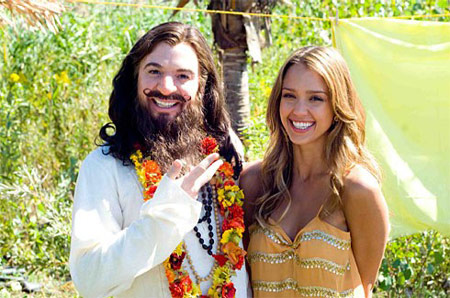
Worst Picture: The Love Guru (which I also picked as the year’s worst in my essay for Rotten Tomatoes)love guru.jpg
Worst Actor: Mike Myers in “The Love Guru”
Worst Actress: Paris Hilton “The Hottie and the Nottie”
Worst Screenplay: “The Love Guru”
Worst Supporting Actor: Pierce Brosnan in “Mamma Mia!”
Worst Supporting Actress: Paris Hilton again in “Repo! The Genetic Opera”
Worst Couple: Paris Hilton again with either Christine Lakin or Joel David Moore in “The Hottie & The Nottie”
Worst Prequel, Remake, Rip-Off, or Sequel: “Indiana Jones and the Kingdom of the Crystal Skull”
And by the way, anyone can vote on the Razzies for a modest fee.
The Spirit Awards (formerly called Independent Spirit) are given out by Film Independent, a resource group for independent film-makers. Its annual awards ceremony is broadcast on the Independent Film Channel and it is always hilarious, outrageous, and lots of fun (warning: very strong language and provocative material).
This year’s Spirit winners include:
“The Wrestler” (best feature, best actor Mickey Rourke, best cinematographer)
“Vicky Christina Barcelona” (best screenplay by Woody Allen, best supporting actress Penelope Cruz)
“Milk” (best first screenplay by Dustin Lance Black, best supporting actor James Franco)
“The Visitor” (best director Tom McCarthy)
“Synecdoche New York” (best first feature, Robert Altman ensemble award)
“The Class” (best foreign film)
“Man on Wire” (best documentary)
“Frozen River” (best actress Melissa Leo)
Membership is also available in Film Independent.
2009 Independent Spirit Awards at LocateTV.com

Related Tags:


Awards

Debate: Is ‘The Reader’ Great Art or Hackneyed Tripe?

Posted on February 22, 2009 at 8:00 am

“Don’t Give an Oscar to ‘The Reader'” is the headline of an angry Slate essay by Ron Rosenbaum, author of Explaining Hitler: The Search for the Origins of His Evil. Rosenbaum says it is “a film in which all the techniques of Hollywood are used to evoke empathy for an unrepentant mass murderer of Jews.” He argues that “This is a film whose essential metaphorical thrust is to exculpate Nazi-era Germans from knowing complicity in the Final Solution.”

I’ve argued that most of the fictionalized efforts either exhibit a false redemptiveness or an offensive sexual exploitiveness–what some critics have called “Nazi porn.” But in recent years, a new mode of misconstrual has prevailed–the desire to exculpate the German people of guilt for the crimes of the Hitler era. I spoke recently with Mark Weitzman, the head of the Simon Wiesenthal Center’s New York office, who went so far as to say that The Reader was a symptom of a kind of “Holocaust revisionism,” which used to be the euphemistic term for Holocaust denial.

SPOILER ALERT: Based on Bernhard Schlink’s best-selling The Reader, an Oprah book selection, the movie stars Kate Winslet as a German woman in the early 1950’s who has an affair with a 15-year-old boy. Years later, the boy has become a law student and he sees her in court, being tried for atrocities during the Holocaust. He discovers that she cannot read and that her humiliation and efforts to hide her ignorance
On the other side is Roger Ebert, who says “The Reader” is not a Holocaust movie; it is a movie about the consequences of not speaking up. He agrees with Rosenbaum that Winslet’s character “was responsible for inexcusable evil.” But he does not feel that the movie excuses her or redeems her in any way. He believes the movie’s point is that Michael was guilty of worse not because the consequences were as bad but because his education and circumstances gave him more of a choice.

Who committed the greater crime? Michael, obviously, although few audience members might see it that way. He was more mentally capable than she was. She is deeply, paralyzingly ashamed of her illiteracy. It has led her a lifelong neurosis. She worked for the Nazis, as many other Germans did with much less reason, or none at all. What did she go through to keep her secret? What lies did she tell, what intimacies did she betray? Has she never been able to have a relationship with a man without using sex and her greater age to prevent the man from learning of her shame? What kind of a monster was she, that she helped innocent victims to go to their deaths because of a secret that seems trivial to us?

Related Tags:


Spoiler Alert Understanding Media and Pop Culture
THE MOVIE MOM® is a registered trademark of Nell Minow. Use of the mark without express consent from Nell Minow constitutes trademark infringement and unfair competition in violation of federal and state laws. All material © Nell Minow 1995-2026, all rights reserved, and no use or republication is permitted without explicit permission. This site hosts Nell Minow’s Movie Mom® archive, with material that originally appeared on Yahoo! Movies, Beliefnet, and other sources. Much of her new material can be found at Rogerebert.com, Huffington Post, and WheretoWatch. Her books include The Movie Mom’s Guide to Family Movies and 101 Must-See Movie Moments, and she can be heard each week on radio stations across the country.

Website Designed by Max LaZebnik