
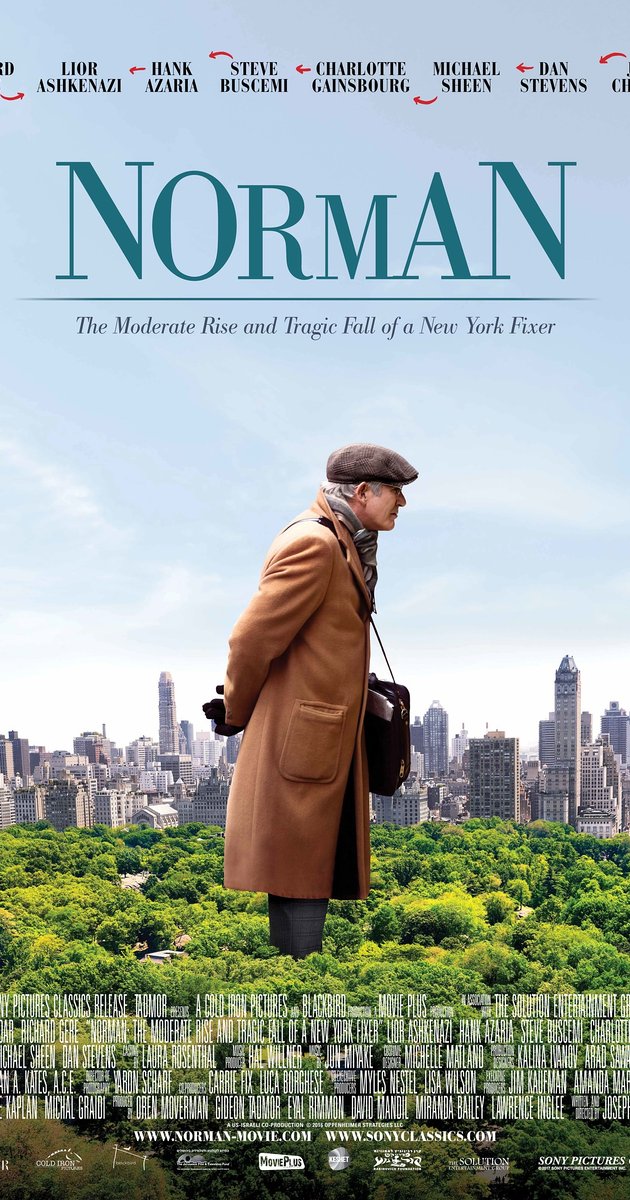
Interview: Director Joseph Cedar on “Norman”

Interview: Director Joseph Cedar on “Norman”

Posted on April 20, 2017 at 8:00 am
Copyright 2017 Sony Pictures Classics

Israeli-American Joseph Cedar wrote and directed one of my favorite movies, the Oscar-nominated Beaufort, and I am a fan of his film “Footnote” as well. Both are in Hebrew. So it was a great pleasure to talk to him about his first English language film, “Norman,” starring Richard Gere and Steve Buscemi. Gere plays the title character, a schmoozer and small-time wheeler-dealer who gets caught up in international politics when he befriends an Israeli government official who ends up as Prime Minister.

Who casts Richard Gere as a shlub?

I think it’s the ultimate challenge. I like it when actors act. It’s gratifying to see an actor do something that is very far from who he is or how we perceive him in other films, his persona. It’s also gratifying to see an actor do something that is genuinely difficult that other people can’t do. And I found that in what Richard was doing, it’s like watching a circus act. It’s was remarkable for me in every scene to see him just be someone he’s not.

The hair really helps create his character, very different from the more glamorous image we have.

We did something with this whole physical appearance which is subtle but changes the way he looks to an audience. More importantly, it changes the way he looks to himself. He’d come out of makeup and wardrobe and look in the mirror and he wasn’t seeing the Richard Gere he is used to seeing on a movie set. That is helpful to create a body language that was different and specific for Norman. And this made it possible for him to do things that he doesn’t normally do in movies. So we did play around a little bit with his physicality.

It was almost as surprising to see Steve Buscemi as a rabbi.

That’s less of a stretch in my mind, I think Steve Buscemi would make a great Upper West Side rabbi. He’s a New Yorker and that is in itself most of the research but I did introduce him to a rabbi and I think it was more for Steve to feel comfortable not trying to be something that’s exotic. I introduced him to someone who gave him license to basically be himself. The character he plays was something we discussed like I would discuss the character with any actor but it was more about the circumstance that he is in, the financial situation his synagogue is in and just how communities are organized at least in New York. Those were the things that we spoke about. I thought it was interesting for him and for me to be a big part of where Norman sits in the grand scheme and the big deal that he is putting together.

It seems to me that one thing that makes it possible for Norman to succeed as much as he does is that he has no social shame. Most of us would cringe at making ourselves vulnerable to so much rejection.

What’s odd about what you just said is that in a different context someone who is shameless is considered a negative thing but I think it’s actually a really positive quality not to have pride or to be willing to take humiliation. It’s something that most of us aren’t willing to do and many times we rely on other people not having those inhibitions, those blocks that we put on ourselves.

I have to really not look at Norman from the outside but be in Norman’s shoes. Norman isn’t aware that he’s doing something that is humiliating. He sees his goals and obviously he is doing things that most people won’t do to achieve that goal but he has his way of denying the insult when it happens. He thanks most people after they push him away. It’s part of what allows him to do what he does and it’s his survival tool, not really being aware of how other people see him.

I think the point for me in just figuring him out is just realizing that it’s not really humiliating, wanting something and being willing to do everything including doing every once in a while a conniving trick if it’s serving something that he thinks is good, then I respect that. The world needs people who are willing to do what Norman does.

Could Norman tell you exactly what he wants? A specific policy goal or project or just being a part of things?

Is it self-serving or is it a mixture of wanting some influence or having a position or having access to something that is good for Norman — but isn’t there also always something else or there might be something else that can be a result of that that is good?

I think it generally starts out that way but then it can get lost. Look at your Prime Minister character, Eshel. He begins as somebody who says, “No I couldn’t let you buy me these very expensive shoes,” and he ends up as somebody who has to do a lot of compromising.

Copyright 2017 Sony Pictures Classics

What happens in that scene from my point of view is morally challenging. If I put myself in both these characters’ places, I don’t think I would accept a $1200 gift from someone I just met and I probably wouldn’t give a gift that is so expensive to someone I just met. So there’s something that feels wrong about the whole encounter and what makes it happen is that both sides convinced themselves that it’s okay. Eshel’s character convinces himself that by accepting the gift he is actually already returning the favor and that he is in a way giving Norman some sense of being part of an important mission or something bigger than himself by offering him a representative in this case of Israeli government, by offering him something that would make them feel more comfortable or feel better about himself. Norman is seeing this as an investment that will help him forward other initiatives that he has been trying to do and has not been successful. It’s a risky investment because Eshel may never call back or may never deliver or may never turn into someone who actually has power, but it’s worth it to him on instinct. He feels that this can work because he really needs to take every opportunity he can to get in. To have a foot in the door.

But that brings us to his downfall. Because he has that strategy or that impulse to take every possible advantage he gets into a conversation on a train that turns out to be kind of disastrous to him because it’s too revealing.

I agree with you in calling it an impulse, it’s not really something he can control, it’s what he does, it’s who he is, it’s an expression of his deepest core. He can’t hold back.

Norman does what he does on instinct. He is wired this way and it’s a survival thing more than a planned-out business scheme. It’s just how he survives. It’s his function in the world.

You live in both the US and Israel. We seem to be in a uniquely tumultuous moment. What comfort do you think people can take from watching this movie?

Hopefully there’s a lot of comfort to take from watching this movie but none of it should affect their mood about what’s happening in America. If anything the times we’re living are times that call for action. We shouldn’t take things for granted and we should try to influence our surrounding.

Related Tags:


Directors Interview Writers

New Documentary: BANG! The Bert Berns Story

Posted on April 19, 2017 at 3:23 pm

If you like behind-the-scenes-of-the-hits films like “20 Feet from Stardom,” “Muscle Shoals,” and “The Wrecking Crew,” you will enjoy “BANG! The Bert Berns Story.” Like “Wrecking Crew,” this is a love letter from a son to his father. You have not heard the name Bert Berns, but you have heard — and I am sure, you have sung — the songs he wrote or produced include “Twist and Shout,” “Brown Eyed Girl,” Janis Joplin’s “Piece of My Heart,” “Hang on Sloopy,” “I Want Candy,” “My Boyfriend’s Back,” “Under the Boardwalk,” and many, many more.

Berns had a weak heart, the result of rheumatic fever. He knew his time was limited. And so he lived hard and fast, to get everything he could in the time he had. As a young man, he fell in love with mambo and the Latin rhythms that were popular at his local dance clubs. He brought some of that sound to the early days of rock music, creating hit after hit as songwriter and producer, working with some of the biggest stars in the business, helping many of them get there.

The film has some great interviews and details, especially some unexpected anecdotes from Berns’ best pal from the mob, who stepped in “Godfather”-style to help out now and then, dragging one singer from his sister’s funeral to make sure he didn’t miss a recording date. There are stories of rising and falling, business partnerships and betrayals, and Bert’s romance with a tough cookie of a blonde go-go dancer who became his wife. Great characters, great music — and a lot of fun to watch.

Related Tags:


Documentary Movies for Grown-Ups Music

Why Do Mega-Budget Movie Directors Make Small Films About Kids?

Posted on April 19, 2017 at 8:00 am

On Vulture, Kyle Buchanan has a fascinating column about three directors who took time off between blockbusters to make remarkably similar small budget films about gifted kids and their single parents. It is well worth reading in full.

Take “Gifted,” this week’s dramedy about a precocious child and the overwhelmed uncle (Chris Evans) who serves as her single parent. It’s directed by Marc Webb, who made the last two Amazing Spider-Man movies, but it’s not to be confused with June’s The Book of Henry, about another child genius and his single parent (Naomi Watts), which director Colin Trevorrow squeezed in between “Jurassic World” and his upcoming production of “Star Wars: Episode IX.” With his schedule so packed, Trevorrow had to abdicate the director’s chair on Jurassic World 2, a gig that went to spectacle-seller Juan Antonio Bayona … who just released his own precocious-child/single-parent movie, “A Monster Calls,” this past December….What’s prompting these similar small movies? To some degree, I expect the directors are treating them as penance: After you’ve neglected your family to fly around the world working on a giant blockbuster, what better way to work out your issues than with a film about a distracted parent reconnecting with a special child? That’s part of the reason that after directing two Iron Man movies, Jon Favreau made the much smaller Chef, where he stars as a single father who quits his fancy restaurant job to start paying attention to his precocious preteen. At the end of their cross-country adventure together, Favreau’s character goes back into the restaurant business a better man who’s informed by the time he’s spent with his son; so, too, has Favreau returned to tentpole filmmaking after his gap-year movie, only now he’s directing films like The Jungle Book and The Lion King that are explicitly made for families.

But I suspect there’s more to this trend than just personal catharsis. For as much as these directors think they’re trading one mode of filmmaking for another, in a way, they’re just toggling between two influential blockbusters: Instead of making Star Wars (literally, in Trevorrow’s case), they’re making E.T.

Related Tags:


Directors Understanding Media and Pop Culture

Fast and Furious and Movie Car Chases

Posted on April 17, 2017 at 3:35 pm

The release of the eighth “Fast and Furious” movie inspired Business Insider to come up with a list of the all-time greatest movie car chases. Some of my favorites are on the list, including the early Steven Spielberg movie, “Duel,” “Smokey and the Bandit,” “Drive,” “The French Connection,” “Bullitt,” and “Mad Max: Fury Road,” but I’d add “Children of Man.” And “Transporter” is still my favorite:

https://www.youtube.com/watch?v=6xewS5I4Eho

On the other hand, Matt Singer says that movie car chases have gone, well, downhill.

These days a really good car chase is almost as rare as a Talbot Lago Grand Sport. Even the films that routinely feature car action, like the Fast and Furious series, focus much more on outlandish CGI effects (like cars fighting with tanks or falling from the sky and jumping between skyscrapers) than one car pursuing another.

That’s the biggest reason the car chase has fallen from grace, particularly in Hollywood. The studio franchise economy in 2017 is predicated almost entirely on the supernatural, the superheroic, and the fantastic, all of which are created by computers. Great car chases, in contrast, are created by real people doing real things with real cars. Big Hollywood movies these days aren’t about real people; they’re about aliens and mutants and transforming robots and boss babies and super soldiers and Vin Diesel as an immortal warlock with earthquake powers.

He gives a bad example: “From Paris With Love.” (I agree — awful movie.) He says:

It’s nonstop cutaways to multiple close-ups, multiple angles of cars spinning, cameras spinning, and the shots are all fractions of a second. Modern taste for chaotic, hyperkinetic editing does not jive with car chases. Even if there was impressive driving going on here, you can’t tell. If you can’t tell what’s going on, it’s hard to care about what’s going on….The imperfections in The French Connection remind us that what Popeye Doyle’s doing in that chase is incredibly difficult. His car is bound by the rules of physics, which will only bend so far. Superhero and fantasy movies are about effortlessly breaking those same rules. And if you can break the rules effortlessly, why bother doing it the hard way?

For more on the cars in “Fate of the Furious,” including the Lamborghini with no snow tires being chased by a submarine over the ice, check out this article from the Florida Times-Union and IndieWire’s piece on the crazy self-driving car pile-up in New York City.

Related Tags:


Behind the Scenes Film History For Your Netflix Queue Movie History

Movies for Easter

Posted on April 16, 2017 at 8:22 am

My gallery of Easter movies includes “Ben Hur,” several different movie versions of the life of Jesus, a couple of choices just for kids, and a classic musical named for a classic song, Irving Berlin’s “Easter Parade.” There’s something for every family celebrating this weekend.

Related Tags:


For Your Netflix Queue Holidays Spiritual films
THE MOVIE MOM® is a registered trademark of Nell Minow. Use of the mark without express consent from Nell Minow constitutes trademark infringement and unfair competition in violation of federal and state laws. All material © Nell Minow 1995-2026, all rights reserved, and no use or republication is permitted without explicit permission. This site hosts Nell Minow’s Movie Mom® archive, with material that originally appeared on Yahoo! Movies, Beliefnet, and other sources. Much of her new material can be found at Rogerebert.com, Huffington Post, and WheretoWatch. Her books include The Movie Mom’s Guide to Family Movies and 101 Must-See Movie Moments, and she can be heard each week on radio stations across the country.

Website Designed by Max LaZebnik