
Interview: David Magee of “Life of Pi”
Posted on November 19, 2012 at 3:48 pm
Screenwriter David Magee met with a group of journalists to talk about “Life of Pi.” He told us that as a not very successful actor, he enjoyed doing audio books. One day he would do the full book and the next, the abridged version. “I came in the next day and said, ‘This is terrible. I’m sorry, but it’s really terrible what you’re doing to this author’s book, I feel bad reading this. I mean, I could do better than this,’ and the producer said, ‘Well, would you like to try? I mean, we need abridgers all the time.’ I asked how much it paid, and it was not a lot but it was enough, and so I jumped at the chance to do it because I could abridge books anywhere, any time. I could be in a theater in Utah and abridging in my apartment while I did a show there. Over the course of about five years I did over 80 novels in non-fiction and all sorts of books, and the process is taking a book that is anywhere from 105,000 to 200,000 words and cutting it down to 29,500 words. By the time I was done I had gotten very good at selecting the essential things for this story, focusing on the dialogue and the action, pairing away the room description; you know, there are a lot of wonderful scenes in books that describe the paintings on the wall and the feeling when you look out the window—there’s no time for that in an abridgment, and in a film, that’s the set job, it’s not your job. So, it actually was very natural training for me to get into this.”
He spoke about the classical stories of survival at sea. “I went back and read Moby Dick and I read back and I read the James Joyce’s Ulysses, which is very different, but I was looking for the spiritual journey. So I was trying to find, and in early version that no one saw, I was sticking in lines from Joyce’s stuff and trying them on Ang Lee…I really, very much took those to heart Moby Dick and Ulysses and Noah, obviously, that was very much apart of it. There’s also obviously Job in his trials and ordeals, and ‘God, why hast thou forsaken me’ and all of that, comes into that storm sequence. When we first started working, we talked big picture. What were we trying to say, how were we trying to combine these characters? And so I spent a lot of the early days just typing up notes about different religious traditions. We did some research, I tried to listen to some tapes on different religions…a lot of it was absorbing that world. And then when we actually went off and wrote it, you know, it was not so much about making sure that every reference was put in, it was trying to find ways to bring action and bring life to what was happening in the scenes.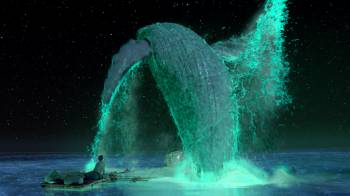
I worked very closely with Ang. Once we decided we were going to do this, I would go away for a week or maybe two and I would type up notes on the project ideas, do some research, pull together different things, and then I’d send it over to him, he’d read it, we’d meet for lunch down in China town, I’d eat very well, and we’d start a discussion: ‘Yes, I like this one…but think more about this, David, think more about: what can we do in this scene? Maybe we should try this part of the structure idea that you had, but let’s keep this open for now.’ There was a lot of back and forth, so it became an extended conversation. I’d then go back home, I’d type more notes, I’d send them back, that would get us a little further down the field. So it was continued that way throughout the research period.” He contacted Stephen Callahan who wrote The Book of Drift, which was about his true-life experience of being adrift at sea for 69 days. “It turned out he lived in Maine. Ang and I went up there and met with him and talked about how that changes the way you feel about life, how that affects you physically, all of those things. Stephen actually became our survival consultant for the film. He ended up being a major part of the film. He took us out on a boat, originally Ang wanted to have him leave us out on the ocean for ‘a few hours,’ he said, so we would experience what it was like–and I’d pull Stephen aside and thank him not to do that. So he went with us, but he did take the sail down and we bounced around in the water for quite a while, it was like being in a washing machine.” Magee and Lee also went to India together “and at some point while I was on the journey with him in India he said something about this being an adult telling an adventure story that he would tell to kids. And I thought ‘that’s the right tone, that’s kind of what we’re looking for—it’s not a kid’s story, it’s not an adult’s story, but it’s an adult telling a story where he wants you to lean forward and go, And then this happened…’ and that clicked with me. I understood what he meant and I started writing that and went into a draft.”
I asked him about the island, which is one of my favorite scenes in the book and the movie. “The way I saw the island…first of all, in the whole of the film, you could take things allegorically obviously, but you can also take them as ‘No, it really happened to me, why are you doubting me?’ which is what Pi essentially says at the end. ‘This is just what happened.’ And so I don’t want to take away from the possibility that this was ‘just what happened.’ Our goal in writing the film the way we did was to make sure that you could read the story or stories in any way you wanted to, and it would be more of a reflection on your own belief system at the end. But if you want to talk about the island allegorically, this is my interpretation of the island and I would say this is the film’s interpretation of the island — it is a place that is nurturing and bountiful by day, it giveth, and at night it’s a place of devouring and consuming and danger, at night, taketh away. Sometimes we call it ‘the Godhead island’ because Pi’s journey, over the course of the film, is to have his presumptions stripped away, his comforts stripped away and ultimately to reach a point where he’s at death, and then he finds himself on that island and comes to know something about the nature of his relationship to God, and that island saves him, and as he says at the end, but that island also pushes him onward on his journey. Rather than resting, which would be essentially death, it forces him to return to society.
He also spoke about the challenge of adapting such an internal book to film. “Sometimes I think when people talk about this book being difficult to film, they were referring just to the fact that it was tremendously difficult to put a boy and a tiger on a boat together without one of them eating the other, but sometimes I think it has as much to do with the structure of the book and the fact that it moves back and forth in time and that it involves several different Pis along the way. We had to make a choice early on whether or not we were going to use the older Pi and the writer at all. We could have framed the film using the story of Pi meeting the investigators in the hospital as the entire frame, and we considered that. Having tried a hundred different ways, because we really did, the reason we ultimately decided to have the writer and Pi as the framing device, this is a story, ultimately, about story-telling, and we wanted the writer to take the story with him, and that passing on of the story was important to us thematically, not just from a framing-device sense. Also if you just tell that third act from the boy’s point of few, it’s told in extremis, it’s told emotionally, not as a grand tale, not reflectively; which, we wanted this to be the kind of big story that, you know, I’m passing this onto you…it gives it a larger scope to say ‘I’m reflecting back now, and I’m telling you the way I felt when I was there. This was how I experienced it, this was the journey and then this is what happened.’ There are all sorts of rules for screenwriting, and they’re generally there for good reasons, and those reasons are that people who’ve tried something different and it falls on its face, and so you want to pay very close attention to those rules, but by the same token, the rules didn’t come before the screenplays were first written, the rules came in response to the fact that people had tried things and they hadn’t worked out, so…they’re not like building codes that you have to follow. They’re warnings, that if you don’t follow them, you have to really think hard about how to do it, and that was a choice that we had to make from the moment that we decided to use that as a framing device.”
And he spoke to us about moments of surrender. “When Pi says, ‘I surrender to you, God, let me know what comes, I want to know what comes,’ he is surrendering on a very surface level but he’s not surrendering his beliefs, he’s not surrendering his belongings…he thinks he’s letting go and he is turning and saying, “What will come, will come,” which is, on a surface level. If he had not made that, I don’t think he would ever have learned to train the tiger. But having mastered the tiger, he has to make a greater, a deeper kind of surrender, he has to essentially, be stripped of everything and find himself reaching that island. So I think that the ultimate moment of surrender is when just before he reaches that island, when he says, he comes to term with the tigers.”


