
Behind the Scenes: Voices of Toy Story 4
Posted on June 15, 2019 at 10:06 pm
It’s a lot of fun to see the voice actors working with the director to create their characters.
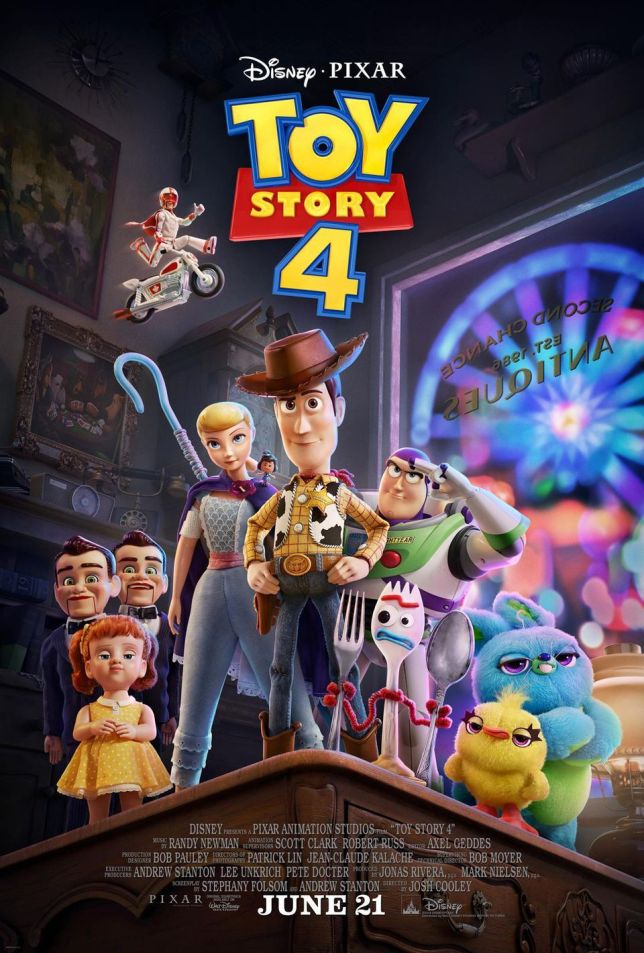
Posted on June 15, 2019 at 10:06 pm
It’s a lot of fun to see the voice actors working with the director to create their characters.
Posted on June 13, 2019 at 11:16 am
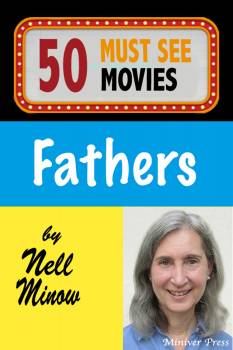
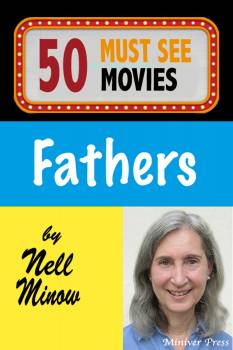
In honor of Father’s Day, my eBook, 50 Must-See Movies: Fathers
 What do “Wall Street” and the “Star Wars” saga and, seemingly, about half the movies ever made have in common? They are about fathers. In “Wall Street,” Charlie Sheen plays the ambitious Bud, who respects the integrity of his blue-collar father, played by his real-life father, Martin Sheen. But Bud is dazzled by the money and power and energy of Gordon Gekko (Michael Douglas). The movie will up the ante with Bud’s father’s heart attack as we see him struggle between the examples and guidance of these two male role models.
In “Star Wars,” Luke (Mark Hamill) does not know until halfway through the original trilogy that (spoiler alert) the evil Darth Vader is his father. He was raised by his aunt and uncle, who are killed very early in the first film, but the father figures who are most meaningful in his life are the Jedi masters Obi-Wan Kenobi and Yoda. Like Bud in “Wall Street,” Luke must choose between the good and bad father figures. Like Luke, Harry Potter is raised by an aunt and uncle, but he finds a true father figure later. For Harry, it is headmaster Albus Dumbledore. In opposition is He Who Must Not Be Named. Like Luke, Harry has the opportunity for great power on the dark side, but he lives up to the example set for him by Dumbledore.
The first stories ever recorded are about fathers. The central human struggle to reconcile the need for a father’s approval and the need to out-do him is reflected in the “hero of a thousand faces” myths that occur in every culture. In Greek mythology, Zeus is the son of a god who swallowed his children to prevent them from besting him. Zeus, hidden by his mother, grows up to defeat his father and become the king of the gods. Ancient Greece also produced the story of Oedipus, who killed his father and married his mother, and The Odyssey, whose narrator tells us “it is a wise man who knows his own father.”
These themes continue to be reflected in contemporary storytelling, including films that explore every aspect of the relationship between fathers and their children. There are kind, understanding fathers whose guidance and example is foundation for the way their children see the world. There are cruel, withholding fathers who leave scars and pain that their children spend the rest of their lives trying to heal. There are movies that reflect the off-screen real-life father-child relationships. Martin Sheen not only played his son’s father in “Wall Street;” he played the father of his other son, Emilio Estevez, in “The Way,” which was written and directed by Estevez, and which is about a father’s loss of his son. Will Smith has appeared with his son Jaden in “The Pursuit of Happyness” and “After Earth.” John Mills appeared with his daughter Hayley in “Tiger Bay,” “The Truth About Spring,” and “The Chalk Garden.” Ryan and Tatum O’Neill memorably appeared together in “Paper Moon.” Jane Fonda produced and starred in “On Golden Pond” and cast her father Henry as the estranged father of her character. Jon Voight played the father of his real-life daughter Angelina Jolie in “Tomb Raider.” And Mario Van Peebles, whose father cast him as the younger version of the character he played in “Sweet Sweetback’s Badasssss Song” made a movie about the making of that film when he grew up. It is called “Badasssss!” In the role of Melvin Van Peebles he cast himself.
Director John Huston deserves some sort of “Father’s Day” award. He directed both his father and his daughter in Oscar-winning performances, Walter Huston in “The Treasure of the Sierra Madre” and Anjelica Huston in “Prizzi’s Honor.”
Some actors known for very non-paternal roles have delivered very touching performances as fathers. Edward G. Robinson is best remembered for playing tough guys, but in “Our Vines Have Tender Grapes” he gave a beautiful performance as a farmer who loves his daughter (Margaret O’Brien) deeply. Cary Grant, known for sophisticated romance, played loving – if often frustrated — fathers in “Houseboat” and “Room for One More.” “Batman” and “Beetlejuice” star Michael Keaton was also “Mr. Mom.” Comedian Albert Brooks is a devoted father in “Finding Nemo” and “Finding Dory.”
There are memorable movie fathers in comedies (“Austin Powers,” “A Christmas Story”) and dramas (“To Kill a Mockingbird,” “Boyz N the Hood”), in classics (“Gone With the Wind”), documentaries (“Chimpanzee,” “The Other F Word”), and animation (“The Lion King,” “The Incredibles”). There are great fathers (“Andy Hardy”) and terrible fathers (“The Shining”). There are fathers who take care of us (“John Q”) and fathers we have to take care of (“I Never Sang for My Father”). All of them are ways to try to understand, to reconcile, and to pay tribute to the men who, for better or worse, set our first example of how to decide who we are and what we will mean in the world.
Posted on June 6, 2019 at 5:01 pm
B +| Lowest Recommended Age: | High School |
| MPAA Rating: | Rated R for language throughout and some sexual references |
| Profanity: | Very strong language |
| Alcohol/ Drugs: | Smoking, social drinking |
| Violence/ Scariness: | Reference to deaths of parent and co-worker, tense confrontations |
| Diversity Issues: | A theme of the movie |
| Date Released to Theaters: | June 7, 2019 |
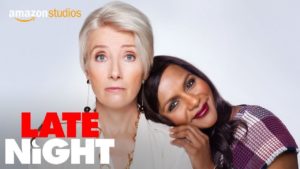
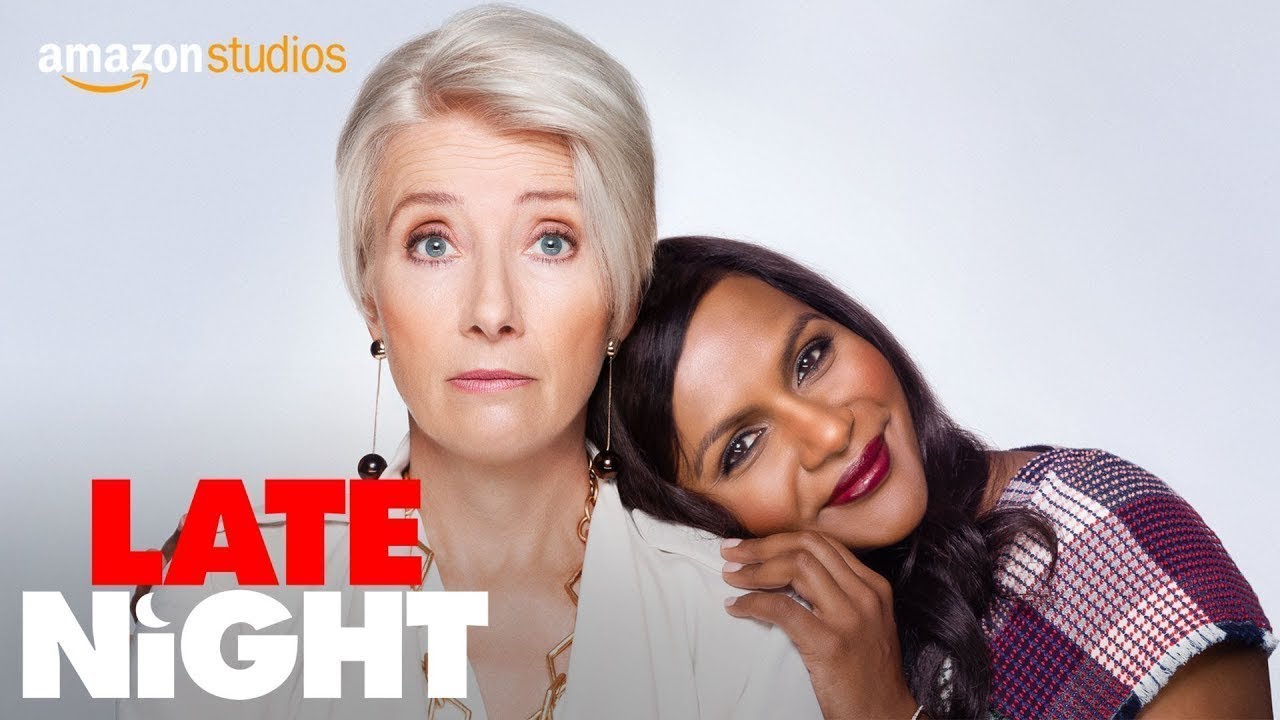
Kaling plays Molly, a quality control specialist in a chemical plant who gets a one in a million shot at the job by winning an essay competition. Katherine (Thompson) has just imperiously ordered her long-suffering producer (Denis O’Hare) to add a woman to the all-male, all-white writing staff, so he gives Molly a chance. What the writers do not know is that the new head of the network (Amy Ryan), who likes to talk about “four-quadrant” audiences (males and females over and under 25 years old) and ROI (return on investment), thinks Katherine, despite her multiple Emmys and other awards, has become out of date and out of touch with her audience. Ratings are down, and Katherine is unlikely to boost them as long as she insists on having guests like Senator Diane Feinstein and historian Doris Kearns Goodwin.
Katherine demands “excellence” from everyone around her, and that means total dedication. Her manner is abrupt and imperious and she fires staff like she’s the Queen of Hearts calling “Off with their heads!” She refuses to capitulate to what she considers the dumbing down of the media (and the world). When her producer persuades her to have a viral YouTube star who makes videos of her sniffing her dog’s butt on the show, the withering contempt she cannot hide alienates her shrinking audience further. She is pushed onto social media, but her first joke about Twitter bombs, perhaps because she calls it “Twittah” but also because she has not taken the time to understand what it is.
There are just two things she cares about, her husband (John Lithgow), who is in the early stages of Parkinson’s Disease, and her show. Both are being taken from her, and she does not have the resources to respond.
Katherine literally does not know the names of her writers, many of whom have never even met her. She has no interest in learning their names, and when she finally sits down in the writers’ room, she assigns them all numbers.
Kaling, who was both writer and actress on the US version of “The Office,” has a good feeling for the “He Man Women Haters”-Our Gang-style dynamics of the all-male writer’s room. They are so used to having no women around that they use the ladies’ room. And her being there doesn’t stop them. At first, she brings her quality control perspective, analyzing what’s missing from the show, until one of the writers gives her some good advice: write something.
Kaling has said that (until “Wrinkle in Time”) every part she has had is one she has had to create for herself. Her strength as a writer is giving us characters who are three-dimensional, vivid, and smart. Both Molly and Katherine filter Kaling’s experiences and perspective in writing for television, the relentlessness of sifting through jokes to put together a polished monologue of perfectly crafted comedy only to have to start over again the next day, the treacherous balancing act between giving enough of yourself to connect with the audience while keeping enough private to keep your sanity and sustain relationships, the even more treacherous challenge of staying on top while people who are every bit as ambitious try to topple you.
She shortchanges Molly a bit here, particularly when she lets herself get hurt by someone her character would be instantly wary of. We get the sense that it is the Katherine character who interests her more, and it gives Thompson one of her all-time best roles. In the first half, she effortlessly tosses off Katherine’s most devastating take-downs, a woman who insists on excellence in a world that does not seem to want it. But in the second half, when Katherine has to be unsure and vulnerable, Thompson gives a performance of exquisite depth and precision. “I hope I have earned the privilege of your time,” Katherine tells her audience. Kaling and Thompson make the privilege ours.
Parents should know that this film includes substantial strong language, sexual references, some potty humor, smoking, and infidelity.
Family discussion: Would you have hired Molly? Why didn’t Katherine change sooner? What was Katherine’s funniest joke?
If you like this, try: “Dancing in September” and “The Mindy Project” and “Larry Sanders Show” television series
Posted on May 30, 2019 at 12:11 pm
“Godzilla: King of the Monsters” opens this week, so it’s time for a look back.
Godzilla, known as Gojira first appeared in a Japanese film in 1954. The film was recut for US release, retitled “Godzilla: King of the Monsters,” with scenes of “Perry Mason” star Raymond Burr added in. It was inspired in part by King Kong and in part by the shock of the atomic age. Godzilla is such a, well, towering figure in world culture that the name has been adapted for terms like Bridezilla.
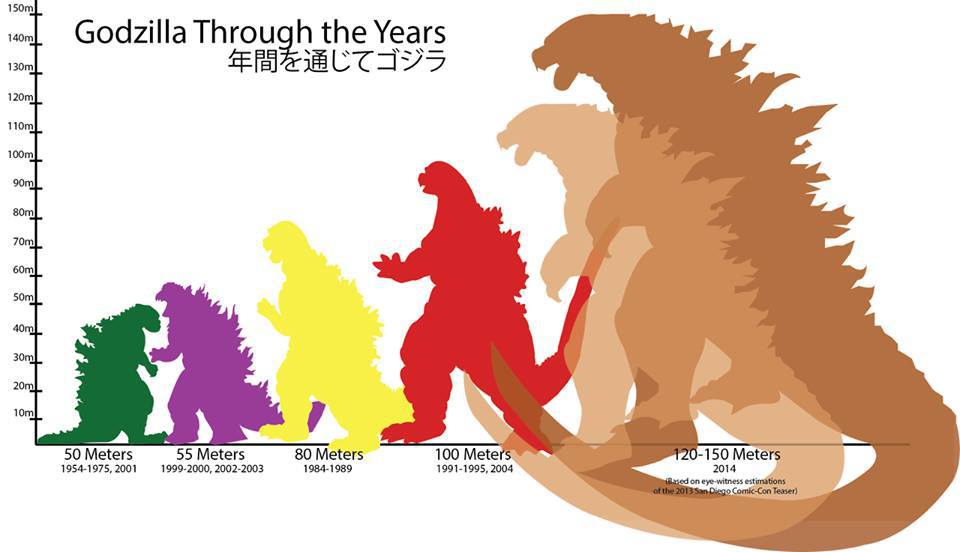
Godzilla can stomp on skyscrapers. He has grown a lot through the years.
Here’s some history:

And then there is the gigantic insect goddess Mothra.
And the flying monster Rodan.
And the three-headed lightning-spitting dragon Ghidorah.
American-made versions of the Godzilla story include the 2014 version with Bryan Cranston and Juliette Binoche, which was pretty good and the Matthew Broderick version of 1992, which has a truly dumb ending.
For more information: David Kalat’s comprehensive history and Memories from Monster Island by Travis Kirkland and Luca Saitta.
Posted on May 28, 2019 at 9:43 pm
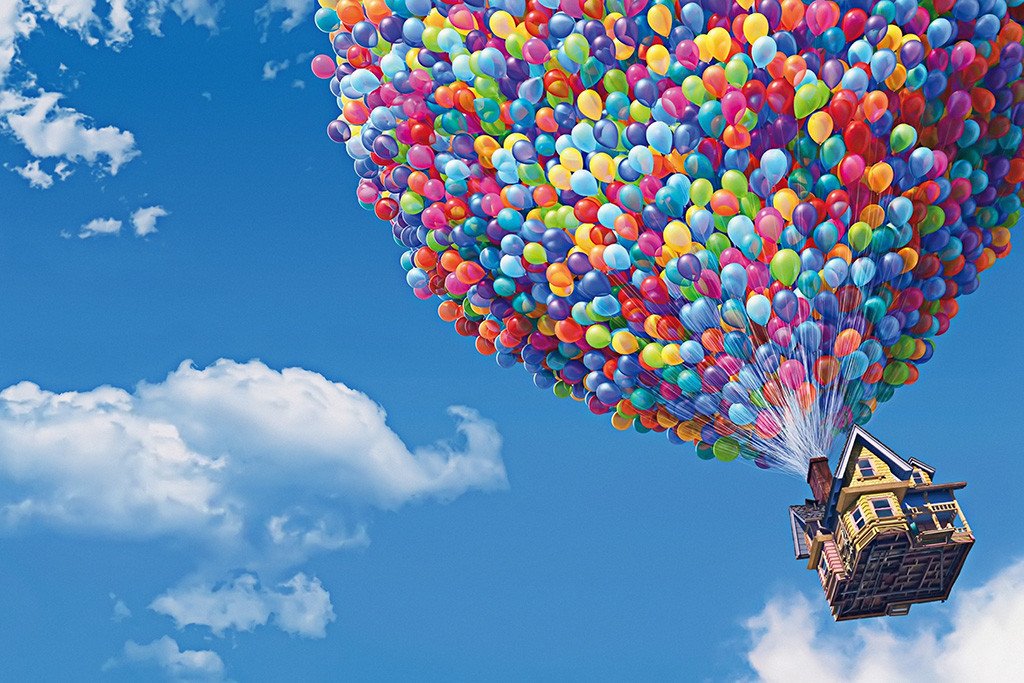
I well remember crying in the first surprisingly heartbreaking — and wordless — moments of Pixar’s “Up.” Here director Pete Docter, now co-head of Pixar, talks about creating that scene and how it evolved from the original idea. Rotten Tomatoes is celebrating its 21st anniversary by paying tribute to 21 unforgettable moments in the last 21 years. This is certainly one of them and I can’t wait to see what’s next.