What is ‘Real’ About Reality TV?

What is ‘Real’ About Reality TV?

Posted on May 12, 2011 at 8:00 am

Kelefa Sanneh has a thoughtful essay in the New Yorker about “reality television,” how it developed, why it fascinates us, and how “real” it really is.  From the Loud family to “Jersey Shore,” they are based on the idea of peeking into the lives of real people in their homes and with their friends and families or putting them in highly artificial situations to see how they react.  Whether a “glamorous competition” or a “homely documentary,” “reality shows still provide a fat target for anyone seeking symptoms or causes of American idiocy; the popularity of unscripted programming has had the unexpected effect of ennobling its scripted counterpart.”

Sanneh discusses serious, even scholarly books about reality television.  Jennifer L. Pozner in Reality Bites Back: The Troubling Truth About Guilty Pleasure TV says that while they may appear to portray extremes and transgressive behavior, reality shows reinforce particular social norms.  The greedy are punished.  The deserving are rewarded.  The lost are found and the lesser are made more.  Sanneh finds some of this analysis reductive, noting that “one of the form’s greatest strengths” is that its stars “unlike their scripted counterparts, outlive their shows, and sometimes find ways to defy them.”

Perhaps because it is more focused, Makeover TV: Selfhood, Citizenship, and Celebrity by Brenda R. Weber, a professor of gender studies at Indiana University, is better able to support its conclusions.
Weber sees in these makeover programs a strange new world—or, more accurately, a strange new nation, one where citizenship is available only to those who have made the transition “from Before to After.” Weber notices that, on scripted television, makeovers are usually revealed to be temporary or unnecessary: “characters often learn that though a makeover is nice, they were really just fine in their Before states.” On reality television, by contrast, makeovers are urgent and permanent; “the After-body, narratively speaking, stands as the moment of greatest authenticity.” We have moved from the regressive logic of the sitcom, in which nothing really happens, to the recursive logic of the police procedural, in which the same thing keeps happening—the same detectives, solving and re-solving the same crimes.

Of course there is no such thing as “reality” television.  The camera angles, the selection of shots, the music, the pacing all influence our reaction as audience members.  And the Heisenberg principle states that molecules behave differently when they are observed.  So do people.  The people who are supposed to be so ordinary, so “real” become celebrities.  “Jersey Shore’s” Snooki, whose primary occupations seem to be drinking and tanning, was in the headlines for getting a higher speaker’s fee for a recent college appearance than the distinguished poet Maya Angelou.  This was shortly after Snooki was in the headlines for being in a brawl.  Kate Gosselin went from being just another mom with a few more kids than most to getting Jennifer Aniston-style coverage when her marriage broke up (for reasons not unrelated to the intense media pressure and shock of “stardom”).  The smart and lucky ones get book deals and product lines.  Others do not do as well.  That is one part of reality television that is really real.

Related Tags:


Television Understanding Media and Pop Culture

Scholastic is Selling Coal Power — to Children

Posted on May 11, 2011 at 2:34 pm

The Campaign for a Commercial-Free Childhood reports that esteemed publisher Scholastic is sending out “teaching materials” to schools that amounts to a commercial for coal power.  The coal industry, through the American Coal Foundation, has hired Scholastic to produce The United States of Energy, sent to tens of thousands of 4th grade classrooms around the country.  CCFC says:

Teachers are told that the curriculum aligns with national standards because it teaches children the advantages and disadvantages of different types of energy.  But while the lessons do extol the advantages of coal, they fail to mention a single disadvantage.  Nothing about the Appalachian mountains chopped down to get at coal seams.  Nothing about the poisons released when coal is burned.  Nothing about the fact that burning coal is the single biggest contributor to human-created greenhouse gases.

Schools should teach fully and honestly about coal and other forms of energy.  However, the materials produced by Scholastic are not genuinely educational; they are industry PR.

With budget cuts and inadequate resources, it is tempting to take advantage of these kinds of “free” materials created with industry support.  But schools should not present commercial material as a part of the curriculum — unless it is to teach children how to separate advocacy from objective, balanced information.  To protest this slanted information masquerading as a book and degradation of the Scholastic imprint, write to Scholastic CEO Richard Robinson.

Related Tags:


Advertising Books Elementary School Marketing to Kids Understanding Media and Pop Culture
Half a Century of the ‘Vast Wasteland’

Half a Century of the ‘Vast Wasteland’

Posted on May 9, 2011 at 2:48 pm

Fifty years ago today, my dad, Newton Minow, the 35-year old Chairman of the Federal Communications Commission, spoke to the National Association of Broadcasters.  What he said was so ground-breaking and so resonant that it has been included in many collections of the best speeches of the 20th century.  It has also been used as an LSAT question, a “Who Wants to Be a Millionaire” answer, and, most memorably, as the inspiration for the name of the sinking ship on Gilligan’s Island.

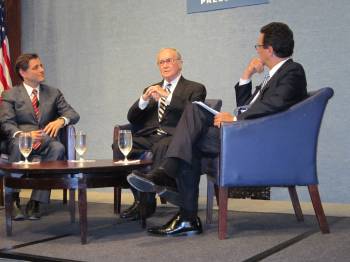
Tonight, Dad will appear at the National Press Club with the current Chairman of the FCC, Julius Genachowski, to talk about the impact of the speech, the stunning revolution in media and technology over the past five decades, and what lies ahead.  If you’re not able to come, you can watch “From Wasteland to Broadband” on C-SPAN

Some tributes and commentaries on the anniversary:

Virginia Heffernan in the New York Times: Television’s Curse was Its Blessing

James Warren’s interview with Dad for the Chicago News Cooperative: Never Mind the ‘Vast Wasteland’ — Newton Minow Has More to Say

Bob Lerhman in Politico: Minow’s Whale of a Speech

Katie O’Brien on WBEZ: Is Television Still a Vast Wasteland?

James Fallows in The Atlantic: Worth Watching — Newton Minow 50 Years Later

Tony Mauro in Legal Times: 50 Years Later, Minow Reflects on ‘Vast Wasteland’ Speech

Jess Bravin in the Wall Street Journal: Vast Wasteland: Marking the 50th Anniversary

On the Media

KPCC

And my dad’s own views about the NAB conference and what happened afterward.

I am very, very proud of my wonderful parents, who have not only devoted their lives to healing the world, from the most individual, personal attention to the most monumental change (Dad helped to create and currently co-chairs the system of Presidential debates), but who set an example for my sisters and me of integrity, fairness, and dedication to family that will always inspire us to do better.

(more…)

Related Tags:


Commentary Television Understanding Media and Pop Culture

The Wrap Raps Another ‘White Summer’ from Hollywood

Posted on May 5, 2011 at 8:25 am

The Wrap notes that despite the record-smashing opening weekend for “Fast Five,” the rest of the summer movie line-up does not feature much ethnic diversity.

“‘Fast Five’ is a great example of Hollywood getting it right,” Craig Detweiler, professor of film history at Pepperdine University, told TheWrap. “Its multi-racial cast matches the multi-racial audience. The Rock and Vin Diesel reflect the browning of America, that there is more blurring across races and cultures than ever before. The box office take reflects that.”

But after that auspicious start, the summer derails quicker than one of Diesel’s sports cars. A quick scan of the major films hitting theaters over the next few months shows that Hollywood is about to flood the marketplace — again! — with four-quadrant fare almost exclusively by and starring the ever-shrinking white plurality.

I was pleased to see one of my favorite actors, Idris Elba of “The Wire” and “Daddy’s Little Girls,” in “Thor” (playing a character who is white in the comic books).  But The Wrap has it right:

Don’t look for anybody ethnic to save the world or make it safe for democracy in “The Green Lantern” or “Cowboys and Aliens.” For that matter, “X-Men: First Class” may preach inclusion, but its cast isn’t exactly a rainbow coalition.


Related Tags:


Commentary Understanding Media and Pop Culture
Ralph Lauren Pretends His Catalog is a Book For Kids

Ralph Lauren Pretends His Catalog is a Book For Kids

Posted on May 1, 2011 at 9:07 pm

Renée Loth writes in the Boston Globe this weekend about Ralph Lauren’s new “book” for children — really a thinly disguised catalog.  They’re calling it “The first ever shoppable children’s storybook.’’

“The RL Gang: A Magically Magnificent School Adventure’’ is a 32-page volume, aimed at preschool-age children. Its slim plot involves a group of eight impossibly cute classmates, all dressed in Polo Ralph Lauren finery, with names like Willow, Oliver, Hudson, and River. The junior fashion icons use magical paintbrushes to draw themselves a garden party that comes alive, complete with ice cream and kittens.

Woozy yet? Reading along in the online video version — narrated by Uma Thurman — parents and kids can take a break to “look inside Oliver’s closet,’’ for example, and buy the twee outfits. “The RL Gang’’ is touted unblushingly as “an innovative way for parents and children to explore style, literature, and digital technology together.’”

It’s bad enough when product placement makes movies and television shows into infomercials and cross-promotions turn all kinds of products and almost-always unhealthy food into promotions for movies and television shows.  But this is essentially a catalog designed to sell very expensive clothes to children, who are not old enough to understand the fast-disappearing line between writing and pictures that are intended to tell a story based on imagination, experience, and heart and writing and pictures designed to make you think you want things you would otherwise never have thought about. 


To complain: CustomerAssistance@RalphLauren.com

Related Tags:


Advertising Books Commentary Elementary School Marketing to Kids Parenting Understanding Media and Pop Culture
THE MOVIE MOM® is a registered trademark of Nell Minow. Use of the mark without express consent from Nell Minow constitutes trademark infringement and unfair competition in violation of federal and state laws. All material © Nell Minow 1995-2026, all rights reserved, and no use or republication is permitted without explicit permission. This site hosts Nell Minow’s Movie Mom® archive, with material that originally appeared on Yahoo! Movies, Beliefnet, and other sources. Much of her new material can be found at Rogerebert.com, Huffington Post, and WheretoWatch. Her books include The Movie Mom’s Guide to Family Movies and 101 Must-See Movie Moments, and she can be heard each week on radio stations across the country.

Website Designed by Max LaZebnik