Annihilation

Annihilation

Posted on February 22, 2018 at 5:12 pm

B +
Lowest Recommended Age: Mature High Schooler
MPAA Rating: Rated R for violence, bloody images, language and some sexuality
Profanity: Some strong language
Alcohol/ Drugs: None
Violence/ Scariness: Extended peril and violence with many characters injured and killed, many grisly and disturbing images, animal attacks, guns, explosives, suicide
Diversity Issues: None
Date Released to Theaters: February 23, 2018
Date Released to DVD: May 28, 2018
Copyright Paramount 2018

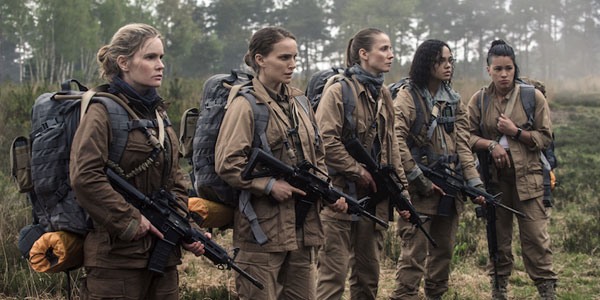
Annihilation” is based on the Nebula Award-winning first volume of Jeff VanderMeer’s Southern Reach Trilogy, adapted by director Alex Garland (“Ex Machina”). Natalie Portman plays Lena, a biologist and Army veteran, who joins a group of woman investigating an ominous anomaly the government is calling the shimmer. It looks like an rainbow prismed oil spill in the air. An area around a lighthouse is glowing and oscillating. Is it aliens? Is it God? Is it dangerous? Well, take a look at the title of the movie.

Whatever it is, it is expanding rapidly, posing a threat to pretty much everywhere. “The silence around it is louder than usual,” one observer notes. All missions, manned and unmanned, to investigate have produced no information and no human or drone sent inside has come back. Until one, an Army sergeant named Kane (Oscar Isaac), Lena’s husband. A year after he left, he shows up at their home, dazed and critically ill.

And so Lena joins the next group going inside, along with Dr. Ventress (Jennifer Jason Leigh), a psychologist leading the team, Anya (Gina Rodriguez), a paramedic, Sheppard (Tuva Novotny), an anthropologist, and Josie (Tessa Thompson), a shy physicist. The film is told in flashback, as Lena is being interrogated by a man in a hazmat suit, so we know that she will be the only one of the group to survive. We know what happened. We will see how.

The New Yorker calls VanderMeer “the King of Weird Fiction” and the Southern Reach trilogy “arresting, unsettling, and unforgettable” and “meditations on the theme of epistemic pessimism, in the tradition of Kafka.” I think what that means is that many science fiction and fantasy writers, even the most imaginative and compelling, base their stories on extrapolating what is already here, whether apocalyptic destruction of the planet due to environmental neglect or aliens who are a reflection of whatever geopolitical issues we are struggling with.

Generally, though, the fundamental rules, the ones we take for granted so much we are not even aware we are taking them for granted, apply, including the rules of dramatic fiction that go back thousands of years. Hubris invites catastrophe. Bad guys want to control everything. Courage and honor triumph. VanderMeer, let’s just say, goes another way. Instead of taking what we have and know and projecting it in a more extreme form, he takes what we have and know and bends reality — and our minds — to make us think about how much we do not know. Inter-species mutations are occuring, suggesting that the shimmer somehow dissolves what we think of as immutable barriers, the ones that define our sense of the world and our sense of ourselves. “It’s literally not possible,” a team member says. “It’s literally what’s happening,” another responds.

One of the first questions we hear at the beginning of the film, as Lena is being something between interrogated and debriefed, is “What did you eat?” Her group had rations for two weeks but survived for months. “I don’t remember eating,” she says. Later we will see the group, dazed, trying to remember what has happened and trying to figure out how much time has gone by based on how much food is gone. They do not know where they are or how long they have been there. Their communications technology does not work. Even the most basic technology, a compass directed only by the magnetism of the North Pole, does not work. They are literally disoriented. The women are there because of their expertise in science, but they cannot even manage some of the most fundamental cognitive tasks. They are not sure whether they cn trust each other. They are there to observe and report but they cannot trust their perceptions or analysis.

And we may not be able to trust our own. This movie puts its cards on the table with an opening that reveals the end. This will be an escape room/haunted house set in the wilds of the Florida swamp story with Lena as the “final girl,” the last woman standing. “It all goes back to the first cell,” we hear Lena tell her class of biology students. Cells do not die; they reproduce. Everything alive is a piece of the first cell. As the women on this mission have to decide whether they want to understand or fight the shimmer, another option presents itself.

Garland uses luscious, even seductive visuals in the verdant Florida swamp setting to beguile and horrify us, sometimes both at once. This is more than mind-bending; it is mind-expanding, something of an intellectual shimmer creating a cognitive distortion of its own.

Parents should know that this film includes extended peril and violence with many characters injured and killed and some very grisly and disturbing images, guns, grenade, fire, suicide, animal attacks, some strong language, and explicit sexual situations.

Family discussion: Why did Lena say she owed it to Kane to go on the mission? Why didn’t she tell the other women about her relationship to Kane? What would you do if you were in charge of containing the Shimmer? What is the relationship of this story to Lena’s lecture about cells?

If you like this, try: “Arrival,” “Invasion of the Body Snatchers,” “Solaris,” “2001: A Space Odyssey,” “Midnight Special,” and “Coherence”

Related Tags:


Action/Adventure Based on a book DVD/Blu-Ray movie review Science-Fiction Thriller
Black Panther

Black Panther

Posted on February 15, 2018 at 6:38 pm

A-
Lowest Recommended Age: Middle School
MPAA Rating: Rated PG-13 for prolonged sequences of action violence, and a brief rude gesture
Profanity: Some strong language
Alcohol/ Drugs: None
Violence/ Scariness: Extended comic book-style peril and violence, guns, fistfights, chases, explosions, characters injured and killed
Diversity Issues: A theme of the movie
Date Released to Theaters: February 16, 2018
Date Released to DVD: May 14, 2018
Copyright Marvel Studios 2018

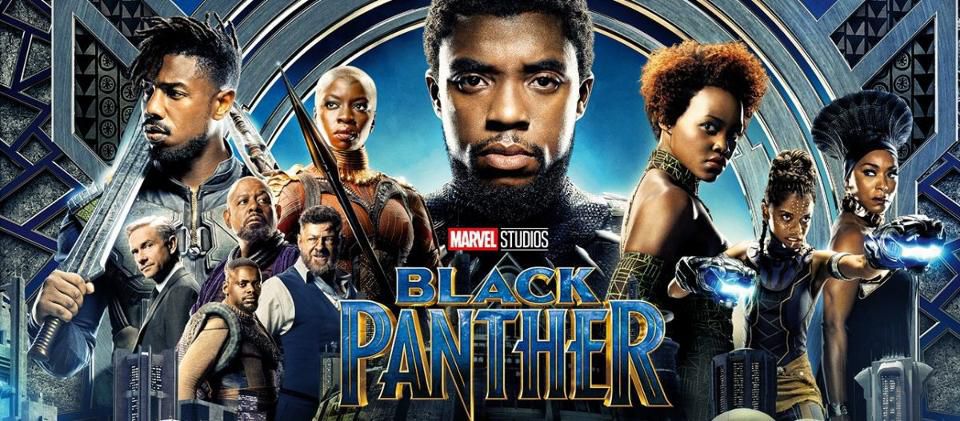
Wakanda forever! And all hail writer/director Ryan Coogler, the Black Panther, the Dora Milaje, and everyone who helped to bring this next-level, majestic, and wildly entertaining superhero movie to life.

Quick primer for those unfamiliar with the Marvel Universe: Black Panther, the first major black comic book superhero, lives in a self-sufficient, almost completely hidden African country called Wakanda. An American CIA field agent describes it as a poor, undeveloped country: “textiles, shepherds, cool outfits.” That is how they want to be seen by the world. In reality, thanks to a meteor that landed there in prehistoric times, they are the world’s only source of a metal called vibranium, which is extremely powerful, and which has been the basis for the world’s most advanced technology. Because Wakanda is cut off from the rest of the continent by mountains and rainforests, they have never been colonized and had very little interaction with the rest of the world. When they did, it did not go well. King T’Chaka spoke to the UN in “Captain America: Civil War,” and was assassinated. After a brief scene set in the past, we begin the story when his son T’Challa (Chadwick Boseman) is about to take over as king.

Much of the film takes place in Wakanda, gloriously imagined by production designer Hannah Beachler and costume designer Ruth Carter, reflecting extensive research into African design. It is worth seeing the film a second time just to revel in the wonderfully vibrant shapes and colors, and in the African landscape.

Copyright Marvel Studios 2018

Wakanda’s all-female military is called the Dora Milaje, led by General Okoye (Danai Gurira). She advises T’Challa about a mission outside of Wakanda, where he is going to rescue his one-time girlfriend, Nakia (Lupita Nyong’o), a spy who has gone undercover and has been captured by warlords. “Don’t freeze,” Okoye tells T’Challa. “I never freeze,” he replies. But he does. That’s the effect Nakia has on him. At first, she is angry that he interrupted her mission. But then he tells her that he wants her there when he becomes king, and she is glad to agree.

When they return, we see him honor his mother (Angela Bassett, regal and steadfast) and get teased by his sister, the tech whiz Shuri (Letitia Wright). She is this movie’s version of James Bond’s Q, except that she does not just provide the cool gadgets; she invents them. Her motto seems to be what she tells her brother: “Just because something works does not mean it can’t be improved.” That comment, made as a gentle taunt to a brother who is not as comfortable with change as she is, is just one example of the way that this film is able to raise profound issues in a way that resonates but is never heavy-handed or distracting. And the way T’Challa responds to being teased like the admonition not to freeze, helps to humanize the brilliant, brave, handsome, wealthy, powerful superhero.

T’Challa wants to continue to keep Wakanda away from the troubles of the rest of the world. Nakia tells him that they are obligated to share what they have to help protect others. She says, “I can’t be happy here knowing there are people out there who have nothing.” Of course, they are both right, and this conflict is reflected throughout the film in a way that is remarkably nuanced and thoughtful, not just for a superhero movie but in any context.

As I have often said, superhero movies depend more on the villain than the hero, and this one has one of the all-time greats. Michael B. Jordan, who starred in Coogler’s two previous films, “Fruitvale Station” and “Creed,” is nothing less than mesmerizing here, playing a man who represents the “other” to T’Challa, but who is connected to him as well. The film touches lightly but with insight on the difference between being an African, raised in a country where everyone is black and unqualifiedly patriotic, if insular, and being an African-American, deeply conflicted about the relationship with “home,” but better able to understand the plight of others. It touches on other vital contemporary issues like refugees and radicalization and it is all completely organic to the story.

And it is a full-on superhero movie, with a wild chase through an Asian city some very cool stunts, and a huge climactic fight scene involving a massive battle and at least two different modes of transportation, not including the battle rhinos. Yes, I said battle rhinos. I know, right?

The supporting cast includes an outstanding Daniel Kaluuya (“Get Out”), a rare on-screen appearance by motion-capture master Andy Serkis with his Tolkien co-star Martin Freeman as a CIA agent, Forest Whitaker as a priest, Winston Duke as the leader of on of Wakanda’s five tribes, and “This is Us” star Sterling K. Brown as a guy you’re better off not knowing too much about until you see the movie, which I hope you do, more than once. You’ll want to be a part of Wakanda, too.

Parents should know that this film includes extensive comic book-style action violence with many characters injured and killed, guns, spears, hand-to-hand combat, chases, explosions, and some strong language.

Family discussion: If T’Challa and Erik had grown up in each other’s environments, how would they be different? How should Wakanda resolve the conflict between tradition and innovation? Is it true that it is hard for a good man to be a good king? Why?

If you like this, try: the Black Panther comics and the Avengers movies

Related Tags:


3D Action/Adventure DVD/Blu-Ray Fantasy Race and Diversity Scene After the Credits Scene After the Credits Science-Fiction Series/Sequel Superhero
Samson

Samson

Posted on February 15, 2018 at 5:10 pm

B-
Lowest Recommended Age: Middle School
MPAA Rating: Rated PG-13 for violence and battle sequences
Profanity: None
Alcohol/ Drugs: Alcohol
Violence/ Scariness: Extended peril and violence, murder, torture, battle scenes
Diversity Issues: A theme of the movie
Date Released to Theaters: February 16, 2018

The Biblical story of the Jewish man who still stands as the exemplar of strength has been brought to the screen by Pure Flix, a sober, sincere retelling of the story that is intended for both religious and secular audiences. As Hollywood has recognized several times in the past, including a big-budget studio epic from Cecil B. De Mille, the story has all of the essentials for drama, a hero of extraordinary power who suffered loss and betrayal and ultimately sacrificed himself to defeat the Philistine leaders who were oppressing his people.

Copyright 2018 Pure Flix

Samson is played by Taylor James, a British actor who had a small part in the “Justice League” movie. In the beginning of the film he is confident and impetuous. He has pledged a life of piety, which means no drinking and never cutting his hair. In return, he has been gifted with great strength. He is not afraid to fight. But he does not consider that it may not be he who pays the consequences. King Balek (an icy Billy Zane) commands a powerful army and does not hesitate to murder the Jews who object, even in the mildest terms, to his brutal demands.

And then Samson falls in love with a Philistine woman. His parents (Lindsay Wagner as Zealphonis and Rutger Hauer as Manoah) know that a marriage would create great risk for the couple and for the Jewish community. But Samson is sure he can make it work. It is a tragic mistake.

The screenwriters made some good choices in expanding the story, creating parallels between the two fathers, Manoah and Balek, and their sons. Balek is as cruel and demanding with his son, Rallah (Jackson Rathbone, in one of the film’s strongest performances) as he is with the Jews. Rallah’s struggle to find his own way gives more texture to the story.

The ambitions of the filmmakers are admirable, but a bit beyond their capacity and it has an amateurish quality that makes this more like the movies you see in Sunday school than the movies you see in theaters. Pure Flix is not Cecil B. De Mille, and director Bruce MacDonald’s staging of the big fight scenes and the literally crashing climax lacks intensity. But it is a respectful and heartfelt portrayal of a story whose power is undimmed over the millennia.

Note: Other movie versions of this story include 2013’s Samson, 1984’s Samson and Delilah, Cecil B. De Mille’s 1948 Samson and Delilah with Victor Mature, and the animated Keep the Trust: The Story of Samson and Delilah

Parents should know that this film includes extended violence including murder and battle scenes with many characters injured and killed.

Family discussion: How does Samson change over the course of the film? Why does he change? Why does Delilah cut his hair?

If you like this, try: “The Ten Commandments” and “The Nativity Story”

Related Tags:


Action/Adventure Based on a book DVD/Blu-Ray Epic/Historical movie review Movies -- format Movies -- Reviews Reviews Spiritual films
The Maze Runner: The Death Cure

The Maze Runner: The Death Cure

Posted on January 24, 2018 at 2:23 pm

B
Lowest Recommended Age: Middle School
MPAA Rating: Rated PG-13 for intense sequences of sci-fi violence and action, language, and some thematic elements
Profanity: Some strong language
Alcohol/ Drugs: Medical tests
Violence/ Scariness: Extensive peril and violence, many characters injured and killed, zombies, guns, chases, crashes, and explosions, some graphic and disturbing images
Diversity Issues: None
Date Released to Theaters: January 26, 2018
Date Released to DVD: April 22, 2018
Copyright 2017 20th Century Fox

These dystopian teen sagas generally run out of steam after the high concept of the first one. While this third and final chapter of “The Maze Runner” series is better than the muddled second one, it does not rise to the level of the existential drama original concept of teenage boys (and finally one girl), their memories wiped, forced to try to get through a booby-trapped maze.

Once they get out of the maze, thanks to the leadership of Thomas (Dylan O’Brien), then there’s just a “Hunger Games”/”Divergent”-style race to the center of operations for the evil and corrupt regime (sometimes involving a lab with white-coated scientists torturing people) to rescue characters we know, some who make it and some who don’t, and also rescue the whole world.

The Jeremy Bentham/Trolley Problem issue of having to decide between the greatest good for the greatest number versus saving the people you care about is raised, which is intriguing, but not in a particularly thoughtful way. It also briefly raises the intriguing issue of how you can reboot a civilization to prevent the mistakes of the past, but spends most of its time on chases, explosions, zombies, evil scientists, and, as in all movies of this genre, the idea that hot teens are all that can save us. “If there’s even the slightest chance to save him, we have to take it, no matter what the cost,” Thomas says, which sounds great, but can that really be true? Doesn’t it mean risking the lives of many to save one? You can’t count on the movie-standard running through the bullets to work every time. But we cannot expect too much from a movie where the bad guys work for a corporation called WCKD.

The action scenes are dynamic and exciting, but there are too many of them and as the film edges past two hours it all gets numbing. There isn’t much help from the grim dialogue, which has a numbing effect as well: “We started this thing together. Maybe we’ll end it that way, too.” “They can only poke the hornet’s nest do long before they get stung.” “It’s amazing what people can accomplish when their survival is at risk.” This movie plays less like their survival is at risk than that they were just trying to make it to the end.

Parents should know that this movie has extended peril and violence with many characters injured and killed and some graphic and disturbing images involving zombies, guns, chases, explosions, and medical torture, as well as some strong language.

Family discussion: Who should decide whether a few get sacrificed to save the rest? What is important about the way Thomas is different from the others? In these films, “Hunger Games,” and “Divergent,” how did well-intentioned efforts to solve past problems create bigger problems?

If you like this, try: the earlier “Maze Runner” films and “The Hunger Games”

Related Tags:


Action/Adventure Based on a book DVD/Blu-Ray Fantasy movie review Series/Sequel Stories about Teens
12 Strong

12 Strong

Posted on January 18, 2018 at 11:22 pm

B
Lowest Recommended Age: Mature High Schooler
MPAA Rating: Rated R for war violence and language throughout
Profanity: Very strong language
Alcohol/ Drugs: Portrayal of misogynistic regime
Violence/ Scariness: Extended wartime violence, characters injured and killed, some disturbing images
Diversity Issues: None
Date Released to Theaters: January 19, 2018
Date Released to DVD: April 30, 2018

Copyright 2017 Warner Brothers
If it was fiction, you’d dismiss 12 Strong as too far-fetched. But this recently declassified military mission following 9/11, with a tiny Special Forces group, just twelve men, led by an officer who had never been in combat, were sent to Afghanistan to take out a Taliban outpost. They were vastly overmatched in terms of men and weapons. And, most improbable of all, they had to travel by horseback. Men trained to use the very latest of technology were riding the mode transportation used by knights and cowboys. These guys are the best of the best, nothing but courage, patriotism, skill, and determination all the way through. Think of them as The Clean or rather Sandy Dozen.

This film begins with a brief reminder of the terrorist attacks leading up to the airplanes that flew into the World Trade Center and Pentagon on September 11, 2001. And then, as in all films of men about to go into danger, we see happy families, just enough to make sure we care about these loving husbands and fathers. We know that Captain Nelson (Chris Hemsworth, back to being mortal after “Thor: Ragnarok” but no less heroic) is not going to be able to keep his promise to pick that adorable ladybug-drawing daughter after school, and pretty soon he knows it, too.

There are wives who bravely say that this is what they signed up for. One says, “Some wives cry; I clean,” as she scrubs her oven. Another looks at her husband grimly, insisting he give their son the bad news himself. Nelson has to undo his plans for a desk job to go back to his team. He also has to prove himself to his commanding officer, who selects him over five other teams because he seems to have the best understanding of the challenges, especially the weather that will make their mission impossible if they don’t complete it before winter makes the route impassable.

And then the twelve are on their way with just the briefest and sketchiest debrief from a CIA officer. There are three warlords in the area who all oppose the Taliban but otherwise are in mortal combat with each other. One of the challenges for the American team will be to keep that fragile alliance in place as they need the support of all of them to reach the outpost, liberating several locations along the way.

It is hard to follow at times. There are so many “the whole world depends on this next impossible thing” moments, so much bro talk, so much tech talk, so many reminders of how many days “in country,” so many similar-looking explosions and shoot-outs. But Hemsworth, Shannon, and Pena create real, relatable and yet heroic characters, and seeing them ride into battle on horseback against daunting odds is genuinely moving and inspiring. The most intriguing part is the developing relationship between Nelson and his local counterpart, General Dostum (Navid Negahban). The outcome revealed before the credits is appropriately both reassuring and disturbing.

Parents should know that this film includes extensive wartime peril and violence including guns and explosions with many characters injured and killed, some grisly and disturbing images, references to child abuse, strong language, and some sexual references.

Family discussion: What is the difference between a soldier, a warrior, and a warlord? How did Nelson and Dostum learn to trust one another? What can we tell about the man by the way they said goodbye to their families?

If you like this, try: the book by Doug Stanton and the movies “Act of Valor,” “Lone Survivor” and “Charlie Wilson’s War”

Related Tags:


Action/Adventure Based on a book Based on a true story DVD/Blu-Ray Pick of the Week movie review War
THE MOVIE MOM® is a registered trademark of Nell Minow. Use of the mark without express consent from Nell Minow constitutes trademark infringement and unfair competition in violation of federal and state laws. All material © Nell Minow 1995-2026, all rights reserved, and no use or republication is permitted without explicit permission. This site hosts Nell Minow’s Movie Mom® archive, with material that originally appeared on Yahoo! Movies, Beliefnet, and other sources. Much of her new material can be found at Rogerebert.com, Huffington Post, and WheretoWatch. Her books include The Movie Mom’s Guide to Family Movies and 101 Must-See Movie Moments, and she can be heard each week on radio stations across the country.

Website Designed by Max LaZebnik