Tom and Jerry

Tom and Jerry

Posted on February 26, 2021 at 3:59 pm

C
Lowest Recommended Age: Kindergarten - 3rd Grade
MPAA Rating: Rated PG PG for rude humor, cartoon violence, and brief language
Profanity: Some schoolyard language
Alcohol/ Drugs: Social drinking
Violence/ Scariness: Comic mayhem
Diversity Issues: Diverse characters
Date Released to Theaters: February 26, 2021

Tom and Jerry
Copyright 2021 Warner Bros.
Making a live action movie about the cartoon characters Tom (the cat) and Jerry (the mouse) was a bad idea. These “let’s see what we can dig up from the intellectual property hiding in our files” reboots usually end up as lifeless as we can expect when they are inspired by balance sheets instead of characters. But “Tom and Jerry” misses even that low bar, dispiriting in its waste of the iconic cartoon characters in the title, a usually reliable director, and some of the most talented performers in movies today.

It may be impossible to make a feature film out of a one-joke set-up that more likely to be sustained in a seven-minute animated short. Certainly, if that question ever goes to court, this movie will be introduced as evidence.

A refresher: Tom wants to catch Jerry and Jerry outsmarts him. Think Road Runner and Wile E. Coyote without access to Acme explosives and anvils. But while Road Runner is being chased around spare western landscapes, Tom and Jerry often create chaos and mayhem indoors. So a lot of Tom and Jerry is things falling over and crashing and smashing.

None of that is especially well staged here. The mayhem/slapstick scenes seem to have been set up based on what they could convey with technology given the interaction between two-dimensional cartoon characters and physical reality, rather than what is involving or engaging. Slapstick has its charms, but it requires a precision of timing that allows us to appreciate the destruction before moving on to the next faceplant. And even though they are 2D cartoon characters, and thus instantly restored to perfect condition after every encounter, setting it in a 3D environment hampers some of the ebullience of the forces of id.

The biggest mistake, though, is expecting, even demanding, more affection from the audience for the characters than it earns. There doesn’t have to be a likable character to root for in a movie, but it helps.

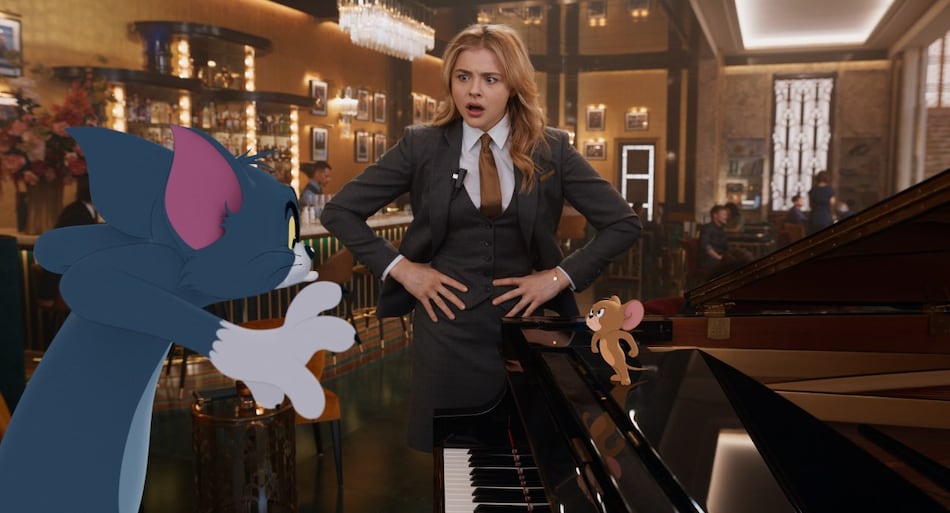
Tom plays the piano in Central Park, busking to make money (what is he going to use it for?), pretending to be blind to make even more from guilt and pity. Jerry comes along, covers his sign with one of his own, and starts collecting from the crowd until Tom sees him and the crowd sees that he can see. Chases ensue.

Meanwhile, Kayla (Chloë Grace Moretz) loses one job because Tom crashes into her bike and spills all the clean laundry she is delivering (which is not even in a bag, but okay). And so she gets another by lying about her credentials. So 20 minutes in, two of our main characters are cheaters.

Kayla’s new job is as a temp at a super-luxurious hotel which needs support for a very high-profile, no expenses spared wedding of two mega-celebrities. (Note to Hollywood: It is time to stop trying to seem relevant by creating characters who are influencers.) Kayla is there to help make everything go smoothly, even when the groom wants elephants and military-grade drones, when the bride’s ring goes missing, and when Jerry is spotted in the kitchen. At the hotel, she has a rival who sees her as a threat and gets help from a ditsy bell girl.

Kayla brings in Tom to help catch Jerry. It does not go well. That’s it. That’s the movie.

The excellent cast does its best, and believably interacts with the animated characters. But no one can make the dreary dialogue sound smart or even interesting. The problem is not that the animated characters are 2D. The problem is that the script is 1D.

Parents should know that this film includes comic violence and mayhem including fire, chases, and crashes. There is brief potty humor.

Family discussion: Why did Kayla lie? Why couldn’t Ben and Preeta tell each other the truth? How did Kayla try to fix the problems she created?

If you like this, try: the original Tom and Jerry cartoons and the Road Runner cartoons.

Related Tags:


Animation Based on a television show Comedy Fantasy movie review Movies -- format Movies -- Reviews Talking animals
Soul

Soul

Posted on December 22, 2020 at 4:18 pm

A-
Lowest Recommended Age: 4th - 6th Grade
MPAA Rating: Rated PG for some language and thematic elements
Profanity: Mild language
Alcohol/ Drugs: None
Violence/ Scariness: Issues of life and death
Diversity Issues: Diverse characters
Date Released to Theaters: December 25, 2020

Copyright Pixar 2020
Pixar likes to take big swings, not just artistically but thematically. In “Soul,” Pixar has its first adult male (human) and its first Black lead character in Joe Gardner, voiced by Jamie Foxx. It has a less stylized look, set in a sepia-toned New York City. And it is about the most fundamental existential questions of all: Why am I me? What makes life meaningful?

We are human because we ask those questions. And the answer to that second one is: In part to make movies like this one, to explore what makes life worthwhile.

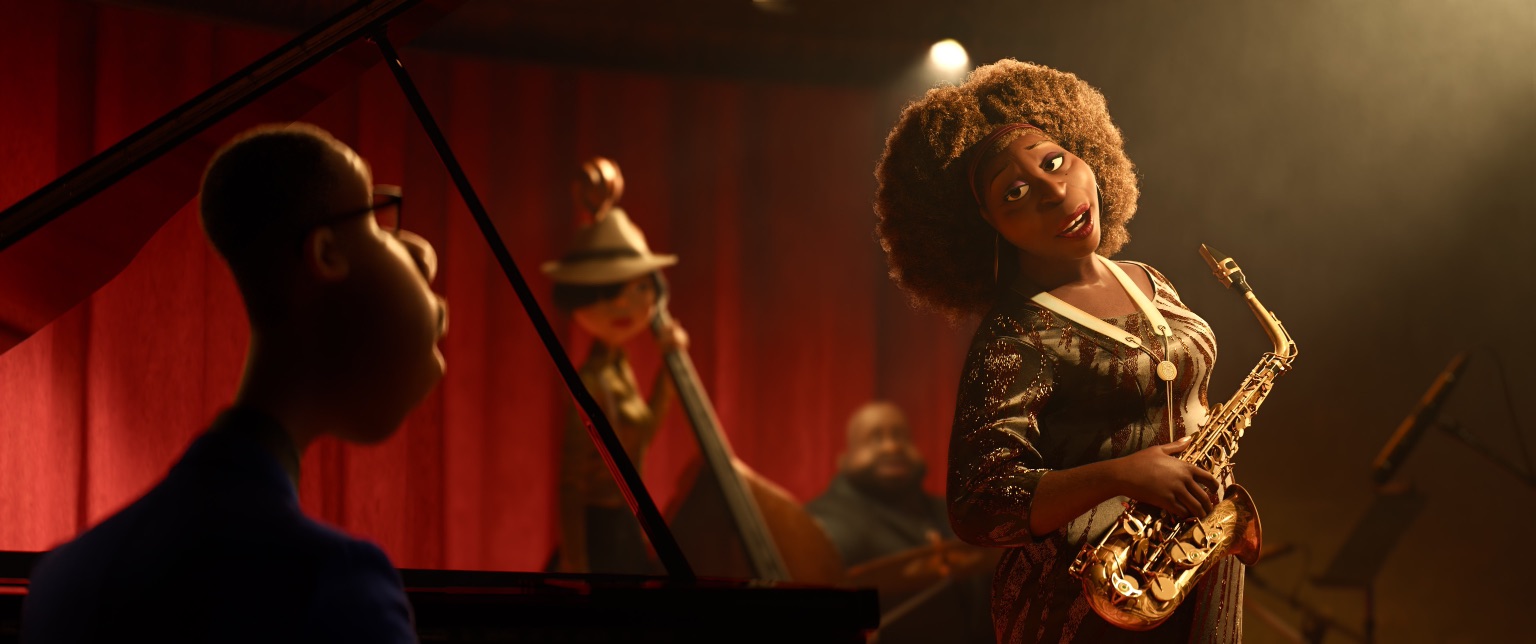
Joe is a jazz musician. At least, that’s what he is in his heart, what he wants to be, what he thinks he was born to be. But what he is at the moment is a high school music teacher trying to make teenagers’ instruments sound less screechy and more on key. And then (this is still in the first minutes of the movie) he gets the chance of his dreams. A former student named Curly (Questlove) invites Joe to to audition for saxophonist Dorothea Williams (Angela Bassett). Joe takes a risk by adding his own ideas to Dorthea’s music, and she agrees to let him join her on stage that night. It’s everything he ever hoped for.

That’s why he is not paying careful attention as he walks home, and so he falls into a sewer and dies. We’re still in the first minutes of the film.

Instead of The Great Beyond, Joe ends up in The Great Before, where young souls prepare to be born. Joe thinks this could be his opportunity to return to earth and become the musician he knows was his reason for being alive. The counselors who guide the little souls think he is a mentor, and assign him to their hardest case, known as 22 (Tina Fey). Mentors like Lincoln, Mother Teresa, and Gandhi have all failed to persuade her. So we have one character who will do anything to get back to life on earth and one who refuses to go because she doesn’t see the point.

Copyright 2020 Pixar

The counselors look like Calder wire sculptures. They are all named Jerry. And they have a diverse range of voices, including Wes Studi, Fortune Feimster, and Richard Ayoade. Why do they look and sound like that? Because they are too complex for humans to comprehend, they have created these simple, accessible forms.

That’s what all story-tellers try to do, what stories are for, and what Pixar has done here: they take very complicated characters and themes and make them accessible to us. When they do it right, we cry. And then we continue to think about what they illuminate for us. If they do it right, we are enlarged by it, as the characters are. This is Pixar, so it will make you laugh, think, and cry, and then think some more. And because it is Pixar the art, from the character design to the real and imagined settings are believable and enthralling. The sublime jazz music is from Jon Batiste and the score is from top team Trent Reznor and Atticus Ross (also heard this year in “Mank” and “Watchmen”).

Co-writer/co-director Kemp Powers (screenwriter of one of December’s other best films, “One Night in Miami”) was one of many Black voices brought in to make sure the film is authentic to the lived experience of Black people for two reasons. First, they wanted Black audience members to recognize the characters and the experiences. Powers encouraged the addition of one of my favorite scenes in the film, the barbershop owned by Joe’s friend Dez (Donnell Rawlings). Co-writer/co-director Pete Docter is exploring what happens to us after we survive growing up, as in his now-classic “Inside Out.”

We learn from Joe’s interactions with Dez and Curly that he is so caught up in music and his fear of not realizing his dream of playing “Black improvisational music” that he does not really listen to others. (An encounter later on with another student helps him begin to realize that even people who are not a part of his “real” life have something to tell him.) And we learn before Joe does that just because we have a dream does not mean it is the only dream or the best dream.

There are so many ideas and insights and so much music in “Soul” that it rewards several viewings. In The Great Before, each soul waiting to be born visits the Hall of You, to pick up individual personal qualities, like being excitable or aloof. They can give the soul the what and the who, but the why is something they have to discover for themselves. There is a sort of no-man’s-land for people who operate outside the rules of The Great Before, including a pirate shipped manned (so to speak) by people like Moonwind (talk show host Graham Norton) who is still alive on earth but through meditation communes with the universe. There are many lovely touches in the details, like the pre-credits “When You Wish Upon a Star” played by Joe’s students.

Joe and 22 end up back on earth, chased by a celestial accountant named Terry (Rachel House) trying to bring them back to The Great Before. Can Joe get to the performance after all? Can 22 find some reason to live as a human? (You don’t have to be an existential philosopher to agree with her that pizza is pretty great.)

We’ve all seen a lot of movies with heroes who seek and find their one true purpose. Many are based on real life, about people who became successful and famous ins spite of doubters. There are always those who nag them to do something else and we are supposed to see them as short-sighted and selfish. “Soul” wants us to see more than that, and it shows us how to begin.

Parents should know that this movie concerns life and death and a character is killed in an accident early in the film and then goes to The Great Before. There is some mild language and some cartoon-style peril.

Family discussion: What would you see in the Hall of You? What would you tell 22? How has this year made you think about what is important?

If you like this, try: “Inside Out” and “Everybody Rides the Carousel”

Related Tags:


Animation Fantasy movie review Movies -- format Movies -- Reviews Spiritual films
The Croods: A New Age

The Croods: A New Age

Posted on November 23, 2020 at 2:06 pm

B +
Lowest Recommended Age: Kindergarten - 3rd Grade
MPAA Rating: Rated PG for peril, action, and rude humor
Profanity: None
Alcohol/ Drugs: None
Violence/ Scariness: Cartoon-style peril, minor injuries
Diversity Issues: A theme of the movie
Date Released to Theaters: November 25, 2020
Date Released to DVD: December 29, 2020
Copyright Dreamworks 2020

The Croods: A New Age is the sequel to the animated film about the prehistoric family is sharply funny, exciting, warm-hearted, and a great watch for the whole family.

We left the Croods at the end of the first film with Grug (Nicolas Cage) finally welcoming in a new family member, Guy (Ryan Reynolds). The family, which sleeps in a pile every night and can form a kill circle in an instant is, Grug thinks, situated as well as possible to find food and to avoid becoming food. But then the climate changes and they have to find another place to live. On the other side of a wall, they discover a kind of paradise, with plenty of food conveniently growing in rows. It is the home of the Betterman family (“emphasis on the Better“), Hope (Leslie Mann), Phil (Peter Dinklage), and their daughter Dawn (Kelly Marie Tran).

The Bettermans, who have discovered tools and simple machines, have an elaborate tree-house, cultivated crops, and the wall, which keeps them safe. They have the concept of “privacy,” sleeping in separate rooms. They also have the concept of “rooms.” Also “windows,” and an amusing running joke is the way Grug’s son Thunk (Clark Duke) is mesmerized by the “screen” that’s just a hole in the wall.

The Bettermans are aghast at the lack of refinement of the primitive Croods and gently try to urge them to move on. Except for Guy, who they knew when he was a child. Guy is happy to be reunited with them, especially his childhood friend Dawn. He starts dressing like Phil Betterman.

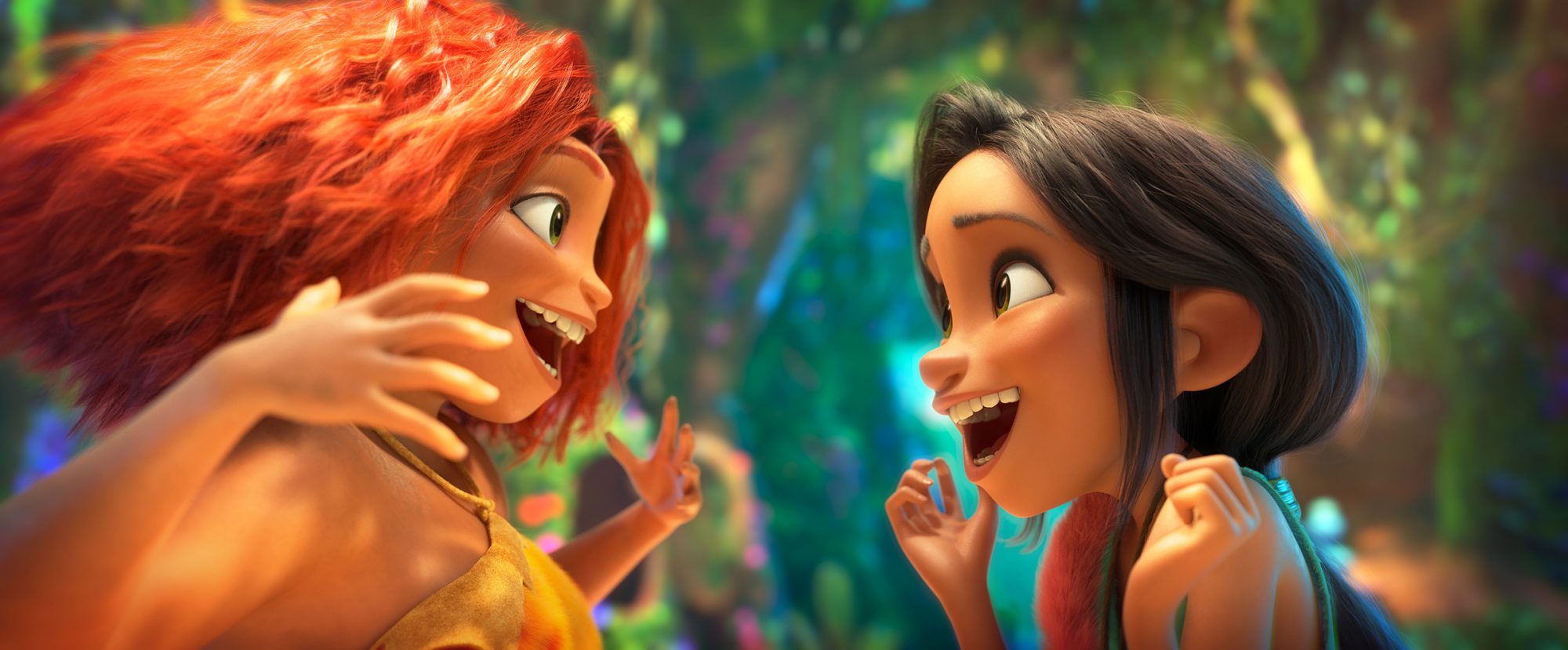
We might expect Grug’s daughter Eep (Emma Stone) to be jealous of Dawn. But this movie wisely makes Eep and Dawn instant best friends in a funny and sweet scene where they discover what it means to know another girl. It also wisely does not make the Bettermans or the Croods all right or all wrong. Balancing the wish to protect your children from any possible harm with the importance of their learning to be independent and developing a sense of curiosity and adventure.

Basically, there are just two jokes here, but they are funny every time. It is funny when we see that the Croods are just like us (parents want to take care of children and children want to try new things, teenagers have a lot to say to each other but do not always have the words, girlfriends’ voices sometimes get a little screechy when they’re excited), and it is funny to see them discover for the first time in human history what we take for granted (privacy, screens). But what makes this movie worth a rewatch is the constant invention of its visuals, the exceptional detail in the characters, animals, and landscapes, its superb voice talent, and its touching depiction of the foundational ties of family and community.

Parents should know that this film includes some peril and mild injuries and some potty humor.

Family discussion: Is your family more like the Croods or The Bettermans? What would you pick for your tribal name? What is your family’s motto? Ask family members for the stories behind their scars.

If you like this, try: “The Croods,” and the “Ice Age” movies and my interview with this film’s director, Joel Crawford.

Related Tags:


Animation DVD/Blu-Ray Family Issues movie review Movies -- Reviews Series/Sequel
Interview: Glen Keane of “Over the Moon”

Interview: Glen Keane of “Over the Moon”

Posted on October 23, 2020 at 11:54 am

I’ve been a huge fan of Glen Keane for as long as I can remember.  As a Disney animator, he worked on classics like “The Rescuers,” “Aladdin,” “Beauty and the Beast,” “Tangled,” and “Pocahontas.” And now, for the first time, he has directed an animated film, the gorgeously designed and heart-warming “Over the Moon.”

You have probably seen Keane as a child. His father, the legendary cartoonist Bil Keane, created the Family Circus comic panel, based on the Keane’s own family and with the distinctive round shape. The comic is still run by Keane’s siblings.

Copyright 2020 Bill and Jeff Keane

Keane gave a virtual interview to Critics Choice members this week. He told us about having his father work from home, drawing Family Circus, and how much it inspired him. When he was very young, his father told him, “I am a cartoonist, but you are an artist,” which made him feel, he said, as though he had just been knighted with a sword. His father gave him a book to get him started, called Dynamic Anatomy, which got him started on understanding how to draw the human figure. One day, when he was about 8, some kids on the school bus made fun of him for drawing nude figures, the classical images of the discus thrower and The Thinker. He said at first he was uncomfortable being laughed at, but then he thought about how much he liked drawing and he said, “I’m different! I like it!”

“Over the Moon,” inspired by a Chinese legend, is the story about a young girl who builds a rocket ship to the moon so she can meet the moon goddess. Keane said that the stories he most loves to tell are about “characters who believe the impossible is possible.” “Over the Moon’s” Fei Fei was “the ultimate.” She has the science and math skills to think through the engineering challenges and the faith that the moon goddess is really there.

Copyright Netflix 2020

I asked about the most important element of character design. He said, “They exist before you design them. It’s a weird thing, but that has been my experience. Like the Beast. I had hundreds and hundreds of drawings of him, but I would look at them and think, ‘I don’t recognize him.’ I like the buffalo head shape, the lion’s mane, the boar tusks, the cow ears to make him friendlier, and then suddenly — that’s him. I felt like he was looking at me. It’s a revealing of the character. For Fei Fei, I wanted to see that intelligence, that spark, thinking her way through things, but also that faith.” He said he focuses on the hair — making a joke about compensating for his own lack of hair. But it is always a symbol of the struggle of the character. “For Rapunzel, her hair was irrepressible, uncontainable. For Pocahontas, it showed the spirit moving in her. For Ariel, the hair always looked like it was floating in the water. Tarzan was like a wild animal with the dreadlocks. And for Fei Fei, her chopped off hair is a constant reminder of that chaos in her life. That design choice dictated so much, too. hHer eyebrows had to be really bold and strong. And if you’re going to make a mistake in design, don’t let it be in the eyes. They are the windows of the soul.”

Copyright Netflix 2020

Keane told us about his first assignment at Disney, one brief scene in “The Rescuers” of a character named Bernard sweeping the floor. But he couldn’t get it right. “I thought I was single-handedly going to destroy Disney’s reputation. Pencil points were breaking off.”

Keane asked Eric Larson, one of the “Nine Old Men,” the legendary Disney animators of films like “Pinocchio” and “Cinderella,” for advice. “I thought Eric was going to give me some kind of a formula.” Instead of guidance on the movement, Larson asked, “What kind of a guy is Bernard? Does he care about his job? Of course he does! He wants to sweep up every speck off that floor.” “Within seconds he was the character,” Keane told us. “I realized that sincerity was make-believe. That’s been the thread for me in everything I’ve done, to live in the character, to believe in it, the passion of becoming something you can see and feel in your heart.”

Related Tags:


Animation Directors Interview
THE MOVIE MOM® is a registered trademark of Nell Minow. Use of the mark without express consent from Nell Minow constitutes trademark infringement and unfair competition in violation of federal and state laws. All material © Nell Minow 1995-2026, all rights reserved, and no use or republication is permitted without explicit permission. This site hosts Nell Minow’s Movie Mom® archive, with material that originally appeared on Yahoo! Movies, Beliefnet, and other sources. Much of her new material can be found at Rogerebert.com, Huffington Post, and WheretoWatch. Her books include The Movie Mom’s Guide to Family Movies and 101 Must-See Movie Moments, and she can be heard each week on radio stations across the country.

Website Designed by Max LaZebnik