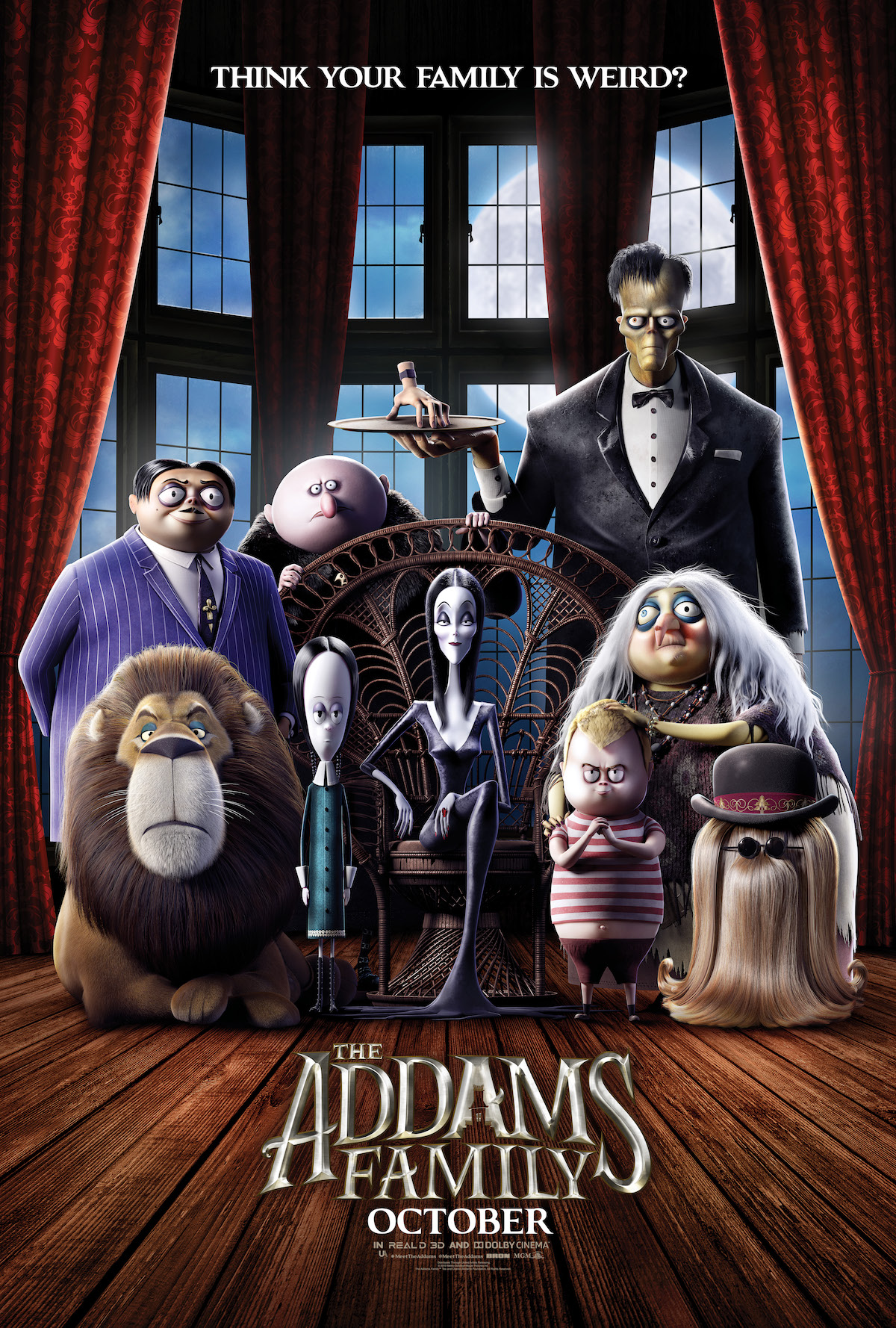
There are about half a dozen bright spots in the new animated feature “The Addams Family,” but in between them is the unbright and unoriginal storyline about how the real monsters are the ordinary people, not the weird people.
Parents should know that this film includes monsters and peril. It is more funny-scary than scary-scary but there are some images that might disturb sensitive viewers, as well as comic/action-style peril with no one hurt, bullies, a neglectful parent, potty humor. Some may be disturbed by a casual portrayal of child who decides to live with a different family
Family discussion: Which characters are really scary? What does “assimilation” mean? What does your family do to recognize adulthood?
If you like this, try: “Hotel Translyvania,” “Igor,” and the “Addams Family” television books, series and films
Terrorism and crime-related violence, drunk driving, child abuse, characters injured and killed including death of five different parents
Diversity Issues:
None
Date Released to Theaters:
September 13, 2019
Copyright Amazon Studios 2019
There are three major problems with “The Goldfinch,” based on the Pulitzer Prize-winning novel by Donna Tartt. The first is that it is long, nearly two and a half hours. The second is that it is dull, so it seems much longer. And the third is that it is a mess, and not in an interesting way. It tries very hard to be many things all at once — to be meaningful, to be significant, to be dramatic, to be exciting, and to illuminate issues of grief and loss and love and identify. Most of all it aspires to be an awards-worthy film, as the adaptation of an acclaimed literary work should be. But it succeeds at none of them.
What it does have are way too many of the indicators of pretentiousness and of telling (which is what books do) instead of showing (which is what movies do, the good ones anyway). Every item on the check list gets ticked off as the film lumbers on: affectedly literary voiceovers with aphoristic sounding observations that are not especially illuminating or insightful, a pinkly pinkly piano on the soundtrack, flashbacks, and w world where even in New York City our character just keep running into each other all the time because there are only six people in the world and everyone else is just background.
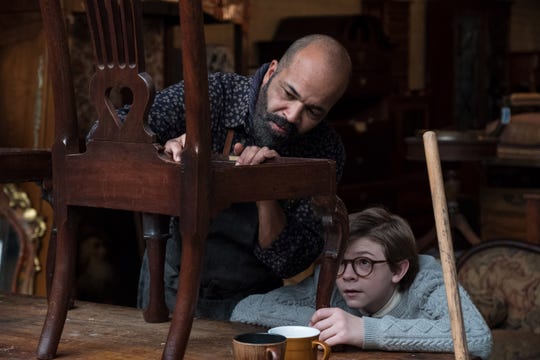
Theo (Oakes Fegley as a boy, Ansel Elgort as an adult) and his mother were at the Metropolitan Museum of Art when his mother and many other visitors were killed in a terrorist bombing attack. Theo blames himself, because his mother was only there with him because she was on her way to see the principal about a bogus complaint that Theo had been smoking at school. Or, perhaps he blames himself because he lagged behind while she went on to the next room because he was mesmerized by a pretty red-headed girl. Or, it could be he blames himself just because he survived and she did not. In the chaos following the explosion, we will learn, Theo had an odd but portentous conversation with a man who was dying. And, in one of the defining moments of his life, Theo took a small, priceless painting from the museum, a picture of a goldfinch.
Theo initially stays with a wealthy, cultured family (headed by Boyd Gaines and Nicole Kidman), then in Nevada the feckless, alcoholic father who had abandoned him (Luke Wilson), then a kindly antique dealer/restorer (Jeffrey Wright) connected to the man whose death Theo witnessed in the museum and the girl who caught his attention just before the blast. He is befriended by a skinny Ukranian immigrant in his class named Boris (“Stranger Things'” Finn Wolfhard as a boy, Aneurin Barnard as an adult), who has the pale skin and unruly hair of Edward Scissorhands. Events lumber forward without any real emotional connection, only hammered-home reminders that life is fragile, grief is inevitable, and a leaf may wilt but a painting of a leaf will not, though it can be stolen.
There. I just saved you a soapy 2 1/2 hour slog capped with a preposterous shoot-out. You’re welcome.
Parents should know that this film includes terrorism and crime-related peril and violence, drunk driving, characters injured and killed including deaths of five parents, child abuse, attempted suicide, drinking and drug use by children and adults, and strong language.
Family discussion: Why did Theo take the painting? Why was the wilted leaf in the painting important? Why didn’t Boris join Theo in New York?
If you like this, try: the book by Donna Tartt and the book and movie “Extremely Loud and Incredibly Close” (also featuring Jeffrey Wright),
Rated PG-13 for thematic material and language including some ethnic slurs
Profanity:
Some strong language including racist terms
Alcohol/ Drugs:
None
Violence/ Scariness:
Some peril, racist attacks
Diversity Issues:
A theme of the movie
Date Released to Theaters:
August 16, 2019
Date Released to DVD:
November 18, 2019
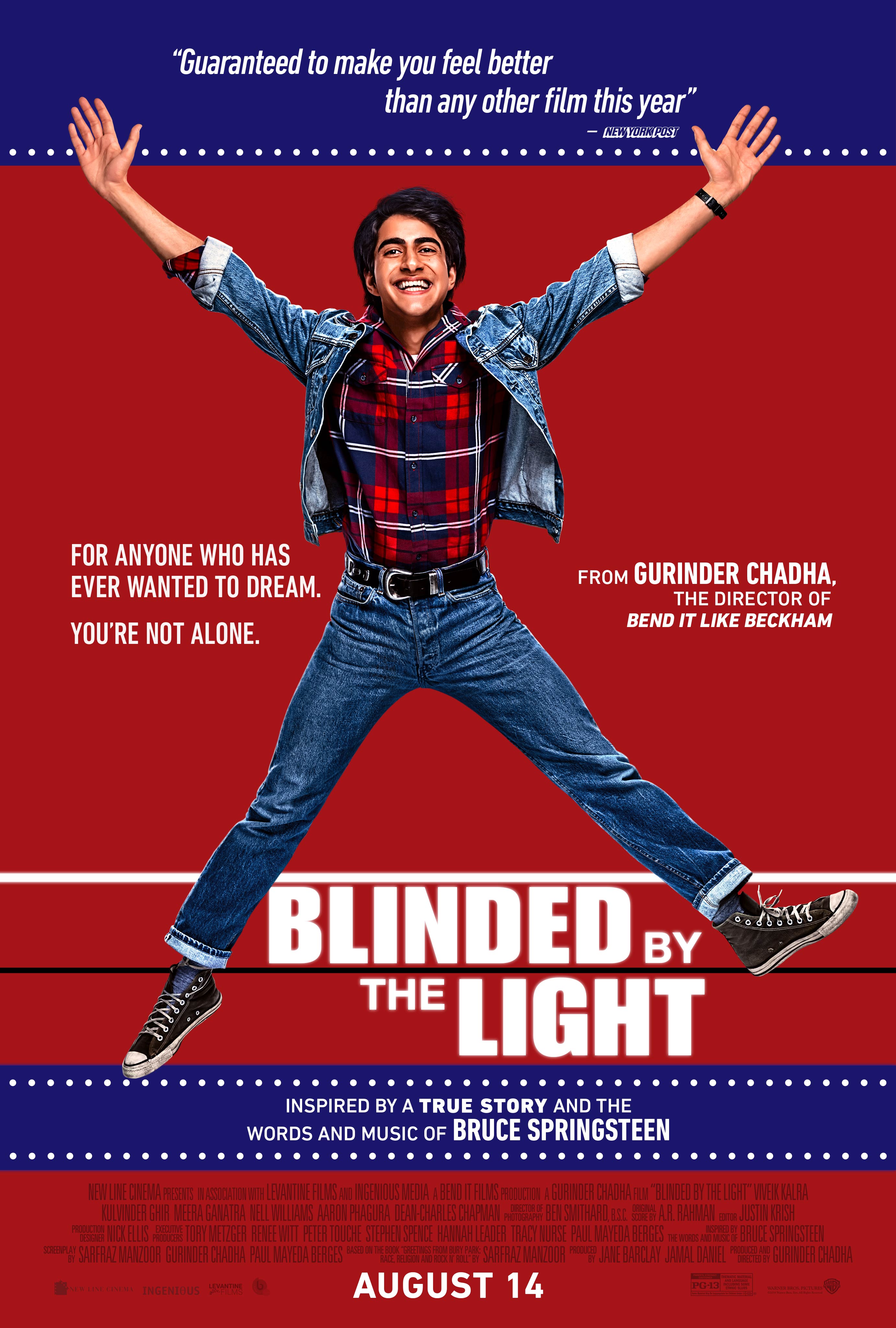
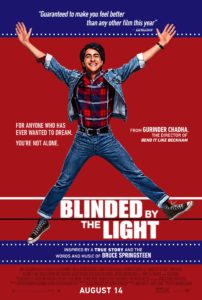
Copyright 2019 Warner BrothersIf we’re lucky, some time in August, as the big blockbusters of July taper off, we get a heartwarming little indie film to brighten the end of the summer. This year we are very lucky. The film is “Blinded by the Light,” set in Thatcher-era England, where the teenage son of Pakistani immigrants heard a song that seemed to explain the world to him. More than that, it explained him to himself. The song was by someone who was not British, Pakistani, or a teenager, but to Sarfraz Manzoor, New Jersey rocker Bruce Springsteen understood him better than anyone he knew.
Around the same time, Gurinder Chadha, the daughter of Indian immigrants in England, was also listening to Springsteen. Manzoor became a journalist whose memoir about his love for Springsteen (Greetings from Bury Park) then inspired Chadha, the director of films like “Bend It Like Beckham,” to make it into a movie.
The character based on Manzoor is Javed (newcomer Viveik Kalra), who dreams of being a writer. He writes poems that he does not share with anyone, even his sympathetic teacher (Hayley Atwell). The world around him seems bleak, unforgiving, and uncaring. An anti-immigration white supremacist group called the National Front is organizing protests and Javed and his family are subjected to harassment and racist graffiti. Javed’s father is strict, holding on to traditions as he is anxious about a lack of control when he is unable to support the family. His son’s sensitivity and inclination to assimilate into English culture makes him even more anxious. Javed’s mother is sympathetic but she has to work around the clock as a seamstress to earn money and does not want to put more pressure on her husband by challenging him. Javed has one friend who shares his love of music, but his freedom and ease only sharpens Javed’s sense of himself as isolated and ineffectual.
At school he meets a Sikh classmate named Roops (Aaron Phagura) who gives him a Springsteen CD. Chadha’s endearingly cinematic depiction of Javed’s reaction to the songs — the words as much as the music — beautifully conveys the jubilant, visceral reaction to truly connecting with another person, whether it is Gene Kelly splashing in puddles to celebrate falling in love or just knowing that somewhere in the world there is someone who has seen into your deepest secret heart and understands and accepts you. For Javed, who cannot fit into his father’s notion of who he should be but is not exactly sure who he will be instead, Bruce shows him the transformational power of putting feelings into words and music. A voice that means the world to him brings him closer to trusting his own voice.
As in “Bend it Like Beckham,” Chadha’s gift for kinetic storytelling reflects the turbulent emotion of the young protagonists. There are so many lovely details and moments — Rob Brydon (of “The Trip” movies) as the Springsteen-loving father of Javed’s friend, Javed’s discovery that his sister has found her own way to be herself, and of course a sweet romance, complete with a musical number that Gene Kelly himself would appreciate. Most important, the movie shows us that the feelings and the issues Bruce was singing about in the 70’s that spoke to Manzoor in the 80’s are still powerfully speaking to us today. Just as Springsteen let Manzoor know that his feelings were real and valid and understood and could be expressed, so Manzoor and Chadha tell us that with this lovely film.
Parents should know that this film includes racist language and attacks, some strong language, family tensions, mild sexual references, and kissing.
Family discussion: What was it about Springsteen’s music that made it so meaningful to Javed? How did listening to the music give him courage? What music is meaningful to you?
If you like this, try: “Bend it like Beckham” from the same director, and the music and autobiography of Bruce Springsteen
Rated PG-13 for some strong language and drug material
Profanity:
Some strong language
Alcohol/ Drugs:
Social drinking
Violence/ Scariness:
Family stress and loss, reference to serious illness of a child and miscarriages
Diversity Issues:
None
Date Released to Theaters:
August 16, 2019
Date Released to DVD:
December 2, 2019
Copyright 2019 Annapurna PicturesThe screen adaptation of Maria Semple’s charming book, Where’d You Go Bernadette is…less charming, though perfectly pleasant in a late summer comfort food kind of way. Semple, a sharp and witty writer for television (“Mad About You,” “90210,””Arrested Development”) moved from LA to Seattle and her sense of dislocation inspired the book, with a sharp take on the crunchy, self-consciously wholesome culture of the Pacific Northwest in contrast to the glossier, smugger world of Los Angeles. Note the title, a question without a question mark. And in this version, the question mark-less question is for no discernible reason, answered at the very beginning, followed by most of the film as a flashback.
Missing the epistolary format of the book, which allows us to follow much of the storyline through the characters’ voices, the sharpness is softened in Richard Linklater’s film. Cate Blanchett plays Bernadette, a devoted mother of Bee (newcomer Emma Nelson). Clinically, she might be classified as struggling with depression or anxiety or agoraphobia, but as we will learn, the behavior that is un-social and non-productive is her way of responding to devastating personal and professional loss. She does not want to talk to anyone, except maybe Bee, with whom she has an easy, natural connection. Bernadette loves her husband, Elgy (Billy Crudup), but he has a demanding job at Microsoft, the reason for their move to Seattle, and is not around much. Bernadette ran from personal and professional loss by devoting herself to Bee. But now Bee will be going away to boarding school and she has nowhere to run.
Bernadette is an architect, but her house is a mess of unfinished repairs. When she spots a bump under the carpet that turns out to be a blackberry bush sprout from beneath the house, instead of pulling it up by the roots she neatly scores the carpet to bend the corners back and staple them to the floor so the bush can keep growing. She has contempt for the moms at Bee’s school who go on about their compost heaps. She refers to them as “gnats” and she is not above some passive aggression, including allowing one to create a lot of damage.
Elgy’s new assistant there is Soo-Lin (Zoe Chao), one of the gnats, who loves to gossip about how weird Bernadette is with Audrey (Kristen Wiig), one of those “Big Little Lies”-type school moms who likes to run everything, talks about her perfect life a lot, and has very strong views on how everyone should behave.
Bee reminds her parents that they rashly promised her a wish if she got perfect grades all through middle school. Her wish is a trip to Antarctica. Bernadette wants to give Bee her dream, but for someone who can barely leave the house, it is an insurmountable challenge — until other challenges of staying home become even more insurmountable.
This is disappointingly one-dimensional work from one of the world’s most talented and versatile directors, Richard Linklater. Instead of the innovative, perceptive work we saw in “Boyhood,” the “Before” series, “School of Rock,” “Waking Life,” “Bernie,” and “Everybody Wants Some!!” “Where’d You Go Bernadette” has all the depth of the Charlene song “I’ve Never Been to Me.”
Parents should know that this film has some strong language, some mayhem, some mild peril, and some discussion of miscarriages and serious medical conditions.
Family discussion: Why didn’t Bernadette tell her family where she was going? What problems are you good at solving?
If you like this, try: “The Secret Life of Walter Mitty,” also starring Wiig.
Writer/director Greta Gerwig cast her “Lady Bird” star Saoirse Ronan as Jo in this latest version of the beloved classic, Little Women, based on the real-life family of author Louisa May Alcott. The casting is exciting: Timothee Chalamet as Laurie, Laura Dern as Marmee, and Meryl Streep as Aunt March.