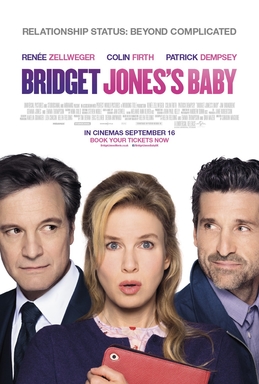
Copyright Working Title 2016I really don’t like saying this. But Bridget Jones has the same problem as Adam Sandler and the rest of those Apatow-ish man-boys. They haven’t figured out that cluelessness and mistakes that are endearing in a 20-something are annoying and then just exhausting when they get older. Bridget, again played by Renee Zellweger though without the yo-yo weight gain, says in this film that she has to stop making the same mistakes and start making new ones. Well, she’s right. But it’s pretty much the same mistakes, professional and romantic disaster, though with higher stakes this time. The filmmakers, director Sharon Maguire (the original Bridget Jones film) and Helen Fielding (creator of the character and co-screenwriter) rely on a level of affection for the characters we first met onscreen 15 years ago and most recently saw 12 years ago, but make no effort to re-introduce them to those of us who, like Bridget, were a lot younger then, or introduce then those who are too young to have seen them.
Bridget, finally at her goal weight and in a good job producing television news, has still not made things work with Mr. Darcy (Colin Firth), who is married to someone else, someone frightfully capable and intelligent. Bridget decides, with some encouragement, to go off and have some carefree sex with a random guy to perk up her spirits, so she goes “glamping” at a music festival something between Burning Man, Woodstock, and Canyon Ranch. After a meet cute than involves her falling into a mud puddle, she does have a wild night of love with a very handsome American named Jack, played by Dr. McDreamy himself, Patrick Dempsey, whose performance would have been a lot better if his character had, well, any characteristics other than being not Mark Darcy in every way.
A few days later, Bridget and Darcy find themselves at the same party and he tells her he is getting divorced. Next thing you know, she is as they say in the UK, up the spout, and has no idea, as they say in the US, who’s the daddy. If you think this is wildly hilarious, wait until she brings them both to childbirth preparation class and they are mistaken for a gay couple. What a knee-slapper! And this comes after the excruciating farce of keeping them from finding out they are both possible fathers (and that she slept with both of them) and the excruciating farce of telling them. The only thing that works in this mess is Emma Thompson at her very best as the obstetrician. Apparently she wrote her own dialog as she is listed as co-screenwriter, and her scenes have a wit and crackle that is sorely missing from the rest of the film.
Parents should know that this film includes very raunchy humor with explicit sexual references and situations and comic nudity, theme of question of paternity, very strong language used by adults and children, and alcohol.
Family discussion: How has Bridget changed since the first film? Is she making the same mistakes or new ones?
If you like this, try: the earlier Bridget Jones films, “and Baby Mama” and the “Catastrophe” series on Amazon
The first film to be based on the work of best-selling author and spiritual teacher Eckhart Tolle is “Milton’s Secret,” a thought-provoking story about purpose, presence, family, and integrity.
Milton (William Ainscough) is a 12 year-old boy growing up in an economically and socially unpredictable world. His mother and father (Mia Kirshner, David Sutcliffe) are workaholics with marital and financial problems, and he is bullied at school. When his grandfather (Donald Sutherland) visits, Milton learns that rehashing the past and worrying about the future are preventing him from finding true happiness.
Rated PG-13 for thematic material and some sexual content
Profanity:
Mild language
Alcohol/ Drugs:
None
Violence/ Scariness:
Discussion of wartime violence and loss, miscarriages, dead body
Diversity Issues:
None
Date Released to Theaters:
September 2, 2016
Date Released to DVD:
January 23, 2017
Amazon.com ASIN:
B01LDWUQ4I
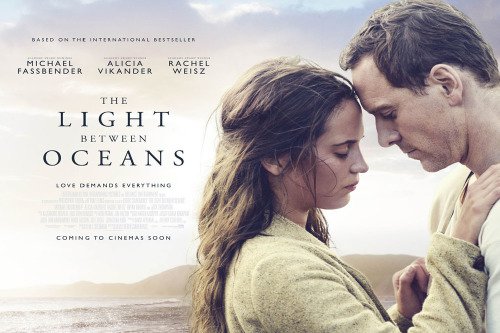
Copyright Disney 2016The lighthouse is on an island called Janus, and the lighthouse keeper explains that it is named for the two-faced god who is memorialized in the first month of each year, January. One face looks to the past, the other to the future — “two ways of looking at things.”
The theme of duality and perspective resonates throughout this story of the lighthouse keeper, Tom Sherbourne (Michael Fassbender) and his wife Isabel (Alicia Vikander), we see how two ways of looking at things can balance or unbalance each other.
Tom is a WWI veteran who tells the man looking for a temporary lighthouse keeper that he is not worried about the isolation of the job. “I just want to get away from things for a little while.” His mother died and he had a father who was so dictatorial that the regimentation of the military was a relief. We do not learn much about his wartime experiences except that they were brutal. He is, as he later admits, numb. The solitude and order of the lighthouse suits him.
But he meets the lively and warm-hearted Isabel, who impetuously proposes marriage, and realizes how much he had been longing for connection. She tells him, “You still have a light inside you, and I have seen it.” And he writes back, “I’ve never known it was all right to talk about the things I feel.”
They marry and are blissfully happy in their tiny little island. But after two harrowing miscarriages, Isabel is devastated. When a boat washes up near the shore containing a dead man and a crying baby, it seems that providence has given them what they were missing. It seems that way to Isabel. Tom knows that he must put the truth into his log and return the baby to her family. But Isabel is desperately in love with the child and insists that they can give her what she needs. Tom, who has promised to do everything he can to make her happy, agrees.
They adore the baby, who they name Lucy. But when Tom sees a woman sobbing in a graveyard (Rachel Weisz) and realizes she is probably Lucy’s real mother, his conscience begins to torture him. They have inflicted on her the same agony that they suffered.
The story gets soapy, and the tinkly piano score from Alexandre Desplat and scenes of waves crashing on the shore suggest literary pretensions that may work better in the acclaimed novel than they do on screen. But Fassbender and Vikander, two of the most compelling actors ever to appear on film, give powerful performances, and their on-screen chemistry, which turned into real-life romance, holds the film together when the story wavers.
Parents should know that this film has discussion of wartime violence and loss, miscarriages, a dead body, and devastating grief.
Family discussion: Who should raise Lucy? Why did she want to see Tom again? Was Frank right about forgiveness?
If you like this, try: “The Widow of Saint-Pierre”
Interview: Natalie Portman on “A Tale of Love and Darkness”
Posted on August 31, 2016 at 3:44 pm
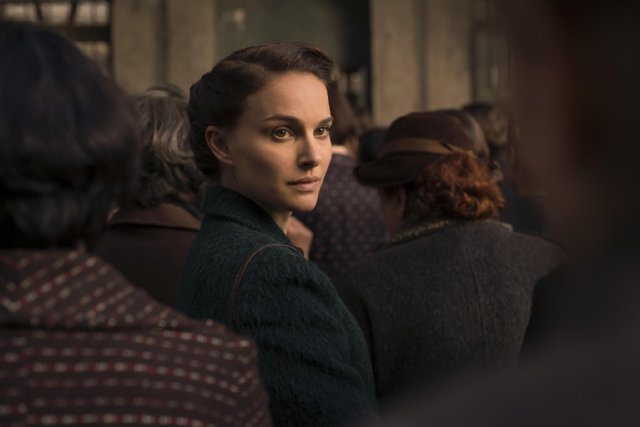
Oscar-winning actress Natalie Portman wrote, directed, and stars in “A Tale of Love and Darkness,” based on the international best-selling memoir by Amos Oz. It was a pleasure to speak to her about the challenges of adapting the book and directing a child actor.
What do we learn from the troubled but tender relationship between Amos and his mother?
The film and the book are very much about what happens when expectations don’t line up with reality. And I think that a lot of the things that they might tell young people about what happens once you have a job or once you go to college or once you get married, these things are like the way to happiness or something, once you’ve got to those realities and you achieved those whether you call them goals or expectations and then they are different than you expected them to be, and then dealing with those differences can be one of the most challenging things in life.
In the film, the child’s father is fascinated at the derivation of and connection between words, possibly because it takes place at a time when modern conversational Hebrew was being invented.
It’s a really fascinating time in history because not only was this country of Israel being created by a group of refugees, which I’m not sure has happened before, but also they were revising the language as you said, a language that has been spoken purely in a religious context, in a Biblical or liturgical context for hundreds of years and then all of a sudden it needed to be used for everyday usage and needed to be updated rapidly. And so it’s really fascinating seeing how they came up with new words, what they drew from. Ohad talked about his uncle in the book who was one of the architects of modern Hebrew, creating new words, from biblical words and he created the word for “shirt” and he says in the book, “If my uncle hadn’t invented the word for shirt we would still be saying, ‘I put on my coat of many colors this morning.'” And it’s really amazing how they introduced these new words and got them really accepted into everyday usage. And what an exciting time to be a writer, too, because you could literally invent your language as you were inventing your story.
Copyright Focus World 2016You began acting when you were very young and now in this movie are working with a very young actor. What did you learn from your experiences as a child performer that helped you direct this actor?
I think the most important thing was that when I was a kid I felt that everyone on set made sure that the environment felt like playing more than working and I wanted to repeat that for Amir because the film is quite serious in tone. The atmosphere should always be positive for him so I really tried to make sure that everyone was very calm on set and between takes we would goof around and make jokes and not have it be a stressful environment for him.
You have worked with so many outstanding directors, very different directors in terms of their approach and their style. What were some of the things that you tried to take from your experiences and use as a director?
I have been lucky to work with so many people who I admire so much and I took a lot from many different directors I worked with. From Darren Aronofsky, I saw how he worked with each actor really individually. He would do different things with different actors to elicit their performances from them which I thought was really smart because everyone needs something different. And from Terrence Malick, I saw that you don’t have to play by the rules at all. You just need to make movies the way that you make them and the way you want to tell them. And then Mike Nichols just always always says, “Keep reminding yourself what story you are telling, where you are in the story and claim the big moment.”
What do we learn from the scene at the end that gives us a glimpse of the main character as an adult?
The book actually deals with many different time periods including the present. I felt that it was important for me to show where he ends up because he did and end up fulfilling his mother’s dreams in a way by becoming this pioneer by becoming a writer. After all of her storytelling, somehow his mother’s absence turned him into the man he became. He was so influenced by her but also he gave himself his own name. Ohad means strong in Hebrew and it.s part of remaking himself.
How did you use your character’s clothing to tell her story?
I actually was lucky enough to have the great designer Alber Elbaz who formerly designed at Lanvin for the past ten years and is originally Israeli also. He did all of my costumes for the film. We really wanted to tell a story through the wardrobe. I like this European elegance that they had but also poverty. They don’t have a lot and she’s wearing the same clothes over and over again. But they’re beautiful clothes that she had from Europe. She had three outfits. Also the clothes helped tell the passage of time. We go from a more 40’s silhouette to a more 50’s silhouette which helps us understand the time that has gone by.
What were you looking for in the movie’s score?
The music was an amazing part of the film to do and to learn. It’s actually really surprising to me how hard it was because I really love music and I’ve always known very specifically the kind of music that I want. But the problem with this film, the music that I felt fit emotionally, when you put it next to the actual emotion on the film, it kind of doubled the emotion and was too much. And so I realized that you have to actually had to go against, and again, it can’t be the exact same emotion you’re going for. I worked with a really close friend, the composer Nick Britell who was amazing. He would just sit with me and try hundred different things because I really needed to hear it to make sure it was right. He wrote so many beautiful pieces for the film. I’m so proud of the work that he did and he added immeasurably to the film.
What do you want this film to tell people about Israel?
I don’t intend to be educational on this film. It’s really very much about a family. But I think if there’s anything that movies can do it is that they can remind us that people and places that we might not know about or that we might have preconceived notions about or even prejudices against, they can make us relate to someone as a human and hopefully you just see them in a different way. A movie can help you relate to the emotion and it might of someone that you might never meet your whole life.
Sneak Peek: Middle School, The Worst Years of My Life
Posted on August 24, 2016 at 8:00 am
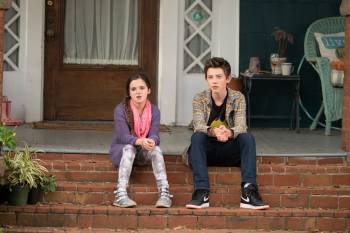
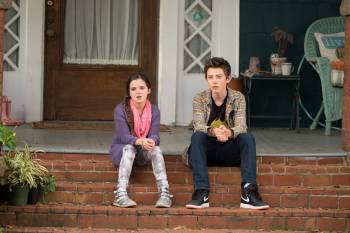
I’m excited about “Middle School: The Worst Years of My Life,” based on the best-selling books by James Patterson and Chris Tebbetts. The terrific cast includes “Gilmore Girls” star Lauren Graham, “Modern Family’s” Rob Riggle, and Adam Pally of “Happy Endings.” We are delighted to present an exclusive still from the film.
CBSFilms_FrankMasi_2015_6424.RAF
It’s the story of Rafe, who doesn’t like rules, and his new principal, who loves them. Rafe (Griffin Gluck) and his friend Leo (Thomas Barbusca) decide to break them all.