Trailer: Middle School – The Worst Years of My Life
Posted on June 17, 2016 at 3:34 pm
James Patterson’s rollicking best-seller Middle School: The Worst Years of My Life, about kids who decide to break every rule in their school’s oppressive Code of Conduct, is now a film starring “Gilmore Girls'” Lauren Graham. Here’s the trailer:
Interview: A. Scott Berg on “Genius,” the Story of Editor Maxwell Perkins
Posted on June 13, 2016 at 1:13 pm
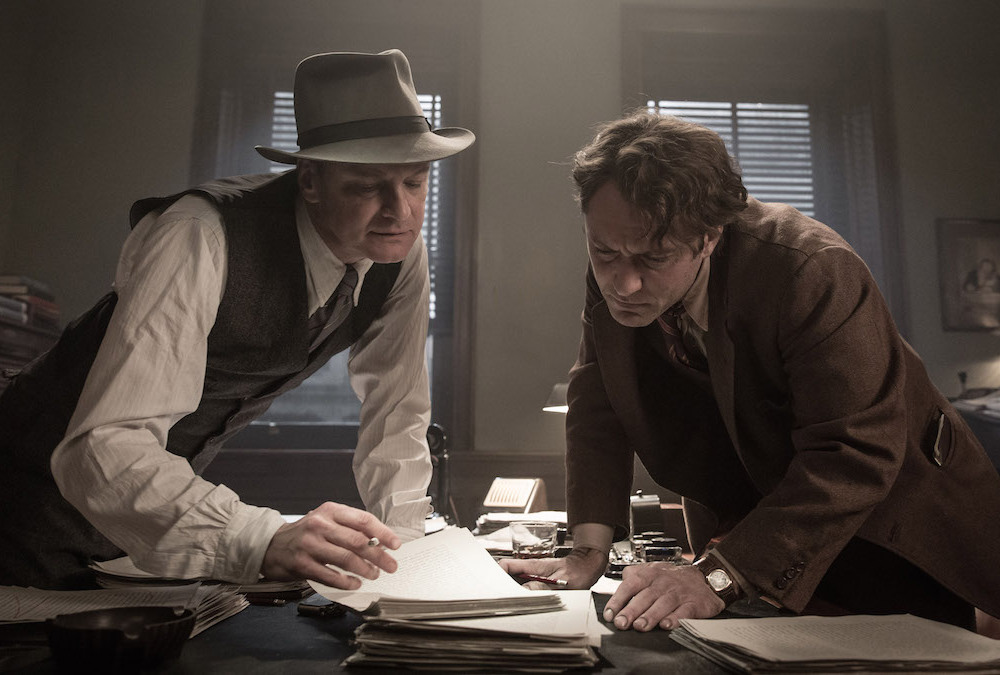
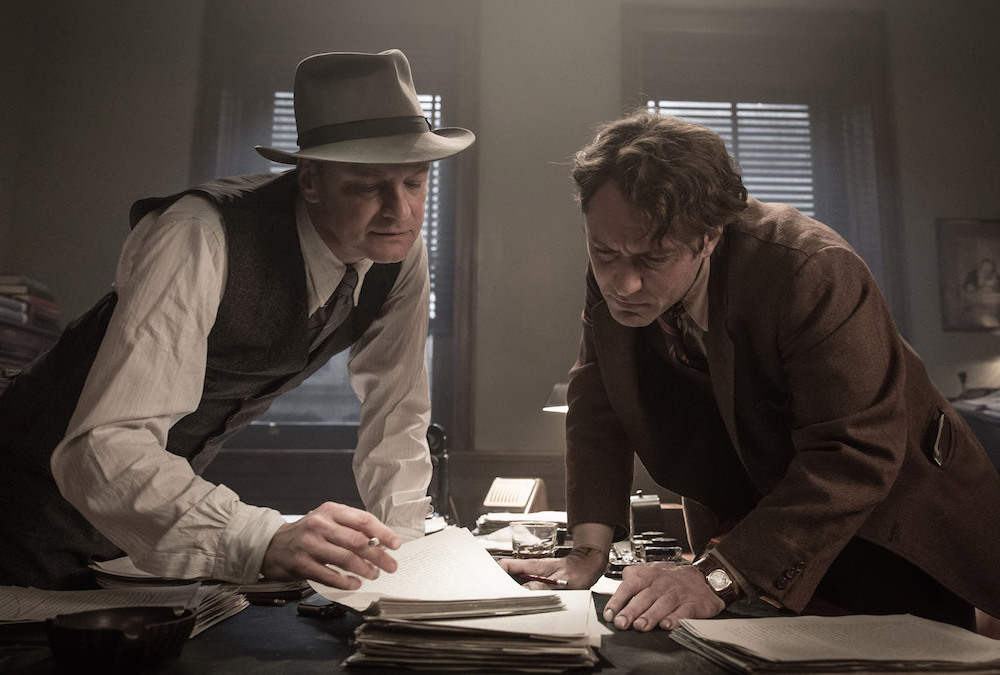
Copyright Lionsgate 2016It was a very great pleasure to talk to A. Scott Berg, whose college paper about editor Maxwell Perkins became the first of his many distinguished biographies of 20th century Americans. Berg was the first to read the just-donated collection of papers from the publisher of books by Hemingway, F. Scott Fitzgerald, Thomas Wolfe, and many others, discovering correspondence that showed the influence Perkins had on some of the greatest works of American literature. The new movie, “Genius,” starring Colin Firth as Perkins and Jude Law as Wolfe, is based on Berg’s book, Max Perkins: Editor of Genius. In an interview, he talked about how the digital world is making it hard for biographers and why Perkins wore his hat indoors.
Throughout the film, Colin Firth as Maxwell Perkins leaves his hat on, even in the office or at dinner with his family, though in that era it was considered disrespectful. Did he really do that?
He did. To be perfectly honest, it was partly a Yankee eccentricity. There is one element that we didn’t get into in the movie which is Perkins was partly deaf and so there was a longtime theory that he used to wear the hat and pushed it down to push his ears forward so it created a better acoustical situation for him. And then a lot of people thought he wore the hat indoors just so that if people walked in for a meeting and they saw him wearing his hat they thought he was on his way out so they better speed it up. But the truth of the matter is he did wear it at home. When Wolfe made a fictional character out of Perkins which he did in You Can’t Go Home Again, a character named Foxhall Edwards, he claimed that the character in the book goes to bed wearing a hat. That part is fictitious. Sometimes his wife would make him take it off in the dining room but for the most part, yes, he wore his hat indoors.
Is it fair to say that he was not a co-author but a collaborator in Wolfe’s work?
He would never say he was a collaborator. I think in retrospect if you start to examine all the work he did, especially with Wolfe, I think it dips into collaboration. I think it’s fair to say that those books first of all would not have been published without Max Perkins and they certainly would not look like the way they look, they wouldn’t read as they do were it not for Perkins. But there is many a book editor today who does as much with some writers. You would never know but some writers get completely rewritten. Perkins never changed the words; he really was there to provide structure. So it’s a fine line. How do you define collaboration? It depends on your definition, I suppose. But it’s fair to say though that that was collaboration certainly for Of Time and the River.
Are there Wolfe purists who prefer his unexpurgated versions?
Yeah, there are a few Wolf purists and in fact some years ago not all that many, they did publish the original version of Look Homeward, Angel called O Lost. And there are number of essays that came out at the time that say this is the way it should have been published and this was the pure version and some people said Max Perkins really did more harm than good. I am not of that school, I am obviously team Perkins and I say this: Thomas Wolfe never did anything against his will. It’s not as if Max Perkins put a gun to his head or said, “Tom, if you don’t change this we are never going to publish it.” These were editorial suggestions. They were strong suggestions and he had the power behind him of having brought Fitzgerald and Hemingway into print so Wolfe was inclined to listen to him but as you see in the movie they argue back and forth but basically Perkins just keeps putting stuff out there until Wolfe gets it the way Perkins sees it. But on any given moment if Wolfe had said, “You know, I am not taking this out” that’s that. It’s Wolfe’s book. As Perkins always said, the book belongs to the author and he believed that.
There are so many strong and vivid characters in this story it seems almost a mini-biography of each of them as well.
Definitely, definitely. This was my first book so I didn’t know what I was walking into but it’s definitely a group biography in some ways. I try to write it in such a way that if you went to the index and just followed all the citations of Fitzgerald or all the citations of Hemingway you could read their life story consecutively. So you do get mini-biographies of virtually every Perkins author in there. Some people like Ring Lardner you may only get a few paragraphs out of his life story but the big three certainly you can follow the arc of their lives, the parts of their careers definitely. But at the end of the day though they are ornaments on my big tree and Perkins is my tree, he’s the thing that pulls them all together.
Biographers often say that the hardest part is knowing what to leave out.
That is so very true. Ultimately that is the single hardest thing about it. For me I finally have to say, “Okay, what is my through line of this book?” What is the arc of his life? When I get to each paragraph, each anecdote, each big story I say to myself: “Does this either deepen the character or does it lengthen the story? Does it move the story forward in some way?” And if it doesn’t then I cut it out and so as a result of that and this ties into your really good prior question about many biographies of everybody else, I found that I had to trim those as closely as I could because I wasn’t at the end of the day writing a biography on Fitzgerald, Hemingway or Wolfe; I was writing a biography of Perkins and I needed to give just enough information about all the other characters to illuminate Perkins’s life. So that’s the general rule.
Scott: Well there is. What happened is, all of Fitzgerald stuff is there, that’s actually one of the reasons I went to Princeton as a teenager. Most of the Scribner family has gone to Princeton since the mid-1800’s and in the late 1960s and into 71 when I graduated the Scribner’s had donated all their company archives to Firestone Library so that meant sitting in the library arriving just as I arrived, were every letter that had ever come into Scribner’s from Fitzgerald, Hemingway, Wolfe, Henry James, Edith Wharton, Galsworthy, Ring Lardner, you name it. So they were all there with a carbon copy of every letter of Max Perkins sent out. And again because Perkins was hard of hearing he did virtually no business on the telephone and so every thought he had he wrote down and mailed it and had a carbon copy waiting for me to discover in 1967-8-9 and that’s what I did. So yeah, there is a huge archive, tens of thousands of letters sitting there and I was basically the first person to mine that entire collection when I a sophomore in college. It was very exciting. It was just a gold mine!
So how do you as a biographer feel about the fact that correspondence doesn’t really exist anymore?
Don’t think that this doesn’t keep me awake at night! I mean I tell people: print it out, print it out! I want a hard copy! You sent a tweet, I want a hard copy of it. I am going to need that! It’s something actually biographers fret about and Perkins was a dream subject because he did write everything down and because he was so articulate. Lord, it’s really going to be a problem! I mean are we going to write books based on Donald Trump’s tweets?
The movie shows us that one reason for the strong connection was that Wolfe was looking for a father and Perkins was looking for a son.
I think it’s fundamental to the lives of each man. Wolfe himself talked about it, he wrote about it, he had conflicted feelings about his own father and he believed most of life was man’s journey in search of a father. And Perkins did want a son as Louise says in the movie; “My husband always wanted to have a son as he proved having five children.” I mean there were almost 2 halves of the Jell-O box coming together. They really needed each other personally on that level and Perkins really did become a great father figure and Hemingway Fitzgerald and Wolf all became surrogate sons for Perkins in so many ways; not just with the work they did but emotionally. The way you see Perkins interacting, giving them money, nurturing them, giving marriage counseling, giving psychiatric advice, I mean he was just always there for all of them.
It seems to me that being a biographer is a little bit like the role that Max Perkins played in that you both standing in the wings in service to what’s going on stage.
Nobody’s ever observed that to me before but I think that’s exactly right. This is my take on biography; a lot of people go into a biography with an agenda of their own and then look for the facts that support the agenda. I am of the objective school of biography; I walk in tabula rasa, I collect as many facts as I can, as many dabs of paint and see what portrait emerges from that. So where that is very much like Perkins is I don’t want my subjects to be what they want the subject to be; I want the subject to be who the subject is and Perkins was that way with Thomas Wolfe, he wasn’t trying to turn Thomas Wolfe into somebody else, he wanted to capture as much pure Wolfe as he could.
They are legends of 20th century American letters, so renowned a single name suffices: Fitzgerald, Hemingway, Rawlings, Lardner, Wolfe. But there is another name — Maxwell Perkins — who was essential to their work and often advisor and support system for their personal lives as well. A. Scott Berg’s brilliant 1978 biography of Perkins has inspired a film that focuses on the most important relationship of Perkins’ professional life — his work on the first two books by Thomas Wolfe.
Intriguingly, all of the major male roles are taken by British and Australian actors playing Americans, and unsurprisingly they are all superb, never missing an final r or an elongated vowel — or worse — showing off. Colin Firth plays Perkins, a mild-mannered man who loved his family but was most alive as a appreciator of literature — he knew it when he received it as a manuscript and he knew how to trim away the underbrush to make it better. His great skill was seeing the story the writer wanted to tell and doing whatever was necessary to get it into the hands of readers.
After Hemingway’s spare, masculine prose and Fitzgerald’s elegant sentences and impeccable structure, Perkins receives a submission from Wolfe that is vital, poetic, and a veritable avalanche of words. “Please tell me it’s double-spaced,” he says, looking at the pile of paper. “That’s a long paragraph,” Perkins daughter remarks, reading over his shoulder. “It started four pages ago,” her father replies.
Like Michelangelo seeing the statue inside the block of marble, Wolfe sees a novel that preserves Wolfe’s torrential style but prunes away the excess. He reassures Wolfe that he will only “shape it a bit, cut off the top branches.” Wolfe knows it needs pruning. “You don’t know how I struggled to cut the gorgon down.”
And Wolfe (Jude Law), who tells Perkins that not just his books but most of all literature is about the search for a father, responds to Perkins’ utter engagement in service to his story. The relationship between a writer and a great editor is one of the most intimate and fulfilling, something between a gifted psychoanalyst, an inspiring teacher, and a fairy godparent — or, just a parent. Perkins, the father of five daughters (charmingly portrayed), found a spiritual son in the troubled genius, and, as Berg’s book argues, was a genius himself in the way he was able to cull out of him timeless classics.
This sympathetic portrayal acknowledges the devastation that can be wrought by geniuses. We see Wolfe’s troubled relationship and careless dismissal of his supporter and mentor, the set designer Aline Bernstein (Nicole Kidman), who is anguished not because she left her husband and children for the much-younger Wolfe, but because once she was successful at getting him launched, he did not need her anymore. We the devastation that can be felt by them as well, as Fitzgerald (Guy Pearce) struggles to write and to care for his wife, Zelda, who is near-catatonic. But the hero of the story is the man waiting patiently backstage, ready to supply a discreet loan or a helpful suggestion: Don’t name the book Trimalchio in West Egg — how about The Great Gatsby? The quiet dignity and integrity of Firth’s performance is a tribute to all whose art is a life of service.
Parents should know that this film includes drinking and drunkenness, smoking, abusive behavior, some sexual references, mental illness, and a sad death.
Family discussion: What did Perkins see in Wolfe that the other publishers did not? Do you agree with Wolfe’s statement that literature is about the search for fathers? How was that reflected in his relationship with Perkins?
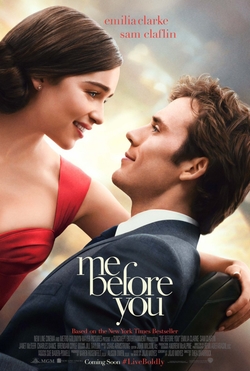
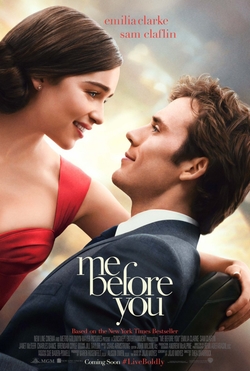
Copyright 2016 New Line Cinema It’s all about the eyebrows. Emilia Clarke (“Game of Thrones”) has gamine-like “natural” eyebrows ideal for expressing wonder, hurt feelings, and enthusiasm, and Sam Claflin (“Hunger Games”) has circumflex-like eyebrows ideal for expressing skepticism, irony, and stoicism. All four eyebrows get an extensive workout in “Me Before You,” based on the international best-seller by JoJo Moyes about Louisa Clark (Clarke), a high-spirited, warm-hearted pixie of a girl, just laid off from her job behind the counter at a bakery, and Will Traynor (Claflin), a once-energetic, once-successful finance type from a wealthy family who is now paralyzed below the shoulders following an accident. Lou is hired by Will’s mother (the redoubtable Janet McTeer) as a “companion” for Will, a position that only exists in novels about warm-hearted young women sent to castles with names like Thornhill that have eligible but tortured men waiting to have their hearts warmed. Will has an Aussie aide who handles the icky physical stuff (Stephen Peacocke), so Lou is there to bring cheer to Will, who has no intention of being cheered. And did I mention he lives in a literal castle?
Lou’s family depends on her for money, because her father has been laid off (due, as we will find, to the financial engineering of Will’s one-time protege). And so she accepts the job with no real understanding of caring for a severely disabled person and stays in it even when he refuses to speak to her or to accept her many offers of a cup of tea. Ultimately, through a combination of ennui, frustration, and the impossibility of resisting the charm of Lou’s kindergarten teacher meets Lisa Frank and Hello Kitty-style attire, Will begins to thaw a little. The immense pressure of what he has lost inspires him to want more for her than she wants for herself, and he feels impelled to show her that, even with a castle in its midst, her little town cannot be enough for all she should want from life. Did I mention that his name is Traynor?
This is not a movie that leaves anything to the imagination. Just in case you were not sure of that, Lou’s boyfriend Patrick (one-time Neville Longbottom Matthew Lewis) is Will’s polar opposite, a fitness instructor and “motivational coach” who thinks a few more reps can solve any problem. And just in case that isn’t enough, there’s a brief encounter with the divine Joanna Lumley to spell it all out for Louisa and for us as well.
Okay, so no surprises here, especially if you’ve read the book. Bring a handkerchief, maybe two. But Clarke and Claflin have palpable chemistry, and we are no more able to resist Lou than Will is. As she takes him back out into the world, she thinks it is for him, but he knows it is for her, and we find that the real hero of the story is Will’s, well, will.
Parents should know that this film includes non-explicit sexual references and situation, mild language, severe injury and discussion of assisted death.
Family discussion: Should Will have changed his mind? What will Louisa do next?
If you like this, try: “Love Story” and “A Walk to Remember”
Mary Poppins Returns — With Emily Blunt and Lin-Manuel Miranda
Posted on May 31, 2016 at 4:41 pm
Hamilton writer/star Lin-Manuel Miranda and Emily Blunt will bring us Disney’s new sequel, “Mary Poppins Returns.” P.L. Travers wrote six books about the magical nanny so there is a lot of great material for new adventures. This will be exciting!