Trailer: Love and Friendship from Jane Austen and Whit Stillman
Posted on March 28, 2016 at 8:00 am
Jane Auten’s unfinished novel Lady Susan is an epistolary story — told via letters. The title character is a scheming, manipulative woman determined to find rich husbands for herself and her daughter. It is the basis for “Love and Friendship,” the new movie from writer/director Whit Stillman, starring Kate Beckinsale.
Morgan Freeman and Jack Huston star in this remake of the Charlton Heston classic, “Ben-Hur,” the story of a falsely accused Jewish nobleman in the time of Jesus (Rodrigo Santoro).
Trailer: Miss Peregrine’s Home for Peculiar Children
Posted on March 21, 2016 at 8:00 am
“Miss Peregrine’s Home for Peculiar Children,” based on the book by Ransom Riggs, stars Eva Green as a Professor X-style collector of young people with an assortment of special powers. Asa Butterfield, Samuel L. Jackson, and Kim Dickens co-star, and director Tim Burton seems just the right choice to bring it to life.
Copyright 2016 LionsgateI can’t help it. They’re all beginning to run together in my head. How many post-apocalyptic stories featuring hot young stars as the brave teen heroes who are the only ones who can save the day for freedom and middle aged, classically trained actors as the totalitarian villains trying to stop them can we have?
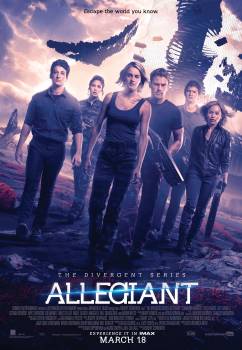
At some point, I forget which one has Meryl Streep (“The Giver”), which one has Julianne Moore (“The Hunger Games”), which one has Patricia Clarkson (“Maze Runner”), and which one has Kate Winslet and Naomi Watts (“The Divergent Series”). When this latest and second-to-last installment of the “Divergent” series has its lead characters scaling an enormous wall in response to a message from an entirely unknown source outside (like “Maze Runner”) and the romance heats up (“Hunger Games”) and another distinguished actor shows up to explain what is going on (“The Giver”), the narratives all sort of begin to merge.
So, let’s try to get it straight. “Divergent” is the one where a post-apocalyptic Chicago had genetically modified its inhabitants so that they each had one strength: compassion, intelligence, courage, honesty, and peacefulness. At age 16, each person is tested and assigned to the appropriate faction. He or she must leave the family; the faction is the family now. The test reveals that Beatrice “Tris” Prior (Shailene Woodley) is “divergent,” with multiple strengths. That makes her a threat to the system and to the people who control it, led by Jeanine (Kate Winslet), who was killed at the end of the last chapter. As this film begins, Tris and Four (Theo James) are deciding what to do about a message calling on them to leave Chicago to find out more about what role the Divergents can play to solve the problems that led to the creation of the faction system. Tris believes she must answer the invitation, but Four worries that it could be a trap.
Four’s mother, Evelyn (Naomi Watts), formerly a leader of the rebel forces, is now beginning to show Jeannine-like tendencies (yes, this is a lot like “Hunger Games”), allowing public executions. She tells Four, her long-estranged son, she is doing it for him, but he sees what she is doing as yet another betrayal.
Tris and Four make it beyond the wall (an extreme version of rappelling is the film’s best action sequence and the only one to match the adrenalin-surge and dynamism of the earlier film’s zip-wire scene) and, behind a digital “camo wall” find a community of “pures,” non-genetically modified people, led by David (Jeff Daniels), who explains in near-folksy genial terms that Chicago was an experiment and its inhabitants were constantly monitored, somewhere between lab rats and “The Truman Show.” Meanwhile, Four, her brother Caleb (Ansel Elgort) and her friends have been assigned to either monitor or fight (with some cool new drone gear).
There are some fancy visuals but as with the earlier chapters no special effects are close to the impact of Woodley’s hazel-colored doe eyes or James’ smoulder. And there’s a bright spot when we meet a new character, Matthew, sympathetically played by Bill Skarsgård, who looks more like the younger brother of “Madame Secretary’s” Erich Bergen than the real-life brother of the various handsome members of the Skarsgård family.
But the plot is overly complicated on the surface, padded (really, can we stop turning three books into four movies?), confusing, and unsatisfying, without the exhilaration we felt as Tris discovered and deployed her power in the first two. She spends too much time in a room listening to David, and a visit to Providence for a meeting with the Council is poorly handled. If this movie had a faction, it would be: placeholder until the last chapter.
Parents should know that this film includes extensive sci-fi/action violence with guns, explosions, and crashes, with many characters injured and killed, brief strong language, and non-explicit nudity in shadow.
Family discussion: Why did Evelyn think she had to use force, despite what had happened before? How did Four and Triss look at the invitation from outside the wall differently? Why did David lie?
If you like this, try: the earlier films in the series and the “Hunger Games” and “Maze Runner” films
Rated PG for thematic material, including accident and medical issues
Profanity:
None
Alcohol/ Drugs:
None
Violence/ Scariness:
Serious illness and peril involving children, sad death (offscreen)
Diversity Issues:
Diverse characters
Date Released to Theaters:
March 16, 2016
Date Released to DVD:
July 11, 2016
Amazon.com ASIN:
B01D1U6V58
Copyright Sony Pictures Entertainment 2016
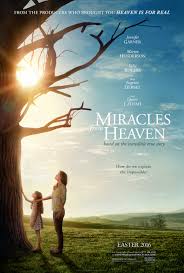
Christy Wilson Beam’s book title says it all: Miracles from Heaven: A Little Girl and Her Amazing Story of Healing. In the book, she tells the story of her daughter Annabel, critically ill with an incurable digestive disorder, who fell thirty feet from a tree branch. Incredibly, she was not injured. And even more incredibly, possibly even miraculously, she was cured.
All of this happens in the trailer, and the movie’s biggest challenge is that the entire story is not much more than that.
A happy, loving family is catapulted into crisis when their sweet-natured daughter becomes ill. It takes a long time to get the right diagnosis, and then it takes a long time to see the only doctor who may be able to help them. And then she gets sicker and sicker and the family is under more and more pressure. And then she climbs the tree and falls. The rest, despite the best efforts of the always-appealing Jennifer Garner, mostly seems like so much padding. So, so much padding.
Just to make sure we didn’t miss the title’s reminder of where miracles come from, we are told right at the beginning what a miracle is: not explainable by natural or scientific laws. And then we meet the Beam family, as adorable as the ray of sunlight of their name, living a life somewhere between a country song and a Hallmark commercial. Everyone is beautiful, loving, patient, and trusting in God. There are sun-dappled vistas and cute animals. They have a kindly preacher, played with warmth and good humor by John Carroll Lynch.
And then Annabel (a very sweet Kylie Rogers), the middle of their three daughters, gets sick. At first, doctors reassure them that it is a minor problem like lactose intolerance, but it turns out to be a major digestive disorder that distends her stomach and makes it impossible for her to eat.
They are told that there is just one doctor in Boston who may be able to help her, but he is so busy they cannot get an appointment. Desperate, Christy (Garner) brings Annabelle to Boston, goes to the doctor’s office, and begs for a chance to see him. While they wait, they meet a kind-hearted waitress (Queen Latifah in a role that verges on uncomfortably confined to quirky comic relief) who gives them a tour of the city (more padding), until they get a call that the doctor is available. Dr. Durko (an engaging Eugenio Derbez) has a great Patch Adams-style bedside manner, but his diagnosis is a heartbreaking one. Annabel is hospitalized, and shares a room with another very sick little girl, who is comforted by Annabel’s reassurance of God’s love and protection.
And then, back at home, Annabel climbs an old dead tree and falls 30 feet inside.
The most touching and inspiring part of the film is not the “miracle” cure of a fall that somehow caused no serious injuries and rebooted the part of Annabel’s brain that was not telling her digestive system how to work. It is when Christy thinks back and realizes how many miracles the family has experienced through kindness and compassion.
Parents should know that this film is about a very sick little girl and includes scenes of illness, with a sad (offscreen) death.
Family discussion: Why did some of the women in the congregation blame Christy? What tested the family’s faith most? Which moments of kindness meant the most to the family?

 . In the book, she tells the story of her daughter Annabel, critically ill with an incurable digestive disorder, who fell thirty feet from a tree branch. Incredibly, she was not injured. And even more incredibly, possibly even miraculously, she was cured.