Trailer: Nick Nolte and Robert Redford Hike the Appalachian Trail in “A Walk in the Woods”
Posted on August 17, 2015 at 3:38 pm
Writer Bill Bryson came back to the US after 20 years in Great Britain and decided to reacquaint himself with his home country by walking the Appalachian Trail. And he took along a friend, or maybe a friend-ish, a cranky guy who was the only one who would come along, primarily because he had nothing else to do. In the grand tradition of other hiking sagas like Wild: From Lost to Found on the Pacific Crest Trail
— but much funnier — he wrote A Walk in the Woods: Rediscovering America on the Appalachian Trail. Now it’s a movie with Robert Redford and Nick Nolte.
Peril, issues of parental death and abandonment, mean adults
Diversity Issues:
None
Date Released to Theaters:
August 14, 2015
Copyright ARC Entertainment 2015“Molly Moon and the Incredible Book of Hypnotism” is a cute family fantasy, based on the series of books about a spunky orphan by Georgia Byng. Raffey Cassidy, the enchanting young star who was the highlight of “Tomorrowland,” is perfectly cast as the determined Molly Moon, who learns from an old book how to use hypnotism to get people to do what she wants. Cassidy’s clear blue eyes are so mesmerizing that it is easy to believe they can bewitch anyone.
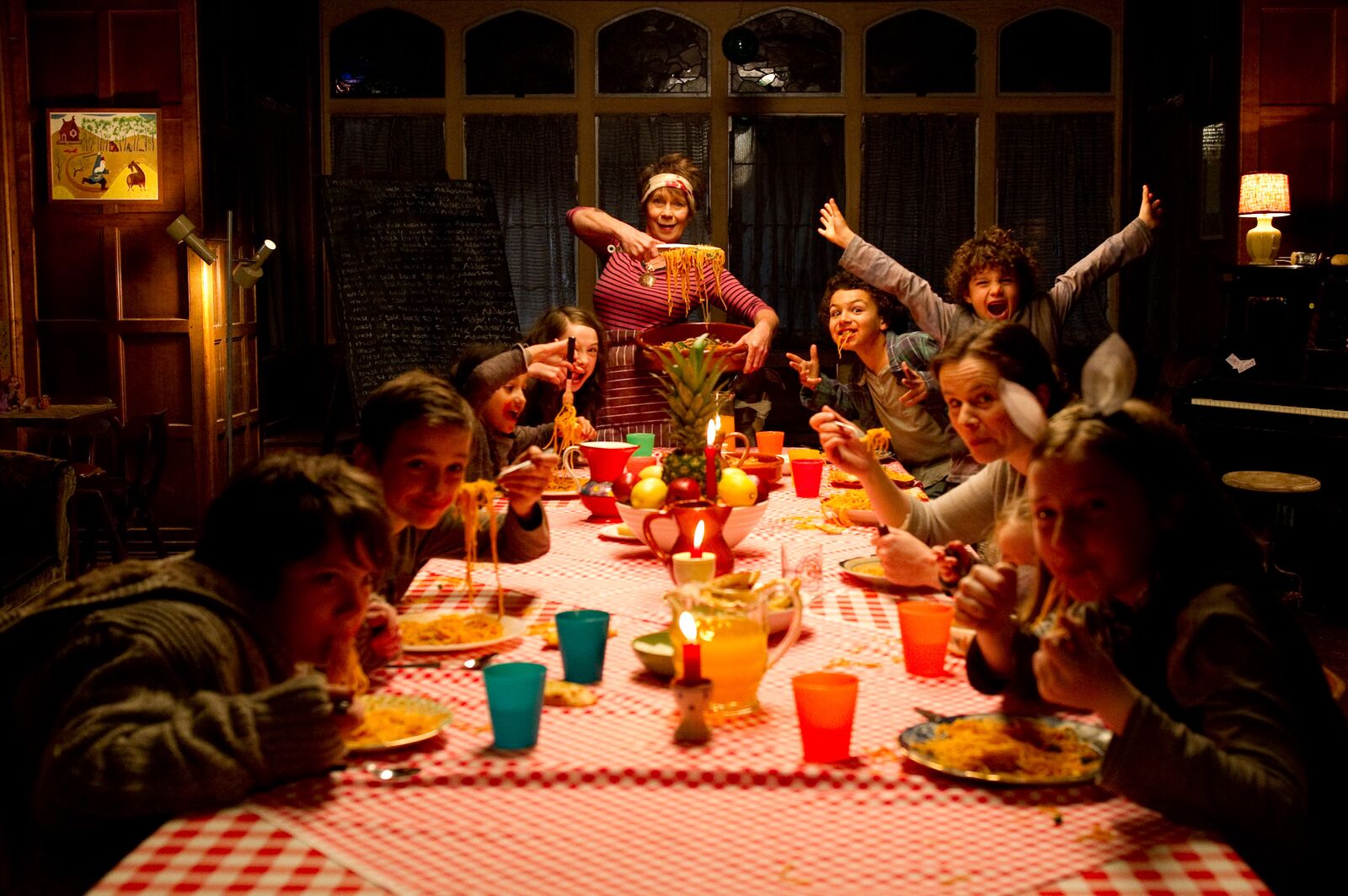
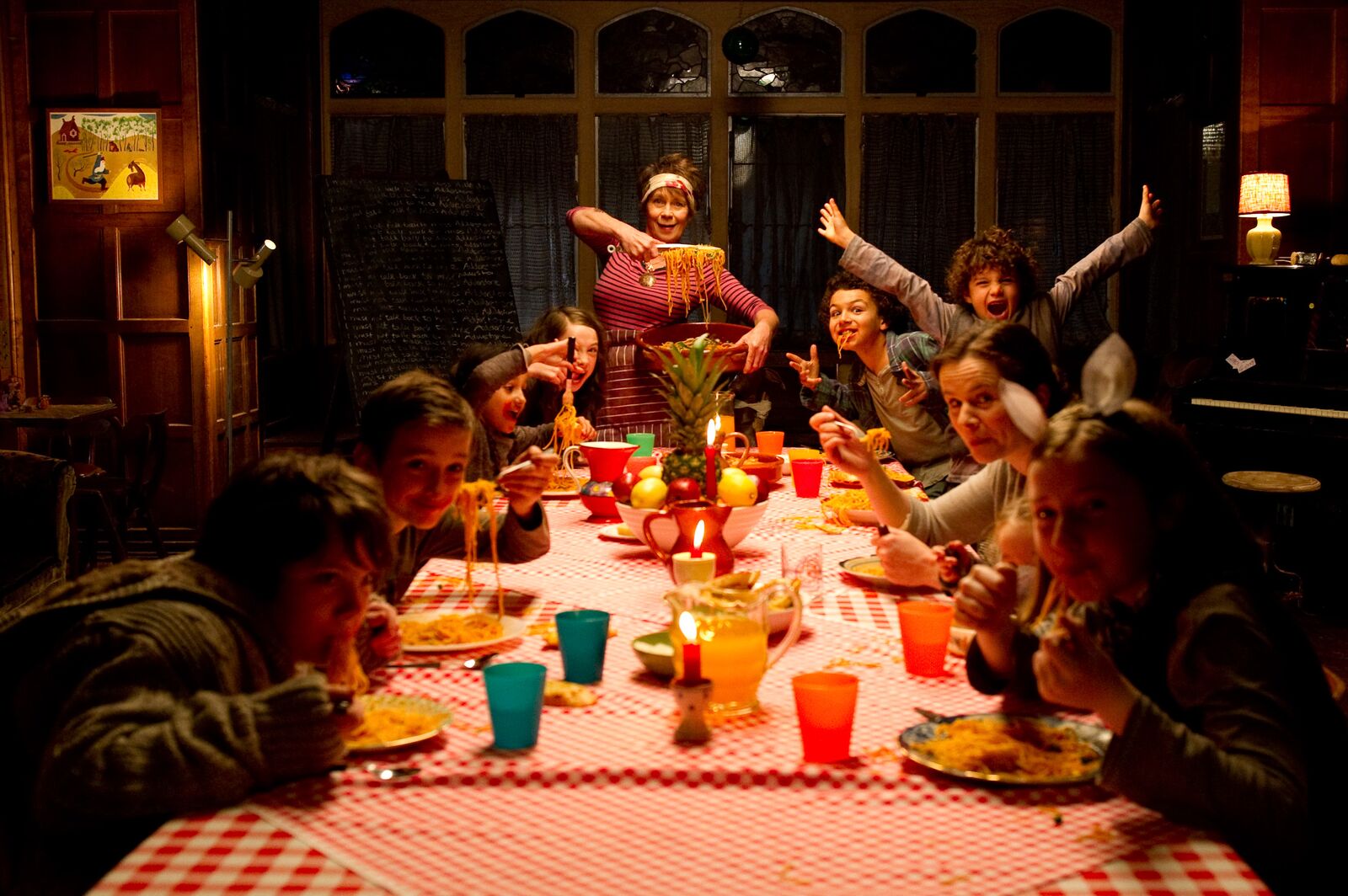
Molly lives in a Little Orphan Annie/Oliver Twist-style terrible orphanage, presided over by mean Mrs. Adderstone (Lesley Manville), with the disgusting food prepared by a cook named Edna (Celia Imrie). In this brutal environment, Molly’s only friend is Rocky (Jadon Carnelly Morris), a gifted singer. Molly promises to be there for his performance but lets him down twice because she is so captivated by an old book about hypnotism she found in the library. She tries out what she learned first on Mrs. Adderstone’s fierce dog Petula, who becomes friendly and devoted. And then she goes to work on Edna, who suddenly starts preparing delicious, wholesome meals for the children. She tries to work out some adoptions that would keep her with Rocky, but, angry and hurt because she broke her promise, he goes off with the wealthy Mr. and Mrs. Alabaster. Molly decides that what she needs is stardom. If she is rich and famous like pop star Davina (Tallulah Evans), she thinks she will be happy. She cannot sing or dance, but she does have the crucial skill — her ability to hypnotize extends not only to a television producer and a talk show host, but by the clever use of magnification, to almost everyone in the audience, not just in the theater where she is performing but those watching on television as well.
Meanwhile, someone else is trying to get the hypnotism book: a crook named Nockman (“Lord of the Rings'” Dominic Monaghan), spurred on by his crime queenpin mother (Joan Collins, as always, at her best playing bad). They want to use hypnotism for a big robbery. And if they can’t get there before a rival gang, maybe they can let them do the robbery and then rob them.
All of the performers, young and grown-up, are clearly enjoying themselves. Cassidy is one of the most appealing young actors in film, Emily Watson is very touching in a brief role as a sympathetic adult supervising the orphans, and Evans is excellent as a pint-sized diva. Director Christopher N. Rowley and director of photography Remi Adefarasin (“Match Point,” “Elizabeth”) keep the tone light and playful, enjoying the heightened fantasy elements of the story. It comes across like a fairy tale, with transformations and enchantments. And it is exceptionally understanding of the story’s villains. In order to hypnotize someone, Molly has to understand something about them. Even pretending to listen to them teaches her something about why acts that are inconsiderate or selfish are often based in hurt and fear. Molly herself is thoughtless and unfair at times. Like Spider-Man she has to learn that with great power comes great responsibility, and like Dorothy, she learns that there’s no place like home.
Parents should know that the film deals with parental loss and abandonment and with adults being cruel to children. They should also know that the film perpetuates inaccurate stereotypes of adoption, including the idea that prospective parents go to orphanages to pick out children as though they are buying groceries. There is some mild peril and brief language and crude humor.
Family discussion: Who would you like to hypnotize? Why didn’t Molly like being a pop star?
Dinotrux are huge creatures are half dinosaur, half construction vehicle. Ty Rux is a Tyrannosaurus Trux, and his best friend Revvit is a razor-sharp Reptool. Together they fight to protect their community from the wrecker D-Structs. Episodes will be available on Netflix August 14, 2015.
Rated R for language including some sexual references
Profanity:
Very strong and crude language
Alcohol/ Drugs:
Drinking and smoking
Violence/ Scariness:
Reference to suicide
Diversity Issues:
None
Date Released to Theaters:
August 7, 2015
Date Released to DVD:
November 9, 2015
Amazon.com ASIN:
B0153C71X8
Copyright A4 2015
Form illuminates content in this imperfect but compelling film based on the real-life audiotapes of a four day interview of author David Foster Wallace in the final days of his book tour for Infinite Jest.
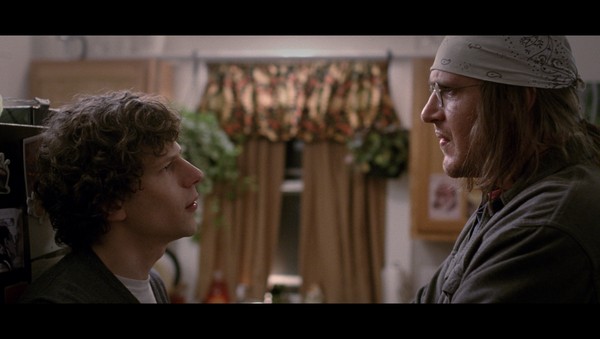
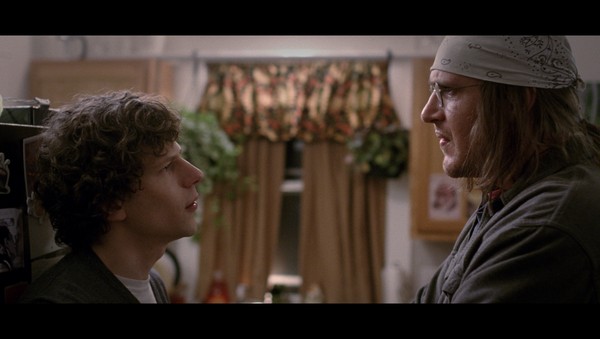
The subject of the interview is David Foster Wallace (Jason Segel), whose writing was densely and intricately layered. The journalist doing the interview is David Lipsky (Jesse Eisenberg), also a recently published novelist, though his book attracted no attention.
Lipsky persuades his editor at Rolling Stone that Wallace, whose book is a critical and commercial hit, would be a good subject for the magazine. And Wallace, now in the final days of his book tour, agrees to let Lipsky come along. Their wide-ranging (in geography and subject matter) conversation over four days reflects a constantly shifting set of expectations, assumptions, and goals for a construct so essentially artificial it hardly makes sense to call it a relationship. And yet, Lipsky literally moves into Wallace’s man cave of a home and for that time there is a simulation of some kind of friendship between them, at times even a sense that they could be friends, which they both seem to find unsettling and appealing. Wallace’s writing had a fractured, self-referential quality, filled with asides and meta-commentary. So it makes sense that the film has some of those qualities as well. If there were such a thing as cinematic footnotes, they’d be here. Instead, the context itself provides the footnotes. Wallace, whose great subject was American consumer culture, ends up in Minnesota’s Mall of America, eating in the food court as the indoor roller coaster zooms by.
Janet Malcolm famously described a journalist as “a kind of confidence man, preying on people’s vanity, ignorance, or loneliness, gaining their trust and betraying them without remorse.” We see some evidence of that in “The End of the Tour” but there are several other layers as well. The two men are about the same age, both writers, one lauded as one of the great novelists of his generation, one who released a book that got no attention at all. So Lipsky wants more from Wallace than a story. He is looking for guidance, validation, understanding. He acknowledges that he wants what Wallace has. At the same time he wants to understand why Wallace does not seem to want it. The two men are both relentless, even obsessive, self-observers. As Lipsky is recognizing the gulf between the kind of superficial details that make up a celebrity profile and what it means to actually know someone, he tries to find some kind of foothold. He wants to prove himself to his editor (in real life, the article was never published). And he wants to prove to himself that he is somehow in the same species as Wallace. There is a Mozart/Salieri element here as Lipsky’s greatest talent may be his ability to appreciate Wallace’s genius.
The commitment to verisimilitude is claustrophobic at times because almost all of the dialogue is taken directly from the tapes. An opening scene where Lipsky first hears of Wallace’s suicide and digs out the tapes adds nothing to the story. And yet again this is a case of form following content, as the near-obsessive, even fetishishtic, constricted particularity of the conversation is the kind of thing one of Wallace’s characters might do. The most telling moment in the film is when Wallace admits that he does not mind being profiled in Rolling Stone. He just does not want the profile to make it appear that he wants to be profiled in Rolling Stone. That is exactly the kind of fractured, Schroedinger-ian attraction/repulsion Wallace felt to the themes of his work: the gulf between presentation and reality, between observing and being, between attention and distraction. As Lipsky knew, it is a privilege to be a part of that conversation, even as we must be aware that it is the kind of entertainment — even at this ambitious level — Wallace would both want and not want to see.
Parents should know that this film includes very strong and crude language, sexual references, drinking, and smoking.
Family discussion: Why did Wallace agree to the interview? Why did he get angry with Lipsky?



 . Raffey Cassidy, the enchanting young star who was the highlight of “Tomorrowland,” is perfectly cast as the determined Molly Moon, who learns from an old book how to use hypnotism to get people to do what she wants. Cassidy’s clear blue eyes are so mesmerizing that it is easy to believe they can bewitch anyone.
 .
.
 .
.