Cinderella — With Music by Rodgers and Hammerstein
Posted on September 10, 2014 at 8:00 am
Every family will enjoy the 50th anniversary edition of the glorious Rodgers & Hammerstein’s Cinderella, starring Lesley Ann Warren, with Celeste Holm as the fairy godmother, Jo Van Fleet as the evil stepmother, and Walter Pidgeon and Ginger Rogers as the King and Queen. One of the ugly stepsisters is played by Pat Carroll, who would go on to provide the voice for one of Disney’s most memorable villains, Ursula in “The Little Mermaid.” And the prince is played by “General Hospital’s” Stuart Damon. The performances are delightful but the star of the show is the wonderful music from Richard Rodgers and Oscar Hammerstein. It was later remade with Brandy, Whitney Houston, and Bernadette Peters, equally delightful. And the rare first version with Julie Andrews is available now as well. All three are perfect for families to watch together.
“Cinderella” was the only musical Rodgers and Hammerstein (“Carousel,” “The King and I,” “The Sound of Music”) ever wrote for television. But it ended up on the duo’s home turf anyway when “Cinderella” became a Broadway hit, with Tony Award-winning costumes.
Rated PG-13 for thematic elements and some sexual material
Profanity:
Some strong language
Alcohol/ Drugs:
Drinking, including teen drinking
Violence/ Scariness:
The film's themes include a tragic accident, characters injured and killed
Diversity Issues:
None
Date Released to Theaters:
August 22, 2014
Date Released to DVD:
November 17, 2014
Amazon.com ASIN:
B00NT964VS
Copyright 2014 Warner Brothers Studio
Hamlet asked it best. “To be, or not to be: That is the question.” We struggle through, worrying about whether someone likes us or whether we will be accepted at the school of our choice. Those seem like serious problems. And then something really huge shows us how small those problems are, and forces us to confront the only question that matters: will we continue to “suffer the slings and arrows of outrageous fortune” or will we obliterate ourselves, and everything we can perceive?
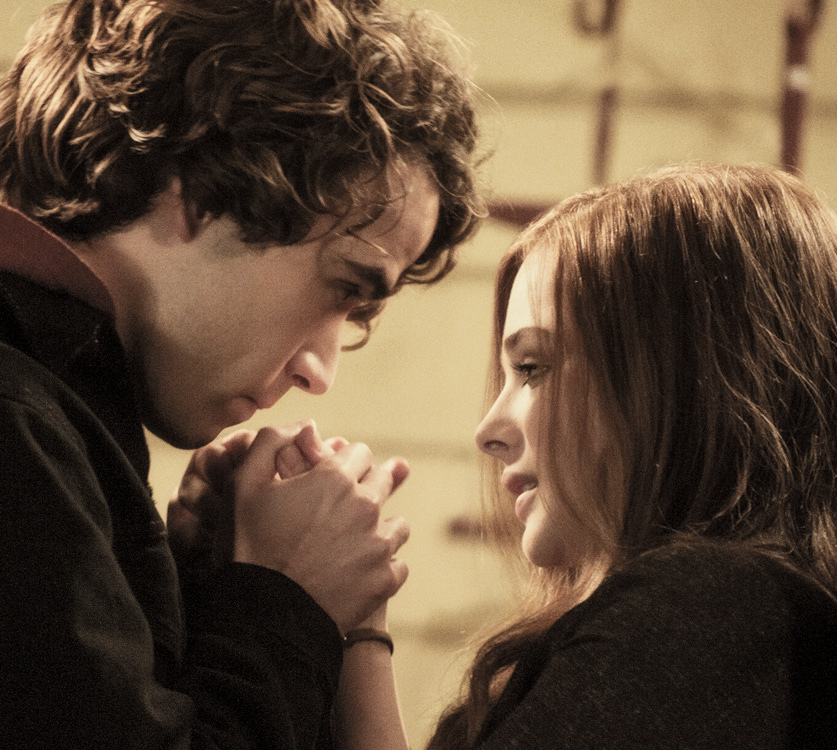
That is the question faced by a young cellist named Mia (Chloë Grace Moretz, in one of her first roles as a normal girl). She has a wonderful family, loving, supportive, understanding and remarkably hip and gorgeous parents (Mireille Enos as Kat and Joshua Leonard as Denny) and a not-too-pesky kid brother named Teddy (Jakob Davies). She has the kind of kindred spirit best friend who is always vitally interested in every detail and always on her side (“Trust’s” terrific Liana Liberato). And they are a part of a warm, loving community in Portland, Oregon that seems like an endless pot luck dinner party, seamlessly blending from one time and place to another, always filled with laughter and music.
And there is Adam (Jamie Blackley). He is the perfect combination of untamed/angsty and utterly devoted swain. He is supposedly a punk musician, though his performances are disconcertingly pop-ish with even a bit of emo. And he says swoon-worthy things like, “You can’t hide in that rehearsal room forever. It’s too late. I see you.” Mia feels like an outsider as a classical cellist in a family of rock musicians. And, of course, she attends high school with teenagers who have no interest in orchestral music. “Right on, I love classic rock,” one of them responds when Mia tries to explain the kind of music she plays.
Adam watches Mia rehearse and instantly sees that in the most important way she is just like him. She is someone who is not just moved by music, but saved by it. She says, “I loved the order, the structure, that feeling in my chest. Like my heart is beating with the cello.” The “whole messy live for the moment punk rocker thing” does not feel right to her.
Soon Adam and Mia are a couple. But then his group becomes successful and he starts to tour. And she may have a chance to go to Juilliard, on the other side of the country.
And then there is the accident. Mia’s family takes advantage of a snow day to go off on an excursion together, but a car slips on the ice and there is a very bad crash. The entire story is told as Mia’s spirit, alone in the limbo between life and death, able to see and hear everyone around her but not able to be seen or heard, is remembering her life, beginning to understand what has happened, and recognizing that it is up to her to decide whether to re-enter her body and fight to stay alive.
Gayle Forman‘s book is thoughtfully adapted by Shauna Cross (“Whip It”), who has a good sense of the inner lives of teenage girls. While Adam and Mia have their struggles, they are thankfully a step above the typical teenage drama (on and off-screen), and almost always respectfully handled and based in character and context and not the usual sitcom-ish miscommunication. Moritz takes on a tough challenge in playing a character who has to express so much anxiety with so little interaction with other actors, except in flashbacks. She does well, as does director R.J. Cutler in keeping an internal story visually engaging. If it doesn’t have the emotional impact of recent YA weepies like “The Spectacular Now” and “The Fault in Our Stars,” it is a touching story about an appealing young couple.
Parents should know that this film has literal life-and-death situations, with a serious accident, and characters injured and killed. It also includes strong language, teen drinking, and non-explicit sexual references and situations.
Family discussion: How did their families influence the different ways Adam and Mia saw their options? Why did Mia’s grandfather tell her she could go? What would you decide and why?
If you like this, try: “The Spectacular Now,” “Save the Last Dance,” and “Bandslam” as well as the book by Gayle Forman and its sequel, told from Adam’s perspective, Where She Went
If you want to not just see but hear an eyeball being pulverized, then see “Sin City: A Dame to Kill For.” If you want to see and hear it in the company of an audience who thinks that’s funny, buy a ticket.
Like the first “Sin City,” this sequel is co-directed by Frank Miller, who created the comic book series that inspired it, and Robert Rodriguez, and they have again perfectly transferred the dark pulp sensibility and striking visuals from page to screen. Like the first film, it is in stark shades of black, white, and gray, with splashes of color — bright red lips, shining blonde hair, sleek blue satin — and, of course, blood.
Sin City is a place of corruption, betrayal, and decay, of haunted souls who can’t remember or who remember too much. “How did I get here? What have I done? And why?” Marv (Mickey Rourke) asks as the film opens and he finds himself with some dead and dying guys. He does remember “wishing I had an excuse to break somebody’s face.” When he gets an excuse, he says he feels like Christmas.
The interlocking stories center on a young gambler named Johnny who wants to bring down crooked Senator Roark (Powers Boothe), who controls just about everything and everyone in Sin City, a private detective named Dwight (Josh Brolin) who takes photos of indiscretions for his clients and who knows he should not trust the woman he loved and lost to a man who could afford her (Eva Green as Ava), and a stripper named Nancy (Jessica Alba), who cannot decide whether she should kill the man who murdered her lover or just drink herself into oblivion and hope she can forget him.
People say a lot of tough things to each other. “They’ll eat you alive,” someone tells Johnny. “I’m a pretty tough chew,” he answers. Everyone in this film is a pretty tough chew. “Death is just like life in Sin City,” another one says. “There’s nothing you can do and love don’t conquer anything.” There are monsters everywhere in Sin City, and some of the most painful struggles are with the monsters within.
But that doesn’t keep people from trying.
There is a lot of artistry in “Sin City,” but it is so stylized that it calls attention to itself instead of its story, characters, or themes. The artistry in visuals and storytelling is so self-conscious it is fetishistic. It always keeps us at arm’s length. Despite superb work from everyone in the cast, especially Brolin, Willis, and Gordon-Levitt, the visuals are more striking than the story and ultimately they overpower it.
Parents should know that this is an extremely violent movie with themes of corruption and betrayal. People are injured, maimed, mutilated, and killed by a wide variety of weapons including a sword, knives, guns, pliers, and arrows. There are graphic and disturbing images and sounds. It also includes explicit sexual references and situations and nudity and strong language. Characters smoke, drink, and use drugs.
Family discussion: How do Dwight, Johnny, and Marv define justice? What do we learn from stories of corruption and betrayal?
If you like this, try: “Sin City” and the Frank Miller comics
Rated PG for thematic material, a scene of violence, and brief smoking
Profanity:
Mild language
Alcohol/ Drugs:
Smoking
Violence/ Scariness:
Shooting, very sad death, serious illness, parental abuse, tense confrontations
Diversity Issues:
Diverse characters
Date Released to Theaters:
August 22, 2014
This dreary assemblage of every possible sports cliché has one thing in common with the game it portrays. Every time it seems to be going somewhere, it stops.
More frustratingly, it wastes the opportunity to tell a good story by trying to squeeze in too many great ones. There are too many crises, too many story arcs, too few resolutions, too few reasons for us to invest in the outcome. When a movie is based on (or even “inspired by”) something that really happened, the first step has to be deciding what the theme is and streamlining all of the real-life details that are not central to that theme. Or, as a coach might say, “Don’t lose focus.”
The real-life high school football team that inspired this story is Concord, California’s De La Salle Spartans, from a small, all-boys Catholic school. They hold the all-time winning streak record for any sport in any category and at any level. We meet the team just as the streak is about to end. The last game of the season is the 151st win in a row. But then Coach Bob Ladouceur (Jim Caviezel) has a heart attack. A player is killed in a drive-by shooting. Another one becomes an orphan, responsible for his younger brother. The other teams do not want to play the Spartans anymore, so they take on the number one team in the state (in a game that is the subject of a book. The winning streak that went from 1992-2004 came to an end.
That’s an interesting place for a sports movie to begin, a refreshing change from the over-familiar sports movie storyline of a scrappy group of underdogs who have to learn to work together. And the film is sincere and good-hearted, though not much we haven’t learned from reading Kipling’s If, especially the part about understanding that winning and losing are both imposters. But the dramatic force of the narrative keeps being mowed down by so many over-familiar sports movie lines that the film’s greatest appeal may be as a drinking game. How many times do we have to hear about how the teammates are family, especially when we hear it more than we see it? (Though I did enjoy seeing the team come on the field holding hands like a kindergarten field trip.)
There is a lot to explore here about what we learn from winning and how much more we learn from losing. Ladouceur’s techniques include “commitment cards” with training goals, practice goals, and game goals, each one written by a player and shared with a teammate to help them understand they are responsible for each other’s performance as well as their own. It is good to hear a coach say that end zone antics are inappropriate and that the purpose of the training is not to produce great high school football players but responsible men.
A number of issues are set up or glancingly referred to without any real connection or follow-through, including some of the coach’s lessons about what matters more than winning. The coach’s son says that when he needed a dad he got a coach and when he needed a coach all he got was a “lame dad.” The coach’s wife (a criminally under-used Laura Dern) says he does not share himself with her or their children. Ladouceur acknowledges that he has been “a bad husband and a worse dad.” But all we see as a response is Ladouceur burning some burgers when he tries to grill.
We do not get enough of the history between the two players who struggle over whether they will stay together through college for it to be meaningful. A brutish father (Clancy Brown) pushes his quarterback son to break the state record in scoring, but the resolution is not set up in a way that makes it a triumph for anyone. Intrusive product placement from a sporting goods store is a distraction as well. As though to keep us on track, equally intrusive sports announcers keep reminding us what the stakes are. Even more intrusive is a musical score that is ploddingly obvious, with hip-hop in a black player’s home and syrupy pop over the white characters. Meanwhile, over on the sidelines (literally), Michael Chiklis as the assistant coach turns in the film’s most intriguing performance.
“It’s no longer about who the bigger, stronger, faster players are,” the coach who has the bigger, stronger, faster players says about playing against the Spartans. (You can tell what’s coming next, right?) “It’s about who plays with more heart.” The heart in this film is mostly over the end credits, where we see the truly inspirational Ladouceur and wish we had just seen a documentary about him instead.
Parents should know that this film includes the tragic murder of a teenager, serious illness of a parent, death of a parent, parental abuse of a teenager, scenes of wounded warriors in rehab, smoking, and brief crude sexual references
Family discussion: What goals will you put on your commitment card? Why didn’t the coach want his players to pay attention to the streak? What was his most important lesson?
Rated PG-13 for a mature thematic image and some sci-fi action/violence
Profanity:
Some strong languge
Alcohol/ Drugs:
Citizens are required to take drugs to make them submissive
Violence/ Scariness:
Sci-fi-style apocalyptic violence, murder, peril, characters injured and killed
Diversity Issues:
A theme of the movie
Date Released to Theaters:
August 15, 2014
Date Released to DVD:
November 24, 2014
Amazon.com ASIN:
B00MU2P0HO
Copyright 2014 The Weinstein Company
“Thank you for your childhood.” Are there any more fearsome words in literature than these?
Lois Lowry’s The Giver is a Newbery Award-winning novel, a staple of middle school reading lists and book reports. It tells a dystopian story of a post-apocalypse society that is pleasantly courteous on its surface, but rigidly regimented and ruthlessly enforced. As children come of age and are assigned to their future careers by the all-powerful elders (who will later assign their mates and children as well), they are thanked for their childhood, words that sound grateful and polite, but which imply that all lives belong to the community, which demands that childhood be somehow contributed. And, it clearly communicates that whatever freedoms or pleasures of childhood exist in this society, they are now in the past.
“From the ashes of the ruin,” we are told, “the communities were built” and “true equality” was achieved. Whoever designed these new communities made the decision that human life could only continue if all memories of the past were erased, so that the sources of catastrophic conflicts — individual and cultural differences, were wiped out, along with the freedom to chose that inevitably leads to jealousy, anger, and struggles for power. Fear, pain, envy, hatred, are all gone. So are colors. We see their world through their eyes, muted greys, no color, no music, no art. There is constant discussion of “precision of language,” but it is just a way to eliminate words that describe strong emotions or complicated concepts, while genuinely imprecise words like “elsewhere” and “release” are euphemisms for dire and tragic consequences. People “apologize” all the time but there are no real regrets and the “I accept your apology” responses are just as perfunctory.
Three friends, the serious Jonas (Brenton Thwaites), fun-loving Asher (Cameron Monaghan), and kind-hearted Fiona (Odeya Rush) are about to receive the thanks for their childhoods and be assigned their jobs. Jonas is worried but his “parents” (a couple assigned to each other and handed babies from a collective nursery) reassure him that the Elders will make a good assignment, whether it is as a laborer, a nurturer (caretaker of infants and elderly), a lawyer (like his mother), or one of the other jobs that keep the community going.
But at the assignment ceremony announcements, Jonas is skipped over. Only when everyone else has been assigned does the Elder (Meryl Streep in Very Serious Hair) tells the group that Jonas has been selected for a very important job. The founders of this post-Ruin society erased all memories of the past but recognized that there might be some circumstances when mistakes could be prevented by reminders of past failures. And so, it turns out, one isolated member of society is designated to be the repository of memories. Jonas has been selected to be his successor. He tells Jonas that because he is transferring the memories, he is The Giver (Jeff Bridges). There is a lot of pressure on The Giver and Jonas because a previous effort to find a new keeper of memories (a small role for Taylor Swift, unglammed and made under) failed.
The story retains its power, despite an uneven translation to screen, in part because the book has been so influential that its ideas are no longer as innovative. There is now an entire literary genre about repressive dystopian societies where it is up to an exceptionally attractive and very brave and talented teenager to save the day: Divergent, The Hunger Games, and the upcoming “The Maze Runner.” Those stories have some similarities — the imposition of sometimes-fatal assignments by all-powerful adults, the rigidity and corruption of the society. But the other stories are more inherently cinematic than The Giver, with a lot of the interaction here limited to conversations. The muted emotions and colors are better imagined by a reader than watched as a viewer. Streep and Bridges give uncharacteristically one-note performances in one-note roles. Only Alexander Skarsgård as Jonas’ “father,” a nurturer in the facility where all the newborns are kept for the first year, gives his character some nuance and complexity, particularly in one very difficult scene that shows Jonas just how ruthless the seemingly placid and egalitarian community really is.
Indeed, that is one of the few scenes that seems to come alive. On film, the book falters, more weighted by ideas than by story or character. Despite the gifted work of production designer Ed Verreaux, whose setting convey placid exterior and deeper menace and director Philip Noyce, who uses music and color to deepen the emotional resonance, the film still feels thinly conceived. The Giver can transmit tumultuous events and powerful emotions with a touch. But the audience never achieves that visceral connection.
Parents should know that there is disturbing dystopic material in this story including peril and attacks, murder of people deemed unwanted or superfluous and mandatory drugging of the entire population, some graphic images, reference to adolescent “stirrings,” and a kiss.
Family discussion: If you were The Giver, what memories would you share and why? What are the reasons someone might think this was a better way for societies to function?
If you like this, try: “Pleasantville,” “The Hunger Games” and “Divergent” and the three sequels to this book by Lois Lowry.




 . The winning streak that went from 1992-2004 came to an end.
 and
and 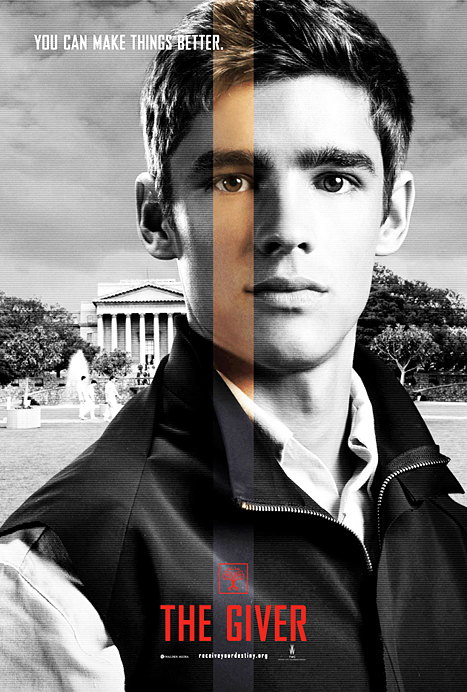
 is a Newbery Award-winning novel, a staple of middle school reading lists and book reports. It tells a dystopian story of a post-apocalypse society that is pleasantly courteous on its surface, but rigidly regimented and ruthlessly enforced. As children come of age and are assigned to their future careers by the all-powerful elders (who will later assign their mates and children as well), they are thanked for their childhood, words that sound grateful and polite, but which imply that all lives belong to the community, which demands that childhood be somehow contributed. And, it clearly communicates that whatever freedoms or pleasures of childhood exist in this society, they are now in the past.