
Snowpiercer

Posted on July 1, 2014 at 6:00 pm
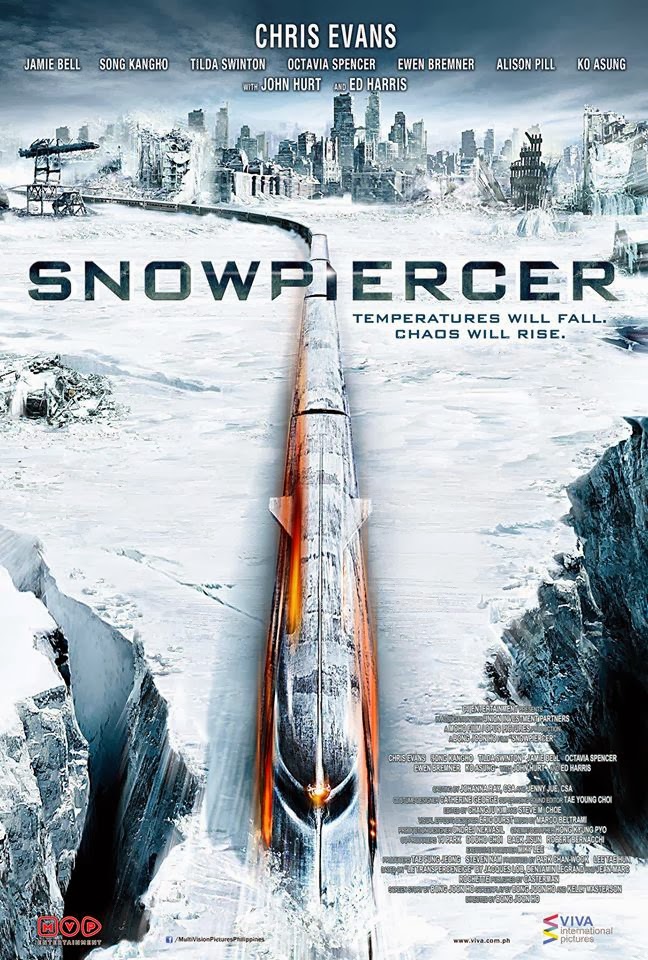
Snowpiercer-posterA French graphic novel by Jacques Lob about a post-apocalyptic train containing all that is left of humanity is now the first English-language film from Korean director Joon-ho Bong (“Mother,” “The Host”), with an international cast that includes Chris Evans, Jamie Bell, Ed Harris, and Tilda Swinton.  It is a visually stunning and intellectually ambitious allegory with all of its action and sci-fi imagination in service of provocative commentary.

In an effort to mitigate the damage from climate change, people all over the world shot a chemical into the air that precipitated an overcorrection so extreme that the entire world is covered with snow and ice and is not longer habitable for humans.  Seventeen years earlier, the few remaining people were allowed to board a train designed by Mr. Wilford, who still lives in the train’s first car and keeps its engine running.  He is considered something like a king or even a god by the train’s passengers, some of whom are 17 or younger and have never known any life off the train.

The train circles the globe once a year, and measures the passage of time by the landmarks it passes. After a brief prologue with snippets of news reports informing us of the environmental catastrophe, we meet the poor, filthy, brutally abused inhabitants of the train’s last car, including Curtis (Chris Evans, almost unrecognizable in a black knit cap and with a haunted expression) and his best friend Edgar (Jamie Bell).  They are kept barely alive through doling out of icky looking “protein bars.”  And they are kept in control by masked, brutal guards armed with assault weapons.  There have been brief attempts at rebellion or escape but all have failed.

Occasionally they are visited by someone from one of the forward cars.  Mason (Tilda Swinton, brilliant as a demented apparatchik) has the most terrifying smile of chipper malice since Imelda Staunton as Dolores Umbridge. And there is another woman who appears from time to time to measure the children in the last car and take some of them away with no explanation. They are never seen again. Curtis reveres Gilliam (John Hurt), a disabled old man who encourages Curtis and Edgar to start a real revolution. But one lesson they have learned from the failed attempts is that it cannot work unless they get all the way to the front car and gain control of the engine. That means they will need to break out of the train’s prison the only man who can unlock the doors between the train cars.

The rebels move forward, at devastating cost, surging through a series of train cars, each with stunning revelations about what has become of human society. But nothing can prepare them for the shocks of the final confrontation in the engine car.

If Jonathan Swift was a filmmaker, this would be the movie he’d make — sharp, compelling, challenging.  As Curtis crosses doorway after doorway, each opens into another remarkable tableau, a beauty salon, a fish farm, a classroom, a disco.  This is a story that is richly imagined and powerfully presented.

Parents should know that this film has apocalyptic themes and images, constant peril and violence with a variety of weapons, disturbing images, many characters injured and killed, constant very strong language, smoking, and drugs and drug addiction.

Family discussion:  What elements of the society on the train are similar to cultures in the world today?  Does Wilford make good points about what it takes to sustain a community?  How does this story explore the way that myths and traditions are developed?  What do you think will happen next?

If you like this, try: “Brazil” and “In Time”
Related Tags:


Action/Adventure Based on a book Comic book/Comic Strip/Graphic Novel Environment/Green Science-Fiction

Think Like a Man Too

Posted on June 19, 2014 at 6:00 pm

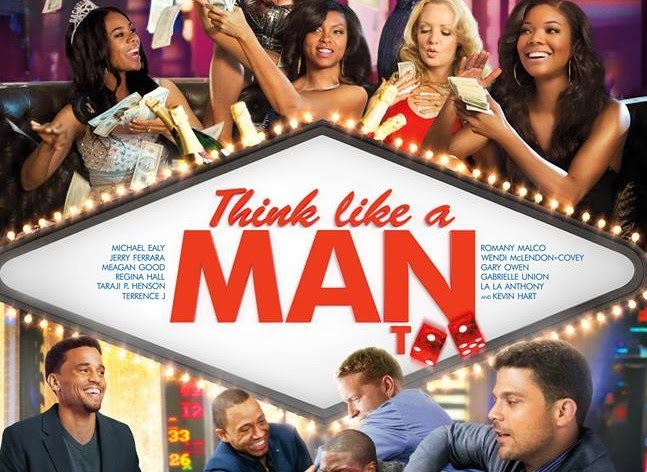
Think-Like-a-Man-Too-Poster-647x472A romantic comedy based on Steve Harvey’s book of advice for women about relationships has now led to a sequel based on finding the slightest possible premise for getting the gang back together to see if they can create some more box office magic.

Not that there’s anything wrong with that.  After all, seeing pretty people do silly things so they can kiss and make up is always a good reason to go to a movie.  And these are some of Hollywood’s most appealing performers.

In the first film, a group of buddies with a regular basketball game find themselves flummoxed by a bevy of beauties who read Steve Harvey’s book for tips on dealing with players, mama’s boys, and perpetual adolescents.  The happily ever after ending has now led to a proposal and the whole group is going to Las Vegas for separate wild pre-nuptial parties followed by the wedding itself.  When the groom-to-be assures his bride that everything will be perfect and nothing can possibly go wrong, we know that nothing will be perfect and everything will go wrong in the most humiliating way possible until we find our way to another happy ending with a possible opening for #3, which I hereby predict will involve a baby or two.

Would-be chef Dom (Michael Ealy) and corporate powerhouse Lauren (Taraji P. Henson) are deeply in love but struggling with job opportunities in different cities that they are afraid to tell one another.  Mya (Meagan Good) is not happy to run into stories about the wild past of “Zeke the Freak” (Romany Malco). Kristen (Gabrielle Union) wants to get pregnant as quickly as possible and that puts a lot of pressure on Jeremy (Jerry Ferrara).

But the development that has the biggest impact on the film is the one that happened off-screen.  Since the first one was released, Kevin Hart has become a box office powerhouse with a concert film in 2013 and two enormously successful comedies already in 2014 (About Last Night and Ride Along).  This is most likely the reason that he takes up so much more of “Too” than he did in the first one.  And since is a very loud guy, he seems to take up even more than he does, too often with all the appeal of a buzzing mosquito.

The entire premise of the first film is jettisoned, along with any aspirations beyond silly fun.  It takes Cedric (Hart) far too long to figure out that he has mistakenly booked himself into a room that costs ten times what he thinks, because every time there is any possibility to mitigate the damages of whatever he has gotten himself into, he blusters like a bantam rooster to block any kind of reality check from the other characters.  And this is close to the movie’s most plausible plotline.  Even Lucy and Ethel could not make us believe that anyone cares whether the boys or the girls have a wilder pre-nuptial party.  Director Tim Story throws in every possible signifier of movie fun, from a makeover (“Bridesmaids'” Wendy McLendon-Covey) to a dance number (okay, the girls’ dancing to Bell Biv DeVoe’s irresistible “Poison” is a treat) and the ever-popular night in the pokey plus the completely superfluous addition of a couple of cute white guys (Adam Brody and “About a Boy’s” David Walton.

The cast is clearly just here to have a good time, and the audience will, too.

Parents should know that this film includes some strong language including crude sexual references and humor, sexual situations, strippers, drinking and drunkenness, and drug use, along with a lot of foolish Las Vegas behavior.

Family discussion:  What were the groups trying to accomplish in their pre-nuptial parties?  Which couple has the strongest relationship?

If you like this, try: the first film and “About Last Night” (rated R), also featuring Hart, Ealy, and Hall.

Related Tags:


Based on a book Comedy Date movie Romance Series/Sequel

Edge of Tomorrow

Posted on June 5, 2014 at 6:00 pm

Are there moments you would like to relive, so you could make a different choice?edgeoftomorrow poster

It’s a universal fantasy that has played out many times in books and films. It can be a gift (About Time). It can be a curse, though a curse with some benefits that could involve saving the world, personal growth, and falling in love (“Groundhog Day,” “Source Code”). In “Edge of Tomorrow,” Tom Cruise plays Major Bill Cage, a slick military officer who stays far away from the fighting by handling press relations for the global effort to defeat mechanical spider-y aliens called Mimics. A general (Brendan Gleeson) wants to send him to the front to get footage of the battle. Cage’s usual smooth patter fails to dissuade him, so he tries blackmail, which so infuriates the general he is demoted and sent to the front, not to shoot movies but to shoot Mimics. He gets hollered at by a Kentucky non-com named Major Sergeant Farell (Bill Paxton), thrown into a exo-skeletal fighting suit, and dropped from a plane, where he gets killed. End of story.

Except that it isn’t. Cage somehow has been caught up in a time loop that keeps bringing him back to that rude awakening in Farell’s division. Like a video game character, when he gets killed, the system is reset and no one but he remembers that it has all happened before. Over and over, he repeats the same actions. No matter what he does, nothing changes until in the midst of battle he meets up with the war’s most decorated soldier, Rita (Emily Blunt), who looks him in the eye and says, “Come find me when you wake up.”

It feels like a nightmare, but it is not. To explain more about what is going on would be to spoil some of this highly entertaining film’s best surprises.  Director Doug Liman and editor James Herbert are terrific at using the re-sets to add energy to the storyline rather than bogging it down.  They use different angles and pacing to help us keep it all straight, even though sometimes we follow Cage back to his original starting point and sometimes we join him well into another foray, not realizing until just the right moment how many tries it took him to get to that point.  Liman deftly plays the rinse-and-repeat familiarity for both us and Cage as comedy and as thriller as needed. Big props to the creature designers, too.  The Mimics are like lethal tumbleweeds made of razorblades, moving at hyperspeed.

Cruise describes himself on Twitter as “running in movies since 1981,” but growing up in movies is something he has done just as often.  He is just right as the slick and callow advertising man turned press relations officer who has to find a way to stay alive and then find a way to save the world.  Blunt is excellent as the battle-worn veteran.  As Cage has to find his inner soldier, Rita has to ask herself whether she can let go of hers, lending just enough emotional heft to the storyline to keep the story moving forward even when the events are repeating.

Note: the DVD release is renamed “Live Die Repeat”

Parents should know that this film includes constant sci-fi/action-style peril and violence with scary aliens and many characters injured and killed.  There is some strong language including one f-word.

Family discussion:  What did Cage learn about himself by repeating the same day?   Why didn’t he tell Rita about the helicopter at first?

If you like this, try: “Source Code” and the graphic novel that inspired this film, All You Need Is Kill by Hiroshi Sakurazaka

Related Tags:


3D Action/Adventure Based on a book Comic book/Comic Strip/Graphic Novel Fantasy IMAX Romance Science-Fiction War

The Fault in Our Stars

Posted on June 5, 2014 at 6:00 pm

fault-in-our-stars-poster-largeJohn Green’s best-selling novel, The Fault in Our Stars is the story of kids with cancer, but it is not about dying.  It is about living.  This exquisite adaptation is that rare film based on a beloved novel that does full justice to the source material without being static or talky.  The screenplay is by Scott Neustadter and Michael H. Weber, who showed exceptional sensitivity in the bittersweet love stories “(500) Days of Summer” and “The Spectacular Now” (also adapted from a beloved YA book and also starring Shailene Woodley), and it was directed by Josh Boone, of the underrated “Stuck in Love” (also starring Nat Wolff, who appears here as a friend of the central couple).  

Remember the hospital scene in “Terms of Endearment?”  This one will make you cry more.  But it is sad, not depressing.

Woodley plays Hazel Grace Lancaster, whose lungs have been badly compromised and who cannot breathe without a nasal cannula attached to an oxygen tank.  Pushed by her mother to attend a support group that meets “literally in the heart of Jesus,” with a guitar-strumming leader who is well-intentioned but unwilling to acknowledge the direness of the circumstances, Hazel catches the eye of lanky Augustus Waters (Ansel Elgort, and yes, he played her brother in “Divergent”).

She’s the nerdy girl, he’s the basketball-player and cool guy, which is the classic high school movie romantic setup for opposite attraction except in this case what they have in common is more important than what table they would sit at in the school cafeteria.  He is not playing basketball anymore because his leg was amputated due to cancer.  What brings them together is not the cancer but the shared worldview they developed as a result of the cancer, with few illusions but an openness to hope, if not hope for a longer life, at least hope for a better life.  Hazel worries that she is “a grenade,” that the most significant impact her life will have is the devastating grief she leaves behind.

Hazel and Augustus exchange favorite books.  His is a novelization of a video game.  Hers is an ambitious, literary novel by a reclusive author named Peter Van Houten (Willem Dafoe, superb in a tricky role).  The book ends abruptly, in the middle of a sentence, when its main character dies, and Hazel is overcome with curiosity about what happens to the characters she left behind.  For all they have lost, they still have “cancer perqs,” privileges that come with the combination of pity and guilt felt by people around them.  Augustus takes advantage of his to help Hazel meet Van Houten.  But it is in the other parts of the journey that they find more important answers and better questions as well.

The characters in the movie like to say, “it’s a metaphor,” but their own story is a metaphor about the issues we all grapple with.  Watching people whose biggest problem should be what to wear to the prom confront the problem of making sense of life, finding meaning, risking intimacy is a heightened version for dramatic purposes.  But these are the core challenges for all of us, whether our lives will last for 16 years or 116.  These teenagers just do not have the luxury the rest of us do of being in denial about how little time there is.

Elgort is marvelous, but then he gets to say swoon-worthy lines like “You realize that trying to keep your distance from me will not lessen my affection for you. All efforts to save me from you will fail.”  On the other hand, he has the challenge of grandiloquent lines like. “It would be a privilege to have my heart broken by you,” and he says them beautifully.  Woodley is in every way (except literally) the heart of the film, and once again delivers a performance of endless sensitivity, even with a cannula in her nose.  Fans of the book will find key scenes like the egging of a car and the ultimate romantic restaurant date exactly as they envisioned it.  Even the trip to the Anne Frank house, which could have been heavy-handed, is handled well.  Anne Frank is, in a way, the spiritual sister of Hazel and Augustus.  Like them, she had to find meaning in the midst of devastation.  As they walk through the hidden annex where she lived, her words of hope come out of tinny display speakers.  And Hazel’s climb up the steep steps to see it is itself a “shout into the void.”

I like the way they call each other by their full names.  Even though their time is limited, addressing each other with a touch of formality and grandeur is too important for short cuts.  I like the intensity and honesty of their talks; anything less they know they do not have time for.  The title comes from Shakespeare’s “Julius Caesar.”  The nobleman Cassius says to Brutus: “The fault, dear Brutus, is not in our stars,/But in ourselves, that we are underlings.”  He is saying that it is we who determine how we live.  But the line that I think of when I see this film is from poet Rabindranath Tagore, who wrote, “The butterfly counts not months but moments, and has time enough.”

Parents should know that the theme of the film is teenagers with cancer.  Many characters are very ill and there is a very sad death, as well as brief strong language, sexual references and situation, teen drinking and adult alcohol abuse.

Family discussion: What questions would you like to ask an author about a book you like? How should you choose who will hurt you? What makes some infinities larger than others?

If you like this, try: the book by John Green and the films “Harold and Maude” and “Restless”

Related Tags:


Based on a book Date movie Drama Romance Stories about Teens Tragedy

Fault in Our Stars: The Real Story

Posted on June 4, 2014 at 3:59 pm

The film of John Green’s The Fault in Our Stars, 72 weeks on the best-seller list, comes to theaters this week, starring Shailene Woodley and Ansel Elgort as teenagers with cancer who manage to find love and meaning in a world of pain and loss. Green based the characters on teenagers with cancer he met working as a student chaplain.

Hazel Grace, played by Woodley, was inspired in part by Esther Grace Earl, who died at age 16 in 2010. Her journal and letters are collected in This Star Won’t Go Out: The Life and Words of Esther Grace Earl. Green wrote an introduction to the book, and Fault in Our Stars is dedicated to her. All proceeds from the book go to helping young people with cancer.

Her parents spoke about her in an interview with WBUR.

Related Tags:


Based on a book The Real Story
THE MOVIE MOM® is a registered trademark of Nell Minow. Use of the mark without express consent from Nell Minow constitutes trademark infringement and unfair competition in violation of federal and state laws. All material © Nell Minow 1995-2026, all rights reserved, and no use or republication is permitted without explicit permission. This site hosts Nell Minow’s Movie Mom® archive, with material that originally appeared on Yahoo! Movies, Beliefnet, and other sources. Much of her new material can be found at Rogerebert.com, Huffington Post, and WheretoWatch. Her books include The Movie Mom’s Guide to Family Movies and 101 Must-See Movie Moments, and she can be heard each week on radio stations across the country.

Website Designed by Max LaZebnik