Noah

Posted on March 27, 2014 at 8:00 pm

B+
Lowest Recommended Age: Middle School
MPAA Rating: Rated PG-13 for violence, disturbing images and brief suggestive content
Profanity: None
Alcohol/ Drugs: Drinking and drunkenness
Violence/ Scariness: Disturbing images, peril, chaos, characters injured and killed, dead bodies, violence, attacks, sexual assaults, girls sold into slavery
Diversity Issues: None
Date Released to Theaters: March 28, 2014
Date Released to DVD: July 28, 2014
Amazon.com ASIN: B00JBGWP3Y

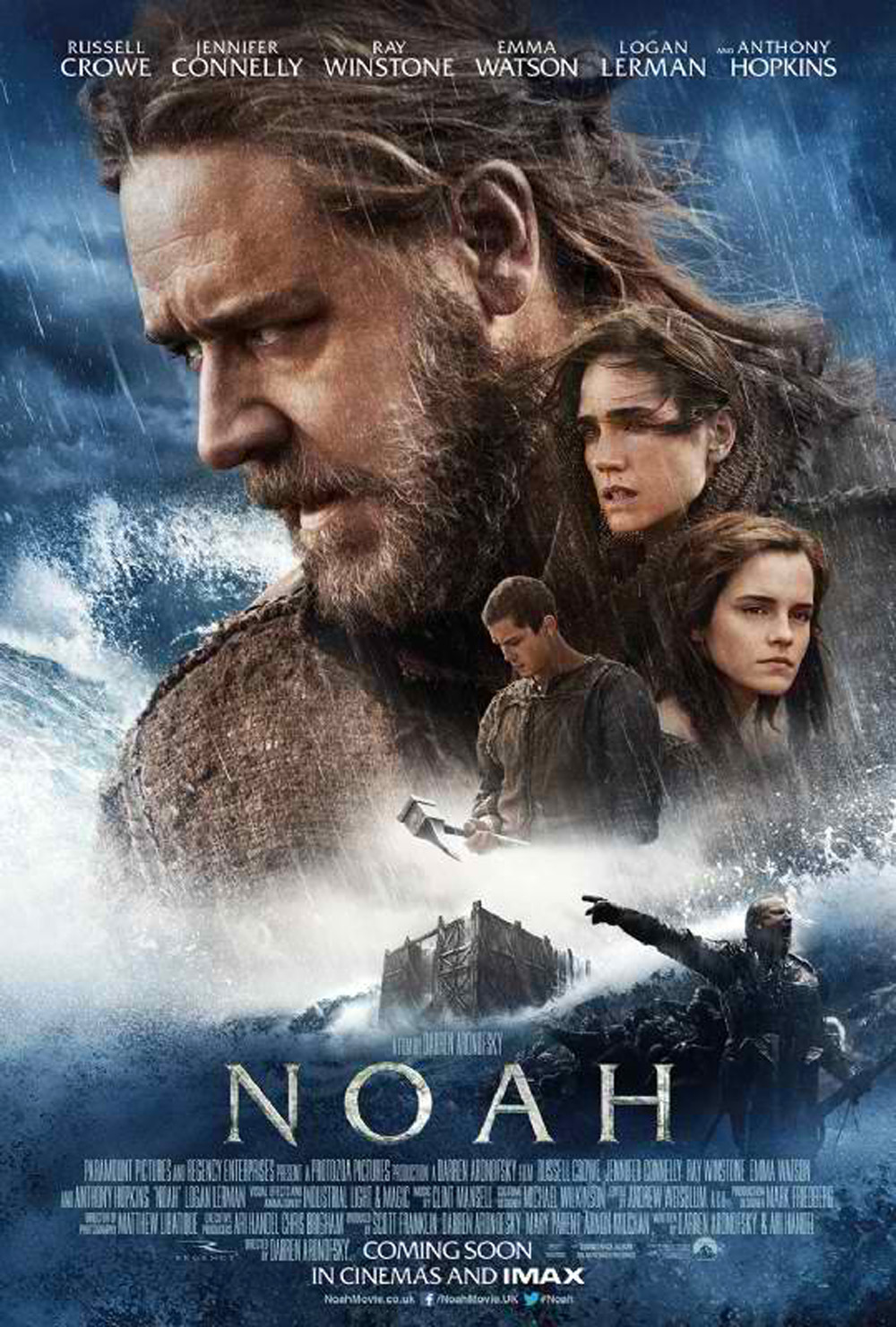
Noah_poster“Noah” is a serious, thoughtful, reverent movie that, like its title character, wrestles with the big issues of morality, survivor guilt, and strengthening a connection to the divine.  It is also a big, grand adventure with drama and special effects.  It should satisfy believers, seekers, and those who just want an exciting story, well told.

Writer/director Darren Aronofsky (“Black Swan”) shows us a Noah (Russell Crowe) who struggles to be a good man and do as God wants. Only ten generations from Adam and Eve, he is haunted by the stories of the Fall and Cain’s murder of his brother. When he was a boy, he witnessed the murder of his own father at the hand of the brutal leader of the descendants of Cain (Ray Winstone as Tubal-Cain). Now, he tries to protect his wife, Naameh (Jennifer Connelly), and three sons from the marauders.

Noah lives lightly on the earth, gently chiding his son for picking a flower because that interfere with its work of spreading seeds. He and his family do not eat animals; they respect the innocence of all creatures, unlike Tubal-Cain who defines himself as someone who takes without regard for anything but his own urges and lust for power.

Noah is filled with an ominous sense that he is receiving omens and seeks the advice of his mystic of a grandfather, Methuselah (Sir Anthony Hopkins).   He begins to understand that he is commanded by The Creator to build an ark and collect the animals of the earth and to preserve them in the coming storm that will wipe out all of life on Earth.  He will be helped in this by The Watchers, fallen angels who were once pure light but are now punished for their mistakes by being imprisoned in enormous bodies of mud and rock.

As Auden reminds us, the grand, sweeping events of the world do not happen purely.  They occur in the midst of human lives that are messy and imperfect.  While Noah struggles to follow the will of The Creator, he has to deal with problems at home.  Ila (Emma Watson), a girl Noah and his family rescued after her entire community was slaughtered by Tubal-Cain, is loved by Noah’s son, Shem (“Romeo & Juliet’s” Douglas Booth), who loves her, too.  But due to her injuries, she cannot have children, and she does not want to keep him from being a father and creating a new generation.  Ham (Logan Lerman of “Percy Jackson”) is furious that there is no prospect of a wife and family for him.

And then there is Tubal-Cain, used to taking whatever he wants.  He will do anything to stay alive through the flood and become king of whatever the world will be afterward.   And he senses that Ham may be susceptible to joining him.

We rarely see Bible stories told with such artistry and power.  The acting is superb and the special effects are well done.  The big moments, the flood, the omens, the Watchers, the thousands of animals moving inexorably toward the ark, are all handled with meaning and import.  When Noah tells his family one of the few stories that they have in this still-new human world, the story of creation, we feel the nothingness that was before.  Story-telling itself becomes a way to shape the world and form an understanding of patterns, purpose, and meaning.

Men wind a snakeskin around their arms in the earliest of rituals and prayers and we see the flicker of what would become a daily observance for Orthodox Jews over the millennia through the present, the phylactery leather strips that men use in their morning prayers.  We are reminded that this is a time before Jesus and before Abraham, when there was no organized religion and no established set of beliefs and practices.  There is not even the word “God.”  It is just “Creator.”

The innocence and the impulse to reach out toward the heavens are very moving.  So is the way that Noah grapples with what today we might call survivor guilt or PTSD.  And he struggles to find his better angels.  Tubal-Cain is not just a man who wants to fight him; he is that part of Noah himself that is all lower urges toward flesh and power, the impulse to trap and smash and to break laws even in a world where laws have not been established.

While some viewers and some who have not even seen the film have objected to this portrayal (or, in the case of strictly Muslim groups, any portrayal of a religious figure), most should see this film as an eternal story well told in a manner that is itself a form of worship in prompting us to think more profoundly about our own choices and connections.

Parents should know that this film includes epic/Biblical violence including murder, battles, flood, some disturbing images, parent killed in front of child, character trampled to death, discussion of infanticide, some disturbing images, non-explicit sexual situation, and childbirth.

Family discussion: Why did the two groups of humans develop so differently? What should Noah have done about Na’el? Why did he separate from the family after the flood?

If you like this, try: “The Fountain” and “Pi” by the same director and Biblical-era classics like “Ben-Hur” and “The Ten Commandments”
Related Tags:


Action/Adventure Based on a book DVD/Blu-Ray Pick of the Week Epic/Historical

Divergent

Posted on March 20, 2014 at 6:00 pm

B+
Lowest Recommended Age: Middle School
MPAA Rating: Rated PG-13 for intense violence and action, thematic elements and some sensuality
Profanity: Some strong language
Alcohol/ Drugs: Mind-altering drugs
Violence/ Scariness: Intense and graphic peril and violence with many characters injured and killed, some disturbing images, guns, fighting, suicide, deaths of parents, sexual assault
Diversity Issues: Diverse characters
Date Released to Theaters: March 21, 2014
Date Released to DVD: August 4, 2014
Amazon.com ASIN: B00GQQ75QO

divergent posterAnother day, another movie based on darkly dystopic book trilogy with a brave and beautiful teenaged girl who is the only one who can save the world. This time it is Tris (Shailene Woodley), who lives in a post-apocalyptic Chicago, where the ravages of a barely-remembered but devastating war have resulted in a totalitarian society that appears benign but is brutal and corrupt.

What is left of civilization has evolved or devolved into a rigidly divided society. There are five factions each named for its sole defining characteristic. Annoyingly, some of those names are nouns and some adjectives, because none of the factions have grammar as a specialty, but they are descriptive. There is Candor (the honest), Abnegation (the selfless), Dauntless (the brave), Amity (the peaceful), and Erudite (the intelligent). The tasks of the society are assigned appropriately. Amity are the farmers. Dauntless are a combination of law enforcement and military. Abnegation care for everyone, even the factionless, and due to their tradition, culture, and ethos of putting the good of others before themselves, they are the governing body.

Each year, all the 16-year-olds are tested to determine whether they will stay in their faction of origin or are better suited for another. If they leave, they never go home again. The slogan is “Faction over blood.”

Beatrice Prior’s test shows that she is a rare “divergent,” combining the qualities of three of the factions: Abnegation, Erudite, and Dauntless.  This means that she has a unique ability to solve problems and understand issues more deeply in a way that threatens the ruling and would-be ruling powers.  She does not tell anyone and chooses Dauntless while her brother Caleb (Ansel Elgort, who will be Woodley’s romantic interest in the highly anticipated upcoming “Fault in Our Stars”), chooses Erudite.

Beatrice choses a new name for herself: Tris.  She and the other inductees are subjected to an intensive boot camp to learn to fight and prove their courage.  The top performers will stay with Dauntless.  The ones who do not make it will be factionless, which means homeless and shunned.  Part of the training includes sessions in a fear room, where the subject’s worst and most disturbing fears are revealed to themselves and to the people conducting the tests.  Tris’s test is overseen by Dauntless leader Four (hunky-but-sensitive-for-a-Dauntless Theo James).  There is a strong connection between them for reasons they do not yet understand.

Kate Winslet plays Jeanine, the calm but steely Erudite who acts as a sort of Chief Operating Officer of the entire community.  She is convinced that human nature is something to triumph over, even eliminate entirely, in order to preserve the peace, and if preserving the peace means chaos and murder, she will not hesitate because she believes it is for the greater good.  Not being Candors, the Erudites have been spreading rumors about the Abnegations to try to take over as rulers.  They cannot do it without the support of the faction with physical courage.  What is the best way to get that support?

Much of the storyline involves the series of physical and psychological tests that Tris and her fellow inductees must take, knowing that anyone who does not excel in every category will be kicked out and shunned.  It is fun to see Tris come into her own, making the most of all she has to draw from and to give to others.  She knows you do not have to be harsh to be strong, or weak to be kind.  And her divergent thinking ability enables her to evaluate options, assess probabilities, and plan strategically.  Woodley carries the most improbable of the story’s twists with sincerity and sweetness that keeps us on her side.  And it is a relief, for once, to have a YA female-led trilogy that does not depend on a love triangle to hold our interest.

Parents should know that this film includes intense and graphic peril and violence with many characters injured and killed, some disturbing images, guns, fighting, suicide, loss of parents, mind-altering drugs, some strong language, sexual assault, romantic kissing and brief discussion of waiting to have sex.

Family discussion: Which group would you pick and why? What is the significance of Four’s name? What compromises of freedom are necessary for peace?

If you like this, try: the books by Veronica Roth

Related Tags:


Action/Adventure Based on a book DVD/Blu-Ray Pick of the Week Fantasy Science-Fiction Series/Sequel Stories about Teens

300: Rise of an Empire

Posted on March 5, 2014 at 10:52 pm

B-
Lowest Recommended Age: Mature High Schooler
MPAA Rating: Rated R for strong sustained sequences of stylized bloody violence throughout, a sex scene, nudity and some language
Profanity: Some strong language
Alcohol/ Drugs: Wine
Violence/ Scariness: Constant very graphic peril and war-time violence with many graphic and disturbing images and sad deaths
Diversity Issues: Diverse characters
Date Released to Theaters: March 7, 2014
Amazon.com ASIN: B00BEJL6Q8
eva-green-as-artemisia-in-300-rise-of-an-empire
Copyright Warner Brothers 2014

Here’s a new term: this movie is neither a sequel nor a prequel to 300, the story of the 300 Spartans who died battling the vastly greater army of the Persians. This is a “side-quel,” a “meanwhile” story about what was going on in a sea battle led by Spartan’s rivals, the Athenians.  While “300” was based on a graphic novel by Frank Miller, itself based on historic events in ancient Greece, this side-quel was written at the same time as Miller’s still-uncompleted follow-up, to be called “Xerxes.”

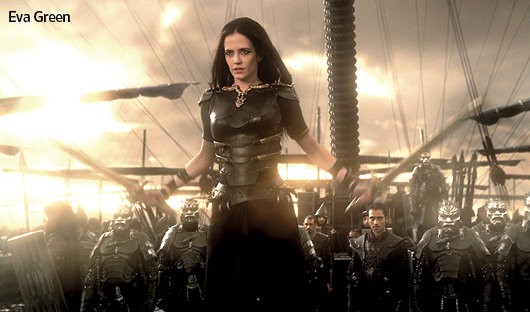
We get a bit more backstory this time, too.  In a previous battle, Athens’ great warrior Themistokles (hunky Sullivan Stapleton) killed the Persian king.  His furious son, Xerxes (returning Rodrigo Santoro) traded his humanity for godlike powers to get his revenge by invading Greece.  The leader of the Persian forces is the even-more-furious Artemisia (Eva Green), who can kiss the lips on the head she has just severed, enjoying the kiss just slightly less than the kill.  She is tougher than any of her generals, more lethal than any of her soldiers, and even hungrier for inflicting desolation on Greece than her king.  And she has the kind of fearlessness only found in those who have nothing left to lose and who will never win enough to feel that they have succeeded.

Themistokles needs to get the support of the resolutely independent city-states if they are to hold off the far greater Persian forces.  He knows that his men have heart and dedication, but they are not trained warriors like the Spartans.  I could say more about the story, but let’s face it — like the first film, this is about abs, swords, and lots of blood spurting in artistic slo-mo, drenching the screen.

The primary differences are the absence of Gerard Butler and the shift from battles on land to battles on water.  We feel Butler’s loss, as he brought a bit more to the original in terms of acting and managed to give his character some depth and personality in the midst of the carnage.  But that works for the story, as the death of his character Leonidas is felt deeply in Sparta.   The only thing that stands out from the carnage, though, is Green, whose Artemisia cranks up the cray-cray as one of the most evil-relishing villainesses since Cruella De Vil.  There’s a sizzling sex-and-fight scene (hmmm, Green did something very similar in “Dark Shadows“) that is way over the top of whatever point over the top used to be.  Green has a blast striding around casting laser beams of hatred at everyone, and wipes everyone else in the cast off the screen more thoroughly than her character does to to the “farmers, sculptors, and poets”-turned soldiers of Athens.

Parents should know that this film has constant very intense, graphic, and bloody violence with many battles, swords, fire, drowning, executions, rapes, disturbing images, nudity, sexual references and situations, and some strong language.

Family discussion: What are the biggest differences between the Greeks and the Persians? Do we think about war differently today?

If you like this, try: “300” and “Gladiator”

Related Tags:


3D Action/Adventure Based on a book Based on a true story Comic book/Comic Strip/Graphic Novel Epic/Historical Movies -- format Series/Sequel War

Son of God

Posted on February 27, 2014 at 6:00 pm

B
Lowest Recommended Age: Middle School
MPAA Rating: Rated PG-13 for intense and bloody depiction of The Crucifixion, and for some sequences of violence
Profanity: None
Alcohol/ Drugs: Wine
Violence/ Scariness: Intense and graphic torture and abuse and disturbing images in depiction of crucifixion, swords
Diversity Issues: Religious diversity issues
Date Released to Theaters: February 28, 2014
Date Released to DVD: June 2, 2014
Amazon.com ASIN: 1455585831

son-of-god“Son of God,” re-cut and expanded from the popular miniseries produced by Roma Downey and Mark Burnett, “The Bible,” tells the story of Jesus from birth to crucifixion and resurrection in a thoughtful, reverent, and dignified manner. This is a movie made by believers for believers. It expects viewers to be familiar enough with the story to fill in some of the gaps and devout enough to assume the significance of each moment. It tells the story in a westernized, conventional manner that can seem superficial at times, more a cinematic Sunday School lesson than a movie.  It is unlikely to persuade anyone, but it is undeniably moving and many believers will find it inspiring.

The production values are high, with Morocco providing the Biblical landscapes, elaborate sets and costumes, and a stirring Hans Zimmer score.  Portuguese actor Diogo Morgado plays Jesus with dignity.  He is very handsome, though his western features seem out of place.  The portrayal of the Jews is always a sensitive issue in the depiction of the New Testament story.  This version is more sympathetic than some, showing the political pressure that gave the Jewish community in Rome-occupied Jerusalem little choice.  But it seems odd that Jesus and his followers, who considered themselves Jews, show no evidence of Jewish practice other than the Hebrew prayer for he dead following the crucifixion.  Even the Last Supper, which has no elements of a Passover seder, though the Gospel of Mark says that Jesus prepared for the Last Supper on the “first day of Unleavened Bread, when they sacrificed the Passover lamb.”

The movie also reflects its source with some odd re-cuts and deletions.  Those who are not familiar with the details of the Gospels may have trouble understanding who some of the characters are and how they fit in.  The death of John the Baptist is mentioned briefly without making it clear what his contribution was and how he died.  Roma Downey has explained that they chose to literally cut the devil out of the story, in part as a result of some claims that the actor cast in the role for the television version bore a resemblance to President Obama.  But that means eliminating a key element of the story, the Garden of Gethsemane, which is an important part of understanding the way Jesus saw his role and his sacrifice. This is an accessible version of the story, but it is also a simplified one.

Parents should know that the New Testament storyline includes illness, bigotry, and graphic and disturbing images of torture, abuse, and crucifixion.

Family discussion: How does this differ from other versions of the story?  What was Jesus’ most important statement and why?

If you like this, try: the rest of “The Bible” miniseries and other depictions of the life of Jesus including “The Gospel of John” and “King of Kings”


Related Tags:


Based on a book Drama DVD/Blu-Ray Pick of the Week Epic/Historical Spiritual films
THE MOVIE MOM® is a registered trademark of Nell Minow. Use of the mark without express consent from Nell Minow constitutes trademark infringement and unfair competition in violation of federal and state laws. All material © Nell Minow 1995-2026, all rights reserved, and no use or republication is permitted without explicit permission. This site hosts Nell Minow’s Movie Mom® archive, with material that originally appeared on Yahoo! Movies, Beliefnet, and other sources. Much of her new material can be found at Rogerebert.com, Huffington Post, and WheretoWatch. Her books include The Movie Mom’s Guide to Family Movies and 101 Must-See Movie Moments, and she can be heard each week on radio stations across the country.

Website Designed by Max LaZebnik