Hotel Mumbai

Hotel Mumbai

Posted on March 21, 2019 at 5:43 pm

B
Lowest Recommended Age: Mature High Schooler
MPAA Rating: Not rated
Profanity: Some strong language
Alcohol/ Drugs: Alcohol
Violence/ Scariness: Extended, intense terrorism violence with many characters injured and killed, disturbing and graphic images
Diversity Issues: A theme of the movie
Date Released to Theaters: March 22, 2019
Date Released to DVD: June 17, 2019
Copyright Bleeker Street 2019

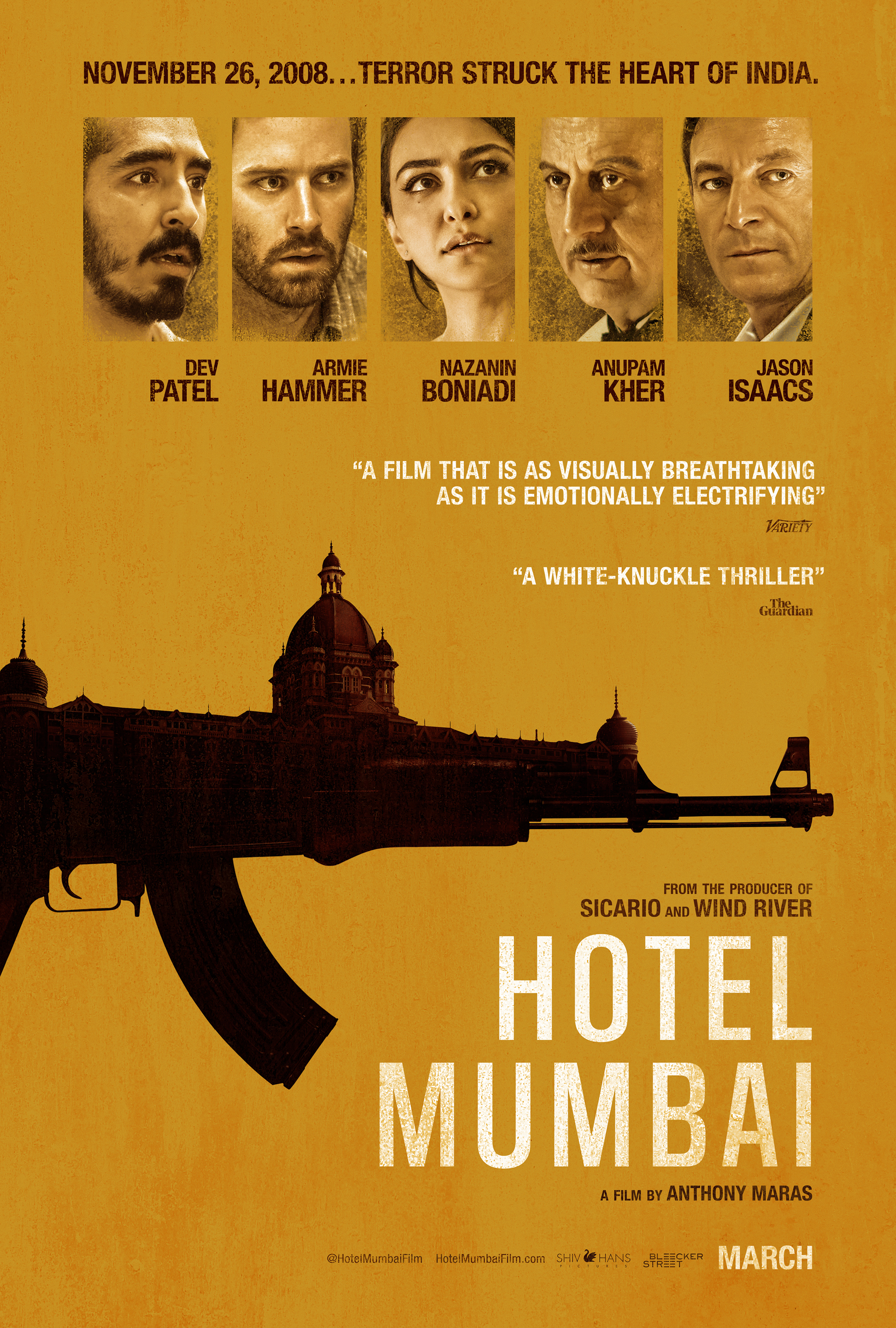
“Look for the helpers.” That’s what Mr. Rogers told children to do when scary and terrible things happen. “You will always find people who are helping.” “Hotel Mumbai” is the story of the unspeakably sad and scary 2008 terrorist attack that lasted for four days in Mumbai, India, including a three-day attack at the luxurious Taj Palace and Tower hotel.

Inspired by the documentary “Surviving Mumbai,” director/co-screenwriter Anthony Maras did extensive research, including interviews with many of the survivors, to tell the story of the sacrifice, courage, and resilience of the helpers.

The Taj is a legendary hotel, “home to statesmen and celebrities for over a century.” It was opened by a wealthy Indian who was not allowed to stay in one of the British-run hotels. It operates at the highest level of service. We see the preparations for the arrival of a wealthy middle-Eastern woman named Zhara (Nazanin Boniadi) who is coming with her new American husband, David (Armie Hammer), their baby, and the nanny (Tilda Cobham-Hervey as Sally). Her rose-petal scented bath is heated to precisely 48 degrees celsius, just as she likes it. And he cautions the staff not to congratulate her on her wedding as it is a sensitive subject, since she was pregnant at the ceremony and her family does not approve. The slogan of the staff is “Guest is God.” Everything they do is for the comfort and enjoyment of the guests.

We see a staff member named Arjun (Dev Patel) adjust his Sikh turban precisely with a pin to make sure that each fold is perfectly aligned before leaving home. But when he gets to the hotel and puts on his impeccable uniform, he realizes that he does not have his shoes. Inspecting the staff before, chief chef Oberoi (Indian cinema star Anupam Kher) tells Arjun he is dismissed. He cannot appear before the guests in sandals, “looking like a beggar.” But then Oberoi relents, and tells Arjun he can wear Oberoi’s own shoes, which Arjun does, even though they are much too small.

Meanwhile, a group of terrorists from an extremist Islamic cult in Pakistan are arriving by boat, listening to a voice on their phones (all taken from real-life recordings from that day), telling them “You are calm…you are all like sons to me…I am with you…paradise awaits you.” Their backpacks are filled with guns and grenades, and their plan is to create chaos and terror at 12 different locations through Mumbai, which, as we will learn, has no special forces with the training or equipment to stop terrorist attacks.

Over the course of the film, three different characters make reassuring and completely dishonest phone calls to parents, telling them that despite what they see on television, everything is fine and they are safe. In another scene, a terrified hotel guest confronts another guest who has been speaking Farsi and says she is afraid of a staff member wearing a Sikh turban. The Sikh talks quietly to her, telling her that the turban is a symbol of honor, but he will remove it if it makes her more comfortable. He shows her a photograph of his family, reminding her of what all humans share, so she tells him to keep it on.

Everything terrible that happens in the film is caused by thinking of some people as “other.” The terrorists are led by a voice who constantly separates them from the rest of humanity. One of them kills a woman when told to by the voice in his ear, but when the voice tells him to reach into the dead woman’s bra to find her ID, he cannot. The voice says she was an infidel, so it doesn’t matter. But his faith is so essential to his identity that touching a woman’s breast is more forbidden than killing her. Throughout the story, as unthinkably horrific violence occurs, family keeps coming to the forefront as the essential connecting force.

Maras has a remarkable gift for a first-time director for giving us a sense of place. In the midst of chaos, we have a good idea of the various locations in the hotel and how they relate to each other. There is an action movie version of this movie where someone like Bruce Willis comes in and “Die Hards” it, but Maras keeps it soberingly, terrifyingly real, in part through tiny moments like the terrorists’ first look at a flush toilet (when they go into a bathroom to shoot an old lady), and when a hostage’s prayer shifts a shooter’s focus so that he is no longer able to make her an other, a moment of human connection that no amount of propaganda can cancel out. Maras wants us to see the helpers. But he wants this movie to help us be helpers ourselves.

Parents should know that this film includes horrific terrorism violence, though much of it is off-screen and not exploitively portrayed. Many characters are injured and killed and there are disturbing images. The film also includes some strong and bigoted language, alcohol, and sexual references and insults.

Family discussion: What do we learn from the three phone calls characters in the movie make to parents?  How did the characters determine what their loyalties were?

If you like this, try: “United 93” and the documentary “Surviving Mumbai”

Related Tags:


Based on a true story Drama DVD/Blu-Ray movie review Movies -- format
The Highwaymen

The Highwaymen

Posted on March 21, 2019 at 5:12 pm

B
Lowest Recommended Age: Mature High Schooler
MPAA Rating: Rated R for some strong violence and bloody images
Profanity: Some mild language
Alcohol/ Drugs: Drinking and alcohol abuse
Violence/ Scariness: Extended bloody violence, characters injured and killed
Diversity Issues: None
Date Released to Theaters: March 22, 2019

Copyright Netflix 2019
The titles say it all. Bonnie Parker and Clyde Barrow, robbed banks, stores, and gas stations, masterminded a prison escape, killed police officers and civilians, all while they were still in their 20’s, until they were gunned down by law enforcement. They were populist celebrities of their time and have been glamorized in movies, most notably the Arthur Penn film “Bonnie and Clyde,” starring Faye Dunaway and Warren Beatty. They get their names in the title, but for the story of the men in law enforcement who tracked them down, a generic term will do.

“The Highwaymen” is the un-glamorous story of former Texas Rangers called back into service who persevere despite unreliable politicians, incompetent federal agents, and a population, including criminals and Depression-era fan who were on the side of anyone who was not on the side of the banks. The story of the lovers who defied the rules created by the rich and powerful and shared cheeky photos of themselves holding guns was much more appealing than the idea of bringing them to justice.

Director John Lee Hancock “The Blind Side” and writer John Fusco (“Young Guns,” “The Shack”), are, like the story’s lead characters, disgusted with those who think that Bonnie and Clyde are more appealing than the men who caught and killed them, though that does not prevent them from altering some of the facts themselves.

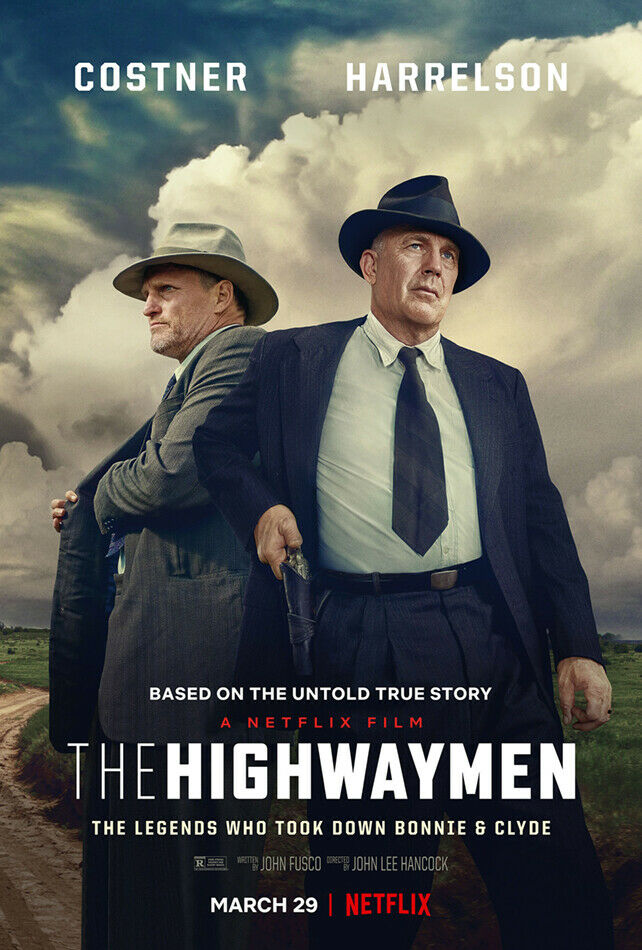
The focus here is on the two old pros, Frank Hamer (Kevin Costner) and Maney Gault (Woody Harrelson). In the Penn film, the Hamer character was portrayed as hapless in comparison to the people he was tracking, initially captured by them (which never really happened). In this version, we only catch brief glimpses of the notorious duo. It is clear who we are supposed to respect and root for.

Texas governor Ma Ferguson (a deliciously bellicose Kathy Bates) has shut down the Texas Rangers in favor of a more modern form of law enforcement. But when it comes to the crime spree of Bonnie and Clyde, she recognizes that she doesn’t need modern and she doesn’t want law enforcement. She wants them dead. And so she has someone contact Hamer, now a successful private investigator living comfortably with his wife (Kim Dickens). And Hamer contacts Gault, living in near-poverty with his daughter trying to stay off the booze.

The pace of the film is slow and deliberate because what these men are doing is slow and deliberate. The filmmaking is straightforward but thoughtful. A scene where Hamer and Gault search what turns out to be an empty house is especially skillful, with the lawmen framed in a dresser-top mirror. The images of Depression-era life, the campout of what in those days were called hoboes, the saucy red shoe that is all we see of Bonnie in her first appearance, the stop to buy guns and the boys who help Hamer with some secret target practice, the face of Hamer’s wife (an excellent Kim Dickens) as she says goodbye — all reward the patient viewer.

Costner and Harrelson have the kind of easy chemistry that suits their characters, men who have seen too much and done too much. They know they have done wrong in the cause of right, but they also know that their wrongs kept people safe. They know that they will not be appreciated by the politicians who will claim credit for their successes and blame them for mistakes made by others, or by the people who thought of Bonnie and Clyde as a romantic fantasy of living fast, dying young, and leaving a good-looking corpse, if you don’t count the bullet holes. But that knowledge will not, as anything else can not, turn them away from what they see is their duty. This movie does what they were too proud to do themselves, tell their story and let us learn from it.

Parents should know that this is a crime and law enforcement story with extended peril and violence. Characters are injured and killed and there are some graphic and disturbing images. The film also has some sexual references, some potty humor, alcohol and alcoholism, and some strong language.

Family discussion: Why did Hamer and Gault take the job? Why did Clyde’s father want to talk to Hammer? Why did so many people root for Bonnie and Clyde?

If you like this, try: “The Untouchables” and “Bonnie and Clyde”

Related Tags:


Based on a true story Crime Drama movie review Movies -- format Movies -- Reviews
A Private War

A Private War

Posted on February 3, 2019 at 4:33 pm

B +
Lowest Recommended Age: Mature High Schooler
MPAA Rating: Rated R for disturbing violent images, language throughout, and brief sexuality/nudity
Profanity: Very strong and crude language
Alcohol/ Drugs: Drinking and smoking, drugs
Violence/ Scariness: Brutal wartime violence, characters injured and killed
Diversity Issues: A theme of the movie
Date Released to Theaters: November 16, 2018
Date Released to DVD: February 4, 2019

Copyright 2018 Aviron Pictures
I reviewed A Private War for rogerebert.com. An excerpt:

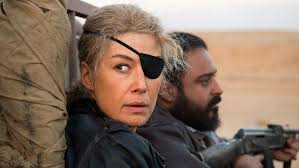
The dramatic, personal story of Colvin herself is absorbingly told here, largely because of Pike’s dynamic performance, showing us a woman who was courageous enough to risk her life for a story on a daily basis but remained vulnerable enough to make the stories viscerally compelling. That combination took a terrible toll. She used sex and booze to numb her feelings but they could not stop the nightmares. “You’re not going to get anywhere if you acknowledge fear,” she says, but she admits that after the danger is over, she feels it. It is surreal to see her back in London at an elegant gala event, picking up another journalism award in between trips to war zones where she has to maintain enough distance from the carnage all around her to write about it – and keep from becoming part of it. The contrast in perspective and priorities between Colvin and her editor (an excellent Tom Hollander) makes a deeper point about the uneasy and sometimes conflicted relationship between editors trying to sell papers and reporters trying to get the story read.

To the extent we need to know why she had this compulsion and whether she missed having a home and family, those elements are present without being reductive or simplistic.

Related Tags:


Based on a true story DVD/Blu-Ray Journalism War

Share the Stories of Martin Luther King on MLK Day 2019

Posted on January 20, 2019 at 12:41 pm

As we celebrate the birthday of Martin Luther King, every family should take time to talk about this great American leader and hero of the Civil Rights Movement. There are outstanding films and other resources for all ages.

I highly recommend the magnificent movie Boycott, starring Jeffrey Wright as Dr. King. And every family should study the history of the Montgomery bus boycott that changed the world.

It is humbling to remember that the boycotters never demanded complete desegregation of the public transit; that seemed too unrealistic a goal. This website has video interviews with the people who were there. This newspaper article describes Dr. King’s meeting with the bus line officials. And excellent teaching materials about the Montgomery bus boycott are available, including the modest and deeply moving reminder to the boycotters once segregation had been ruled unconstitutional that they should “demonstrate calm dignity,” “pray for guidance,” and refrain from boasting or bragging.

Families should also read They Walked To Freedom 1955-1956: The Story of the Montgomery Bus Boycott. Paul Winfield has the lead in King, a brilliant and meticulously researched NBC miniseries co-starring Cecily Tyson that covers Dr. King’s entire career.

The March, narrated by Denzel Washington, is a documentary about the historic March on Washington with Dr. King’s famous “I have a dream” speech.

The brilliant film Selma tells the story of the fight for voting rights.

The Long Walk Home, starring Whoopi Goldberg and Sissy Spacek, makes clear that the boycott was a reminder to black and white women of their rights and opportunities — and risk of change.

Citizen King is a PBS documentary with archival footage of Dr. King and his colleagues.

Martin Luther King Jr. – I Have a Dream has his famous speech in full, still one of the most powerful moments in the history of oratory and one of the most meaningful moments in the history of freedom.

For children, Our Friend, Martin and Martin’s Big Words are a good introduction to Dr. King and the Civil Rights movement.

Related Tags:


Based on a true story Biography Documentary Race and Diversity
THE MOVIE MOM® is a registered trademark of Nell Minow. Use of the mark without express consent from Nell Minow constitutes trademark infringement and unfair competition in violation of federal and state laws. All material © Nell Minow 1995-2026, all rights reserved, and no use or republication is permitted without explicit permission. This site hosts Nell Minow’s Movie Mom® archive, with material that originally appeared on Yahoo! Movies, Beliefnet, and other sources. Much of her new material can be found at Rogerebert.com, Huffington Post, and WheretoWatch. Her books include The Movie Mom’s Guide to Family Movies and 101 Must-See Movie Moments, and she can be heard each week on radio stations across the country.

Website Designed by Max LaZebnik