The Walk

The Walk

Posted on October 1, 2015 at 12:17 pm

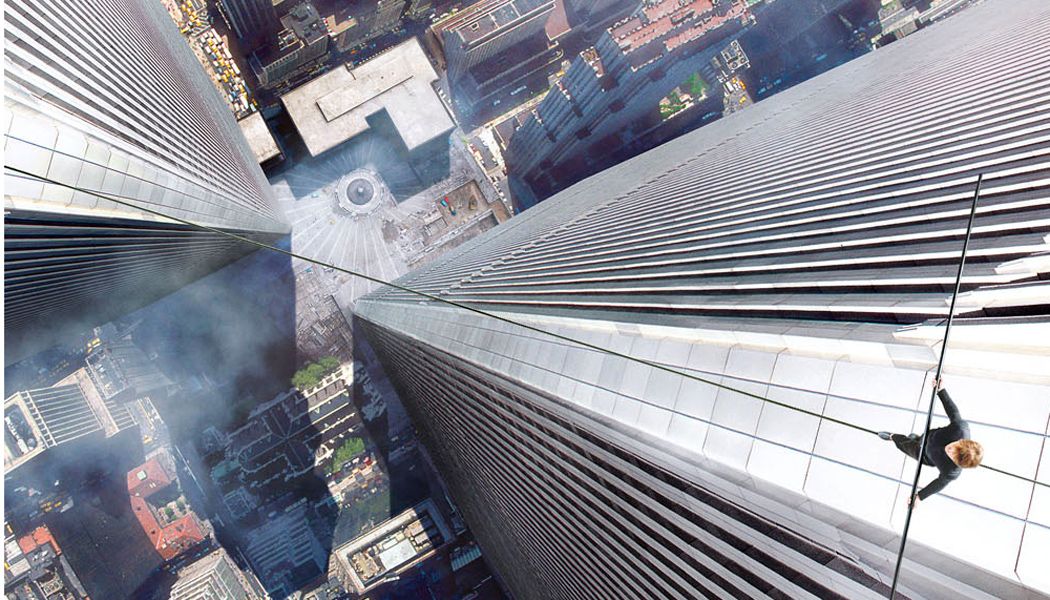
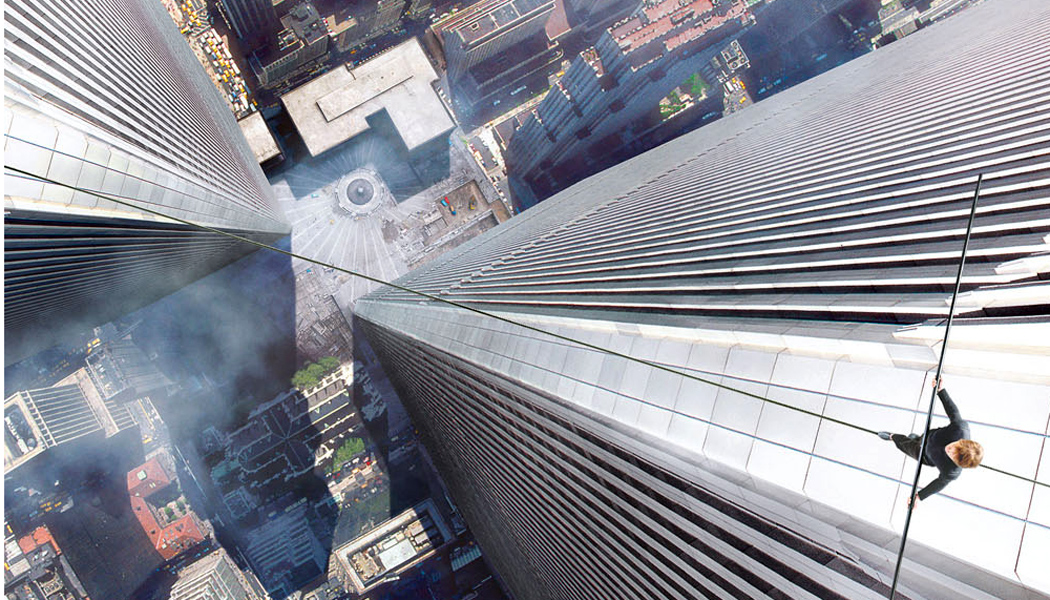
If you have vertigo or acrophobia, you will have trouble with “The Walk,” the story of Frenchman Philippe Petit’s tightrope walk between the towers of the World Trade Center. If you don’t have vertigo or acrophobia, you might have after you watch the movie, with the most stunningly realistic 3D effects ever put on screen. At least I think they’re still just on the screen. It sure feels like it goes on way, way behind it.
Copyright 2015 Sony
Copyright 2015 Sony

“Man on Wire,” a documentary about Petit’s 1974 stunt, or, as he might prefer to say, coup, won an Oscar in 2008. In this film, Joseph Gordon-Levitt, with an accent that just manages to avoid Pepe LePew dimensions, plays Petit, a street performer who saw a photograph of the World Trade Center in the waiting room of his dentist and was instantly consumed with the dream of a walk in the sky, more than 1300 feet above the sidewalk, between the towers. Like Petit himself, the movie does not bother with the question of why this might be a good thing to do. If pressed, he might just say, like Mallory, “Because it’s there.” The problem is that he doesn’t have an answer but still keeps talking and talking. For no reason we keep going back to Petit narrating the story from the torch of the Statue of Liberty. It is distracting and dull.

Petit could not or would not articulate it, but I think I know why. When huge institutions get together to create a world-record setting edifice — taller than the Eiffel Tower, the Frenchman notes — there is something irresistibly enticing about coming back as a lone soul and literally topping it. Director Robert Zemeckis, who can get more excited about the technology than the story in his films, may identify with that challenge. Petit wanted to walk across the sky, with an audience to appreciate it. And Zemeckis wants to recreate that experience for us, taking us to the roof of the Towers, and inviting us to look down.

Still, while we love movies about dreamers of impossible dreams who make them come true, we do like to have a reason, and Petit edges over the line from audacious dreamer to inconsiderate narcissist, despite Gordon-Levitt’s considerable appeal. This lends a hollow quality, overcome less from the story of the film to what is in our own hearts as we watch, knowing what the tragedy that lies ahead for the World Trade Center.

What works well in the first part of the film is Petit’s tutorials with a tightrope master played by Sir Ben Kingsley and the procedural elements once Petit and his team get to New York and start preparing as though they are getting ready to rob a bank. Indeed, it becomes a heist film of a sort because they have to find different ways to sneak into a building that is still under construction and gather the information they need to figure out how to install the cable and keep it from swaying or buckling. And then to install it. There are a lot of problems along the way, including Petit stepping on a nail and injuring his foot and dropping his black turtleneck from the roof when he is trying to assume his performer persona. They omit, however, my favorite detail from the documentary: Petit explains that in America, if there’s pencil in your pocket everyone assumes you are part of the construction team and are entitled to be there. Like the loss of the buildings themselves, Petit’s ability to exploit lax security is a poignant reminder of what we no longer have.

The last half hour or so of the film is breathtaking and well worth the price of admission in IMAX 3D. You will feel that you are on the tightrope with Petit. As the crowd gathers below and the police arrive (who thought a police helicopter would be a good idea?), Petit is suspended in the clouds, mentally, emotionally, and physically. For just a moment, Zemeckis and Gordon-Levitt bring us up there with him, and his dream, however frivolous and ephemeral, becomes ours.

Parents should know that this film has very risky and dangerous behavior, vertiginous 3D effects, brief nudity, some strong language, and smoking and drinking.

Family discussion: What big dream would you like to make come true? Who would you want to be your team?

If you like this, try: the documentary “Man on Wire”
Related Tags:


3D Based on a true story Drama IMAX

FREE Tickets to TONIGHT’s showing of “Just Let Go”

Posted on September 28, 2015 at 1:08 pm

I have FREE tickets for tonight’s 8:00 pm showing of “Just Let Go” at both the AMC Hoffman Theater in Alexandria, Virginia and the AMC Tyson’s Corner, also in Virginia. To get your free tickets, send me an email ASAP at moviemom@moviemom.com with your “Forgive” in the subject line and your full name. We’ll email you the tickets.

On a cold February night in 2007, a devoted father of four and a seventeen-year-old drunk driver both receive life sentences. In one violent, devastating instant, each faces a drastically different and uncertain future. But as Chris Williams sits in his demolished vehicle staring at the car that had just caused the death of his wife, his unborn baby, and his nine- year-old daughter and his eleven-year-old son, he commits to doing something extraordinary: to forgive. Chris’ story is the cinematic tale of how a person can forgive despite the retaliatory tendencies that surface within the darks corners of the human heart showing the world that hope, love and forgiveness can overcome all when you make the decision to just let it go.

Related Tags:


Based on a true story Contests and Giveaways Spiritual films
Stonewall

Stonewall

Posted on September 25, 2015 at 8:00 am

D
Lowest Recommended Age: Mature High Schooler
MPAA Rating: Rated R for sexual content, language throughout, some violence and drug use
Profanity: Very strong and crude language
Alcohol/ Drugs: Drinking, smoking, drugs
Violence/ Scariness: Police brutality, riots, reference to murders
Diversity Issues: A theme of the movie
Date Released to Theaters: September 25, 2015

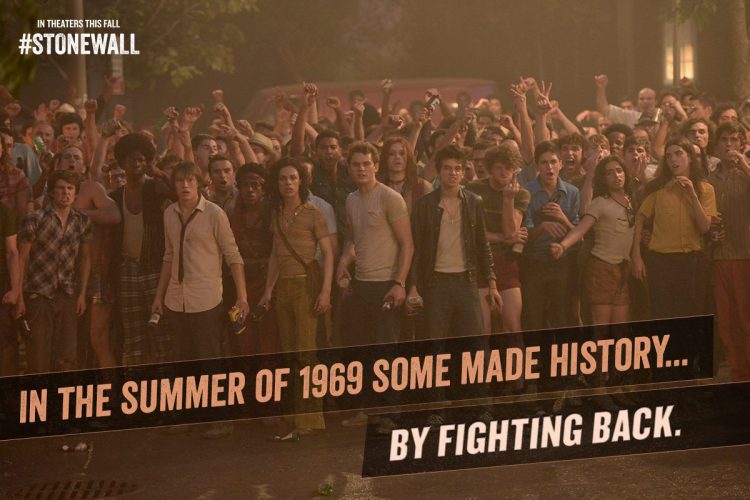
In 1969, when the federal government prohibited the firing of gays and lesbians, when it was illegal for them to congregate in a bar or even to have consensual sex, when police harassment and brutality was not only permitted but expected, a man threw a brick, shattered a window, and began four days of riots that galvanized the fight for GLBTQ equality. The window was in a bar called Stonewall, and its name lives on as the symbol of the moment that ignited a revolution.

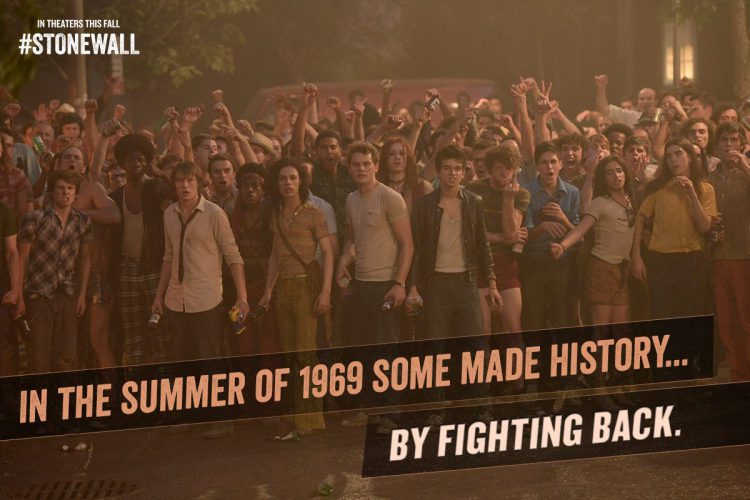
The movie “Stonewall,” intended as history and tribute, instead throws a brick through the meaning and the moment, shattering both. This movie is more than bad and worse than disappointing. It is a tragic distortion of a vitally important story that insults the people it tries to honor and insults its audience as well. Director Roland Emmerich (known for movies with a lot of big explosions and stunts) and screenwriter Jon Robin Baitz so vastly underestimate their audience that they apparently believe cannot understand a movie about the GLBTQ community unless we have an all-American-style high school football hero from the heartland to identify with. How do you make a movie about the Stonewall uprising and so completely miss the point?

Copyright 2015 Roadside

Our point of entry is handsome but bland Danny (Jeremy Irvine), a Hoosier who has a crush on the quarterback. He is Goldilocks to the three bears of his family, spread out to represent all points on the gay-friendliness spectrum: a taciturn father (also his football coach), a passive mother, and a devoted and free-thinking younger sister (Joey King). When his assignations with the quarterback are discovered, “faggot” is scrawled on his locker and he is shunned by everyone. He refuses to tell his father that it was a one-time thing and leaves for New York.

And so we shift from tone-deaf cliches about the Midwest to tone-deaf cliches about Christopher Street, with a group of adorably scruffy and flamboyant runaway Lost Boys who spend their time tricking and clubbing. Their leader is an Artful Dodger type known as Ray (Jonny Beauchamp). They sit on the stoop and talk about Judy Garland, alternately enjoying shocking decadence and longing for home. Around the edges of the story are the real-life characters who are far more interesting, or at least who were in real life.

This is a bad movie, purely from the standpoint of drama. It is poorly constructed, with cardboard characters and worst-of-the-year category clangers in dialog, provoking snicker and then outright snorts from the audience. “I’m too angry to love.” “These kids have nothing to lose.” But the monumental failure here is the disrespect for the real-life courageous souls who fought back nearly half a century ago and for the audience, who would relish a film that does them justice.

Parents should know that this film has explicit sexual references and situations, including predatory behavior, abuse, and prostitution, homophobic and bigoted insults, police brutality, and riots. Characters use very strong language, drink and smoke, and use drugs.

Family discussion: How was the gay rights movie like and not like other civil rights movements of the 20th century?

If you like this, try: “Longtime Companion.” “Pride,” and “Milk”

Related Tags:


Based on a true story Drama GLBTQ and Diversity Movies -- format Politics
Captive

Captive

Posted on September 17, 2015 at 8:00 pm

B
Lowest Recommended Age: High School
MPAA Rating: Rated PG-13 for mature thematic elements involving violence and substance abuse
Profanity: Some strong language
Alcohol/ Drugs: Drugs and discussions of drug abuse
Violence/ Scariness: Prison escape, violent murders, tense confrontations, hostage situation
Diversity Issues: Diverse characters
Date Released to Theaters: September 18, 2015
Copyright 2014 BN Films

Two desperate people who think they have nothing discover that there is still a lot more to lose in this fact-based story about an escaped prisoner and the woman he held captive.

The story made headlines throughout the country. Ashley Smith, a young widow still in her 20’s, was in the early, fragile stages of recovery from drug abuse. Her daughter was living with Smith’s aunt, but Smith was working hard to be able to care for her. Brian Nichols was in prison, charged with rape. When he was being transferred for his trial, he beat the security guard, stole the civilian clothes he was to wear for the trial, and went on the run, killing a judge and three other people. He grabbed Smith, and forced her to let him into her apartment. He held her there for seven hours before she was able to leave and call 911. While they were together, they talked, she made him pancakes, and she read aloud to him from Rick Warren’s best-seller, The Purpose Driven Life: What on Earth Am I Here For?. The book was given to her by a woman in her 12-step group, and she tossed it in the garbage. But it was waiting for her again at her job. The woman who gave it to her got it out of the garbage can and left it for her.
Kate Mara plays Smith and David Oyelowo plays Nichols, and the heart of the movie is seeing each of them find some humanity in the other. Neither has any reason to trust, and neither does much to earn trust, either. “I’m a mother!” she says when he first captures her. She wants him to see her as a person, and as a person someone else depends on. But she tells him the truth, that her daughter is not there and will not be returning. And then she lies to him and says that her husband is coming home soon. He asks her for weed, and she says there isn’t any, but he can tell from the way she says it that she is holding something else. It is “ice” (meth) and it is in a small packet she almost could not resist shortly before Nichols captured her.

He takes some and tries to force her to take the rest. But she realizes that she would literally rather die than start using again, and it is the strength of that moment that is the turning point for her. Hopped up on drugs, Nichols says he wants Smith and her daughter to come with him to Mexico. He will kidnap his infant son and they can all be together. But he knows it is impossible. Listening to the book, or perhaps seeing Smith get the message that she can still have a purpose even after all her mistakes, helps him understand what he must do. Smith herself says that moment was when faith in God’s love filled her heart and she knew she would be all right.

The movie loses momentum when it shifts to the law enforcement efforts to track Nichols. What matters is two people who think they have lost everything and how one of them chooses life, hope, and purpose.

Parents should know that this movie includes a prison escape with four brutal murders, guns plus reference to drug dealing and another murder, hostage, drugs and discussion of drug abuse, some strong language, and issues of child custody and parental fitness.

Family discussion: What were the most meaningful parts of the time they spent together to Ashley? To Brian? What book would you want to read to someone afraid and in pain?

If you like this, try: the book by Ashley Smith Robinson and Rick Warren’s The Purpose Driven Life

Related Tags:


Based on a book Based on a true story Crime Drama Movies -- format Spiritual films
Black Mass

Black Mass

Posted on September 17, 2015 at 6:00 pm

Copyright 2015 Warner Brothers
The most terrifying image on movie screens this year is the ice blue eyes of crime boss Jimmy “Whitey” Bulger, played by Johnny Depp in “Black Mass.” They are opaque, implacable, and piercing. Depp’s performance as the man who was second on the FBI’s Most Wanted List when Osama Bin Laden was number one is a return to form for one of Hollywood’s most talented performers, whose recent films have been a series of disappointments. His Bulger is coiled fury, horrifying when he kills, even more horrifying when gets an FBI official to tell him the secret recipe for a steak marinade and most horrifying of all when he strokes a woman’s face and touches her throat, pretending concern that she may be ill but very clear about the menace he is contemplating.

Director Scott Cooper (“Crazy Heart”) has assembled a superb cast to tell a complicated story. Bulger was a full-service crook — a killer, racketeer, extortionist, and drug dealer. When a businessman would not cooperate, he did not waste time making him an offer he couldn’t refuse. Told that he wouldn’t make a deal, he asks, “Will his widow make a deal?” And then the guy gets shot in the parking lot of his country club and she is a widow.

What makes this story different from the usual gangster film is that Bulger was enabled by a childhood friend from the neighborhood who became an FBI agent, John Connelly (Joel Edgerton). At first, they help each other, especially when Bulger tips off the FBI so they can go after his rivals, clearing the way for the expansion of Bulger’s Winter Hill gang into new territories and lines of illegal business. But the FBI ultimately becomes complicit, even turning over to Bulger the names of informants so he can execute them. “Black Mass” is a reference to a Satanic perversion of the Catholic rites of prayer, and this movie is about the secular perversion that has a murderer sharing a jolly Christmas dinner with the most powerful politician in the state (Bulger’s brother Billy, played with wily street smarts by Benedict Cumberbatch) and the FBI agent who is supposed to be investigating him.

Cooper and screenwriters Mark Mallouk and Jez Butterworth (based on the book by Boston Globe reporters Dick Lehr and Gerard O’Neill, keep the pressure taut. It opens on the close-up of one of Bulger’s Winter HIll gang, insisting he is not a rat, but making it clear is his about to tell the police what he knows. We can see every individual whisker on his cheeks, every bit of scar tissue from a lifetime spent getting beat up and beating up other people. (Extra credit to the makeup department headed by Joel Harlow for the most believable aging I’ve seen in a movie.) The score by Junkie XL is one of the best of the year, and the closing credit sequence is superbly designed.

We see Bulger harden over the years, as though he is freezing from the inside out. There is a lot of talk about loyalty but it is really about pride and power. Its exploration of the compromises that may be necessary to stop someone who operates entirely outside the rules and the implosion of spirit necessary to maintain those compromises gives a texture to the story by asking us to consider who was responsible for more damage and who was more responsible as well. Bulger is a deeply frightening bad guy. But the scarier bad guys are the ones who are supposed to be protecting us from the Bulgers of the world and protect them instead.

Parents should know that this movie is based on the true story of a notorious crime boss. It includes many brutal murders, drug dealing, racketeering, corrupt law enforcement, graphic and disturbing images, constant strong language, sexual references, prostitution, drugs, drinking, smoking.

Family discussion: What should the rules be for working with informants who are involved enough with crime to provide reliable testimony? Do you agree with the punishments for the various characters? What would you do differently?

If you like this, try: “The Departed” (Jack Nicholson’s character was in part inspired by Bulger) and “Goodfellas,” and the documentary “Whitey: United States of America v. James J. Bulger”

Related Tags:


Based on a true story Crime Drama
THE MOVIE MOM® is a registered trademark of Nell Minow. Use of the mark without express consent from Nell Minow constitutes trademark infringement and unfair competition in violation of federal and state laws. All material © Nell Minow 1995-2026, all rights reserved, and no use or republication is permitted without explicit permission. This site hosts Nell Minow’s Movie Mom® archive, with material that originally appeared on Yahoo! Movies, Beliefnet, and other sources. Much of her new material can be found at Rogerebert.com, Huffington Post, and WheretoWatch. Her books include The Movie Mom’s Guide to Family Movies and 101 Must-See Movie Moments, and she can be heard each week on radio stations across the country.

Website Designed by Max LaZebnik