
Get on Up

Posted on July 31, 2014 at 5:59 pm
Copyright 2014 Universal Pictures

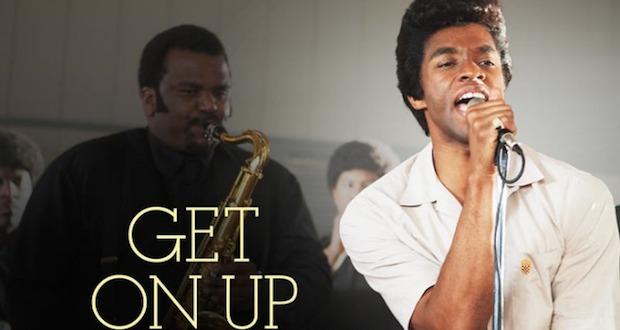
There are a lot of challenges in taking on the life story of James Brown, known variously as the Hardest Working Man in Show Business, the Godfather of Soul, Mr. Dynamite and others with variations on the term “Funk.” First and foremost, James Brown was one of the most electrifying performers of all time and though he is gone, the memories of his sizzling stage shows are vivid and the evidence is on YouTube.

Second is the conundrum that besets all who want to do biographical stories of well-known people, especially musicians. Is there a life as big as the work they did? We know that those who achieve greatly often pay an enormous price in personal turmoil for themselves and those around them. But those stories are not easy to tell, especially in the structure of the typical biopic, which goes from hardscrabble childhood to big dreams to first discovery by someone who can open doors to triumph, the first recording session where the heard-it-all studio technicians are blown away, the rapturous discovery by the fans, setback, the corrosive impact of fame and money, and then some catharsis and the achievement of legendary status. (I’m looking at you, “Jersey Boys.” Also “Ray,” “Coal Miner’s Daughter,” “Walk the Line,” “What’s Love Got to Do With It,” “The Benny Goodman Story,” “8 Mile,” etc. etc. etc. etc.)

Director Tate Taylor (“The Help”) makes some good choices addressing these challenges. First, he wisely cast Chadwick Boseman (“42”) in the lead role. Boseman is an actor of exceptional ability and magnetism, and he works as hard as the man he is playing to convey the power of Brown’s stage presence. Second, Taylor, who grew up in the South, has a superb sense of place that helps evoke Brown’s world. And he is not afraid of cinematic touches to evoke what is going on in Brown’s mind, including some asides to us in the audience.

But the film frustrates us with its random swings back and forth as we get so many flashbacks we are not sure where we are. Is this Brown looking back over his life with any insight or regrets or pride? Is the layering supposed to add depth to the story? Are we supposed to make sense of the juxtapositions between scenes of the past and present, sometimes explicitly expressionistic and imagined or exaggerated? It comes across as tricked up and distracting. Boseman is outstanding in the performance scenes but trapped in the rest of the film by Brown’s thick Georgia accent and frequent habit of just not making any sense, as in the very beginning scene when he uses a gun to threaten someone for using his bathroom. It skips over at least one wife and at least seven children, various arrests, and most of the saga of his extended problems with the IRS, without making it clear how what it does tell us illustrates his triumphs, struggles, and motives.

Even more frustrating is that we get so little sense of Brown himself. He comes across as damaged but opaque. What was it that drove him as a performer? What inspired him? We see him berating and imposing fines on his band, but very little of him creating.

There are moments in the film that could be enough for an entire feature. When he is talking to his manager (a wryly sympathetic Dan Aykroyd) on his private plane, en route to the White House, about the conflict he faces as he achieves the mainstream acceptance he strove for in meeting the President at the same time he is accused of selling out. The conflict between “show” and “business” deserved much more exploration.  And then there is the core relationship in the story, between Brown and Bobby Byrd (the terrific Nelsan Ellis), the long-time member of his team who finally could not take the star’s ego any more. A Peter Morgan-style story on any of those conflicts would be far more powerful and avoid the “what happened to that person/marriage/record” that this VH1 Behind the Music too-quick trip over a very complicated life can hold.

Parents should know that this is a movie about sex, drugs, and rock and roll, with strong material for a PG-13 with strong language including two f-words, drugs, domestic abuse, child abuse, sad deaths, brief wartime violence, and sexual references and situations.

Family discussion: Why did James and Bobby call each other “Mr.?” How do you “flip” an obstacle? What did it mean when he said, “I paid the cost?”

If you like this, try: watch James Brown’s real-life performances
Related Tags:


Based on a true story Biography Drama Musical Race and Diversity

Jersey Boys

Posted on June 19, 2014 at 6:00 pm

Winston Churchill famously said that history is written by the victors.  In movie terms, that means that when you see the names of just two of the original Four Seasons listed as the film’s producers, it is clear we are going to get their side of the story.jersey boys

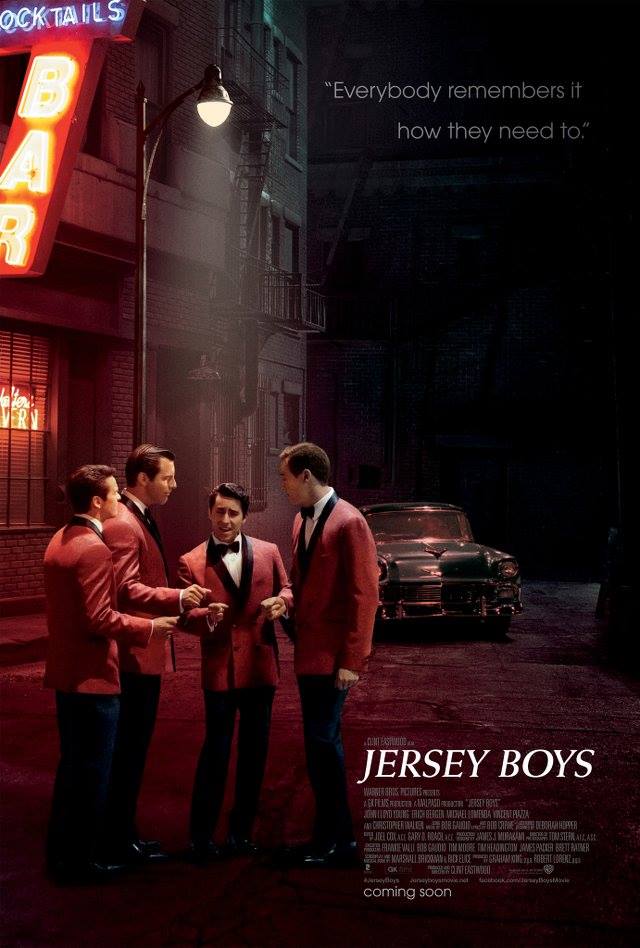
This film, like the Tony Award-winning musical, is the “VH1 Behind the Music”-style story of four guys from the scrappy streets of New Jersey who grow up with only three possible career paths: the military, the mob, and somehow achieving fame.  The first two have a high risk of getting killed.  The last seems unobtainable.  But the four guys, brought together in part by a fifth guy who took the fame option, Oscar-winner Joe Pesci (played in the film by Joseph Russo), became one of the most successful pop acts of all time, with number one hits through the 60’s-70’s.

Clint Eastwood, a composer himself, who made a fine musical biopic about Charlie Parker (“Bird”), has taken on this story, beautifully performed, but too focused on the lives of the group’s members, with very little about what it was that made them stars, or even what the music meant to them aside from a way to get out of New Jersey and support their families.

Tony Award-winner John Lloyd Young plays the undisputed star of The Four Seasons, Frankie Valli, whose pure-toned, remarkably elastic three-octave range was the pure aural joy amidst the sweet harmonies of the Four Seasons sound.  It was that voice that persuaded 15-year-old Bob Gaudio (Erich Bergen), already the composer of a hit single (“Who Wears Short Shorts”), to join the group.  A handshake deal between Gaudio and Valli continues to this day.

Eastwood and cinematographer Tom Stern give the movie a bleached-out look that gives the skin tones of the cast the consistency of putty.  This is intended to express the grittiness of the New Jersey community, but it just looks drab.  And it undermines the points that Eastwood and the Jersey boys themselves try to make about their rough-and-tumble environment when the kindly cop knows everyone in the community so well he remembers Frankie’s curfew.  Even the mob boss (a deliciously droll performance by Christopher Walken) is so cute and cuddly that he cries openly when Frankie sings a sentimental number.  And he’s there to step in when another mob guy is less understanding.

The predictable temptations and stresses of life on the road are predictably laid before us.  Some day, I hope someone will make a movie about a famous guy that won’t have the screaming fight with the wife about how he’s never home.  This is not that film.  And there are the struggles for leadership, the poor judgment with money, also resolved the Jersey way.  We briefly see decisions that led to iconic details.  After several other names, the group picked “The Four Seasons” from a sign at a bowling alley that would not hire them to perform.  “Big Girls Don’t Cry” came from a Billy Wilder movie they saw on television.  But we never get a real sense of the era, of how they fit into the culture musically, how they interacted with the fans, how they were affected by experiencing the world outside of New Jersey.

It is absorbing, largely because of excellent performances by all four of the Jersey Boys, but uneven, largely because the script assumes that we will be as fascinated with the relationships of the four men as they are themselves.  At the end, Frankie says that for him the high point was finding their sound, just four guys harmonizing under a street light.  That’s a moment we never get to experience.  The only time we feel their pleasure in performing is in what has to be seen as the curtain call number, an odd piece of theatricality that, after two and a half hours of running time, finally shows us what made the Four Seasons so thrilling to experience.

Parents should know that this film has very strong language including crude sexual references, a non-explicit sexual situation, smoking, drinking, off-screen drug abuse, and references to mob activity.

Family discussion: Why does Frankie take responsibility for what Tony did? Why did he leave his daughter with her mother? What do you think was their high point and why did Frankie pick the one he did?

If you like this, try: other musician biopics like “Ray” and “Walk the Line” and the music of the Four Seasons.  And to get a glimpse of Frankie Valli today, look for him in a small role in Rob Reiner’s “And So It Goes” with Michael Douglas and Diane Keaton.

Related Tags:


Based on a play Based on a true story Biography Crime Drama Musical

Trailer: Get On Up — The James Brown Story

Posted on March 14, 2014 at 4:15 pm

Chadwick Boseman (“42”) looks electrifying as James Brown in this biopic directed by “The Help’s” Tate Taylor, produced by Ron Howard, and co-starring Viola Davis, Jill Scott, and Octavia Spencer.  It will be in theaters this summer.

Related Tags:


Biography Musical Race and Diversity Trailers, Previews, and Clips

Exclusive Clips: The Gabby Douglas Story

Posted on January 30, 2014 at 1:23 pm

Olympic champion Gabby Douglas plays herself in a new Lifetime movie called “The Gabby Douglas Story” premiering Friday, February 1 at 8 Eastern.  The superb cast includes Regina King, S. Epatha Merkerson, Imani Hakim, and Sydney Mikayla.

A prodigy from a very young age, Gabby Douglas originally made her mark on the world of competitive gymnastics at age eight. She won numerous state championship titles in her age group throughout her early competitive career. While her star was fast rising in the arena, Gabby and her family faced economic challenges at home and she made the difficult decision to leave her mother Natalie, three siblings and grandmother in Virginia Beach and move to Des Moines, Iowa, to train with renowned coach Liang Chow to pursue her dream of Olympic glory. Buoyed by her early success, dedication and unyielding love from her family, Gabby made it onto the 2012 U.S. Women’s Gymnastics team, with whom she faced intense competition in the London Games. Her sacrifice and perseverance were triumphantly rewarded with Team Competition and Individual All-round gold medals, placing Gabby and her teammates – known as “The Fierce Five” — among the world’s all-time greats in gymnastics.

I am delighted to be able to share some exclusive clips from what looks like a terrific film about an extraordinary athlete.


Related Tags:


Based on a true story Biography For the Whole Family Sports Television

Remembering the Reverend Dr. Martin Luther King

Posted on January 14, 2014 at 8:00 am

As we celebrate the birthday of Martin Luther King, every family should take time to talk about this great American leader and hero of the Civil Rights Movement. There are outstanding films and other resources for all ages.

King: A Filmed Record… From Montgomery to Memphis (2-Disc Set) is an excellent documentary from Sidney Lumet.

I highly recommend the magnificent movie Boycott, starring Jeffrey Wright as Dr. King. And every family should study the history of the Montgomery bus boycott that changed the world.

http://www.youtube.com/watch?v=DemvZzUAAyU

It is humbling to remember that the boycotters never demanded complete desegregation of the public transit; that seemed too unrealistic a goal.  There are video interviews with the people who were there. This newspaper article describes Dr. King’s meeting with the bus line officials. And excellent teaching materials about the Montgomery bus boycott are available, including the modest and deeply moving reminder to the boycotters once segregation had been ruled unconstitutional that they should “demonstrate calm dignity,” “pray for guidance,” and refrain from boasting or bragging.

Families should also read They Walked To Freedom 1955-1956: The Story of the Montgomery Bus Boycott. Paul Winfield has the lead in King, a brilliant and meticulously researched NBC miniseries co-starring Cecily Tyson that covers Dr. King’s entire career.

The Long Walk Home, starring Whoopi Goldberg and Sissy Spacek, makes clear that the boycott was a reminder to black and white women of their rights and opportunities — and risk of change.

Citizen King is a PBS documentary with archival footage of Dr. King and his colleagues. Martin Luther King Jr.  I Have a Dream has his famous speech in full, still one of the most powerful moments in the history of oratory and one of the most meaningful moments in the history of freedom.

For children, Our Friend, Martin and Martin’s Big Words are a good introduction to Dr. King and the Civil Rights movement.

Related Tags:


Based on a true story Biography Documentary Holidays Lists
THE MOVIE MOM® is a registered trademark of Nell Minow. Use of the mark without express consent from Nell Minow constitutes trademark infringement and unfair competition in violation of federal and state laws. All material © Nell Minow 1995-2026, all rights reserved, and no use or republication is permitted without explicit permission. This site hosts Nell Minow’s Movie Mom® archive, with material that originally appeared on Yahoo! Movies, Beliefnet, and other sources. Much of her new material can be found at Rogerebert.com, Huffington Post, and WheretoWatch. Her books include The Movie Mom’s Guide to Family Movies and 101 Must-See Movie Moments, and she can be heard each week on radio stations across the country.

Website Designed by Max LaZebnik