
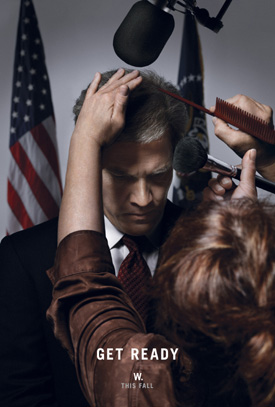
W.

Posted on February 10, 2009 at 8:00 am

Maybe it is just too soon, maybe we are just too used to the high-gloss satire of “Saturday Night Live” and “The Daily Show,” maybe it’s the kaleidoscopic structure, but this movie feels like a rough draft. Director Oliver Stone throws almost-randomly arranged scenes from the 43rd President’s life up on screen in an attempt at insight but too often it dissolves into caricature.

It begins promisingly with a defining moment for the George W. Bush presidency, or at least a moment intended to be defining. In an Oval Office meeting, W. (Josh Brolin) and his top advisors are debating the terminology they will use to explain the President’s view — literally — of the world in his first State of the Union address in January 2002, just months after the 9/11 terrorist attacks on New York and Washington. How to describe our enemies? They settle on “axis of evil.” And we get acquainted with the cast of characters who will be portraying the headline names — Jeffrey Wright as Secretary of State Colin Powell, Scott Glen as Secretary of Defense Donald Rumsfeld, Thandie Newton as Condoleezza Rice, Toby Jones as Senior Advisor and political strategist Karl Rove, and Richard Dreyfuss as Vice President Dick Cheney. A strong beginning is diminished as the characters are introduced because the audience is distracted by the effort of determining which actors do the best job of look and sound like the real-life characters they portray (that would be Newton and Dreyfuss) and which look and sound nothing whatsoever like their characters (Glen).

Then we get some flashbacks to unroll the well-known story of President Bush’s misspent youth, the drinking, the partying, the series of failed careers. Brolin gives a thoughtful performance, but the superficiality of the assessment of Bush as a man (trying to both please and do better than his father) and as a leader (there is not enough here to understand his policies or priorities) give the film an uncertain tone, sometimes verging on satire, sometimes sinking to melodrama, sometimes showing flashes of farce, especially when almost every scene shows him chomping on a sandwich or when Rice murmurs support for everything the President says. Why give us Bush choking on a pretzel? Then why have it a second time?

Elizabeth Banks gives a warm and appealing performance as Laura Bush, Ellen Burstyn is fiery as Barbara Bush, and Dreyfuss has Cheney’s steely purr down perfectly. The movie ambitiously tries to make President Bush appear more overmatched than cynical or incompetent. There are hints of hubris but Stone does not doubt the sincerity of Bush’s intentions or the merits of his aspirations. But there are too many characters and the events are glossed over too quickly. It’s very tempting to make it a metaphor for the Bush Presidency — unclear in direction and suffering from attention deficit disorder. But ultimately, it is just a movie, and despite moments of value finally an unsuccessful one.
Related Tags:


Based on a true story Biography Drama

The History Channel Presents The Presidents

Posted on January 19, 2009 at 10:00 am

B+
Lowest Recommended Age: Middle School
MPAA Rating: NR
Profanity: None
Alcohol/ Drugs: Some references
Violence/ Scariness: References to war and assassination
Diversity Issues: A theme of the series
Date Released to Theaters: 2005
Date Released to DVD: 2005
Amazon.com ASIN: B0007VY3ZK

This week we observe one of the great strengths of the system created by the founding fathers, the orderly transition to a new administration. In honor of the outgoing and incoming Presidents of the United States, take a look at this eight-part series from the History Channel about the Presidents from George Washington to George W. Bush, their careers and their lives, their triumphs and their disappointments.

Related Tags:


Biography Documentary DVD/Blu-Ray Pick of the Week Elementary School Teenagers Tweens

Notorious

Posted on January 15, 2009 at 6:00 pm

B-
Lowest Recommended Age: Mature High Schooler
MPAA Rating: Rated R for pervasive language, some strong sexuality including dialogue, nudity, and for drug content
Profanity: Constant extremely strong and crude language
Alcohol/ Drugs: Drinking, smoking, characters sell drugs, reference to drug use
Violence/ Scariness: Gang-related violence, characters shot and killed
Diversity Issues: A theme of the movie
Date Released to Theaters: January 16, 2009

Christopher George Latore Wallace lived fast, died young, and left a very big corpse. He started dealing drugs as a young kid in Brooklyn, went to prison, and was killed at age 24 in a gang-style shooting that is still unsolved. What makes him worthy of a biopic is that in between all of this he made two rap albums as Biggie Smalls/Notorious B.I.G. that were and continue to be enormously successful.

This movie will inevitably come up short when compared to documentaries like the one about the similarly brief life of the far more prolific rapper Tupac Shakur or full-scale Hollywood biopics like “Ray” and “Walk the Line.” It is produced by Wallace’s biggest promoters, his mother and impresario Sean Combs, who was then known as Puff Daddy and it has the soft edges of a hagiography. And its star, newcomer Jamal Woolard, evokes Biggie’s flattish affect without making the story’s main character particularly dynamic. The film benefits from very strong performances by the supporting cast, including Angela Bassett as Wallace’s mother, Derek Luke as Combs, Naturi Naughton as protege/girlfriend Li’l Kim, Anthony Makie as Shakur, and Antonique Smith as his wife, Faith Evans. But there is not enough in it to engage anyone who is not already a knowledgeable fan. It does not provide any context about why Wallace was different or important or how his experience informed his lyrics or what it was about his performances that connected with such a wide audience. It does not explore the notion of authenticity and “keeping it real” and the inability to understand how legitimate success was different by almost everyone but Puff Daddy that made the tragic outcomes almost inevitable. It is superficial and overly commercial, something the really Biggie never was.

Related Tags:


Based on a true story Biography Movies -- format

Cadillac Records

Posted on December 4, 2008 at 5:00 pm

B+
Lowest Recommended Age: Mature High Schooler
MPAA Rating: Rated R for pervasive language and some sexuality
Profanity: Very strong language including crude sexual references and racist epithets
Alcohol/ Drugs: Drinking, smoking, drug use
Violence/ Scariness: Guns, brutal beating, drug overdose
Diversity Issues: A theme of the movie
Date Released to Theaters: December 5, 2008

In the words of Etta James, at last.

At last, albeit imperfectly, the extraordinary story of the rise and fall of Chess Records has been given the loving attention it deserves. Magnificent performances and soul-shaking music make up for some narrative stumbles and dubious fictions in this, the higher profile of two films this year about the legendary Chicago record label.

Adrian Brody plays Leonard Chess, a Jewish immigrant who was one of the first to record and market the work of black artists in the 1950s, when it was still called “race music.” With talent like Mississippi Delta blues player Muddy Waters, harmonica virtuoso Little Walter, powerhouse vocalist Howlin’ Wolf, the silky soul chanteuse Etta James, and proto-rocker Chuck Berry, Chess recordings established the foundation for “race music” to become blues, then rhythm and blues, and then rock and roll.

That is a lot to get through in one movie, and if at times it descends into VH1 “Behind the Music”-isms, muddled chronology (the Rolling Stones show up before the early Elvis), and distortions of fact, it is understandable. The movie touches on some of the difficult issues of race and gender without much depth, as when the performers, limited by lack of education and the bigotry of the day, begin to resent the paternalism — and sloppy bookkeeping — of Chess. Generations of oppression and naivete about business make them suspicious that he is keeping too much of their money. And dramatically it falls victim to what I call the “and then” syndrome, piling events on top of each other without a strong narrative arc.

Jeffrey Wright as Muddy Waters, Gabrielle Union as his significant other Geneva, and Mos Def as Berry are outstanding as always; they are among the finest actors and most mesmerizing performers in Hollywood. Columbus Short, an appealing presence in “Stomp the Yard” and “This Christmas” is a revelation as Little Walter. And Beyonce Knowles (who also produced) gives James a gritty authenticity this glossy pop star has not reached before. What matters here is the characters and the music and in both categories the performances really deliver.

Related Tags:


Based on a true story Biography Drama Movies -- format Musical

Thoughts on ‘W’ as Movie, History, and Politics

Posted on October 18, 2008 at 2:20 pm

Movie review from Dana Stevens of Slate:
Neither satire nor biopic, the film is a kind of secular pageant, enacting with dogged literality the well-known stations of the cross of Bush’s life: the 40th-birthday hangover-turned-religious-conversion! The near-asphyxiation by pretzel! Mission accomplished! “Is our children learning?” The moments scroll up the screen like the song titles on one of those greatest-hits collections advertised on TV. The movie is done in the broad strokes and primary colors that are Stone’s trademark–lest you’ve forgotten JFK, this is not a filmmaker of nuance–but the net effect is both satisfying and strangely cathartic to watch.W-poster-sml.jpg
My enjoyment of this film hovered perilously close to camp at times. Stone’s musical choices lay it on particularly thick: He accompanies a party scene during Bush’s drinking years with the Freddy Fender song “Wasted Days and Wasted Nights” and scores the fall of Baghdad to the marchlike rhythm of “The Yellow Rose of Texas.” But if Stone’s portrait of George Bush is laid on with a trowel, maybe it’s because God seems to have engineered the real Bush’s life with a similarly crude sense of irony. W. is a case of biographer and subject being perfectly matched: You really don’t want a Bush biopic directed by Jean-Luc Godard (though Robert Altman could have done something interesting with it if he were still around). Like Tina Fey’s Sarah Palin, Stone’s George Bush gets his best lines straight from the source. This movie was scripted by screenwriter Stanley Weiser (Wall Street) but was ghostwritten by history itself.
Slate political columnist Timothy Noah talks about what they left out:
W. is the rare Oliver Stone film that had to tone down the historical record because the truth was too lurid. How the hell do you tell the uncensored story of a guy like George W. Bush? No one would believe it.
Stevens and Noah have a great conversation about the movie on the weekly “spoiler special,” which can be accessed via iTunes.

(more…)

Related Tags:


Based on a true story Biography Commentary Quote of the Week
THE MOVIE MOM® is a registered trademark of Nell Minow. Use of the mark without express consent from Nell Minow constitutes trademark infringement and unfair competition in violation of federal and state laws. All material © Nell Minow 1995-2026, all rights reserved, and no use or republication is permitted without explicit permission. This site hosts Nell Minow’s Movie Mom® archive, with material that originally appeared on Yahoo! Movies, Beliefnet, and other sources. Much of her new material can be found at Rogerebert.com, Huffington Post, and WheretoWatch. Her books include The Movie Mom’s Guide to Family Movies and 101 Must-See Movie Moments, and she can be heard each week on radio stations across the country.

Website Designed by Max LaZebnik