The Phoenician Scheme

The Phoenician Scheme

Posted on May 29, 2025 at 5:30 pm

C
Lowest Recommended Age: High School
MPAA Rating: PG-13 for violent content, bloody images, some sexual material, nude images, and smoking throughout
Profanity: Some strong language
Alcohol/ Drugs: Drinking and smoking
Violence/ Scariness: Graphic violence with disturbing images, characters injured and killed
Diversity Issues: None
Date Released to Theaters: May 30, 2025
Copyright 2025 Focus Features

You say you want to see a very smart, darkly comic film about the daughter of an unscrupulous businessman who before the story begins has joined a religious order but over the course of the story learns that she can do more to help people in his secular world and becomes drawn to a young professor? Then I suggest you watch the brilliant film “Major Barbara,” starring Wendy Hiller and a young Rex Harrison and with a very young Deborah Kerr, based on the classic play by George Bernard Shaw.

Or, if you would like to see a movie that skitters along the surface of some of those themes without having much to say about them but looks gorgeous, in fact so exquisite that if it starts to drag, which it does, we wish the actors would get out of the way so we could better absorb the beauty of the settings. In other words, we’re in the bento box movie world of Wes Anderson.

What bothers me third-most about Wes Anderson films is the way the characters speak the mildly arcane dialogue in constant near-robotic deadpan. What bothers me second-most is that the dialogue delivered in monotone is not just mildly arcane but pretentiously so, as though the twee-ness indicates both comic sensibility and deeper meaning. There can be humor in saying extreme things with a flat delivery, as though you’re politely asking to pass the butter, can be funny, but not always and not for a whole movie. What bothers me most is the way many people emperor’s-new-clothes the films, believing that the humor and deeper meaning they discern is somehow invisible to the less sophisticated instead of non-existent.

Benicio Del Toro plays Zsa-zsa Korda, a wealthy, powerful, and corrupt businessman, who says his two imperatives are “Who could lick who (or whom)?” (measuring success by beating the competition) and “If something gets in your way, flatten it” (the ends justify even scorched-earth means).

There are those who have similar guiding principles, or lack of principles, and therefore, as we see in the first scene, when an explosion on Korda’s airplane blows a big hole in the hull, and also in one of his aides, slicing his top half from his bottom half. Korda then goes into the cockpit and fires his pilot, in both senses of the word, dismissing him from employment and jettisoning him via ejector seat. Korda survives the crash landing with injuries. He knows more murder attempts are coming, and so he reaches out to his daughter Liesel (Mia Threapleton, daughter of Kate Winslet). She is about to take orders as a nun, and throughout the film she wears a snowy white habit, though as it goes on she also sports colorful eye shadow and bright red nail polish. Korda also has nine young sons, some adopted. His only interest in them is the thought that there are so many of them, odds are one will be brilliant.

Anderson’s two most recent films were episodic, like nested dolls. This one is slightly more linear, but still in chapters as Korda visits a series of characters in very different settings played by stars like Tom Hanks and Bryan Cranston (as American brothers in college sweatshirts), Scarlett Johansson as Korda’s second cousin and possible future wife, Jeffrey Wright as a ship captain, and Benedict Cumberbatch as Korda’s rival and half-brother. There are various murder attempts (the characters refer to them as assassination attempts, but that seems grandiose for a businessman, even one who is rich and powerful and has done evil things, because the term refers to the killing of an important person for political or religious reasons). And Korda and Liesel are accompanied by a character played by Michael Cera, introduced as a tutor brought on to teach them about insects (do not try to make this tie into anything except the overall anemic randomness that translates to “and then this character appears.” He plays a more important role as the story goes on and is the closest the movie comes to having a bright spot. It’s not that it has style and no substance. It has style and anti-substance.

Other than the settings, of course, which are fabulously imagined and entrancingly detailed. (As always with Anderson, look at the titles and covers of the books the characters read.) The movie might work better with no dialogue, just the visuals and the music.

Parents should know that this movie has a lot of peril and violence with some graphic and disturbing images. The movie includes guns, knives, bombs, fire, plane crashes, and quicksand. Characters are injured and killed, including references to a murdered parent. Characters are corrupt and murderous. they behave badly in business and with family, and they drink and smoke. Characters’ religious beliefs are not meaningful or sincere.

Family discussion: Why does Liesel stay with her father? What does she hope to achieve and how does that change? What do we learn from the names of Korda’s projects? From his mottos?

If you like this, try other Wes Anderson Films, especially “The Fantastic Mr. Fox.”

Related Tags:


Comedy Drama movie review Movies -- format Movies -- Reviews
Bad Shabbos

Bad Shabbos

Posted on May 23, 2025 at 5:32 pm

B +
Lowest Recommended Age: High School
MPAA Rating: Not rated
Profanity: Strong language
Alcohol/ Drugs: Alcohol, medication
Violence/ Scariness: Accidental death, some disturbing images
Diversity Issues: A theme of the movie
Date Released to Theaters: June 6, 2025
Copyright 2024 Menemsha Films

The title makes it clear. Like “Bad Teacher,” “Bad Santa,” and “Bad Day at Black Rock,” this is a very dark comedy about an evening that does not go well. And then it goes extremely not well.

There’s a lot of pressure on this Friday night shabbos (Sabbath) family dinner at the home of religiously observant Jewish parents Richard (David Paymer) and Ellen (Kyra Sedgewick). Joining them are their three adult children, David (Jon Bass), Abby (Milana Vayntrub), and Adam (Theo Taplitz). Just about everyone is hiding something or worried about something or lying about something or all of the above.

Abby brings her boyfriend, Benjamin (Ashley Zukerman). She does not want her parents to know that they drove, which is forbidden on the Sabbath. David brings his fiancee, Meg (Meghan Leathers). Richard and Ellen are not happy that Meg is not Jewish, though somewhat mollified because she is studying Judaism with plans to convert. This dinner will be the first time Meg’s Catholic parents from Wisconsin meet David’s family and everyone is concerned about how that is going to go, especially since Meg has not told her parents that she is going to convert. Contributing to the pressure on David and Meg, it seems everyone in town knows about the expectations for this meal. They stop at the legendary Barney Greengrass deli to pick up challah (the braided bread traditionally eaten at Shabbos dinner), where they are waited on by real-life Gary Greengrass, who learned about the meeting of the two sets of parents from Richard. At the apartment building, the affable doorman, Jordan (Wu-Tang’s Method Man, in an irresistibly charming performance) says that “Richie” has told him all about it, and that David’s family is his favorite. Method Man just about steals the film as the ultimate ride or die friend of the family.

The family’s youngest son is fragile, highly sensitive Adam, who does not have a job and still lives with his parents. Richard and Ellen are constantly trying to reassure him that he is doing fine and loved by everyone, but he is only too aware that his family is worried and perhaps a little disappointed. He takes the anti-anxiety psychotropic drug Klonopin, and apparently some other medications as well. It is clear that at least some members of the family are concerned that his behavior might be disturbing for Meg’s parents. He is probably imagining a scene like the one in “Annie Hall,” where Woody Allen’s New York Jewish character meets Diane Keaton’s very Christian midwestern family, and imagines they see him as an Orthodox Hassid.

So, a lot of pressure. And then, as noted, things get very, very bad. As Meg’s parents, John (John Bedford Lloyd) and Beth (Catherine Curtain) are on their way, one of the people in the apartment is accidentally killed, implicating Adam. And then, along the lines of the recent “The Trouble with Jessica,” the group decides not to call an ambulance or the police but somehow cover it up, and the rest of the film is farce.

In “The Trouble with Jessica,” the people at a dinner party decide to cover up a death for selfish reasons. What gives “Bad Shabbos,” a lighter tone is the way the family immediately decides that their priority is protecting a vulnerable person and, of course, not making Meg’s parents think that they are the kind of people who have dead bodies in their apartment. Their logic — and their morality — may be wobbly, but it is hard not to sympathize with them. There is an extremely sweet moment when Meg delivers the d’var torah (a brief discussion of the meaning of a passage from the first five books of the Bible) to demonstrate what she is learning in her class. And it is very funny that the family keeps trying to persuade John and Beth that every unusual action is part of their tradition, expecting that anything Jewish is so unfamiliar to them they will just try to be polite and go along with it.

What makes the film especially engaging is the way it gets the details of a New York Jewish shabbos meal right. The tone of the film may be heightened, exaggerated for comic purposes, but unlike too many other portrayals this film never makes the characters into caricatures and the details are precise and affectionate. It’s very dark, but it is also very funny.

Parents should know that this is a comedy about a dead body and the lies and cover-ups in response to an accident. Characters use some strong language. They drink wine and misuse medication. There is an accident and brief disturbing images. A character struggles with mental illness.

Family discussion: Why did the family agree to lie? Were they right?

If you like this, try: “Round and Round”

Related Tags:


Comedy Jewish movie review Movies -- format Movies -- Reviews Thriller
The Ballad of Wallis Island

The Ballad of Wallis Island

Posted on April 3, 2025 at 5:40 pm

B +
Lowest Recommended Age: Preschool
MPAA Rating: Rated PG-13 for some language and smoking
Profanity: Some strong language
Alcohol/ Drugs: Drinking and smoking
Violence/ Scariness: Reference to sad death
Diversity Issues: None
Date Released to Theaters: March 28, 2025

Come on, admit it. Somewhere secretly stored away in your heart, you know what you would do if you won the lottery. “The Ballad of Wallis Island” is a wonderfully warm and touching film about a male nurse who won the lottery twice. The first time, he and his wife travelled all over the world. The second time, now a widower, he decided to spend it all on a concert for an audience of one, reuniting his all-time favorite musical duo for a performance on a very remote island.

Copyright 2025 Focus

That duo is McGwyer & Mortimer, who last performed together 15 years earlier. Herb McGwyer (Tom Basden, also co-screenwriter and composer of the songs) is cynical and detached. He has no idea what he is getting into, even when it turns out he has to disembark from the small boat bringing him to the island by wading to the shore. He assumes that Charles Heath (co-screenwriter Tim Key) is something like a bell boy come to carry his bags. And Charles’ natural awkwardness, compounded by five years of near-complete solitude and being overwhelmed by the presence of his idol, is no help in clarifying the situation.

Furthermore, Charles has not told Herb that Nell Mortimer (Carey Mulligan) is coming and the performance will be the songs they recorded together. Also, she is married and living in America, where she now sells chutney at the farmer’s market.

Herb needs the £500,000 Charles is paying to make his next solo record. So, even though each new piece of information he learns about the gig is increasingly distressing, he agrees to stick it out, with the exception of the time he tries to leave and finds out that the one boat that takes people to the mainland does not come in bad weather. He is stuck. And then Nell arrives, with her husband, Michael (Akemnji Ndifornyen), an easygoing American who spends just long enough at Charles’ house to unsettle Herb and then departs for a birding tour.

This gives Herb and Nell a chance to practice for the upcoming performance. And it gives Charles a chance to go from extremely annoying to less annoying to endearingly annoying.

That’s a tricky challenge for any actor, but Key and Basden created these characters to play to their strengths as performers and it works beautifully. Key shows us that Charles is shy, lonely, sad, and vulnerable. He is not good at showing how much he cares. Basden shows us that Herb is lonely, too, and his songs are everything a character with Herb’s level of success should have in his set list. Mulligan harmonizes beautifully and we see what her experience after the break-up has been when she says what she misses is the music, allowing Herb and us to fill in what she leaves out: she does not miss him. Seeing each other does, though, allow them both to go forward with a better sense of what they have and what they want.

Sian Clifford is terrific as the proprietor of the tiny local store on the island, which never has anything the mainlanders want, like rice to cure a phone that fell in the water (“We have pasta?” she asks hopefully) or a Reese’s Peanut Butter Cup. We may all wish for a visit to Wallis Island when the movie ends.

Parents should know that this movie has strong language, smoking and drinking, and some mild sexual references.

Family discussion: If you won the lottery, what would you spend the money on? Why is the music so important to Charles? Herb left two things for Charles — what was the reason for each of them? What will Herb do next?

If you like this, try: “Once” and “Sing Street”

Related Tags:


Comedy Drama movie review Movies -- format Movies -- Reviews Musical
A Minecraft Movie

A Minecraft Movie

Posted on April 2, 2025 at 4:11 pm

B
Lowest Recommended Age: 4th - 6th Grade
MPAA Rating: Rated PG for violence/action, language, suggestive/rude humor and some scary images
Profanity: Some schoolyard language
Alcohol/ Drugs: None
Violence/ Scariness: Fantasy peril and violence, some scary creatures
Diversity Issues: None
Date Released to Theaters: April 4, 2025
Copyright 2025 Warner Brothers

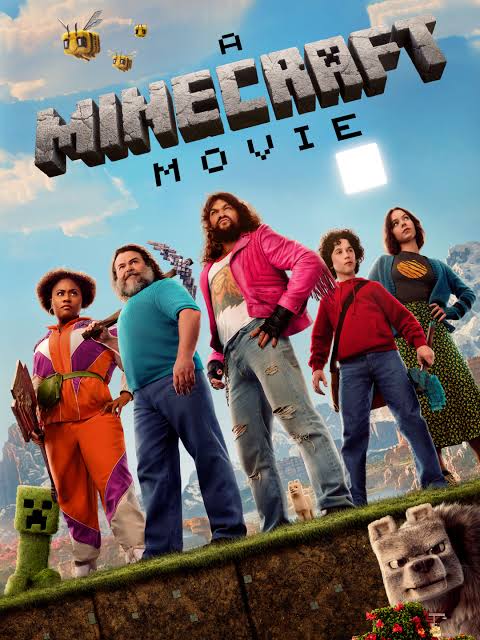
“A Minecraft Movie” is a lot of fun. Fans of the game will enjoy a lot of touchstones and to its dedication to giving players “where anything you imagine you can create.” Those who don’t know anything about the game will appreciate its good spirits, off-beat humor, and appealing characters.

“Napoleon Dynamite” directors Jared Hess and Jerusha Elizabeth Hess (working together under his name) brings their love for off-beat small-town America and the “Velvet Mischief” signature scent. They reunite with his “Nacho Libre” star Jack Black. There’s also an appearance by their “Gentlemen Broncos” star Jemaine Clement and tater tots, reminiscent of the “tots” in “Napoleon Dynamite.”

Black plays Steve, whose dream as a child was to be a miner. When he grew up, he left his humdrum job selling doorknobs and was transported vis “this thingy and that cool thingy” into the world of the game, where he met his beloved wolf, Dennis. The chance to create and explore with his devoted companion was everything he ever wanted until he entered the Nether and was captured by its witchy evil queen Malgosha (Rachel House) and put in prison by her pig-soldiers.

Back in the real world, more specifically the small town of Chaglass, Idaho, the Potato Chip Capital, we meet some characters who are struggling. One-time world video game champion Garrett Garrison (Jason Momoa, also a producer and clearly having a blast) is having a hard time accepting that he is no longer successful. His business, Game Over World, is failing and no one is impressed by the high scores he had in the 90s that inspired his GAMR 89 license plates. Natalie (Emma Myers) and her younger brother Henry (Sebastian Hansen) have just moved to Idaho after the death of their mother. Their warm-hearted realtor, Dawn (Danielle Brooks) welcomes them, but explains that she has had to take on several other jobs, including a traveling zoo. Natalie takes a job doing social media for the local potato chip company while Henry is bullied on the first day at his new school.

Then they find themselves transported into Minecraft where they meet up with Steve. Like Dorothy in Oz and Alice in Wonderland, Garrett, Natalie, Henry, and Dawn spend the rest of the story trying to get back home but learning some lessons and developing some friendships along the way.

There are a lot of adventures along the way, too, as the group travels throughout the world of Minecraft to get to the MacGuffin, which in this case is the glowing thingy and the cool thingy that will allow the humans to return to their world. By the way, in this square-ified voxel-built world, a glowing cube thingy is referred to as an orb.

It’s a looser, lower-key, goofier version of “Jumanji,” with Momoa substituting for Dwayne Johnson, with Iron Golems, a chicken jockey, some great eyebrow action, zombie skeletons riding giant spiders and shooting flaming arrows, a talent show, a tot launcher, and surprise! instead of an English accent, the villain has a New Zealand accent! Plus Jennifer Coolidge as the school principal who has her own adventure with a Minecraft creature, briefly but hilariously voiced by Matt Berry.

It’s called “A Minecraft Movie” instead of “The Minecraft Movie” to pay tribute to the game’s possibilities, with every player creating a unique experience. The movie does not have that luxury; it is the same for every viewer. But its appreciation for the endless potential of imagination should be more likely to inspire viewers to try to play the game or even create their own.

NOTE: Stay all the way through the credits for a mid-credit scene AND a post-credit scene.

Parents should know that there are some scary monster and characters are in extended peril, but there are no serious injuries, mostly slapstick including a crotch hit and a scene of two men tightly strapped together. Characters use some schoolyard language.

Family discussion: How does Garrett change and why? If you play Minecraft, what makes it different from other games? What’s your favorite place in the Minecraft world and your favorite way to play?

If you like this, try the “Jumanji” movies, also with Jack Black

Related Tags:


Action/Adventure Based on a video game Comedy Fantasy movie review Movies -- format Movies -- Reviews Scene After the Credits
The Penguin Lessons

The Penguin Lessons

Posted on March 27, 2025 at 5:55 pm

B +
Lowest Recommended Age: High School
MPAA Rating: Rated PG-13 for strong language, some sexual references and thematic elements
Profanity: Strong language
Alcohol/ Drugs: Alcohol
Violence/ Scariness: Mostly off-screen depiction of a military coup, characters captured and beaten
Diversity Issues: None
Date Released to Theaters: March 28, 2025

“I had you as a head down sort of fellow. Anything for a quiet life.” Jonathan Pryce as the headmaster of a posh private school in Buenos Aires is disappointed to discover that the English professor he thought wanted to hide from the world and, especially, from his feelings, might have started out that way but due to an outside influence, had become a head up sort of fellow who was increasingly less quiet.

That professor is Tom Michell (Steve Coogan), who is joking-not-joking when he tells the headmaster his career has been “steadily working my way down,” and then adds, “geographically speaking.” Both are Brits who have ended up in Argentina just as it is on the brink of a military coup in 1976. The headmaster explains that there is “trouble in the streets and the economy is in free fall,” but their school is a haven where wealthy families send their sons. He tells the faculty it is also a haven from any conversation about politics. “Whatever strong opinions you may have, keep them to yourselves and don’t bore the rest of us.”

The coup happens and the school sends the students home for a week until the country calms down. All this means to Michell is a chance to go to Uruguay for a chance to drink and perhaps find some ladies. A lonely colleague from Finland (Björn Gustafsson) comes along, telling Michell, “I like you.” Michell responds, more wry than bitter, “Do you? I don’t.”

They go to a bar and Michell meets a beautiful woman who takes him for a walk on the beach. They come across a Magellanic penguin drenched in oil from a spill. Only because he wants to impress (meaning, have sex with) the lady, Michell agrees to clean off the penguin. The lady then leaves and Michell is about to discover that penguins are very loyal and this one will not leave him.

That is how Michell ends up hiding a penguin, later named Juan Salvador, in his room. The flightless bird is quickly discovered by the maid and her granddaughter, Sofia (Alfonsina Carrocio) who gives him his name, from the Spanish version of Jonathan Livingston Seagull.

The setting makes this more than the typical “grumpy or grieving person finds solace, hope, and connection with an animal” movie. Screenwriter Jeff Pope, who worked with Coogan on “Philomena,” “The Lost King,” and “Stan and Ollie,” took the real-life story of a 23-year-old teacher and adapted it to Coogan’s strengths as an actor. This is one of the best performances from someone who is not given a chance to show all he can do often enough. At first he is remote, though not humorless. He tries to reach his “privileged and spoiled” students by explaining sarcasm. Then, as it becomes harder to pretend to ignore the atrocities around him, especially after Sofia is taken, the poetry he shares with his students begins to tend first toward loss, then courage, integrity, even rebellion. There’s a wonderful moment when Michell is on the phone with the local zoo, saying he will kill the bird if they won’t take Juan Salvador, quickly gesturing to the penguin reassuringly.

The combination of horrific national tragedy with the personal story of someone unconnected to the community does not always work. But people do struggle to work through their own losses and sometimes they do find connection in unexpected places that help them reconcile emotions they thought were too painful to acknowledge. There is so much warmth and humor in this story that we cannot help feeling touched by the story and maybe even thinking about a penguin of our own.

Parents should know: This movie occurs during a brutal military coup and while much of the abuse is off-screen, a character is “disappeared” and the end credits acknowledge that thousands were captured and killed during this period. Characters use strong language, drink alcohol, and mention sex

Family discussion: When did Michell’s feelings about the penguin begin to change? Why did everyone want to talk to the penguin?

If you like this, try: The book by the real Tom Michell, My Penguin Friend, and the beloved documentary March of the Penguins

Related Tags:


Based on a book Based on a true story Comedy Documentary movie review Movies -- format Movies -- Reviews School
THE MOVIE MOM® is a registered trademark of Nell Minow. Use of the mark without express consent from Nell Minow constitutes trademark infringement and unfair competition in violation of federal and state laws. All material © Nell Minow 1995-2026, all rights reserved, and no use or republication is permitted without explicit permission. This site hosts Nell Minow’s Movie Mom® archive, with material that originally appeared on Yahoo! Movies, Beliefnet, and other sources. Much of her new material can be found at Rogerebert.com, Huffington Post, and WheretoWatch. Her books include The Movie Mom’s Guide to Family Movies and 101 Must-See Movie Moments, and she can be heard each week on radio stations across the country.

Website Designed by Max LaZebnik