Rated PG-13 for thematic material, some language, disturbing images, and violence
Profanity:
Some strong language
Alcohol/ Drugs:
Alcohol
Violence/ Scariness:
Peril and violence, guns, references to war
Diversity Issues:
A theme of the movie
Date Released to Theaters:
December 12, 2020
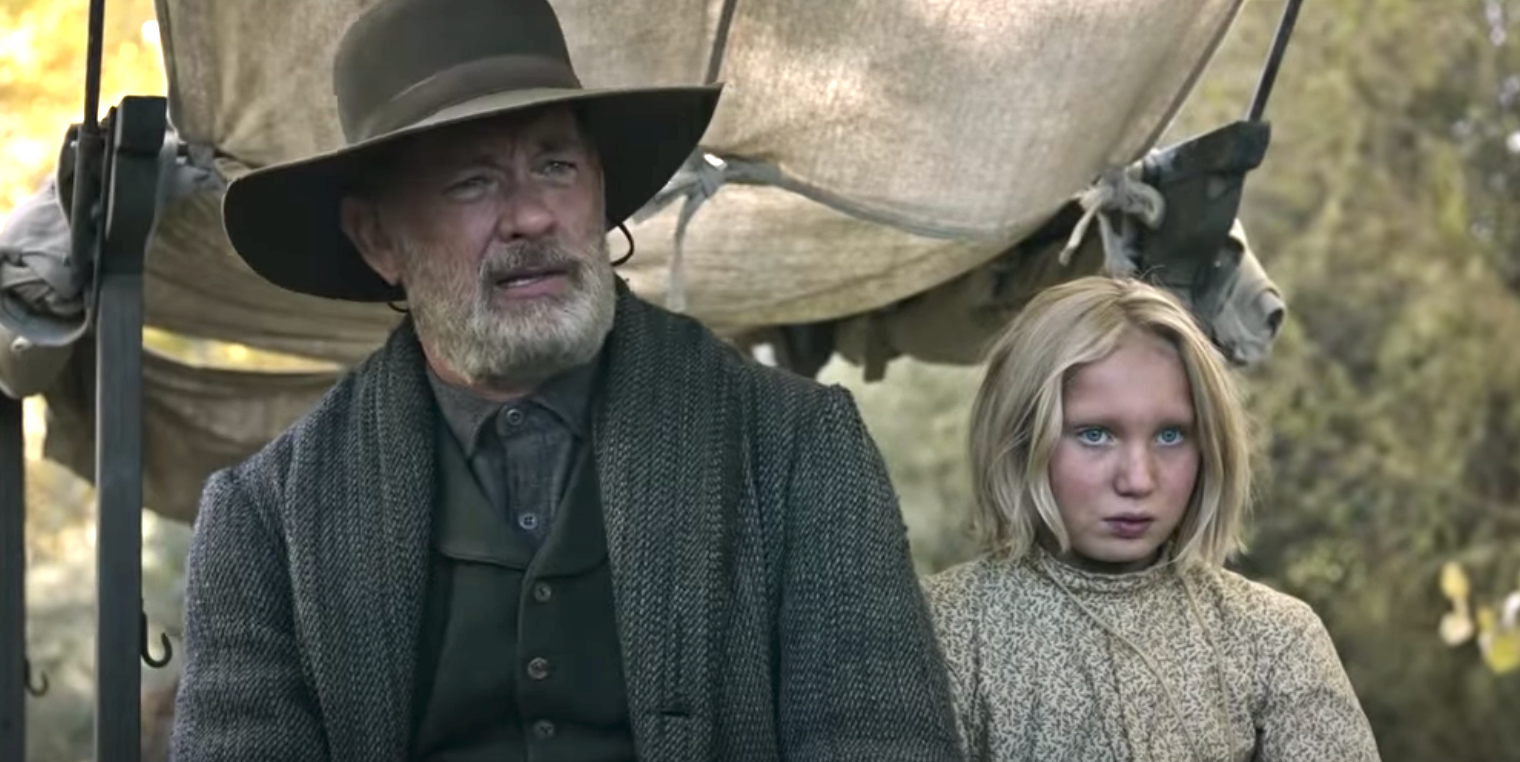
Copyright 2020 Play-Tone“News of the World,” based on the book by Paulette Jiles is filled with undeniable good intentions, but that does not always translate to the screen. Tom Hanks, who also produced the film, stars as Captain Jefferson Kyle Kidd, a Civil War veteran who travels from town to town, charging crowds to read the aloud the news to crowds who otherwise would not know what was going on outside their community.
A young girl who was captured by Kiowa Indians needs to be taken to the only family she has, an aunt and uncle, but no one is available to get her there. The Captain agrees, even though the girl has forgotten anything about her earlier life and speaks only Kiowa.
So this is the story of a journey, with two very different people who will face many challenges and obstacles as they try to reach to their destination. That destination is not just a place. Both Captain and the girl, once known as Johanna (Helena Zengel) do not know whether any place will be home to them. As the Captain says, Johanna is a child who has lost her family twice. Her birth family was killed by the Kiowa and her Kiowa family was killed by the US Cavalry. And the Captain not only survived the unspeakable brutality of war; he was on the losing side, fighting for the Confederacy. So, two broken people may find that making a connection is, well, the way home.
“News of the World” touches on issues of history, identity, and reconciliation, a response to the classic western myth and movie. This is not about claiming and taming the land. It is about painfully won understandings. There are exciting confrontations along the way but the triumphs here are about relationships and honor. Like the classic westerns, the setting is magnificent, gorgeously photographed by Dariusz Wolski, and the peril is intense, especially a shoot-out when three ex-military come after the girl. The movie has bigger ambitions, but it is the moments between Hanks and Zengel that stand out.
Parents should know that this film includes peril and violence, including the threat of child rape. Characters are injured and killed and there are references to tragic offscreen losses including murder of parents and death of a spouse. Characters use some strong language and drink alcohol.
Family discussion: Why does the Captain become a news reader? How did Johanna change the Captain’s life?
If you like this, try: “True Grit,” “Silverado” and “The Searchers”
Copyright Netflix 2020“Mank” is a big, breathtakingly ambitious, multii-layered story of Herman Mankiewicz, the man who wrote the original screenplay for what many people consider the greatest film ever made, “Citizen Kane.” This was a passion project for one of the most passionate and meticulous, film-loving directors in Hollywood, David Fincher, partly because the original script for this film was written by his late father, Jack, the sole credited screenwriter.
“Mank” is firmly rooted in its period, down to the black and white film with high ceilings and shadowy images, paying tribute to “Citizen Kane” and other films of that era, it is, like most films set in a different time, very much in conversation with and commentary on where we are today. So. the settings are re-created with exquisite precision and any old Hollywood cinephiles will be overjoyed to be able to visit the office of legendary producer Irving Thalberg (Ferdinand Kingsley) or sit in on a writers’ conference featuring the men who wrote films like Charles Lederer (the original “Oceans 11,” “His Girl Friday,” “Gentlemen Prefer Blondes,” played by Joseph Cross) and Ben Hecht (“Scarface,” “Gunga Din,” played by Jeff Harms. They will also get a kick out of the faux “cue marks,” the circles in the upper right-hand corners of the frame to let the theater projectionist know when it was time to get ready to change reels, long disappeared from movies in the digital era.
And then there is San Simeon, the unimaginably lavish Hearst castle built by the unimaginably wealthy William Randolph Hearst (Charles Dance). He was the heir to a gold mining fortune and a political dynasty. He became the owner of the country’s largest media empire, which he used to push his political priorities. Is the commentary on today coming into focus?
Herman Mankiewicz was brilliant, sardonic, cynical, and a raging alcoholic and gambler. He ruefully notes that his wife is always referred to as ‘poor Sarah” (“Downton Abbey’s” Tuppence Middleton). He was a real-life version of those journalists in the wild wild West days of newspapers, as often portrayed by Clark Gable. He famously sent a telegram to Ben Hecht (in the movie version to Charles Lederer encouraging him to come to Hollywood: “Millions are to be grabbed out here and your only competition is idiots. Don’t let this get around.”
A brilliant trouble-maker of an enfant terrible from radio and theater named Orson Welles (Tom Burke) has been given free rein to make a movie, what he would later call “the The biggest electric train set any boy ever had.” He asks Mankiewicz, recovering from a leg injury, to write the script and puts him in a remote cabin with a secretary (Lily Collins as Rita Alexander) to keep him away from “distractions,” meaning booze and gambling.
Like “Citizen Kane,” the movie goes back and forth in time, the flashbacks illuminating the movie’s present, especially the inspiration for the title character, who would be played by the 25-year-old director himself. We see moments and characters and ideas sparking the ideas in the screenplay. And we see the painful and often self-destructive force of an intellect that is so deeply cynical only because at heart he is so deeply idealistic.
Mank’s warm friendship with Marion Davies (Amanda Seyfried) is at the heart of the movie. He can be honest with her because she is honest with him and because, unlike “poor Sarah,” he does not feel, at least in the earlier days of their relationship, that he is letting her down. Davies was the long-time romantic partner of Hearst, who was married to someone else. He ordered his newspapers to write about her frequently, leading to the joke that every story about a Hollywood event had the line “And Marion Davies looked lovely.” (Because of the Susan Alexander character in “Citizen Kane,” the second wife Kane insisted on promoting as an opera singer with disastrous results, people often think Davies was untalented, but she was a lovely light comedienne with a charming presence on screen.)
Because of Davies, Mankiewicz is often a guest at San Simeon and has a cordial relationship with Hearst, until Hearst’s opposition to the progressive California gubernatorial candidate Upton Sinclair (cannily played by Science Guy Bill Nye) and the movie studios’ anti-Sinclair propaganda “news” films lead to intolerable behavior in social gatherings — and to the corrupt, lonely former idealist Charles Foster Kane.
It is pure pleasure to see a film that respects the audience enough to take on big issues with complexity, humanity, and wit, every careful detail and layered performance providing much to think about and many questions about our own time and how it will be seen eighty years from now, if we are lucky enough to have filmmakers of this quality.
Parents should know that this movie includes strong language, alcoholism and other addictive behavior, some sexual references, and references to the Holocaust.
Family discussion: Who is most like William Randolph Hearst today? Most like Upton Sinclair? Why did Mank change his mind about wanting credit for the movie? Was he fair to Marion Davies?
Copyright Amazon 2020We’re going to have to come up with a better term than POV to describe “Sound of Metal,” the story of a drummer who loses his hearing. POV describes a subjective portrayal, where we see just what the character sees instead of what an outsider can see. But “see” is the operative word. Much of “Sound of Metal” is subjective, so that we hear only what Ruben (brilliantly played by Riz Ahmed) is hearing. Many of the sounds are muted or distorted. Some of the movie is in silence. Sometimes we get a brief chance to hear what he cannot. There are subtitles in some moments but not in others so we can experience Ruben’s sense of confusion and isolation.
This is a remarkably assured debut from co-writer/director Darius Marder and his co-writer/composer/brother Abraham Marder. In an interview with me and a small group of other journalists, Darius Marder said making music the center of Ruben’s life was appealing because music connects people and because hearing loss is both a personal and professionally devastating for a musician. But he also said that music serves as a metaphor for relationships. We all have our own place within a relationship,” Darius said. “I play the drums and you play guitar and together we make this music. But what are we if we start pulling those sounds apart? If you leave, what is left? Abraham and I were both inspired by the concept of using this two-person band as a metaphor for a relationship. Even though it is steeped in a very specific music world, the intention was for it to be universal in
feeling.”
The Marders trust the audience to lean in to the film, to not need to have every detail explained in advance. So we gradually learn that Ruben is a former heroin addict, who has been clean for four years with the support of his girlfriend and bandmate Lou (Olivia Cooke) and his utter devotion to music. We can see from the performance that leads off the film that Ruben gives everything he has to the raw emotion of the punk/metal music he and Lou play.
And then, suddenly, he hears a pop and then sounds are muffled and distorted. A doctor tells him it may be a result of the heroin use and that it isn’t coming back.
It’s just like the Elizabeth Kubler-Ross stages for impending death. The first stage is denial. Ruben plays another gig. He is sure he can fix this. But he can’t. Lou takes him to a rehab program for addicts with hearing loss led by Joe (played by Paul Raci, the son of Deaf parents). The program is attached to a school for Deaf children and at first Ruben is put in class with them to learn to sign.
The Marders show us in an understated way that Ruben’s addictive personality has just transferred from drugs to music and Lou. Away from both, he is lost. He learns to sign and begins to be a part of the new community but he is determined to get back what he lost, at any cost.
Ahmed, Cooke, and Raci all give understated, natural performances that draw us into the story even more than the immersive sound design. Much of Ahmed’s performance is in his deep, expressive eyes, making Ruben one of the most memorable characters on screen this year.
Parents should know that this movie includes very strong language and discussion of substance abuse. There are some graphic images in a scene of an operation.
Family discussion: What will Ruben do next? Did he make the right decision about the operation? Why does Joe insist that Deaf people do not need to be “fixed?”
Extended and very tense peril and violence, sad death, characters injured and killed, guns, ax, fire
Diversity Issues:
A theme of the movie
Date Released to Theaters:
November 6, 2020
Date Released to DVD:
February 1, 2021
Copyright 2020 Focus FeaturesWe think George (Kevin Costner) and Margaret (Diane Lane) Blackledge are dressing for a funeral. In the first moments of “Let Him Go” their adult son was killed in an accident on their farm, and their expressions and clothes are somber. But it is three years after their son’s death and they are dressing for a wedding, not a funeral. Lorna (Kayli Carter), the widow of their son James and the mother of his now-three-year-old son Jimmy, is getting married to a man named Donnie Weboy (Will Brittain) and leaving their farm to live with him. They reassure themselves that they will still see Jimmy. But then Margaret sees them when they don’t know she is there, and Donnie hits Lorna. And then, without any notice, Donnie, Lorna, and Jimmy disappear. He has gone home to his family, leaving no way to contact them. It is the 1960s, and it was easier to hide in those days, whether from grandparents or from law enforcement.
Margaret decides to go after them, to bring Jimmy home to live with them. George agrees to go along, but he does not think they can get Jimmy away from his mother and his new family. He wants to give Margaret a chance to say goodbye.
“Let Him Go” is based on a book by Larry Watson, adapted by writer/director Thomas Bezucha. He makes great use of the majestic scenery of the northwest, especially when George and Margaret encounter a lone young Native American named Peter Dragswolf (Booboo Stewart). Just as in the classic westerns, the landscape emphasizes the opportunity — and the dangers — of a world where there is so much land and people are so isolated.
Lane and Costner, who played a couple in two Superman movies, have an easy chemistry that makes us believe there is a long history between them. Neither George nor Margaret say much, in part because they know each other so well there is little more to say, and that includes understanding that there is no point in trying to persuade each other on issues that they know too well will never be resolved. “Sometimes that’s all life is, a list of what we’ve lost,” George says. But Margaret is not going to give up.
Bezucha knows how to create tension, even with seemingly simple comments or undramatic settings, which only adds to the sense of dread. You don’t find a Weboy, a relative tells them. “You let it be known you’re looking for a Weboy. They find you.”
And they do, at a place so far off the map they could never find it without being led by Donnie’s uncle. They are invited to dinner by Donnie’s mother Blanche, played by the unsurpassable Lesley Manville, in one of the year’s best performances. She can make the offer of pork chops sound ominous. And she does. She rips into the role and is absolutely electrifying. And terrifying.
Two solid citizens up against a family of feral outlaws, an updated western with good guys and bad guys leading to an intense and violent battle. The set-up is conventional, but the direction and performances make it memorable.
Parents should know that this film is an exceptionally tense thriller with peril, abuse, and violence that includes guns, an ax, and fire. Characters are injured and killed.
Family discussion: Why did George and Margaret have different ideas about what they wanted to get from finding Jimmy? What do we learn from Peter’s story?
If you like this, try: “The Lookout” and “The Highwaymen”
Rated R for some language and some sexual references
Profanity:
Strong language
Alcohol/ Drugs:
Social drinking
Violence/ Scariness:
None
Diversity Issues:
None
Date Released to Theaters:
October 24, 2020
Copyright 2020 A24
I admit that I was about to give up on Sofia Coppola. I admired her early films, “The Virgin Suicides” and “Lost in Translation,” in part because of her exquisite framing and intriguing silences. But her later films made the framing seem precious and the silences seem empty. They were like precisely arranged bento boxes created for display only, beautiful to look at but not very nourishing or flavorful.
But now we have “On the Rocks,” a slight film but with more warmth and a more relaxed tone than her previous work. It’s bittersweet, but it is beguiling. Rashida Jones plays Laura, a writer in New York living with her husband Dean (Marlon Wayans) and two young children, one still a toddler. Dean has been working hard at his job, which requires a lot of travel, and Laura has been feeling neglected, struggling with her writing, and she begins to worry that Dean might be having an affair with the beautiful and a bit intimidating colleague who travels with him (Jessica Henwick and Fiona). While he is traveling the world and making big deals, she says, “I’m just the buzzkill waiting to schedule things.” And then, for her birthday, he gives her a kitchen appliance.
One reason Laura might be suspicious is her father, a charming and utterly unrepentant man about town, who has never been faithful to a partner, including Laura’s mother. But he loves Laura, and thinks the best way for him to help her is to help her follow Dean to find out for sure. She isn’t sure whether it’s better to find out that he is having an affair or finding out he is not having an affair but she has just become boring. “Ehst if we find out he is just busy and I’m in a rut?”
Laura’s father, Felix, is played by Coppola favorite Bill Murray, who worked with her in “Lost in Translation” and “A Very Murray Christmas.” The fun of the movie is seeing Jones and Murray together as they take us to one fabulous Manhattan location after another, to the sounds of the lush score from Phoenix. They adore each other, but there is strain between them. He betrayed her mother — and the woman who came after her, and many others. “Why do women get plastic surgery?” Felix asks Laura. “Because of men like you,” she says. He tells her he prefers women who have not had work done and she says he prefers all kinds of women. When he is stopped for speeding as they are following Dean, he utterly disarms the policeman by telling him he knew the cop’s father and grandfather. “It must be very nice to be you,” she says. He smiles, “I wouldn’t have it any other way.”
The plot barely exists, but like Laura and Felix, it is more about spending time together than answering the question about Dean. “On the Rocks” is like a lighter, sweeter Woody Allen film, a love letter to Manhattan, to music, to fathers and daughters, and to love itself.
Parents should know that the theme of this movie is adultery, including strong language and sexual references.
Family discussion: Why was Laura worried about Dean? Why didn’t she talk to him about her concerns?
If you like this, try; “Midnight in Paris” and “Celeste and Jesse Forever,” written by and starring Rasida Jones