A Hologram for the King

A Hologram for the King

Posted on April 19, 2016 at 5:36 pm

B+
Lowest Recommended Age: Mature High Schooler
MPAA Rating: Rated R for some sexuality/nudity, language and brief drug use
Profanity: Some strong language
Alcohol/ Drugs: Drinking, drunkenness, drugs
Violence/ Scariness: Some disturbing scenes relating to medical issues
Diversity Issues: A theme of the movie
Date Released to Theaters: April 22, 2016
Date Released to DVD: August 8, 2016
Amazon.com ASIN: B01GP4HSH2
Copyright 2016 Roadside Attractions

“Hologram for the King” is an uneven but engaging and always-watchable film based on the book by Dave Eggers. Like Arthur Miller, David Mamet, and many others, Eggers chose a salesman as a central figure and metaphor to illustrate the mixture of optimism, determination, and despair that is the Sisyphean life of someone whose job is to take no after no after no and keep coming back.

Tom Hanks plays Alan Clay, who has all the people skills of a lifelong salesman and all the desperation of a man who has one last chance to make a deal. He is under intense pressure from his ex-wife and his boss. His daughter has had to take time off from college because he cannot pay the tuition, and her kindness and encouragement just make him more desperate to get the money to get her back in school. And there is a troubling lump on his back that he is not prepared to confront until he

But what he has to sell is an elaborate hologram-based conference call system to the king of Saudi Arabia. Even with his advance team in place he discovers that the set-up is not what he expected. The extensive business and university complex he is hoping to service is not yet built beyond one huge office building. The advance team has been relegated to a tent with no food or wi-fi. And the king is not there and no one knows when he will be there or if he will ever be there.

Alan is so jet-lagged he keeps oversleeping and missing the shuttle, and so he gets transported back and forth day after day of pointless frustration by a genial “driver, guide, hero” named Yousef (Alexander Black). He tries everything he can think of to make progress but is always met with polite deferrals. Drunk one night, he tries to dig out the lump on his back himself and ends up in the hospital, where he is treated by a woman doctor named Zahra (Sarita Choudhury).

Metaphors usually work better in books than in films, and the effort to translate Eggers’ commentary on geopolitical and capitalistic forces like outsourcing is not always successful. But Hanks is ideal as the decent guy trying to do the best for everyone, with a long-practiced salesman’s ability to project good cheer and quiet competence. Director Tom Tykwer (“Run Lola Run”) brings a lot of vitality to the story, beginning with a captivating version of Hanks performing the Talking Heads song “Once in a Lifetime.” Choudhury is a warm, wise presence as the doctor trying to be true to herself despite the restrictions of the culture. Whether or not Alan makes the sale, he sells us on the value of trying to make things work.

Parents should know that this film includes very strong language, some disturbing images and health issues, drinking and drunkenness, sexual references and situations, and nudity.

Family discussion: What should Alan have done at Schwinn? What qualities made him good at his job?

If you like this, try: “Up in the Air”

Related Tags:


Based on a book Comedy Drama DVD/Blu-Ray Pick of the Week Romance
The Dark Horse

The Dark Horse

Posted on April 14, 2016 at 5:27 pm

B+
Lowest Recommended Age: High School
Profanity: Strong and crude language
Alcohol/ Drugs: Drinking, drugs
Violence/ Scariness: Gang related violence, domestic violence
Diversity Issues: A theme of the movie
Date Released to Theaters: April 15, 2016

Copyright Broad Green 2016
It would be so easy — and so wrong — to make this true story of a Maori chess champion who struggles with mental illness as he teaches underprivileged kids into a safe, simple, saccharine, uplifting story. But writer/director James Napier Robertson, who himself played hundreds of chess games with real-life speed chess champion Genesis Potini, trusts his story and his audience enough to give us a film that is refreshingly messy, even grungy, and therefore much more powerful.

The extraordinary actor Cliff Curtis is renowned for being able to play almost any ethnicity, one reason he was an affecting Jesus in the recent Risen. Here, though, as in “Whale Rider,” he has a chance to play the part of a person of his own ethnic heritage, the speed chess champion Genesis Potini, who had bipolar disorder. Curtis shows us that Genesis is a person first, not a group of symptoms. In a meet, wanting so much for the kids he has trained to have a chance to succeed, he cannot restrain himself from shouting encouragement, and we see how painful it is for him to feel like two people at once, the one who cannot control his impulses and the one who understands what he is putting at risk.

Robertson also gives us an honest, unflinching look at the community where Genesis has come, after being released from the mental hospital with a fistful of pills and the direction to find something to care about. The only place he has to go is the home of his brother, Ariki (Wayne Hapi), and Ariki’s son, Mana (James Rolleston of “Boy”). Ariki is a member of a gang that hangs out, gets high, commits petty and not so petty crimes, and spends a lot of time in not so petty macho posturing. He does not like having Genesis there and soon kicks him out.

Genesis sees a flier for a program that provides enrichment services for needy kids and decides that this will be the purpose that will help him maintain equilibrium. He volunteers — waking the director up in the middle of the night to offer his services, and against his better judgment, the director accepts, warning Genesis that if he shows up, he cannot let the kids down. Genesis impulsively (he does everything impulsively) tells kids who have never seen a chess game before that they will be competing at a big tournament in six weeks. Before they learn how to play, he lets each of them pick a chess man to take home as a totem, and to bring with them every day so that the set can be a team again. It makes them into a team as well. He uses the money Ariki gave him for rent to buy chess sets for the kids and he sleeps outside.

Genesis’ splintered reality and lack of impulse control may be advantages for speed chess. All of the possibilities are laid out before him but that does not make him hesitate. But chess is a game of rules and it provides a certainty, order, and mastery that Genesis and the kids he teaches can hold onto and build on. Mana has to decide whether he will follow his father or his uncle. Genesis has to try to be the man Mana and the kids need. It might get corny but for Robertson’s unaffectedly gritty settings and understanding that modest gains can be enough for checkmate.

Parents should know that this movie includes violence, child abuse, drinking, drugs, mental illness, and extreme poverty. Characters use very strong language.

Family discussion: Why was helping the children so important to Genesis? Why was having Mana in the gang so important to his father?

If you like this, try: “Searching for Bobby Fischer,” “Bobby Fischer Against the World,” and “Endgame”

Related Tags:


Based on a true story Drama Illness, Medicine, and Health Care Movies -- format
Demolition

Demolition

Posted on April 7, 2016 at 5:44 pm

B+
Lowest Recommended Age: Mature High Schooler
MPAA Rating: Rated R for language, some sexual references, drug use, and disturbing behavior
Profanity: Very strong language
Alcohol/ Drugs: Alcohol, drugs, smoking (by a young teenager)
Violence/ Scariness: Fatal car crash, guns, dangerous and destructive behavior
Diversity Issues: None
Date Released to Theaters: April 8, 2016

Copyright Fox Searchlight 2016
As the title suggests, this is a movie about taking things apart, literally and spiritually. And Jake Gyllenhaal gives a performance of shattering intensity as Davis, a finance executive whose wife is killed in a car accident.

At the hospital, he puts five quarters into a vending machine, which fails to deliver the peanut M&Ms he has selected. So he goes home and writes a long, detailed letter of complaint to the vending machine company. And then another one. And then another one. And then another one.

And he begins to take things apart. Screenwriter Bryan Sipe says the idea was inspired by the time he spent knocking down damaged houses for his father’s insurance company. Davis says he feels numb. He says he did not really know his wife. And he really wants satisfaction for that undelivered bag of peanut M&Ms.

His father-in-law, also his boss (Chris Cooper, who played Gyllenhaal’s dad in “October Sky”), is devastated. He immediately plans a tribute to his daughter and wants Davis to support it. But Davis just wants to take things apart.

A call from the complaints department at the vending machine company leads to an adventure. Davis ends up spending time with an angry teenager (Judah Lewis) who has been suspended from school. They do things that would get him expelled and probably arrested. Those scenes are the best in the film as the kid who feels too much meets the adult who cannot feel at all.

The film, directed by “Dallas Buyers Club’s” Jean-Marc Vallee, is uneven but arresting and impressively ambitious. He maintains a fascinating, heightened tone that never interferes with the real humanity of the characters. Gyllenhaal, long one of the most underrated actors, shows once again that he can take on an exceptionally challenging role and bring enormous depth and authenticity. More important, even before Davis is able to connect to his own feelings, he is able to connect to ours.

Parents should know that this film includes a sad death, fatal accident, very strong language, drinking, drugs, smoking (by a child), sexual references including adultery, destructive and dangerous behavior, and guns.

Family discussion: Why did Davis write the letters? What do we learn from his decision about how best to honor his wife?

If you like this, try: “Donnie Darko”

Related Tags:


Drama Movies -- format
Hello, My Name is Doris

Hello, My Name is Doris

Posted on March 17, 2016 at 5:14 pm

B+
Lowest Recommended Age: Mature High Schooler
MPAA Rating: Rated R for language
Profanity: Strong language
Alcohol/ Drugs: Drinking, smoking, drugs
Violence/ Scariness: Sad offscreen death, wrenching emotional confrontations
Diversity Issues: A theme of the movie
Date Released to Theaters: March 18, 2016
Date Released to DVD: June 12, 2016
Amazon.com ASIN: B01F08XCAG

Copyright Roadside 2016
Thank you, Michael Showalter, for giving American treasure Sally Field a role that gives her a chance to show us not just what she is capable of but what it means to fully inhabit a character with enough sensitivity and tenderness to illuminate the world.

In the very first seconds of the film, where we meet the title character at the funeral of the mother she has spent her life caring for, we are asked to look at the kind of person we prefer to ignore. It is the funeral of the mother she has spent her life caring for, and she is bereft, not only of her mother, but of her sense of who she is and what she is in the world. She is odd and needy and repressed. She wears a jumble of mismatched clothes and a frowsy topknot of a hairpiece. She works with a bunch of brisk, hip young people who ignore her. She has a feisty best friend named Roz, played with enormous gusto by Tyne Daly. Roz is so left wing that she comforts herself about here daughter’s imprisonment for for auto theft, because she stole a fuel-efficient hybrid. And she lives in the same house she grew up in, packed full of stuff that she holds onto because of memories or because some day it might be useful. When Roz points out that her refrigerator contains packets of duck sauce that have been there since the 1970’s, Doris responds with incendiary ferocity: “IT KEEPS!”

There’s someone new in Doris’ office. His name is John Fremont (a warm and magnetic Max Greenfield). Doris, whose emotions have been on ice even longer than the duck sauce, somehow explodes with emotion when she sees him.

With her mother gone, Doris begins to have the kind of agonizing crush that most of us get over by the end of middle school. With the help of Roz’s teenage granddaughter, Doris friends John on Facebook under a pseudonym, and then uses what she learns there to make him think they have interests in common, including a band called Nuclear Winter. Doris decides to attend a Nuclear Winter performance, and like Alice through the looking glass, she finds the club an opposite world, where her thrift shop clothes are suddenly vintage and daring. She and John become friends.

Showalter has three great strengths here. First, as we saw in “Hot Wet American Summer” and the underrated “The Baxter,” he is is a master of impeccable casting. Every role, down to the smallest part, is a small gem, deep bench strength that includes Natasha Lyonne as a co-worker, Beth Behrs as the girl John dates, Elisabeth Reaser as an understanding therapist, and Stephen Root as Doris’ impatient but loving brother. Second is his willingness to combine poignancy with humor, grounding and deepening the story. But most important is Field, who is a wonder in a role that has us rooting for her as well as for Doris.

Parents should know that this movie has very strong language and sad and uncomfortable confrontations.

Family discussion: What should Todd and Doris have done when their mother got sick? Why did Doris want to hold on to one ski?

If you like this, try: Some of Fields’ other films like “Norma Rae,” “Steel Magnolias,” “Murphy’s Romance,” and “Soapdish”

Related Tags:


Comedy Drama DVD/Blu-Ray Pick of the Week
Eye in the Sky

Eye in the Sky

Posted on March 10, 2016 at 5:43 pm

B+
Lowest Recommended Age: High School
MPAA Rating: Rated R for some violent images and language
Profanity: Very strong language
Alcohol/ Drugs: None
Violence/ Scariness: Military violence including terrorism, bombs, explosions, characters injured and killed, some disturbing images
Diversity Issues: Diverse characters
Date Released to Theaters: March 11, 2016
Date Released to DVD: June 27, 2016
Amazon.com ASIN: B01CUMHBJS
Copyright Bleeker Street 2016

“Eye in the Sky” is a rare thriller that grips the mind and heart equally. Drones take our military closer than we have ever been before to the people and the activities of the enemy as they remove us further than we have ever been before from the visceral reality of the actions we take based on what we have learned. This film takes us inside the tactical, political, legal, and moral choices faced by the international governments and military in combating terrorism. Director Gavin Hood and screenwriter Guy Hibbert show us the stakes rising and the options shrinking with each passing second, so we in the audience must constantly ask ourselves not just what the characters should do but what we would do.

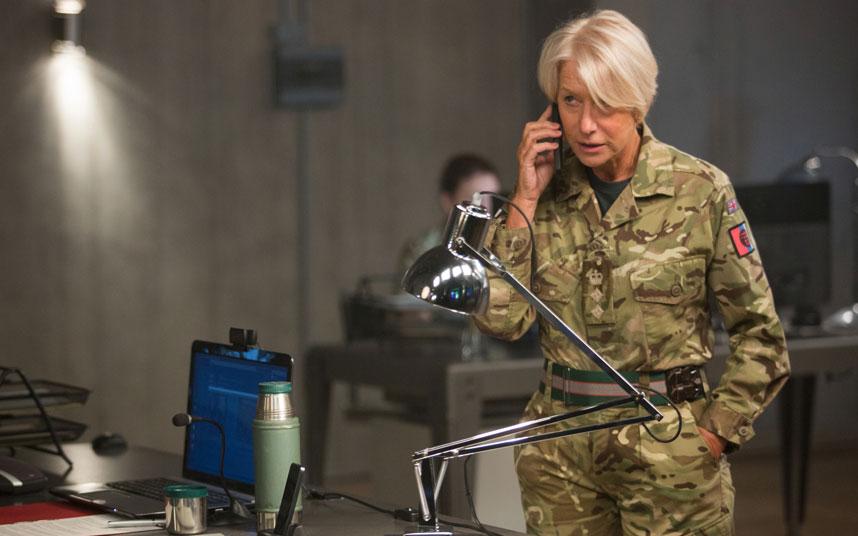
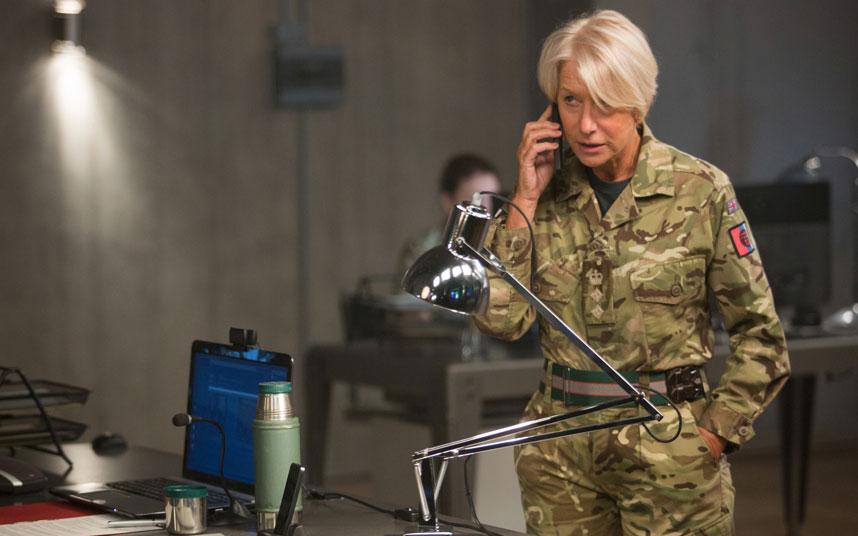
Colonel Katherine Powell of the British Army (Helen Mirren) is awakened by her phone. Intelligence received via drone indicates that three from the top ten international most wanted list of terrorists may possibly be together at a home in Kenya. The British and the US are especially interested in one couple they have been trying to find for six years. The wife is British and the husband is American. Both countries want them captured and tried at home.

If her team can positively identify the couple and the man they are meeting with, the mission will turn from reconnaissance to capture. But then the drone camera reveals that the danger is far more dire and imminent than they thought. The house is not just a meeting place. They are arming suicide bombers, taping their last statements, and presumably getting ready to send them into densely populated areas for maximum carnage. The people working on this are all over the world, with a military unit in Hawaii that analyzes images from a drone in Kenya, flown by a pilot in Las Vegas, commanded by military personnel in England, under the direction of elected officials who are both away from their countries on business.

The military has the capacity to prevent the suicide bombers from inflicting damage on civilians by blowing them up before they leave. But they are in the middle of a residential area. Is this warfare or an execution? Does it matter that two of the targets are British and US citizens? Does it matter that a little girl is selling bread just outside the house?

The international scope of the mission and the bureaucratic/political decision-making is fascinating. Information inside the house comes from a tiny mini-drone that looks like an insect, flown into the house by an operative nearby who is pretending to be both selling buckets in the open market and playing a video game on a phone. The operative is played by “Captain Phillips” star Barkhad Abdi, a very different and equally impressive performance of great intelligence and thoughtfulness. Information from the outside, including the biometric identification of the suspected terrorists, comes from drones monitored by Americans half a world away. Sitting at screens are Aaron Paul and Phoebe Fox as US military who are diligent and dedicated but not really prepared to blow up the people they’ve been spying on, especially that little girl.

There is a literal ticking time bomb in that house. We can see it. What should we do about it? Should we risk that child’s life to keep the suicide bombers from taking more lives? For the military, including Colonel Powell and her boss, Lieutenant General Frank Benson (the late Alan Rickman, making us miss him even more sharply), it is a mathematical calculus; not simple, but clear. They know they must consult the lawyers, who remind them of the criteria, almost a formula, they are required to apply. But the bureaucrats get nervous, and bump it up to the politicians. Calls must be made all over the world as the officials are participating in various diplomatic events; at one point it is even suggested that the question be put to the President of the United States.

But the film shows us that these questions have already been asked and answered. There is a calculus that is reassuringly quantitative and comprehensive but disturbingly clinical. As we see the people all over the world watching the people inside the house, trying to figure out how to apply those algorithms expressed in acronyms and percentages, the film forces us along with the characters to try to apply formulas to a world that will always confound them.

Parents should know that this movie features military violence including drones, guns, explosions, terrorism, suicide bombers, with some grisly and disturbing images, and very strong language. An extended part of the film focuses on potential “collateral damage” to civilians, including a child, from military action.

Family discussion: How would you improve the decision that was ultimately made? How would you improve the process for making it? Who should decide?

If you like this, try: the documentary “Drone”

Related Tags:


Drama DVD/Blu-Ray Pick of the Week Politics War
THE MOVIE MOM® is a registered trademark of Nell Minow. Use of the mark without express consent from Nell Minow constitutes trademark infringement and unfair competition in violation of federal and state laws. All material © Nell Minow 1995-2026, all rights reserved, and no use or republication is permitted without explicit permission. This site hosts Nell Minow’s Movie Mom® archive, with material that originally appeared on Yahoo! Movies, Beliefnet, and other sources. Much of her new material can be found at Rogerebert.com, Huffington Post, and WheretoWatch. Her books include The Movie Mom’s Guide to Family Movies and 101 Must-See Movie Moments, and she can be heard each week on radio stations across the country.

Website Designed by Max LaZebnik