The Piano Lesson

The Piano Lesson

Posted on November 19, 2024 at 1:47 pm

B +
Lowest Recommended Age: High School
MPAA Rating: Rated PG-13 for strong language, violent content, some suggestive references and smoking
Profanity: Strong language including many uses of the n-word
Alcohol/ Drugs: Alcohol
Violence/ Scariness: Tense emotional confrontations, recollections of enslavement and abuse, supernatural horror
Diversity Issues: A theme of the movie, disabled character
Date Released to Theaters: November 22, 2024
Copyright 2024 Netflix The Piano Lesson

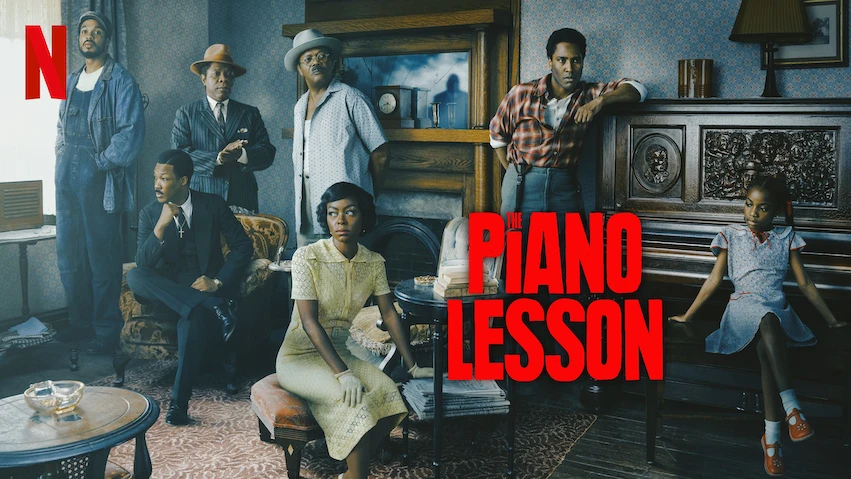
August Wilson wrote a play for each of the decades of the 20th century, all set in Pittsburgh and all exploring themes of race, family, and generational trauma. Denzel Washington, who starred in “Fences” on Broadway and directed and starred in the 2106 film that featured Viola Davis in her Oscar-winning role and produced “Ma Rainey’s Black Bottom,” also starring Davis, who nominated for an Oscar, along with her co-star, Chadwick Boseman. This third in the series is a family story on screen and behind the camera, produced by Washington, directed by his son Malcolm Washington (who adapted the screenplay with Virgil Williams), starring his other son, John David Washington (“BlackkKlansman”), and his wife Pauletta and daughter Olivia in small roles.

The lesson here is not about someone learning how to play the piano. It is the struggle between Charles family siblings who represent two polar opposite views on history, heritage, and obligation. John David Washington and Danielle Deadwyler give sizzling performances as Boy Willie and Berniece (her name possibly a reference to a character in The Member of the Wedding).

Boy Willie, described by Wilson as “brash and impulsive, talkative and somewhat crude in speech and manner,” arrives at the Pittsburgh home shared by Berniece, her young daughter, and their Uncle Doaker (Samuel L. Jackson). He is uninvited, unannounced, unexpected, and unwanted. He and his friend Lymon (Ray Fisher) have driven a truck filled with watermelons from their rural community in Mississippi. Boy Willie’s plan is to sell the watermelons to get the money to buy property. It is more than a chance to be his own boss. The property was once owned by the Sutter family that enslaved his ancestors. The Sutter patriarch has just died by falling into his well.

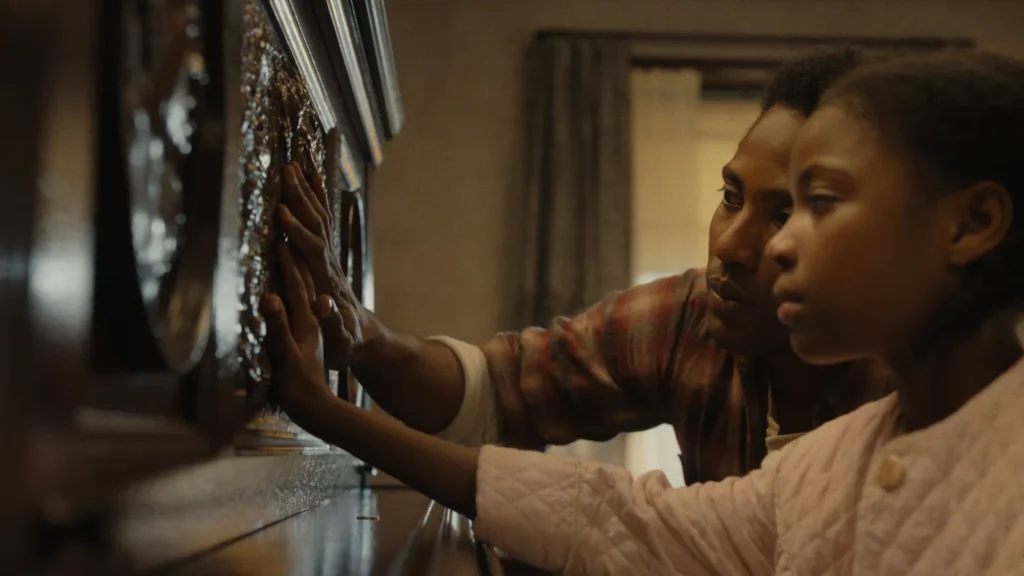
The Sutter family also once owned a piano they got in exchange for slaves, separating a mother and child of the Charles family from the husband and father, a gifted carpenter, who was considered too valuable to sell. He carved his family’s history into the piano, and a later generation stole it from the Sutters. Now it is in the living room of Berniece’s home. The conflict in the play is between Berniece, who does not play the piano but refuses to sell it because of what it represents about the pain, skill, courage of her family. Boy Willie is determined to sell it so he can build a future which in his mind also honors the family history. If stealing the piano was a triumph over enslavement and abuse, owning the Sutter property is even more so.

Washington is a mesmerizing performer and his Boy Willie is electric, charismatic, and dangerous. Deadwyler has a quieter role, especially in the first half of the film, but gets a chance to show Berniece’s fiery determination. Wilson, always a master of creating arresting, complex characters, has two of his best in the two siblings. A conventional story would have the widowed Berniece find a happy ending with the preacher who loves her (Cory Hawkins, excellent as always). But Wilson’s plays grab onto big, existential issues and he did not hesitate to go to extremes to demonstrate the intensity of his characters’ struggles. When does your family history support you? When does it weigh you down? What do you do when the answer is both?

Parents should know that this film has strong language, including many uses of the n-word. Characters drink and smoke. There are references to the sad death of a husband and father and to the abuses and deprivations of enslavement and bigotry. The story also includes some supernatural/horror events with disturbing images.

Family discussion: Who is right, Berniece or Boy Willie? What could they have said to better explain why they felt so strongly? Does your family have a cherished heirloom and who cares the most about it?

If you like this, try: “Fences” and “Ma Rainey’s Black Bottom”

Related Tags:


Based on a play Drama Family Issues movie review Movies -- format Movies -- Reviews Race and Diversity VOD and Streaming
A Real Pain

A Real Pain

Posted on November 12, 2024 at 5:46 pm

A-
Lowest Recommended Age: High School
MPAA Rating: Rated R for language throughout and some drug use
Profanity: Constant strong language
Alcohol/ Drugs: Alcohol and marijuana
Violence/ Scariness: References to the Holocaust, attempted suicide
Diversity Issues: A theme of the movie
Date Released to Theaters: November 15, 2024

Jesse Eisenberg wrote, directed, and stars in “A Real Pain” but gave the showiest role to Kieran Culkin, who gives one of the best performances of the year.

Eisenberg, a careful writer with an excellent ear for what people say, and the spaces left by what they don’t say, gives the film a title with an illuminating double meaning. There’s the colloquial use for someone or something that is annoying, frustrating, but generally in a minor way. It is sometimes said with affection, sometimes with impatience, sometimes both. Then there is the more literal recognition of two words of enormous portent. This is a movie about pain, about generational pain caused by historic trauma and by internal, very individual struggles. It is about the pain we bear and the more difficult challenge of the pain we witness but cannot fix.

A Real Pain trailer

David (Eisenberg) and Benji (Culkin) Kaplan are close but very different first cousins who are on a Heritage Tour of Poland, a small group led by a British historian, visiting locations related to the Holocaust. They are planning to leave the tour a day early to stop at what was once the home of their late grandmother, a Holocaust survivor.

David is intentional and careful. He worries constantly, which makes it difficult for him to feel comfortable around new people. Benji is impulsive, with volatile moods and no filters. He is often annoying, but he is genuinely curious about other people and warmly sympathetic, and authentically vulnerable, which makes people feel comfortable, even protective.

As the trip begins, David leaves a series of voicemails for Benji with advice and encouragement and concern. Meanwhile, Benji is at the airport early, chilling (or maybe he just has nowhere else to be). The tour guide is James (Will Sharpe), who begins by telling the group he is not Jewish but very interested in the culture and history. The other people on the tour are Marcia (Jennifer Grey), a recent divorcee, a retired married couple, Diane (Liza Sadovy) and Mark (Daniel Oreskes), and Eloge (Kurt Egyiawan), a survivor of the genocide in Rwanda and convert to Judaism.

The inherent impossible conflicts of a trip like this (based on one Eisenberg and his wife took) are handled exceptionally well in the film, often explicitly. Benji objects to first class train travel en route to a tour of a concentration camp, compared to the horrific cattle car transport of the people the trip is attempting to honor. He’s right and he’s wrong, of course. Would walking to the site be more respectful? Is there any accommodation today’s visitors could make that would not be somehow disrespectful? In another moment, Benji tells James he is throwing too many facts and statistics at them. Again, he’s both right and wrong. While history is essential for understanding the past, it is impossible to find an appropriate context for paying the right (if there is such a thing) kind of respect to those who suffered and perished. There will always be survivor guilt, but anyone who thinks skipping dinner or traveling economy — or immersing themselves in numbers and names — will assuage that burden is in denial. And Benji, by the way, stalks out of the first class car with a superior edge, and then ends up traveling first class anyway, laughing at his pretension.

Benji wants a picture of himself doing a silly pose on a huge statue memorializing the Warsaw uprising, the largest armed Jewish rebellion against the Nazis, insensitive. David finds that insensitive and disrepectful. At first, the others in the group do, too, but then they join in, finding some release in pretending to be part of the heroic response to oppression. As James reminds them, this is just one example that refutes the claims that Jews were docile in response to the horrors of the Holocaust. So perhaps the silly pretense of fighting alongside the Jews confined to the Warsaw ghetto eased the tension and helped the group bond.

The challenge of comfortable 21st century American tourists visiting sites from the Holocaust in a manner that is meaningful is juxtaposed with the very personal conflicts between David and Benji. Both struggle with anxiety. David takes medication, does meditation, and has established a satisfying life with a wife and son (played by Eisenberg’s real-life son, Banner). He has a job, though it is one Benji thinks is useless. And he worries about Benji. Their grandmother, who died a few months earlier, left money for the two of them to visit her home in Poland. Benji has been rudderless, without a job or family, self-medicating with weed. David hopes that bringing Benji on the trip will help him get some distance from his grief and give him something to do.

When David’s patience runs out, Eisenberg delivers a beautiful speech to the rest of the group about his love, frustration, worry, and his envy for Benji’s easy ability to connect and endear himself to everyone he meets. Like Norman Maclean in the book and movie “A River Runs Through It,” Eisenberg recognizes that:

We can seldom help those closest to us. Either we don’t know what part of ourselves to give or, more often than not, the part we have to give is not wanted. And so it is those we live with and should know who elude us. But we can still love them – we can love completely without complete understanding.

Parents should know that this movie has mature material including historical references to the Holocaust, very strong language, smoking, drinking, and drugs. The characters discuss a sad death and a suicide attempt.

Family discussion: Who from this group would you rather travel with? How can we best show respect for the past?

If you like this, try: the “Trip” trilogy starring Rob Brydon and Steve Coogan

Related Tags:


Comedy Drama Family Issues movie review Movies -- format Movies -- Reviews
Blitz

Blitz

Posted on November 7, 2024 at 12:06 pm

B +
Lowest Recommended Age: High School
MPAA Rating: Rated PG-13 for thematic elements including some racism, violence, some strong language, brief sexuality and smoking
Profanity: Some strong and racist language
Alcohol/ Drugs: Drinking and smoking
Violence/ Scariness: Extended wartime violence with bombing, characters injured and killed
Diversity Issues: A theme of the movie
Date Released to Theaters: November 8, 2024
Copyright 2024 Apple

“Blitz” is set in the chaotic wartime bombing of London, when the Nazis attacked the city from the sky for more than 8 months, and many families sent their children to stay with strangers in the countryside to keep them safe. Writer/director Steve McQueen immerses us in the terrifying assault, the bombs seeming pointed directly at us, no way of knowing where they will land or what kind of destruction they will cause.

Fire and rubble are everywhere, and the water pressure in the firehose is so powerful that it jumps out of the hands of the people trying to help. The overwhelming attacks are met with determination and resilience. But within it is the recognition that they are terrified. When the security guards try to keep people fleeing the bombs out of the underground Tube stations, people push through. A live radio broadcast intended to boost morale features musical performances by weapons manufacturing workers, the British version of Rosie the Riveter. It is interrupted with protests about inadequate safety. Recognizing that nowhere is safe, London parents prepare to send their children away. One of those children is George (Elliot Heffernan), the nine-year-old bi-racial son of Rita (Saoirse Ronan), who works in the munitions factory.

They live with Rita’s father, Gerald (Paul Weller) and they are a close and devoted family. Gerald is a piano player in a bar in the evening. Rita has a lovely singing voice and is featured in that radio broadcast. Music plays a key role throughout the film, from two different nightclub scenes featuring Black performers to people camping out in bomb shelters singing songs to keep their spirits up.

Rita brings George to the train, loaded with children, each tagged like a piece of luggage. There is very little supervision and no kindness or sympathy. George, frightened and angry, barks “I hate you!” at Rita, who is already devastated at sending him away. As the train chugs into the countryside, some boys on the train try to bully George. He feels so much regret about the way he left his mother that he decides to go back home. He jumps from the train with no idea of where he is or how far he is from London. His journey is a Dickensian odyssey. Heffernan is the heart of the film, and he gives a thoughtful, soulful performance.

Nine is an age right at the cusp between the magical thinking of a child and the beginning of a deepening understanding of the world of adults. McQueen, so good at conveying the chaos of the Blitz, is even better at conveying that liminal moment. Through the havoc, George seems to travel in a protective aura of innocence. He is smart and brave, but we see through his eyes and understand the dire risks George is facing far better than he does.

George meets a lot of people along the way, including three young brothers who refused to be placed in different homes, Ife, a kind-hearted African-born security officer (Benjamin Clémentine), and a cruel group of scavengers who steal from dead bodies and destroyed buildings. They capture George because he is small enough and expendable enough to send into places they cannot reach. The lost boy themes echo Great Expectations and David Copperfield, giving George’s story a connection to heroic myth. Along the way, we get flashbacks showing us the racism experienced by George and his now-absent father. The bombs keep falling.

There is a optimism in the film that seems inaccurate for the era, including a Capra-esque speech chastising those in a shelter who do not want to interact with people of color and a very idealized character in Ife. Even within the context of George’s naive perspective and the “carry on” imperatives of the era, it is out of place, the present speaking through the past. Maybe we still need it to hear it.

Parents should know that this movie is a wartime story with intensive bombing attacks, characters are injured and killed and there are graphic and disturbing images. It also includes cruel and criminal behavior and racism. A child is in danger through much of the story. People having sex are overheard by others, including a child.

Family discussion: How did Ife change George’s mind about himself? What did the scene in the subway with characters from earlier in the film mean? What does music mean to the characters?

If you like this, try: “Hope and Glory” and “Au Revoir, Les Enfants,” other WWII stories from a child’s perspective

Related Tags:


Drama Epic/Historical Family Issues movie review Movies -- format Movies -- Reviews Stories About Kids War
Here

Here

Posted on October 31, 2024 at 12:33 pm

B-
Lowest Recommended Age: Middle School
MPAA Rating: ated PG-13 for thematic material, some suggestive material, brief strong language and smoking
Profanity: Some strong language
Alcohol/ Drugs: Drinking and alcohol abuse
Violence/ Scariness: Sad deaths and medical problems, references to wartime injuries and deaths
Diversity Issues: Treatment of BIOPC characters superficial
Date Released to Theaters: November 1, 2024

Near the end of the multi-generational saga “Here,” a character mentions that the time he spent caring for his difficult father in his last years helped them have a better, more understanding relationship. This is tell, not show, the opposite of what a movie is supposed to do. In this case, that really important part, the show part, is a lower priority than the movie’s conceptual and technology gimmicks.

“Here” is based on a graphic novel by Richard McGuire. Its conceit (in both senses of the word) is that the whole story takes place on one spot, going back millions of years, before there was any life on Earth, then with plants, then dinosaurs trampling across, then people, an indigenous couple, a Colonial era man (the royalist son of Ben Franklin) and the enslaved people who resignedly salute him as his carriage passes. A house in what will be the suburbs is built in 1911. Its first owners are a Victorian couple, then an inventor and his devoted wife, much later a Black family in contemporary times, and, in between the central focus, a WWII veteran and his wife, and their three children, one who grows up to be played by Tom Hanks, de-aged by CGI, then looking like he lives now, then aged to show how he may/will look in 20 years. The content of these stories is designed to trigger reactions more based on our own experiences of the big life moments — love, loss, job woes, marriage, family conflict, Thanksgiving, babies, aging parents, more Thanksgivings, a wedding, a funeral — than on any connection to these characters. Our hearts may be tugged at because we are humans who cannot help identifying with these touchstones, but it’s all as synthetic as astroturf.

Copyright 2024 Sony

This film reunites the “Forrest Gump” team, Hanks as Richard and Robin Wright as his wife, Margaret, along with composer Alan Silvestri, cinematographer Don Burgess, screenwriter Eric Roth, and director Robert Zemeckis, who co-wrote the screenplay. Zemeckis, as he does too often, seems far more interested here in the technology than the storyline. The camera placement is static, always the same location in the house’s living room, facing the bay window across from what was once the Colonial plantation. Unlike the images in a graphic novel, movies have to have movement; it;’s in the name. So what we have is a lot of boxes coming in and out of the screen with glimpses of what is happening or did happen that may be contrast or commentary on the cyclicality of events or may just be there to remind us what time we’re in: the Beatles on Ed Sullivan! Jane Fonda’s exercise tapes! And then there are the technology touchstones. Radio, then television. The first cordless phone.

It reminded me of the Carousel of Progress at Disney World, and to be honest, the animatronic characters in that revolving audience show created for the New York World’s Fair in 1964, have more personality than most of the one-attribute characters in “Here.” That is unfortunately even more true of the characters of color in the film. The Black family seems to be there only to show us The Talk with their teenage son about how to behave if he gets pulled over by the police for a traffic violation. Their Latina housekeeper exists only to show us the pandemic. The indigenous people are like the dinosaurs — they exist only to disappear.

Parents should know that this film includes many family ups and downs including conflicts, divorce, serious illness, and death. There is a teenage pregnancy. A WWII veteran with injuries and PTSD self-medicates with alcohol. A young husband and father dies. There are sexual references, scanty attire, references to racism, and some strong language.

Family discussion: What would you want to say to the families who live in this house? Why didn’t Richard want to move? How did the characters decide to compromise on their dreams?

If you like this, try: the book by Richard McGuire, the Thornton Wilder play “The Long Christmas Dinner,” and the 1961 short film “The House”

Related Tags:


Based on a book Comic book/Comic Strip/Graphic Novel Drama Epic/Historical Family Issues movie review Movies -- format Movies -- Reviews Romance
Juror #2

Juror #2

Posted on October 25, 2024 at 5:46 pm

B-
Lowest Recommended Age: High School
MPAA Rating: Rated PG-13 for PG-13 for some violent images and strong language
Profanity: Some strong language
Alcohol/ Drugs: Drinking, drunkenness, and alcoholism
Violence/ Scariness: Murder trial, graphic and disturbing descriptions and images of dead body
Diversity Issues: None
Date Released to Theaters: November 1, 2024
Copyright 2024 Warner Brothers

“Juror #2,” directed by Clint Eastwood, has a preposterous premise and a first-rate cast valiantly trying to make it seem less preposterous. Nicholas Hoult plays Justin, a teacher whose wife Allison (Zoey Deutch) is nearing the end of a high-risk pregnancy. Justin has just been called for jury duty. He tries to get out of it by explaining his situation, but the judge (the always excellent Amy Aquino), dryly points out that his hours in the courtroom will keep him away from his wife no longer than his hours at work.

He is assigned to a criminal case. James Michael Sythe (Gabriel Basso) has been charged with the murder of his girlfriend, Kendall (played in flashbacks by Eastwood’s daughter, Francesca Eastwood). Arguing the high-profile case are prosecutor Faith Killebrew (Toni Collette) and Eric Resnick (Chris Messina), Faith’s law school classmate and sometime drinking buddy, a public defender trying to persuade the jury that his client is innocent.

As the lawyers make their opening arguments, telling the story of the night Kendall was killed following an argument with Sythe in a rowdy bar (the bar is even named Rowdy’s, just to make sure we get the point), it begins to dawn on Justin that he was at Rowdy’s that night and saw the argument. As someone who really does not want to be there and told his wife he would do whatever it took to get out of serving, he completely ignores the fact that that memory in and of itself would be a reason to alert the judge that he is a material witness and cannot serve as a juror. But no, instead he thinks more about what happened that night and realizes that while he thought he hit a deer as he was driving home from the bar in a heavy downpour, he may have, indeed he probably did hit Kendall and is responsible for her death. And he decides on two equally important goals: not letting an innocent man be convicted of murder and keeping himself out of prison.

That’s a LOT! And then everything keeps getting melodramatically ramped up even further. Faith is running for District Attorney on a platform of protecting the community from crime, with the election just days away and apparently the vote depending on the outcome of this case. Justin is in recovery and his AA sponsor is a lawyer (Kiefer Sutherland) who advises him not to come forward. And then we are in jury deliberations a la “12 Angry Men,” with an assortment of characters. On the first round of voting, Justin is the only “not guilty.” He has to try to persuade the rest of the jury that there is reasonable doubt without letting them know about his own involvement.

One of the other jurors is a former cop (J.K. Simmons). Another is a med student. Their expertise shifts the balance, but the central question ends up being whether anyone can change.

Eastwood is 94 and outspoken about his political views (remember his debate with the empty chair?). A few cranky old guy elements flicker in and out of the film. It’s more than a low-grade potboiler with high-grade actors for him. He wants to say something about his worldview and he is not subtle. The first image in the film is Allison wearing a blindfold as Justin leads her into the room he has prepared for the baby. This is the part of a movie where usually, in the least time possible, we get to know the main characters well enough to care about whatever challenges lay before them. But Eastwood wants to say something beyond the adorable couple so excited about the new baby and so devoted to each other. The blindfold comes back a few more times in the statue of Justice in front of the courthouse, the one of the woman holding up the scales, with a blindfold over her eyes.

If he wants what may be his final film to make a statement about the inadequacies of the criminal justice system, though, it is one that is muddled by (1) a retired police detective who is dedicated and capable (though willing to act outside the law), and (2) see “preposterous” and “melodramatically” above.

Parents should know that this is the story of a murder case and there are graphic and disturbing images of the body as well as flashbacks showing the suspect and the victim drunk and fighting with each other.

Family discussion: What should Justin have done and when? What should Faith have done and when?

If you like this, try; “12 Angry Men,” “Reservation Road,” “The Judge,” and John Grisham films like “The Rainmaker” and “The Client”

Related Tags:


Courtroom Crime Drama movie review Movies -- format Movies -- Reviews
THE MOVIE MOM® is a registered trademark of Nell Minow. Use of the mark without express consent from Nell Minow constitutes trademark infringement and unfair competition in violation of federal and state laws. All material © Nell Minow 1995-2026, all rights reserved, and no use or republication is permitted without explicit permission. This site hosts Nell Minow’s Movie Mom® archive, with material that originally appeared on Yahoo! Movies, Beliefnet, and other sources. Much of her new material can be found at Rogerebert.com, Huffington Post, and WheretoWatch. Her books include The Movie Mom’s Guide to Family Movies and 101 Must-See Movie Moments, and she can be heard each week on radio stations across the country.

Website Designed by Max LaZebnik