
True Grit

True Grit

Posted on December 22, 2010 at 8:05 am

In a remake of the John Wayne classic that is truer to the Charles Portis book, the Coen brothers have made their most sincere film yet, a western as spare and yet majestic as its unspoiled landscapes. Like all great westerns, it is a meditation about the forces that shaped the American spirit, the determination, resilience, passion for justice, and most of all the mingled pragmatism and idealism.
Joel and Ethan Coen’s previous films have had a preciousness and remove from their often-grotesque characters, a frequent feeling of ironic air quotes in their picaresque speech patterns and fantastic, even mythic plot twists. This time, they give us a sincere and appreciative portrayal of a steely 14-year-old heroine (remarkable newcomer Hailee Steinfeld) who wants to find and kill the man who murdered her father. true-grit-2010.jpg
Steinfeld plays Mattie Ross, a girl whose tight braids demonstrate her no-nonsense determination. She crisply negotiates the disposition of her father’s body with the undertaker and then demonstrates her mastery of horse-trading by selling back to the local broker the horses her father had come to town to buy, and, with a little extra leverage from a threatened lawsuit, getting some cash and a pony out of the deal. And so when she sets her mind to hiring the top tracker in town to find Tom Chaney (Josh Brolin), the man who killed her father, you know she is going to be successful.
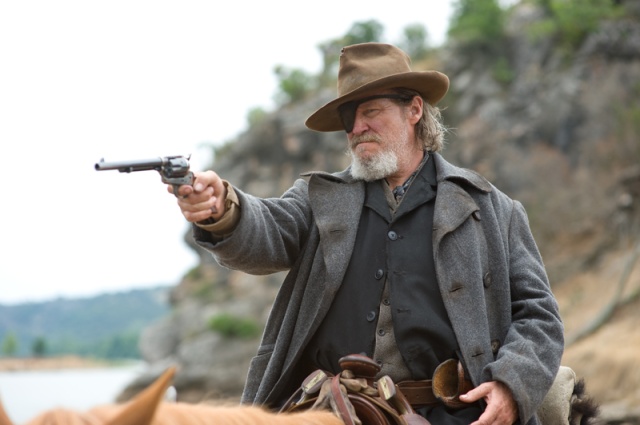
That tracker is Rooster Cogburn (Jeff Bridges), a man who may too old and infirm (he has an eye patch and a drinking problem) and possibly be too quick to kill (he can’t or won’t recall under oath the details of some of the men he’s killed) to do the job. It turns out someone else is looking for Chaney, a Texas Ranger named LeBoeuf (Matt Damon). The two men have no interest in working together and even less in bringing along a 14-year-old girl, but their mutual determination and stubbornness has them soon on the trail together.
The first version, directed by Henry Hathaway, was a bit of a miss-match and a more than a bit meta, with Wayne playing and playing off of his screen persona, pop singer Glen Campbell as LeBoeuf, and Kim Darby, then in her 20’s, playing Mattie. In this film, the actors are far better matched to each other and their roles. Bridges, whose most memorable role may be in the Coens’ “The Big Lebowski,” fully commits to the character, not caricature, of Rooster Cogburn. The asperity and resolve of the young girl are well matched by the man who may be undisciplined and ungovernable but who is also in his own terms honorable. It is these two, both who must continue after dire physical sacrifice, who represent the forging of a social construct that will support frontier society.
The landscape, spare, magnificent, and challenging, is stunningly photographed by the Coen brothers favorite cinematographer, Roger Deakins. Production designer Jess Gonchor makes every shot look like a painting somewhere between Thomas Eakins and Grant Wood. Each shot is meticulously framed to add a transcendent dignity and seriousness of purpose to the story.

(more…)

Related Tags:


Action/Adventure Based on a book Drama Epic/Historical Remake Western

Robin Hood

Posted on September 21, 2010 at 8:00 am

If, as the Gothic calligraphy tells us as the beginning of this film, tyrants inspire heroes, then the clear implication is that heroes inspire movies. And Robin Hood, who stole from the rich to give to the poor, has been one of the most frequently portrayed on screen over the course of the last century, beginning with a silent film in 1908 and continuing through portrayals that have included Disney animation, Mel Brooks comedy, a space-age version, a gangster version, and films with Robin as a woman, as a child, and as an old man decades after his famous adventures (played by Sean Connery at age 45, Crowe’s age when he made this film).

Pretty much, though, all versions have stuck with the idea of Robin Hood as a nobleman who valiantly defends the rights of the commoners against a corrupt prince who hopes to take over the throne and who falls in love with the beautiful Maid Marian. In this version, something of a prequel, Robin is not noble and Marian is not a maid.

The “Gladiator” director and star reunite ten years later with another story of a heroic rebel leader. Russell Crowe, looking a little more doughy than he did a decade ago in the toga, is Robin Longstride, an archer in the army of King Richard the Lionhearted who has the courage to tell the king he is wrong, landing in the stocks for his impertinence. The king is killed in battle and the knights taking his crown back to London are ambushed by Godfrey (all-purpose villain Mark Strong), a traitor close to Prince John (Oscar Isaac) but working for King Philip of France. Robin and his men pretend to be the knights so they can get back home. And he promises the dying knight whose armor he takes that he will return his sword to his father, Sir Walter Loxley, in Nottingham.

With John as the new king, Godfrey is given the authority to collect taxes from the noblemen, who have already been taxed into poverty. But Godfrey’s plan is to pillage the country so brutally that the nobility will no longer support the king, making the country more vulnerable to attack. Robin delivers the sword to Sir Walter (Max von Sydow), who asks him to stay and pretend to be his son, to help protect his land. Sir Walter’s daughter-in-law, Lady Marian (Cate Blanchett), the knight’s widow, reluctantly agrees. This puts Robin, now known as Sir Robert Loxley, in Godfrey’s path.

As you can tell from this rendition, it’s overly complicated and a lot of what we expect in a Robin Hood story is missing. But it is one thing to omit the archery competition and another to remove the key element of the story, the idea of a nobleman who fights for the commoners. While “Gladiator” did a masterful job of creating a sense of time and place, “Robin Hood” has some clanging anachronisms that take us out of the movie entirely, including some of the dialogue and a scene where von Sydow and Crowe have an Oprah-esque therapy session so that Robin can have an epiphany about his feelings for his father.

Scott and his CGI crew have put together a gorgeous and compelling re-creation of the landscape and architecture of the era, and the movie conveys the fragility of the overlay of civilization as unsettling new ideas about justice, equality, and self-determination are beginning to take hold. But the script itself has a sense of struggle behind it, with too many story lines and too little resolution. Retro elements like burning map montages to show the progress of the pogrom-like raids compete with winks to the future as scenes suggest iconic images like Joan of Arc in armor, D-Day, and the Holocaust. And the concluding scene is such a fundamental re-writing of history that we wonder whether it is not we who have been robbed.

Related Tags:


Action/Adventure Based on a book Based on a true story Epic/Historical Remake Romance

Prince of Persia: The Sands of Time

Posted on September 15, 2010 at 12:00 pm

Roger Ebert launched a thousand blog posts with howls of protest by asserting that a video game could never be a work of art. I don’t say “never” when it comes to art, but by all evidence to this point, a video game does not make a movie. Producer Jerry Bruckheimer, who improbably turned a theme park ride into a phenomenally successful movie franchise with the Pirates of the Caribbean movies, has not done as well by the Prince of Persia game, omitting the two elements that made the Pirates movies sensationally entertaining: a very good script and Johnny Depp.

Jake Gyllenhaal, newly bedecked in long hair, buff bod, and English accent, plays Dastan, a former street kid adopted by a king and raised as brother to his two sons. When he is framed for the murder of the king he must run. And since he has taken a special dagger that belongs to a princess, she has to come with him. She is the keeper of a sacred dagger, which gives everyone something to chase after, steal from each other, and almost lose many times.

The movie is about two-thirds action and one-third bickering banter. The action scenes are fairly good; the banter is below the level of chit-chat from Oscar presenters. There are winks at the game, with a lot of leaping between ledges and rooftops and the ability to rewind time. The story also has several distracting winks at current or near-current events, with complaints about taxes and a fruitless search for the ancient equivalent of weapons of mass destruction.

The settings are glorious. As swords are being wielded in a kaleidoscope of quick shots, we keep hoping for more of a chance to enjoy the scope and sweep and sumptuousness of the re-created ancient world of walled cities, palaces, and desert. Instead, it just serves to remind us of how undeserving the story that takes place there is by comparison.

Related Tags:


Action/Adventure Based on a video game Epic/Historical Fantasy
Clash of the Titans

Clash of the Titans

Posted on July 27, 2010 at 8:45 am

Director Louis Leterrier (the second “Hulk” movie) says that he was a big fan of the 1981 Clash of the Titans when he was a child. Perhaps that is why he has remade the wrong parts of that film. Nearly 30 years later, fans of the film are willing to overlook its essential cheesiness because of their affection for its special place at the apex of old-school analog special effects before the rise of computer-generated images. People did not watch the movie to see classically trained British actors slumming for a paycheck; they watched it to see the last creatures created by special effects superstar Ray Harryhausen. Each one was meticulously crafted and, as often happened in Harryhausen films, they often seemed more alive than the human performers. Note, too, that the movie was shot in 2D and then reconfigured after the fact for 3D, a very different effect than the fully-realized, fully-immersive experience of a movie conceived and shot in 3D.

This remake is bigger and grander but it is missing just that sense of life that Harryhausen brought to his fantastic creations, which were always astonishing and unique. Instead, we get the same CGI-fest we have seen so many times, with nothing especially imaginative or memorable.

The same can be said for this generation of classically-trained British actors, including Liam Neeson as Zeus, in a shiny (and anachronistic) Joan of Arc-style suit of armor and Ralph Fiennes as Hades, the god of the underworld, dressed like a Norwegian death metal band member trying to play Richard III. They are the titans who clash by proxy.

The gods need the loyalty of humans to survive. Zeus insists that they will get more fealty with love; Hades, still bitter and jealous that it is his brother who is king of the gods, believes in ruling by fear. The winner of their battle will be decided by a fight to the death of their progeny. Perseus (Sam Worthington in an even more anachronistic buzz cut) is Zeus’s son; the sea monster called the Kraken is the child of Hades. The arrogant king and queen of Argos have committed the sin of hubris, thinking they are more important and powerful than the gods. So Hades tells them that he will destroy the city unless they sacrifice their daughter, Andromeda to the Kraken. Perseus is determined to fight the Kraken and save the princess. And he is determined to “fight as a man,” not to use any of the powers or tools of the gods because he blames Zeus for the death of his mother and his adoptive parents.

With a small band of allies, Perseus travels to the three Stygian witches, who share one eye, to find out how to defeat the dragon. The journey involves battles with giant scorpions and trip into the underworld to fight the serpentine Medusa, the snake-headed lady whose eyes can turn a person to stone. And then, he must make it back to Argos in time to save Andromeda and defeat the giant sea monster, to the tune of some even more anachronistic rock chords.

The effects would be more impressive than the original’s only if you were still living in 1981. Today we take for granted that anything is possible on screen. But possible is not good enough; there has to be something truly striking. The witches and desert djinns look like they are wearing Halloween masks and the creatures look like variations on one predictable theme. There is a demigoddess whose powers seem to vary from scene to scene. The liberties taken with the original myths and the 1981 version’s story seem purposeless. And Worthington just seems lost, as though he wandered in from the set of “Avatar” and is looking around for the exit. I know how he felt.

Related Tags:


3D Action/Adventure Based on a book Epic/Historical Fantasy Remake
THE MOVIE MOM® is a registered trademark of Nell Minow. Use of the mark without express consent from Nell Minow constitutes trademark infringement and unfair competition in violation of federal and state laws. All material © Nell Minow 1995-2025, all rights reserved, and no use or republication is permitted without explicit permission. This site hosts Nell Minow’s Movie Mom® archive, with material that originally appeared on Yahoo! Movies, Beliefnet, and other sources. Much of her new material can be found at Rogerebert.com, Huffington Post, and WheretoWatch. Her books include The Movie Mom’s Guide to Family Movies and 101 Must-See Movie Moments, and she can be heard each week on radio stations across the country.

Website Designed by Max LaZebnik