
Philomena

Posted on November 24, 2013 at 8:40 pm

B+
Lowest Recommended Age: High School
MPAA Rating: Rated PG-13 on appeal for some strong language, thematic elements and sexual references
Profanity: Very strong, frank, and explicit language for a PG-13
Alcohol/ Drugs: Drinking
Violence/ Scariness: Sad deaths and abuse
Diversity Issues: Diverse characters, issue of anti-gay bigotry is discussed
Date Released to Theaters: November 22, 2013
Date Released to DVD: April 14, 2014
Amazon.com ASIN: B00GSBMNOQ

Philomena-dench-movieDame Judi Dench has played many strong-minded, determined characters, from Queens (Victoria and Elizabeth I) to the even more imperious head of the MI6 who can take on James Bond with an air of crisp authority.  As the title character in “Philomena,” she shows us the radiance and inner core of strength in a woman we might otherwise find easy to overlook.

Martin Sixsmith (co-screenwriter Steve Coogan) underestimates her at first, too.  Sixsmith is a journalist-turned politician smarting from a public humiliation after he was fired for something he did not do.  He gets little sympathy from those around him and it seems clear that being aggrieved has only fed his sense of superiority, isolation, and entitlement.  He mutters something about writing a book on Russian history, though he realizes no one is very interested in reading it.  When he meets a young Irish woman who offers him her mother’s story of a half-century search for the son she was forced to give up for adoption, his first reaction is a haughty, “I don’t do human interest stories.”  The truth is, he is not really interested in humans, in part because they have not done a very good job of being interested in him.

Sixsmith did eventually write some books about Russia.  But first he decided to give human interest a try.  The result was Philomena: A Mother, Her Son, and a Fifty-Year Search.

When she was a teenager, Philomena (Dench) became pregnant and her parents sent her to the now-notorious Magdalene Sisters workhouse.  The girls were forced to work for years to pay (financially and spiritually) for their sins.  The abused and underage girls also signed away all of their rights to their babies, including access to information about where they were placed.  Philomena (Sophie Kennedy Clark as a young woman) was working in the laundry when her son was taken from her and adopted by an American family.  For half a century, as she became a nurse, married, and had more children, she missed him and worried about him.  Sixsmith found an editor to pay him to write the story, covering expenses for a trip to America to see if they could track him down.  She hopes the story will have some lurid details.  “Evil is good — story-wise, I mean….It’s got to be really happy or really sad.”

Coogan knows he is at his best playing slightly high-strung, slightly self-involved guys who are too smart for the room and usually end up outsmarting themselves (see “The Trip”).   It is especially satisfying to watch his character go from irritation to respect and then affection.  There’s a reason the movie is named for her.  Philomena is a surprise.  If she has awful taste in books and movies, it is because she has the gift of being able to be pleased.  When it comes to the big things, she is refreshingly clear-eyed and open-minded.  And  she understands what it takes to not let anyone make you a victim.

More improbable than any fictional story would dare to be, the journey taken by Philomena and Sixsmith is bittersweet and ultimately transcendent.  Performances by Dench and Coogan of great sensitivity illuminate this story of a quiet heroine and the man who was lucky enough to learn from her.

Parents should know that this movie was initially rated R and then given a PG-13 on appeal.  It concerns young teenagers put in a home for out-of-wedlock pregnancies and forced to give up their babies for adoption and there is frank discussion of sex and a childbirth scene, the abuse of the young women by the nuns who ran the home, and the life of a character as a closeted gay man.  Characters use very strong and explicit language and there is some drinking.

Family discussion: Why did Martin and Philomena feel differently about forgiveness?  Did she find what she was looking for?

If you like this, try: “The Magdalene Sisters” and “The Trip”
Related Tags:


Based on a book Based on a true story Drama DVD/Blu-Ray Pick of the Week Family Issues

Delivery Man

Posted on November 21, 2013 at 6:00 pm

B
Lowest Recommended Age: Mature High Schooler
MPAA Rating: Rated PG-13 for thematic elements, sexual content, some drug material, brief violence and language
Profanity: Very strong and crude language
Alcohol/ Drugs: Character grows marijuana, alcohol, hard drug abuse treated seriously but irresponsibly
Violence/ Scariness: Fight, drug abuse
Diversity Issues: Diverse characters
Date Released to Theaters: November 22, 2013
Amazon.com ASIN: B00GEKO51U

delivery-man-vaughnThe undeniable sweetness of “Delivery Man” makes its inherent silliness just about forgivable.  Or, it just might be the sense of relief that Vince Vaughn is finally making a movie that is just silly instead of crass and stupid like “Couples Retreat,” “Four Christmases,” “Fred Claus,” and pretty much most of what he’s done since “Wedding Crashers.”

Vaughn plays his usual likeable shlub, this time Dave, the son of a butcher.  His brothers work in the store with their father, but all Dave can do is drive the delivery truck, and he does not even do that very well.  “It’s like every day you find some new way to push the limits of incompetence.”

He also has the usual long-suffering girlfriend, a cop named Emma (Cobie Smulders), who, like all girlfriends in these arrested development movies, has only one responsibility in the story, which is to look beautiful when she tells him that it’s time for him to grow up.  It turns out that she is pregnant, and she does not believe he has it in him to be responsible enough to be a dad.

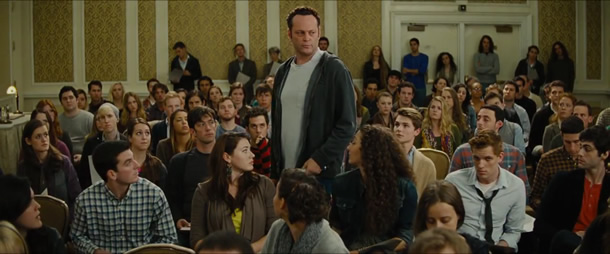
In the midst of all this, he discovers that he already is a dad, at least in the strictly biological  sense.  Some time ago, he was a “very, very frequent donor” at a sperm bank, which carelessly made it available to many more women than its guidelines allowed.  A lawyer shows up in Dave’s apartment to tell him that he is the biological father of 533 children, and 142 of them have sued the facility to find out the identity of the mysterious “Starbuck” whose genetic heritage they carry.  Starbuck is not related to the coffee shops or the Moby Dick character who inspired their name.  It is the name of the French-Canadian film adapted by its writer-director for this remake, and the name of a legendarily productive stud bull.

Dave is known only as “Starbuck” to the progeny, and his anonymity is guaranteed by the terms of his donor agreement.  His best friend is Brett (Chris Pratt, a highlight of the movie and quickly becoming one of our most indispensible comic actors), a lawyer who is beleaguered by his four young children.  “My children cannot pick up the frequency of my voice,” he explains, exhausted.  Brett gives Dave the folder of information on the 142 plaintiffs and tells him not to open it.  What was he thinking?

Dave reads just one file, and is thrilled with his connection to a very accomplished young man.  So he takes out another one, and then another, and finds that many of them need help.  And he finds that helping them gives him a great sense of satisfaction and purpose.  Most don’t need much help.  Dave covers a would-be actor’s day job (badly) so he can go on an audition.  He warns off catcallers harassing a young woman in a short skirt.  He helps an inebriated kid get home.  These are in the trailer and are fairly cute.

Some have serious problems.  One is a drug addict.  One is severely disabled and cannot communicate.  These are handled superficially at best and downright irresponsibly at worst.

It’s all just a matter of time before everyone finds out, generally in the most awkward of ways.  Cue the fake Jay Leno monologue.  But babies are heart-tugging, even twenty years later, and the longing for family from both the children and their bio-dad is so touching that even the most preposterous resolution somehow seems just fine.

Parents should know that the film is about a man who fathered more than 500 children through a series of donations to a fertility clinic and it includes explicit references and crude jokes about producing samples and fertility treatments.  Characters use strong and crude language, drink, grow marijuana and abuse harder drugs (the movie implies that addicts can quit easily without any help), and there is some brief violence.

Family discussion: How should Dave prove that he “deserves” to be the baby’s father?  What did the children want from the lawsuit?  How did he help them?

If you like this, try: “Baby Mama”

Related Tags:


Comedy Courtroom Family Issues Movies -- format

About Time

Posted on October 31, 2013 at 6:00 pm

B+
Lowest Recommended Age: Mature High Schooler
MPAA Rating: Rated R for language and some sexual content
Profanity: Very strong and crude language
Alcohol/ Drugs: Drinking and substance abuse
Violence/ Scariness: Sad death, scary car crash
Diversity Issues: None
Date Released to Theaters: November 1, 2013
Date Released to DVD: February 3, 2014
Amazon.com ASIN: B00BEIYGK2

about-time1Richard Curtis perfected the art of the 21st century romantic comedy in “Four Weddings and a Funeral,” “Notting Hill,” and “Love Actually.”  They were witty and sophisticated and had posh British accents that made them seem twice as witty and sophisticated.  They were filled with of pretty people wearing pretty clothes in pretty settings, seasoned with self-deprecating humor, magnificent friendships, pop-y soundtracks, and happy ever after endings.  “About Time” has all of that, plus a twist.  I don’t mean the addition of a fantasy time travel element, thought that is something of a departure.  The real twist is that the important love story here is not between man and woman but between father and son.

Oh, there’s a romantic love story, of course, and it’s the part that’s featured on the poster.  Tim (Domhnall Gleeson, son of the Irish actor Brendan Gleeson and best known as one of the Weasley brothers in the “Harry Potter” films) lives in Cornwall with his family, a blissfully happy group that includes his slightly starchy mother (Lindsay Duncan), slightly dotty but impeccably dressed uncle (Richard Cordery), wild child of a sister (Lydia Wilson), and book-loving, family-loving dad (the indispensable Bill Nighy).  Dad explains to Tim that the men in their family have the ability to travel through time.  There are limits, of course.  Like “Quantum Leap,” he is limited to his own lifetime.  He can’t go back and meet Queen Victoria or ride a dinosaur.  And, as Tim will spend the rest of the movie discovering, while he can go back to correct a mistake, the ripple effect of even the tiniest change may have very big consequences that are not so easy to fix.

It may sound all very precious and cutesy, and it is, with Curtis’ trademark adorable eccentrics that are less adorable than he intended.  Even an English accent can only make up for so much.  Tim’s use of his time travel powers to make up for various gaffes is entertaining in a “Groundhog Day”-lite sort of way.  (There’s something rather meta about a feeling of deja vu in these repeated, slightly improved encounters.)  The romance between Tim and a pretty American named Mary (Rachel McAdams), while refreshingly free of the kinds of agonizingly silly misunderstandings that plague most romantic comedies, is on the bland side.  The first meeting with Mary’s parents is supposed to be awkward and funny, but it’s just awkward.  Things get more interesting later, as Tim and Mary get married and start a family.  The stakes are higher and the choices are more complex.

It is in the third act when things start to get interesting, because that is when the focus shifts to the father-son relationship.  Curtis, who says this is his last film, opens up his heart for a piercingly bittersweet engagement with the big questions of who we are, making peace with not being able to fix everything for everyone we love, and finding a way to make pain and loss deepen us.

Parents should know that this film includes sexual references, some explicit, and some sexual situations, very strong and crude language, car accident, and a sad death.

Family discussion: If you could go back in time, would you correct a mistake or take time to enjoy what already happened? Why did Kit Kat have such a hard time making good decisions? Was there anything her family should have done differently to help her?

If you like this, try: “Four Weddings and a Funeral” and “Love Actually” from the same writer/director and “Groundhog Day”

Related Tags:


Comedy Date movie Drama DVD/Blu-Ray Pick of the Week Family Issues Fantasy Romance

A.C.O.D.

Posted on October 4, 2013 at 7:30 am

B+
Lowest Recommended Age: Mature High Schooler
MPAA Rating: Rated R for language and brief sexual content
Profanity: Very strong language, some crude
Alcohol/ Drugs: Drinking, drug references
Violence/ Scariness: Tense family confrontations, some shoving, fire
Diversity Issues: Diverse characters
Date Released to Theaters: October 4, 2013

AdamScottCOPortraits2013SundanceFilmMmjP6NGACVblAre today’s 20-and 30-somethings the least-parented generation in history, as a character explains in this film? To quote Rosie O’Donnell in “Sleepless in Seattle” about another depressing statistic, “It’s not true, but it feels true.” While the generation that came of age in the 1970’s and early 80’s were self-actualizing and consciousness-raising and yuppifying, their children were being raised by adults who were too often acting like, well, children.

Adam Scott (“Parks and Recreation,” “Party Down”) produced and stars in “A.C.O.D.,” which stands for “Adult Children of Divorce.” It’s an apt oxymoron. Scott plays Carter, who is very much the adult in his relationship with his long-divorced but still-warring parents and with his younger brother, Trey (Clark Duke). He is also the adult in his professional life, as the owner of a trendy restaurant. But that has a considerable advantage, he points out. “It may be like a family, but I could fire the ones I don’t like.”

Trey’s engagement creates some immediate problems. He and his fiancée Kieko (Valerie Tian) have only known each other four months.  Trey cannot support himself; he is living in Carter’s garage.  But those are minor concerns compared to the “9 year marriage turned into a 100-years war” — their parents, Hugh (Richard Jenkins) and Melissa (Catherine O’Hara).  Trey wants them to come to his wedding and be civil to one another.  Even though both have re-married (Hugh twice), their toxic mutual hostility is still the most powerful and all-consuming force in their lives.

Carter, himself allergic to marriage due to the childhood trauma of his parents’ divorce (and their self-absorption, bitterness, manipulation, and use of him as a go-between and subject of endless custody disputes), knows that Trey’s plans are unrealistic.  But he can’t help being captivated, even a little wistful and the optimism and certainty of the couple.  And he knows it is in part because he has worked so hard to protect Trey from the worst of his parents’ battles.

The stress of negotiating with his parents is so unsettling, Carter seeks help from a woman he saw after his parents split up (Jane Lynch).  She is glad to see him again, but informs him that she was not his therapist.  She was interviewing him for a book about the impact of divorce on children.  And it became an international best-seller.  This puts him even deeper into a tailspin, as he reads the book for the first time and discovers what his middle-school turmoil looked like to an observer.  “Am I living in a shell of insecurity and approval-seeking?”  It is even more disconcerting that the book is a best-seller (“Fourteen printings and Margot Kidder did the audio book.”)

Meanwhile, his efforts to get his parents to be civil to one another has had some very disturbing repercussions.  And Carter’s sympathetic and supportive girlfriend of four years (the magnificent Mary Elizabeth Winstead) may not put any pressure on him, but she does point out that it would be nice to have a key to his apartment.

The storyline may be weak in spots, but the spectacular cast (Scott’s “Parks and Recreations” co-star Amy Poehler plays Hugh’s third wife) makes the most of the sharp dialogue and depictions of world-class boundary issues.  A credit-sequence coda with the movie’s real-life crew discussing their own A.C.O.D. issues is, like the film itself, sobering but still a reminder that ultimately, no matter how dysfunctional our origins, we get to decide who we want to be.

Parents should know that this film includes explicit sexual references and brief situations, rear nudity, very strong language, drinking, smoking, and drug references.

Family discussion: Why was Carter unhappy about the way he was portrayed in the book? How did he try to be different from his parents?

If you like this, try: “It’s Complicated” and “The Baxter”

Related Tags:


Comedy Drama Family Issues Independent Movies -- format Romance

Lee Daniels’ The Butler

Posted on August 15, 2013 at 6:00 pm

B+
Lowest Recommended Age: Middle School
MPAA Rating: Rated PG-13 for some violence and disturbing images, language, sexual material, thematic elements and smoking
Profanity: Some strong language, n-word and other racist epithets
Alcohol/ Drugs: Drinking and alcohol abuse, smoking
Violence/ Scariness: Peril and violence including police brutality, lynching, murder, rape (off-camera), sad deaths
Diversity Issues: A theme of the movie
Date Released to Theaters: August 16, 2013
Date Released to DVD: January 13, 2014
Amazon.com ASIN: B00EV4EUT8

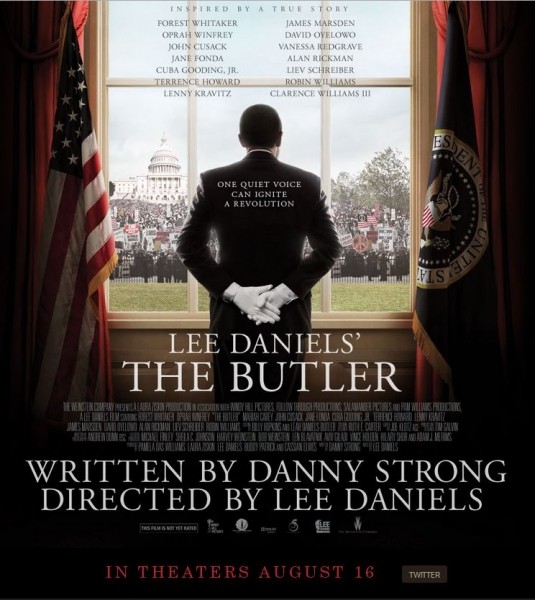
the-butler-poster

Washington Post reporter Wil Haygood was covering the 2008 Obama campaign when some young black women told him that they were going to vote for America’s first major party Presidential candidate who was African-American, even though their fathers told them not to.  The generational chasm that separated the fathers who were not ready to see one of their heritage in the White House and the daughters who were inspired him to check to see whether there might be someone in the White House itself who was of that older generation.  He found one, Eugene Allen, who had been a butler in the White House from the Truman administration to the Reagan administration, and who was planning to vote for Barack Obama, and Haygood  wrote an article telling his story.

That story inspired this film, with Forest Whitaker as Cecil Gaines, born on a plantation in the Jim Crow south and serving eight Presidents while raising two sons.  Like the young women Haygood met, the next generation had very different ideas and aspirations.  The conflict between a man whose job was to serve by being “invisible in the room” had sons who wanted to be anything but invisible. As Sidney Poitier said to Roy Glenn in “Guess Who’s Coming to Dinner” in 1967, “Dad, you think of yourself as a colored man.  I think of myself as a man.”

There are some awkward moments in trying to get through so much material so quickly, with just brief glimpses of some of the Presidents and some of the events.  By the time we figure out that it is Robin Williams playing President Eisenhower, painting a landscape as Cecil serves him from a silver tray, his appearance is over. John Cusack has two juicy scenes as Richard Nixon.  As the eager, if socially clumsy Vice President, he visits the kitchen to hand out buttons and ask the staff what issues are important to them.  “As members of the Negro race,” he intones, as though they do not know who they are, “what are your biggest concerns?”

Later, Cecil sees the President unraveling under the impeachment proceedings.  James Marsden has some of President Kennedy’s charisma, and Minka Kelly is lovely and utterly heartbreaking as Jackie, sobbing in the pink suit covered with blood that she could not bring herself to remove.  Liev Schreiber shows us President Johnson’s swagger, leaving the bathroom door open so he can talk to his aides while he is on the toilet.  Presidents Carter and Ford are seen only in brief archival footage, but Alan Rickman and Jane Fonda are both excellent as the Reagans, shown with more warmth and humanity than the caricatures we might expect.

This cavalcade of star power is just the frame.  Director Lee Daniels and screenwriter Danny Strong (Danny Siegel on “Mad Men”) put the human story at the center of the tumultuous historic changes from the late 1950’s to the first decade of the 21st century.  That gets a little didactic and clumsy.  Cecil Gaines is given two sons, Louis (David Oyelowo of “Red Tails”) and  Charlie (Elijah Kelley of “Hairspray”), so that Louis can become involved in the Civil Rights movement, from sit-ins to freedom rides, and then the Black Panthers and anti-apartheid, while Charlie goes to fight in Vietnam.   But sensitive and heartfelt performances and the ultimate recognition by the characters that despite their estrangement, the connection between Cecil and Louis is powerful and unbreakable makes their reconciliation hit home.  There is a distracting and unnecessary detour into the relationship between Cecil’s wife, Gloria (Oprah Winfrey) and a neighbor (Terrence Howard).  And the cameos by big stars as the Presidents are distracting — and a grim reminder that even powerhouses like Winfrey, Whitaker, and Daniels and a relatively modest budget were not enough to get a Hollywood greenlight without some white stars.  Some of the best scenes are when we see the African-American characters away from the “other face” they have to show whites, relaxed and joking in the White House locker room (Cuba Gooding, Jr. Lenny Kravitz) and  or at neighborhood parties.

Ultimately, this is Cecil’s story.  When he was a child, service was a chance to get out of the cotton field.  In his first job away from the plantation, he learns to present a pleasant, respectful, and helpful face to the customers, to “make them feel not threatened,” to look at them only to “see what they need.”  And he learns to stop using the n-word about himself or anyone else.  When he comes to the White House, he is told,  “You hear nothing.  You see nothing.  You only serve.”  As for the issues, when it comes to the staff, “We have no tolerance for politics at the White House.”

While Louis and his friends are staging a sit-in at a segregated lunch counter, his father is serving dignitaries, wearing white gloves and a tuxedo.  But all the courage and determination Louis shows in his passionate commitment to equality don’t reach the power of the moments when Cecil challenges the long-standing tradition of paying the African-American staff of the White House 40 percent less than the white staff, and not allowing them the opportunity for promotion.

“Darkness cannot drive out darkness,” the movie’s opening epigraph from the Reverend Dr. Martin Luther King tells us.  “Only light can do that.”

Parents should know that this film includes strong language, drinking, drunkenness, and alcohol abuse, sad deaths, peril and violence including police brutality, rape, murder, lynching, racial epithets, sexual references and non-explicit situations.

Family discussion: Talk to members of your family about their own experiences before and during the Civil Rights era and read about some of the people and incidents mentioned in this movie, including Emmett Till, Pablo Casals, and James Lawson.

If you like this, try:  The Autobiography of Miss Jane Pittman, “Eyes on the Prize,” and “The Remains of the Day” and the books The Butler: A Witness to History and White House Butlers: A History of White House Chief Ushers and Butlers

Related Tags:


Based on a book Based on a true story Biography Drama DVD/Blu-Ray Pick of the Week Epic/Historical Family Issues
THE MOVIE MOM® is a registered trademark of Nell Minow. Use of the mark without express consent from Nell Minow constitutes trademark infringement and unfair competition in violation of federal and state laws. All material © Nell Minow 1995-2026, all rights reserved, and no use or republication is permitted without explicit permission. This site hosts Nell Minow’s Movie Mom® archive, with material that originally appeared on Yahoo! Movies, Beliefnet, and other sources. Much of her new material can be found at Rogerebert.com, Huffington Post, and WheretoWatch. Her books include The Movie Mom’s Guide to Family Movies and 101 Must-See Movie Moments, and she can be heard each week on radio stations across the country.

Website Designed by Max LaZebnik