On the Rocks

On the Rocks

Posted on October 22, 2020 at 5:49 pm

B +
Lowest Recommended Age: High School
MPAA Rating: Rated R for some language and some sexual references
Profanity: Strong language
Alcohol/ Drugs: Social drinking
Violence/ Scariness: None
Diversity Issues: None
Date Released to Theaters: October 24, 2020
Copyright 2020 A24

I admit that I was about to give up on Sofia Coppola. I admired her early films, “The Virgin Suicides” and “Lost in Translation,” in part because of her exquisite framing and intriguing silences. But her later films made the framing seem precious and the silences seem empty. They were like precisely arranged bento boxes created for display only, beautiful to look at but not very nourishing or flavorful.

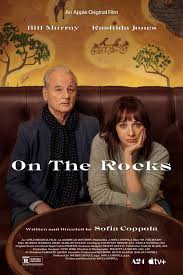
But now we have “On the Rocks,” a slight film but with more warmth and a more relaxed tone than her previous work. It’s bittersweet, but it is beguiling. Rashida Jones plays Laura, a writer in New York living with her husband Dean (Marlon Wayans) and two young children, one still a toddler. Dean has been working hard at his job, which requires a lot of travel, and Laura has been feeling neglected, struggling with her writing, and she begins to worry that Dean might be having an affair with the beautiful and a bit intimidating colleague who travels with him (Jessica Henwick and Fiona). While he is traveling the world and making big deals, she says, “I’m just the buzzkill waiting to schedule things.” And then, for her birthday, he gives her a kitchen appliance.

One reason Laura might be suspicious is her father, a charming and utterly unrepentant man about town, who has never been faithful to a partner, including Laura’s mother. But he loves Laura, and thinks the best way for him to help her is to help her follow Dean to find out for sure. She isn’t sure whether it’s better to find out that he is having an affair or finding out he is not having an affair but she has just become boring. “Ehst if we find out he is just busy and I’m in a rut?”

Laura’s father, Felix, is played by Coppola favorite Bill Murray, who worked with her in “Lost in Translation” and “A Very Murray Christmas.” The fun of the movie is seeing Jones and Murray together as they take us to one fabulous Manhattan location after another, to the sounds of the lush score from Phoenix. They adore each other, but there is strain between them. He betrayed her mother — and the woman who came after her, and many others. “Why do women get plastic surgery?” Felix asks Laura. “Because of men like you,” she says. He tells her he prefers women who have not had work done and she says he prefers all kinds of women. When he is stopped for speeding as they are following Dean, he utterly disarms the policeman by telling him he knew the cop’s father and grandfather. “It must be very nice to be you,” she says. He smiles, “I wouldn’t have it any other way.”

The plot barely exists, but like Laura and Felix, it is more about spending time together than answering the question about Dean. “On the Rocks” is like a lighter, sweeter Woody Allen film, a love letter to Manhattan, to music, to fathers and daughters, and to love itself.

Parents should know that the theme of this movie is adultery, including strong language and sexual references.

Family discussion: Why was Laura worried about Dean? Why didn’t she talk to him about her concerns?

If you like this, try; “Midnight in Paris” and “Celeste and Jesse Forever,” written by and starring Rasida Jones


Related Tags:


Comedy Drama Family Issues movie review Movies -- format Movies -- Reviews
The War With Grandpa

The War With Grandpa

Posted on October 8, 2020 at 3:15 pm

D
Lowest Recommended Age: 4th - 6th Grade
MPAA Rating: Rated PG for PG some thematic elements, rude humor, language
Profanity: Some schoolyard language
Alcohol/ Drugs: None
Violence/ Scariness: Extended cartoon-style comic peril and mayhem, some injuries, mourning, funeral scene
Diversity Issues: None
Date Released to Theaters: October 9, 2020
Copyright 101 Studios 2020

Sigh.

Robert Kimmel’s 1984 book, The War With Grandpa, is a lot of fun and also thoughtful about family, resolving conflicts, and war. The movie has tons of star power but it is just dumb slapstick, with escalating cartoon-style mayhem. It’s been on the shelf since it was originally scheduled for release in 2017 and even by pandemic shut-in standards it is barely watchable.

Which is not to say that some children won’t be amused by it because, see above re slapstick and mayhem. For the rest of us, it’s just sad and exhausting seeing Robert De Niro, yes that Robert De Niro, dropping his pants and flashing his son-in-law, plus sticking his hands down the pants of a dead body at a funeral. Then there’s Uma Thurman doing a spit-take and running around in a Christmas elf costume, plus a lot of predictable jokes about old people (they don’t understand technology! Hilarious!), married people (Dad feels diminished by his job, his father-in-law, and sometimes his wife), teenagers (they like to make out!), middle schoolers (puberty humor! bullies!), and little kids (precocious witticisms!).

The story is in the title. De Niro plays Grandpa, still mourning his late wife and not doing so well living at home since he can no longer drive. After he gets frustrated at the grocery store because they’ve switched to all self-checkout and, say it with me, old people don’t understand technology, he gets into a fight with the security guard. And so his daughter Sally (Uma Thurman) says he has to move in with her and her family, including her architect husband Arthur (Rob Riggle), teenage daughter who is always running off to “study” with her boyfriend (Laura Marano), middle school son Peter (Oakes Fegley of “Pete’s Dragon”), and youngest daughter Jenny (Poppy Gagnon).

Pete gets moved to the attic so Grandpa can have his room, and Pete is not happy. And so he slips a note under his old bedroom’s door signed “Secret Warrior.” It is not much of a secret, though, since he says he wants his room back. It is a declaration of war. At first, Grandpa doesn’t take it too seriously. After all, Pete is just a kid and he does feel back about taking the room. But then there is one prank too many and someone who knows what a real war is (“It’s not like a video game”) is in. But first, some rules of engagement. No collateral damage (no one else in the family can be affected, like that’s possible) and no tattling.

Each party is advised by friends. Pete has his pals from school and Grandpa has his buddies Jerry (Christopher Walken) and Danny (Cheech Marin), and later a pretty store clerk (Jane Seymour). But none of it really makes any sense and some elements are unnecessarily sour. If Arthur is an architect, can’t he figure out a better way to use the space than sticking Pete in a rat and bat-infested attic? In fact, Arthur serves no role whatsoever in the story except to try to prove that he deserves some respect, which would be nice if he actually earned some. How can this family afford a crazily over-the-top Christmas-themed birthday party for a child including artificial snow? Even if it made sense for Grandpa to agree to a war, why would he let Pete pick the battleground for the supposed winner-take-all? It never gets past the idea that there is just something uncomfortable about a kid picking on his sad grandfather this mean-spirited and selfish way, while insisting that he loves him and expecting us to like him.

That’s a lot more thought than this movie deserves. Even the A-list cast can’t win the war with a dumbed-down script, awkwardly staged stunts, and lackluster direction.

Parents should know that this movie includes comic peril and mayhem with a lot of pratfalls and injuries but no one seriously hurt. There is also some potty humor, along with references to puberty, a school bully, crotch hits, teen making out sessions, some schoolyard language, and implied nudity.

Family discussion: Why did Pete declare war? Why did Ed agree? Were those the right rules of engagement? What would you advise that family?

If you like this, try: the book by Robert Kimmel Smith, “Spy Kids,” “How to Eat Fried Worms,” and the various versions of “Freaky Friday”

Related Tags:


Based on a book Comedy Family Issues Kids movie review Movies -- format Movies -- Reviews Stories About Kids
The Personal History of David Copperfield

The Personal History of David Copperfield

Posted on August 27, 2020 at 5:51 pm

A-
Lowest Recommended Age: Middle School
MPAA Rating: Rated PG for thematic material and brief violence
Profanity: None
Alcohol/ Drugs: Alcohol and alcoholism, smoking
Violence/ Scariness: Brief violence including a fight scene and some abuse, sad offscreen death of a parent
Diversity Issues: Race-blind casting
Date Released to Theaters: August 28, 2020

Copyright 2019 FilmNation Entertainment
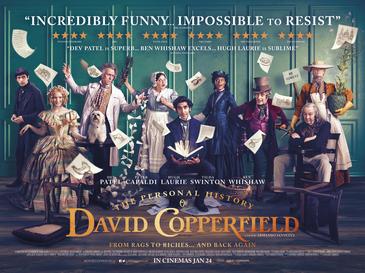
There is no higher praise than to say that Armando Iannucci (“In the Loop,” “Veep”) has adapted the book Charles Dickens said was his favorite of all the novels he had written, the book closest to his own history, in a manner as jubilant and shrewdly observed, as touching, as romantic, as exciting, as the novel itself.

For those who made not be familiar with the story: David Copperfield is a Bildungsroman that begins with the birth of the title character to Clara, a sweet but naive weak-natured young widow (played by Morfydd Clark, who also plays David’s first love, Dora). They have a blissful life together until she marries the stern and cruel Mr. Murdstone (Darren Boyd), who, with his equally formidable sister (Gwendolyn Christie), takes over the household.

Murdstone sends David to work in a bottle factory, where he lodges with the impecunious Mr. Micawber (Peter Capaldi). Years later, he runs away to his only relative, the formidable Miss Betsey Trotwood (Tilda Swinton), who lives with a kind-hearted but rather vague man named Mr. Dick, who struggles with intrusive thoughts about King Charles I.

Miss Betsey sends David to school, where he meets the indolent Steerforth (Aneurin Barnard of “Dunkirk”) and is befriended by Agnes (Rosalind Eleazar). After graduation he goes to work for Mr. Spenlow, and is immediately overwhelmed with love for his daughter, Dora. During all of these adventures and more David changes names and positions in society several times, and the concerns he and others have about their status in society is a recurring theme.

David Copperfield is one of my favorite books of all time, and I well understand it would take a trilogy as ambitious as “Lord of the Rings” to fully do justice to all of its characters and events. But even I had to admit that it has been judiciously pruned (the characters of Rosa Dartle and Mrs. Steerforth have been combined, no Barkis or Miss Mowcher, Tommy Traddles only mentioned, etc.). I strongly concur with dropping the “Little” from Emily’s name, and quickly got used to the idea that she was nearly an adult when David was a child. And I even applauded some happier resolutions for some of the characters. After 170 years, they deserve it.

And the cast! Not since the grand 1935 MGM version with Freddie Bartholomew as young David, Lionel Barrymore as Daniel Peggoty, Edna May Oliver as Aunt Betsey Trotwood, and Basil Rathbone as Mr. Murdstone (no one has ever been as good at naming characters as Charles Dickens), has there been such fitting richness of acting talent. Iannucci’s decision to use race-blind casting, without regard to the genetic realism of biological connections only adds to the universality and ample bounty that is fitting for Dickens, who populated his works with more vivid and varied characters per page than any other author in the English language.

Dev Patel is a superb choice for David, who is thoughtful, open-hearted, and innocent but with a strong core of honor and optimism. We first see David, like the real-life Dickens who went on very popular speaking tours, reading the book’s famous opening line on stage before an appreciative audience. “Whether I shall turn out to be the hero of my own life, or whether that station will be held by anybody else, these pages must show.” That framing, that self-awareness is fitting for an authorial voice that opens a book by challenging us to make up our own minds about what is to come. Iannucci’s theatricality and gift for telling stories cinematically shimmers through the film, with occasional images projected onto a wall, a hand reaching down into a model of the set, Patel talking to his younger self, played by Ranveer Jaiswal.

Class as it is perceived and as it is in reality is a theme of the film, but so is story-telling itself. Mr. Dick struggles to tell his story without reference to Charles I, and David comes up with an ingenious way to help him. Even as a young child, David wrote down memorable turns of phrase he heard on scraps of paper. His realization that those pieces of paper and pieces of memories are the basis for understanding his past, his purpose, and his future is a deeply satisfying answer to the question he poses at the beginning.

Parents should know that this film includes some tense and sad moments including an abusive stepfather and the offscreen death of a parent. There are financial reversals, confrontations (one fistfight), and a character embezzles.

Family discussion: Is David the hero of the story? Why is it so important to him to be considered a gentleman?

If you like this, try: The MGM version and the book, as as well as other film adaptations of Dickens books including the David Lean “Great Expectations” and the many, many versions of “A Christmas Carol” and a film about the writing of “A Christmas Carol” with Dan Stevens as Dickens, “The Man Who Invented Christmas.”

Related Tags:


Based on a book Comedy Drama Epic/Historical Family Issues movie review Movies -- format Movies -- Reviews Remake Romance
Made in Italy

Made in Italy

Posted on August 13, 2020 at 5:14 pm

B-
Lowest Recommended Age: High School
MPAA Rating: Rated R for language
Profanity: Some strong language
Alcohol/ Drugs: Some alcohol
Violence/ Scariness: References to sad offscreen death, divorce, family conflict
Diversity Issues: None
Date Released to Theaters: August 8, 2020
Date Released to DVD: December 7, 2020

Copyright 2020 IFC
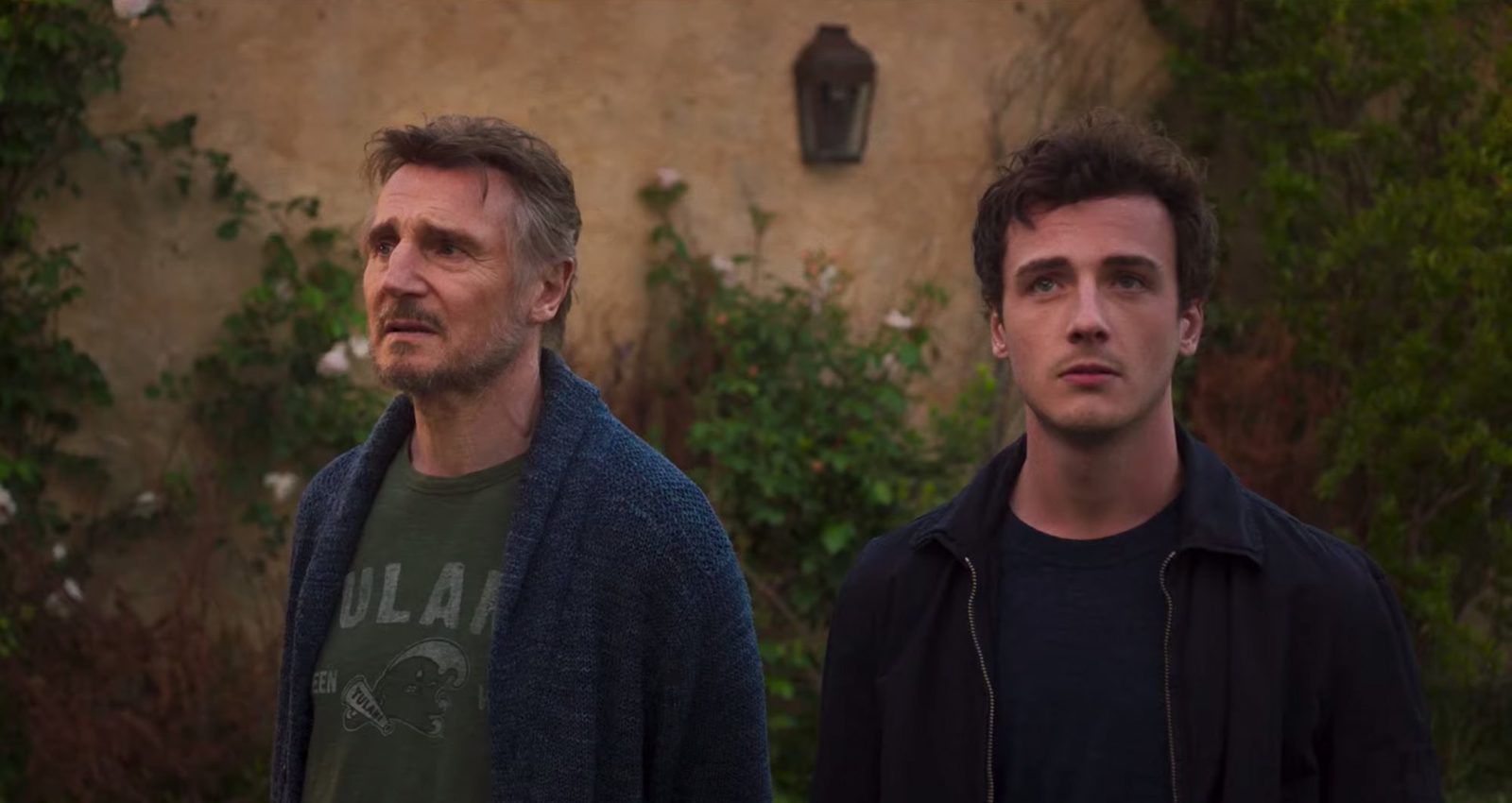
Made in Italy” is a labor of love starring a real-life father and son playing a father and son. And it is about a labor of love in the most literal terms as the estranged father and son have to work together on the house in Tuscany they jointly own so that it can be sold.

Like the characters they play, Liam Neeson (Robert) and his son Micheál Richardson (Jack) experienced the devastating loss of a wife and mother, actress Natasha Richardson (Micheál uses her last name as a tribute). This adds an overlay of intimacy to the film would not be supported by the script alone, a first-time feature written and directed by actor James D’Arcy. It is perhaps for that reason that a climactic scene of grief is truncated and underplayed. Maybe it is because it was just too painful. Or the shifting and uncertain tone of the film, which wants to be warm-hearted, romantic, comic, and dramatically emotional at the same time.

Jack manages an art gallery owned by the family of the wife who is divorcing him. When she tells him they are going to sell the gallery, he insists he will buy it. “The gallery is my home,” he says. He cannot let it go. But to get the money he needs he will have to sell his late mother’s home in Tuscany, deserted for twenty years because it was too painful to return. And he will have to get his father to agree. They are barely on speaking terms. Jack has contempt for his father’s failure to produce any new artwork in years and for his irresponsible attitude. Jack arrives to take him on the trip and Robert has not packed (“I thought it was tomorrow”) and, in one of the movie’s most regrettable cliches, cannot remember the name of the woman who spent the night. Robert does not respect Jack. Again, regrettably, he puts it this way: “Those who can, do. Those who can’t run their wive’s galleries.”

The house is a beautiful mess. The landscape around it is breathtaking. Robert calls it “one of the most fabulous convergences of nature ever,” and dismisses Jack’s referring to it as “the view.” And they disagree about a mural Robert painted on one of the walls, which he calls his tribute to abstract expressionist Franz Kline, but looks more like a tribute to the blood-tsunami elevator in “The Shining.”

There is a brisk British real estate agent with a severe haircut (Lindsay Duncan), who brings a delightful mix of disdain and saleswomanship to every scene she’s in, at least until her character has to soften up when she is charmed by Robert. There’s a warmhearted local woman (Valeria Bilello) who is there to soften up Jack. These women and the experience of living in and working with the home of the woman they are still grieving makes it possible for them to do what they have never done before: talk about their loss in a scene that is not as emotionally resonant as the film sets us up to expect. Maybe it is just be British reticence.

But then we return to the real heart of the film, the spectacularly gorgeous Tuscan scenery and oh, that food. That setting, and the genuine affection between Neeson and Richardson, makes up for the predictability of the script. What do you think, with the potential buyers be kind, considerate people who deeply appreciate the house as it is or a poor copy of the self-centered boors Kristen Wiig and Jason Sudeikis used to play on “Saturday Night Live?” It’s the fabulous convergence of nature and the almost-fabulous convergence of the actors that makes it worth a watch.

Parents should know that this movie concerns a tragic death, survivor guilt, and family estrangement. Characters use strong language and there is a mild sexual situation.

Family discussion: Why wouldn’t Jack sign the divorce papers? Why was the gallery so important to him? Why couldn’t Jack and Robert be honest with one another?

If you like this, try: “Under the Tuscan Sun,” “Life as a House,” and “Enchanted April”

Related Tags:


Drama DVD/Blu-Ray Pick of the Week Family Issues movie review Movies -- format
The Secret Garden

The Secret Garden

Posted on August 6, 2020 at 5:37 pm

B +
Lowest Recommended Age: Kindergarten - 3rd Grade
MPAA Rating: Rated PG for thematic elements and some mild peril
Profanity: None
Alcohol/ Drugs: None
Violence/ Scariness: Sad offscreen deaths of parents, illness, depression, fire
Diversity Issues: None
Date Released to Theaters: August 8, 2020

Copyright STX 2020
Most of the time I was beguiled by the gorgeously designed latest version of “The Secret Garden,” Frances Hodgson Burnett’s classic 1911 story of the orphan girl named Mary Lennox sent to live with her uncle in a vast castle-like home on the moors. She discovers a locked, hidden garden — and some family secrets. But there were moments when I was as cross as Mary herself, the book version that is.

What I loved most about the book when I first read it as a child and then when I read it aloud to my own children was that Mary is that rare heroine in a classic children’s book who is unapologetically imperious, outspoken, and, until the secret garden works its magic, selfish. Anne Shirley, Pollyanna, Alice, Caddie Woodlawn, and Burnett’s unfailingly saint-like Sara Crewe, Mary Lennox had a sour disposition and yet, she was the heroine of the story. This fifth movie version begins with Mary comforting her doll. The book’s Mary would never do anything so empathetic.

So, it took me a while to let go of my version of Mary and warm to the softer version from screenwriter Jack Thorne (“Wonder”), enjoying the movie within its own conception of the story. As in the book, Mary (Dixie Egerickx) is raised in colonial-era India (here set in 1947), then sent to live with the uncle she does not remember ever having met (Colin Firth as Archibald Craven), in an enormous house called Misselthwaite Manor, on the windy, misty moors of Yorkshire.

She discovers a secret garden and two boys, one who seems to be a part of the moors, and a relative who is as removed from the natural world — even other humans — as it is possible to be. She discovers some important understanding about herself, in part through evidence that helps her reframe her past.

Sumptuously imagined and lovingly presented, this is a fine family film, and a good reminder that even being stuck at home can be an adventure.

Parents should know that this film features three children mourning lost parents and a grief-stricken father/uncle. A character has severe depression, which her daughter interprets as not caring about her. There is some mild peril and a fire.

Family discussion: Grief is expressed in many different ways in this film. What are some of them? What did Mary and Colin learn from the letters that made a difference to them? What would be in your secret garden?

If you like this, try: the book and the earlier versions of the story, especially the 1987 version directed by Agnieszka Holland.

Related Tags:


Based on a play Family Issues movie review Movies -- format Movies -- Reviews Remake Stories About Kids
THE MOVIE MOM® is a registered trademark of Nell Minow. Use of the mark without express consent from Nell Minow constitutes trademark infringement and unfair competition in violation of federal and state laws. All material © Nell Minow 1995-2026, all rights reserved, and no use or republication is permitted without explicit permission. This site hosts Nell Minow’s Movie Mom® archive, with material that originally appeared on Yahoo! Movies, Beliefnet, and other sources. Much of her new material can be found at Rogerebert.com, Huffington Post, and WheretoWatch. Her books include The Movie Mom’s Guide to Family Movies and 101 Must-See Movie Moments, and she can be heard each week on radio stations across the country.

Website Designed by Max LaZebnik