The Boxtrolls

Posted on September 25, 2014 at 5:59 pm

A-
Lowest Recommended Age: Kindergarten - 3rd Grade
MPAA Rating: Rated PG for action, some peril and mild rude humor
Profanity: None
Alcohol/ Drugs: None
Violence/ Scariness: Cartoon-style peril and some violence, comic allergic reaction, references to disturbing violence, some gross images
Diversity Issues: A theme of the movie
Date Released to Theaters: September 26, 2014
Date Released to DVD: January 19, 2015
Amazon.com ASIN: B00HLTDARS
The-Box-Trolls-2
Copyright LAIKA Studios 2014

LAIKA Studios (Paranorman and Coraline) has created another  loveably crooked world, this time inspired by Alan Snow’s Here Be Monsters! (The Ratbridge Chronicles).  It’s their first period setting, a sort of slightly bent Edwardian with a touch of steampunk, in the town of Cheesebridge.  LAIKA’s motto may be “No straight lines, no right angles, no perfect circles,” but this wobbly community is rigidly stratified, with the White Hats at the top of society, nibbling on exotic cheeses in the elegant Tasting Room and hosting elegant parties, the lower class Red Hats desperate to be accepted by them. There is an entirely separate group, the gentle Boxtrolls, who live underneath the city, turning rubbish into Rube Goldbergian machines and tending their garden.  They are called Boxtrolls because of their attire — discarded cardboard boxes.  And their names come from the boxes they wear: Fish, Fragile, Shoes, and Specs.

And then there is Eggs (Isaac Hempsted Wright).  He thinks he is a Boxtroll, but he is a human, left as a baby by his father, who was trying to keep him safe.  Apparently Cheesbridge follows Noam Chomsky’s theories of language: while the Boxtrolls speak in a sort of mumbly pidgin talk, Eggs speaks flawless and rather aristocratic-sounding English.  Their happy life is disturbed by Snatcher (Sir Ben Kingsley), the leader of the Red Hats, who conducts raids to capture the Boxtrolls.  He knows they are harmless, but he has persuaded the White Hats that the Boxtrolls capture and eat human children so that they will depend on him to exterminate them.  If Snatcher gets rid of all of them, the Mayor of Cheesebridge has promised to give him a White Hat and allow him into the sanctum sanctorum, the Tasting Room.  There is one problem, though.  Snatcher, despite his protestations to the contrary, is massively lactose-intolerant.

Mayor Lord Portly-Rind (Jared Harris) and his wife Lady Portly-Rind (Toni Collette) have a daughter named Winnie (Elle Fanning, the sister of “Coraline” star Dakota Fanning).  She longs for them to pay attention to her.  Their neglect has led her to develop a macabre fascination with what she imagines are the atrocities of the Boxtrolls and she decides to investigate.  When she finds out that the Boxtrolls are harmless, she agrees to help Eggs tell her father that Snatcher has lied.  Eggs will need to be persuaded that he is in fact human and then taught some of the basics of human interaction so that he can deliver the message.

The word “immersive” is often used to describe movies with 3D effects that seem to make the images surround the viewer by extending both in front of and behind the screen.  But LAIKA’s films are more deeply immersive than that because of the intricacy of the world they create.  Most animated movies use miles of code to show us how every individual hair in an animal’s fur rustles in the wind.  But the handmade touch and infinite care of LAIKA’s stop-motion films, where figures and props are nudged ever so slightly for each individual frame and craftspeople spend months creating practical (not digital or virtual) effects to evoke water, fire, and clouds, creates an environment that is tantalizingly complex and invites many viewings to explore its wonders.

LAIKA is perfectionist in its dedication to not being perfect.  It embraces the messiness of life.  The Boxtrolls’ cavern is grimy and dank, and the Portly-Rind home filled with dessicated finery, but both are brimming with endlessly inventive detail, especially the elaborate mechanics of the Boxtrolls’ cave and the meticulous choreography of the White Hats’ ball.  Every single object reflects the care taken by the filmmakers and every detail reflects some element of character and story, which are messy as well.  Winnie, who has so much, is lonely and neglected.  But she is brave and honest.

Eggs, who has so little, is surrounded by love.  He is loyal and courageous.  And Snatcher, who is so desperate for acceptance that he will don an elaborate disguise, make libelous accusations, and put his health and even his life at risk, is ultimately not really able to destroy the Boxtrolls.  His henchmen, played by Tracey Morgan, Nick Frost, and Richard Ayoade are less wicked than existentially confused, trying to persuade themselves that they are on the right side.

The visuals are deliciously grotesque at times, but the message is a sweet one: families come in all sizes and shapes, sometimes biological, sometimes not, but what defines them is love.

NOTE: Be sure to stay through the credits to see some existential ponderings by the characters and a brief cameo by animator/CEO Travis Knight.

Parents should know that there are some comic but grotesque and macabre images.  Characters are in peril and apparently killed, though shown later to be imprisoned.  A character appears to have lost his mind.  Another character explodes (offscreen).

Family discussion: Why was it so important for Snatcher to be a White Hat?  Why didn’t Winnie’s parents pay more attention to her?  Why did some of the Red Hats think they were the good guys?

If you like this, try: “Coraline,” “Paranorman,” and “Monster House”

Related Tags:


3D Animation Based on a book DVD/Blu-Ray Pick of the Week Fantasy For the Whole Family Scene After the Credits Stories About Kids

The Maze Runner

Posted on September 18, 2014 at 5:59 pm

B
Lowest Recommended Age: High School
MPAA Rating: Rated PG-13 for thematic elements and intense sequences of sci-fi violence and action, including some disturbing images
Profanity: Some strong language
Alcohol/ Drugs: Underage drinking
Violence/ Scariness: Extended sci-fi action, peril and violence with many disturbing images, including monsters, dead bodies, apparent suicide, and wounds, many characters injured and killed
Diversity Issues: Diverse characters
Date Released to Theaters: September 19, 2014
Date Released to DVD: December 15, 2014
Amazon.com ASIN: B00OY7YPGK

maze runnerYes, it’s another dystopic YA trilogy (actually, there’s a fourth volume, a prequel), and yes, only a teenager with fabulous cheekbones can save the day. But “The Maze Runner” is not a lesser repeat. It is a worthy addition to the genre, an absorbing drama with surprising turns and even more surprising resonance to contemporary conflicts.

Our main character learns what is going on around him at the same time we do. He awakens with a gasp in an elevator cage hurtling to the surface. His memory is gone. He does not know who he is or where he is. When the elevator stops, he finds that he is in a wilderness, the entire population adolescent boys. They call it The Glade. For three years, one boy has arrived by that same elevator every month, along with some supplies in a box marked WCKD. We learn along with the boy, called “Greenie” by the others because he is new, that they have created a society with rules and assigned tasks. The Glade is surrounded by a massive maze that re-arranges itself every night. One group of boys, called Runners,” explore the maze every day to try to map its variations and figure out an escape path. They have to be out of the maze at night because horrible monsters called The Grievers come out. No one who was in the maze at night has ever survived. A “sting” from one of the monsters is toxic, causing madness. The other boys, led by Alby (Aml Ameen of “The Butler”), introduce the greenie to their world and tell him he will remember his name. “It’s the one thing they let us keep.” He does remember. His name is Thomas (Dylan O’Brien).

The boys understand the concept of parents but have no memory of ever having had any. Chuck (Blake Cooper), one of the youngest and most tender-hearted of the boys in The Glade, confides to Thomas that he has carved a little totem for the parents he cannot remember but hopes to be returned to some day.

Alby explains the rules to Thomas. Everyone must do his part. Never harm another Glader. “None of this works unless we have trust.” Never go beyond these walls. But those rules are based on the past. Thomas’ arrival signals some changes. Or did he create those changes? That is an issue that will be debated and then fought over.

“You’re not like the others,” someone says to Thomas. “You’re curious.” Thomas says that if they have not figured a way out in three years, it is time to try something new. Some of the others agree with him, especially after the elevator arrives with someone new — a girl — with a note that says she will be the last one.

A little bit “Lord of the Flies” (boys creating their own society, the struggle between animal instincts and human justice), a little bit “Hunger Games” (teenagers used as pawns by adults), it still manages to bring some imaginative and provocative themes and create distinctive characters. The maze itself is stunning. Production designer Marc Fisichella and the entire sound team have created a maze that is more than an obstacle course or a metaphor. The conflicts as the boys try to maintain some control in the midst of an environment that, like the maze, shifts and constricts are absorbing. The result is a film that you do not need to be a teenager or a YA fan to appreciate.

Parents should know that this film has sci-fi-style action, peril and violence, guns, knives, many young characters injured and killed, suicide, scary and disgusting monsters, some disturbing images, some strong language, and teen drinking.

Family discussion: Why do Thomas and Gally have different ideas about what to do? What was the maze supposed to test?

If you like this, try: the book series and other dystopian films like “The Hunger Games” and “Divergent”

Related Tags:


Based on a book DVD/Blu-Ray Pick of the Week Fantasy Stories about Teens

Cinderella — With Music by Rodgers and Hammerstein

Posted on September 10, 2014 at 8:00 am

Every family will enjoy the 50th anniversary edition of the glorious Rodgers & Hammerstein’s Cinderella, starring Lesley Ann Warren, with Celeste Holm as the fairy godmother, Jo Van Fleet as the evil stepmother, and Walter Pidgeon and Ginger Rogers as the King and Queen. One of the ugly stepsisters is played by Pat Carroll, who would go on to provide the voice for one of Disney’s most memorable villains, Ursula in “The Little Mermaid.” And the prince is played by “General Hospital’s” Stuart Damon. The performances are delightful but the star of the show is the wonderful music from Richard Rodgers and Oscar Hammerstein. It was later remade with Brandy, Whitney Houston, and Bernadette Peters, equally delightful. And the rare first version with Julie Andrews is available now as well. All three are perfect for families to watch together.

http://www.youtube.com/watch?v=VtFhREtPdiE

“Cinderella” was the only musical Rodgers and Hammerstein (“Carousel,” “The King and I,” “The Sound of Music”) ever wrote for television. But it ended up on the duo’s home turf anyway when “Cinderella” became a Broadway hit, with Tony Award-winning costumes.

Related Tags:


Based on a book Classic Fantasy For the Whole Family Movie Mom’s Top Picks for Families Musical New on DVD/Blu-Ray Romance

The One I Love

Posted on September 4, 2014 at 6:00 pm

B+
Lowest Recommended Age: Mature High Schooler
MPAA Rating: Rated R for language, some sexuality and drug use
Profanity: Very strong language
Alcohol/ Drugs: Drinking, drugs
Violence/ Scariness: Scuffle, some creepy themes
Diversity Issues: None
Date Released to Theaters: September 5, 2014
Amazon.com ASIN: B00MB7KXPM

“The One I Love” is pretty good as a movie and sublime as an exercise, especially an acting exercise. Just describing details about the story will require a huge spoiler alert, which I will insert below before giving away some of what happens in the film (omitting the ending, of course). But first, we can mention the acting challenge presented by the film. Two actors are on screen for almost the entire running time and are required to display small but distinctly different characteristics to help us and the characters keep everything straight. That is a pleasure to watch on a whole other level aside from the storyline. The-One-I-LoveElisabeth Moss (“Mad Men”) and Mark Duplass (“The Mindy Project”) play Ethan and Sophie, a married couple seeing a therapist (Ted Danson) for counseling. Ethan remembers with great warmth when they first met, and impulsively went for a swim in a stranger’s pool. The sense of fun and freedom they had is something he misses. Sophie is having trouble trusting Ethan again because he had an affair and he is embarrassed and defensive. “I felt like our happiness used to be so easy and there used to be so much of it,” she says sadly. The therapist recommends a weekend getaway to a beautiful, remote cabin, assuring them that every couple he has sent there has returned “renewed.”

They arrive at the cottage, which is lovely, and discover that it has a guest house. SPOILER ALERT: As each of them enters the guest house separately, they encounter what they at first think is each other, but then realize is some other version of the person they married, a little brighter, sweeter, more considerate, more agreeable. Sophie’s new Ethan apologizes sincerely and contritely for his transgression and paints a portrait of her to show his devotion. Ethan’s smiling, slightly Stepford wife-ish new Sophie makes him bacon for breakfast, which the old Sophie didn’t like. At first, each thinks that the other is somehow making progress, becoming more cooperative, more committed to intimacy and rebuilding the relationship. But then it becomes clear that only one of them can enter the guest house at a time, and that the spouse they experience inside is someone new, different, and possibly some sort of projection, not a real person at all.

Ethan and Sophie respond very differently. He takes it on as an opportunity for rational detective work. “Of course you thought the fun was the investigation,” Sophie says, reminding him of the magic show where she enjoyed the show but he insisted on deconstructing all the tricks.

The original Sophie and Ethan at first decide to leave. It is just too creepy. But then they decide to return, making a pact about how each of them will handle the guest house doppelgangers. Is that the therapy? Giving them a shared experience so bizarre that it jolts them into working together to puzzle it out may be part of rebuilding their relationship, after all. “It’s like an exercise in trust,” Ethan says.

Screenwriter Justin Lader plays out the possibilities very cleverly, and it would be unfair to spoil it further. If the ending is not all one might hope, more of a trick than a conclusion, the performances and the ideas are provocative, fun, and something of a therapeutic trust exercise of their own.

Parents should know that this film includes very strong language, sexual references and situations, drinking, and drug use.

Family discussion: What is your explanation for how this retreat came together? If you had a chance to enter the guest house, would you? What would you find there?

If you like this, try: “Safety Not Guaranteed”

Related Tags:


Fantasy Movies -- format Romance VOD and Streaming

The Giver

Posted on August 12, 2014 at 7:00 am

B
Lowest Recommended Age: Middle School
MPAA Rating: Rated PG-13 for a mature thematic image and some sci-fi action/violence
Profanity: Some strong languge
Alcohol/ Drugs: Citizens are required to take drugs to make them submissive
Violence/ Scariness: Sci-fi-style apocalyptic violence, murder, peril, characters injured and killed
Diversity Issues: A theme of the movie
Date Released to Theaters: August 15, 2014
Date Released to DVD: November 24, 2014
Amazon.com ASIN: B00MU2P0HO
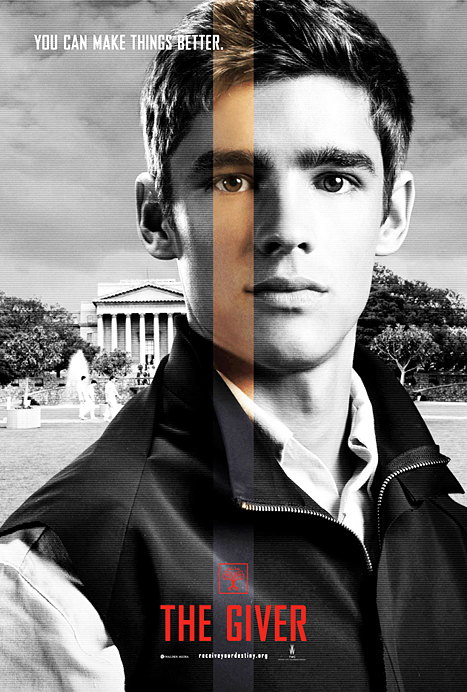
the giver poster
Copyright 2014 The Weinstein Company

“Thank you for your childhood.” Are there any more fearsome words in literature than these?

Lois Lowry’s The Giver is a Newbery Award-winning novel, a staple of middle school reading lists and book reports. It tells a dystopian story of a post-apocalypse society that is pleasantly courteous on its surface, but rigidly regimented and ruthlessly enforced. As children come of age and are assigned to their future careers by the all-powerful elders (who will later assign their mates and children as well), they are thanked for their childhood, words that sound grateful and polite, but which imply that all lives belong to the community, which demands that childhood be somehow contributed.  And, it clearly communicates that whatever freedoms or pleasures of childhood exist in this society, they are now in the past.

“From the ashes of the ruin,” we are told, “the communities were built” and “true equality” was achieved.  Whoever designed these new communities made the decision that human life could only continue if all memories of the past were erased, so that the sources of catastrophic conflicts — individual and cultural differences, were wiped out, along with the freedom to chose that inevitably leads to jealousy, anger, and struggles for power.  Fear, pain, envy, hatred, are all gone.  So are colors.  We see their world through their eyes, muted greys, no color, no music, no art.  There is constant discussion of “precision of language,” but it is just a way to eliminate words that describe strong emotions or complicated concepts, while genuinely imprecise words like “elsewhere” and “release” are euphemisms for dire and tragic consequences.  People “apologize” all the time but there are no real regrets and the “I accept your apology” responses are just as perfunctory.

Three friends, the serious Jonas (Brenton Thwaites), fun-loving Asher (Cameron Monaghan), and kind-hearted Fiona (Odeya Rush) are about to receive the thanks for their childhoods and be assigned their jobs.  Jonas is worried but his “parents” (a couple assigned to each other and handed babies from a collective nursery) reassure him that the Elders will make a good assignment, whether it is as a laborer, a nurturer (caretaker of infants and elderly), a lawyer (like his mother), or one of the other jobs that keep the community going.

But at the assignment ceremony announcements, Jonas is skipped over.  Only when everyone else has been assigned does the Elder (Meryl Streep in Very Serious Hair) tells the group that Jonas has been selected for a very important job.  The founders of this post-Ruin society erased all memories of the past but recognized that there might be some circumstances when mistakes could be prevented by reminders of past failures.  And so, it turns out, one isolated member of society is designated to be the repository of memories.  Jonas has been selected to be his successor.  He tells Jonas that because he is transferring the memories, he is The Giver (Jeff Bridges).  There is a lot of pressure on The Giver and Jonas because a previous effort to find a new keeper of memories (a small role for Taylor Swift, unglammed and made under) failed.

The story retains its power, despite an uneven translation to screen, in part because the book has been so influential that its ideas are no longer as innovative.  There is now an entire literary genre about repressive dystopian societies where it is up to an exceptionally attractive and very brave and talented teenager to save the day: Divergent, The Hunger Games, and the upcoming “The Maze Runner.”  Those stories have some similarities — the imposition of sometimes-fatal assignments by all-powerful adults, the rigidity and corruption of the society.  But the other stories are more inherently cinematic than The Giver, with a lot of the interaction here limited to conversations.  The muted emotions and colors are better imagined by a reader than watched as a viewer.  Streep and Bridges give uncharacteristically one-note performances in one-note roles.  Only Alexander Skarsgård as Jonas’ “father,” a nurturer in the facility where all the newborns are kept for the first year, gives his character some nuance and complexity, particularly in one very difficult scene that shows Jonas just how ruthless the seemingly placid and egalitarian community really is.

Indeed, that is one of the few scenes that seems to come alive.  On film, the book falters, more weighted by ideas than by story or character.   Despite the gifted work of production designer Ed Verreaux, whose setting convey placid exterior and deeper menace and director Philip Noyce, who uses music and color to deepen the emotional resonance, the film still feels thinly conceived.  The Giver can transmit tumultuous events and powerful emotions with a touch.  But the audience never achieves that visceral connection.

Parents should know that there is disturbing dystopic material in this story including peril and attacks, murder of people deemed unwanted or superfluous and mandatory drugging of the entire population,  some graphic images, reference to adolescent “stirrings,” and a kiss.

Family discussion:  If you were The Giver, what memories would you share and why?  What are the reasons someone might think this was a better way for societies to function?

If you like this, try: “Pleasantville,” “The Hunger Games” and “Divergent” and the three sequels to this book by Lois Lowry.

Related Tags:


Based on a book Drama DVD/Blu-Ray Pick of the Week Fantasy Stories about Teens
THE MOVIE MOM® is a registered trademark of Nell Minow. Use of the mark without express consent from Nell Minow constitutes trademark infringement and unfair competition in violation of federal and state laws. All material © Nell Minow 1995-2026, all rights reserved, and no use or republication is permitted without explicit permission. This site hosts Nell Minow’s Movie Mom® archive, with material that originally appeared on Yahoo! Movies, Beliefnet, and other sources. Much of her new material can be found at Rogerebert.com, Huffington Post, and WheretoWatch. Her books include The Movie Mom’s Guide to Family Movies and 101 Must-See Movie Moments, and she can be heard each week on radio stations across the country.

Website Designed by Max LaZebnik