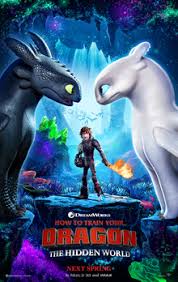
The final chapter of the “How to Train Your Dragon” saga is visually stunning and emotionally satisfying, with a conclusion that may leave the parents in the audience a little tearful….Sometimes the banter in the film can be too silly, and the reintroduction of the characters can be a bit awkward, especially when one of the teenagers tries to flirt with Hiccup’s mother Valka (Cate Blanchett). The script is also weakened by dumb insults between the twin characters, and an over-used storyline about whether a couple is ready to get married. But the opening scene of liberating caged dragons is excitingly staged and the film gets better quickly when it becomes more comfortable with its deeper themes. The characters have to rethink some of their ideas about tradition, change, what makes a home, and loss as “part of the deal that comes with love.”
The film’s breathtaking images provide a fitting accompaniment to the characters’ emotional struggles. Master cinematographer Roger Deakins served as a consultant on all three movies and I’m guessing he played a part in developing the exquisite quality of natural light, particularly in the flying scenes and a stunning phosphorescent-lit encounter. The visuals keep us inside a rich world of fantasy—the variations in dragon species continue to dazzle—one that is always grounded in human fears and feelings that are very real and very moving.
Rated PG for thematic content, some peril and rude humor
Profanity:
Some mild language
Alcohol/ Drugs:
Drinking and drunkenness
Violence/ Scariness:
Illness and sad deaths of humans and animals, automobile accident, stalker, family conflict
Diversity Issues:
None
Date Released to Theaters:
May 17, 2019
Date Released to DVD:
August 19, 2019
Copyright Universal 2019In “A Dog’s Purpose,” based on the book by W. Bruce Cameron, the soul of a dog named Bailey (voice of “Frozen’s” Josh Gad) was reborn over and over as we saw him (and sometimes her) with different owners, from a boy named Ethan to a police officer, to a lonely single woman, and ultimately back to a middle-aged Ethan again, now played by Dennis Quaid. Through it all, Bailey wonders what his purpose is, and learns that, like the rest of us it is to love and be loved, and to be loyal to his “pack.”
Bailey’s story continues in “A Dog’s Journey,” also based on a Cameron book. This time the tender/sad/sweet series of rebirth stories are all in the same family, as Bailey’s purpose is to look after Ethan’s granddaughter, CJ.
At the end of the last movie, Bailey helped to reunite Ethan with the girl he loved in high school, Hannah (Marg Helgenberger). As this movie opens, both Ethan and Bailey are a bit creaky in their joints, but they are still devoted to one another. Hannah’s son was killed in an accident when his wife Gloria (“GLOW’s” Betty Gilpin) was pregnant. Now she and her toddler daughter live on Ethan’s idyllic farm, which is always bathed in golden light and looks like something out of a coffee commercial. Ethan and Hannah adore their granddaughter, and the little girl loves them and Bailey but Gloria is restless and insecure. She takes the girl and refuses any contact with Ethan and Hannah. As Bailey dies, Ethan whispers that he should find CJ and take care of her.
And so Bailey is born as Molly adopted by now 11-year-old CJ (“Ant-Man’s” Abby Ryder Fortson). She has to hide the dog from Gloria, who has become alcoholic and neglectful. Molly is a great comfort to CJ, her only source of stability other than her best friend Trent, who has adopted Molly’s brother.
As CJ grows up (now played by British actress/singer Kathryn Prescott), Bailey finds a way to keep coming back to her when she needs it most.
The gentle humor in the film comes from what Bailey does and does not understand. Does understand: “take care of CJ,” “go where the good smells are,” “when Ethan crouches and throws the deflated football, leap over his back and catch it.” Does not understand: “what does shhh mean?” “why is CJ spending time with someone who is not in our pack when I have just led her to her long-lost best friend Trent (Henry Lau)?” The sweet moments come from the connections, between humans and between humans and dogs. The cute moments come from — did I mention all the puppies? There are plenty of “awwww” moments to go around, with reconciliation, support, and reunion, and plenty of human and canine characters to care for. I’m glad Bailey keeps coming back.
Parents should know that this film includes sad deaths of humans and animals, potty humor, a car accident, serious illness, drinking and drunkenness, a neglectful parent and an abusive boyfriend.
Family discussion: What convinced C.J. that her grandfather was right about Bailey? Why was it hard for her to acknowledge her feelings about Trent? Is there an animal that has been special to you?
If you like this, try: “A Dog’s Purpose” and “A Dog’s Way Home”
Copyright 2019 AFI
The AFI Docs festival in Washington DC (June 19–23) is the best place to see the latest, the most searingly powerful, the most surprising, and the most touching films of the year - because they are all documentaries, true stories about real people and places.
This year is especially exciting because a remarkable 48 percent of the films in the festival were directed by women and 68 percent had female Producers. The film is truly international with 72 films From 17 countries, including six world premieres. There will be films about famous people like Toni Morrison, Mike Wallace, Miles Davis, and Ruth Bader Ginsburg (following last year’s “RGB” and “On the Basis of Sex”), and films about not-famous people like “17 Blocks,” the story of a family who lives just a few blocks from the US Capitol, whose son documented their daily lives and struggles over almost two decades and “The Amazing Jonathan Documentary,” a sort of dueling documentary as two crews compete to make a film about an elderly magician.
A group of documentaries about music includes profiles of David Crosby, the San Francisco Gay Men’s chorus on tour through the South, and Linda Ronstadt, the legendary Apollo Theater and the also-legendary record producer Rick Rubin, who has worked with everyone from the Beach Boys to Public Enemy, Lady Gaga, and Shakira.
There are documentaries that are an exceptionally compelling form of journalism, covering the most vital contemporary issues from gun safety (“After Parkland” to criminal justice “True Justice: Bryan Stephenson’s Fight for Equality,” “Ernie and Joe”) to immigration (“Border South”) and cybersecurity/election tampering (“The Great Hack,” “Slay the Dragon”).
The festival will also present three classic documentaries: “An American Family,” “Tongues Untied, and Frederick Wiseman’s “Law and Order.”
Some of the other films I am most excited about:
“American Factory,” this year’s Centerpiece film, is directed by Steven Bognar and Julia Reichert, which examines the culture clash resulting from the takeover of a Dayton, OH, factory by a Chinese company.
“Raise Hell: The Life and Times of Molly Ivins” is the tale of one of the sharpest (in both senses of the word) political journalists of the 20th century. I’ve already seen it, and it is a treat. No matter who you support politically, you will be captivated by her wit, her honesty, and her dedication to her readers.
“Chasing the Moon” commemorates the historic trip to the moon, where Neil Armstrong and Buzz Aldrin not only walked on the moon but, with the help of Michael Collins and hundreds of engineers, scientists, military, and contractors, came safely home. (Watch for the companion book coming out next month as well.)
“Maiden” is the story of 24-year-old Tracy Edwards, who led the first all-female sailing crew to compete in the Whitbread Round the World Race thirty years ago.
Rated PG-13 for some suggestive content and language
Profanity:
Some strong language
Alcohol/ Drugs:
None
Violence/ Scariness:
Accident with pedestrian injuries, family scuffle
Diversity Issues:
A theme of the movie
Date Released to Theaters:
May 17, 2019
Date Released to DVD:
August 19, 2019
Copyright 2019 Warner Brothers StudiosA pair of teenagers who happen to meet on a day of great pressure for both of them are riding on a New York City subway train that gets stuck. The engineer comes on the speaker to tell them a story reminiscent of the Taoist parable about the farmer, the son, and the horse. Sometimes the very thing that you think is an insurmountable obstacle to what you are urgently trying to achieve turns out to lead you to something you could not have imagined, or even to save your life.
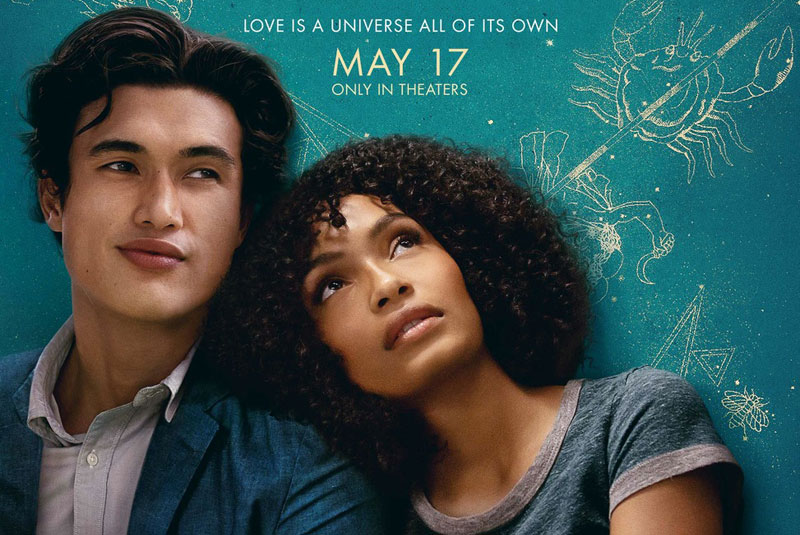
That is a theme in “The Sun is Also a Star,” along with the divide and sometimes conflict between poetry and science, the left brain and the right, what we feel and what we can prove, and the needs and dreams of the individual versus what is best for the family or the group — and who gets to decide what “best” means. And at the center of it is the thrum of issues of immigration and assimilation. It might be easy to lose sight of the love story under the weight of all of this, but the star power of lead actors Yara Shahidi (“Black-Ish” and “Grown-Ish”) and Charles Melton (“Riverdale,” “Glee”) and the deeply romantic direction of Ry Russo-Young, the romance is in every way the heart of the film.
Natasha (Shahidi) is the daughter of Jamaican immigrants who are being deported following an ICE raid of the restaurant where he father works. The family moved to New York when she and her brother were young children, meaning that they are not American citizens in the family on which to base an appeal. As her parents pack up, Natasha goes to ICE to see if she can appeal their decision.
A compassionate case officer says it is too late for him to re-open the case but he gives her the card of a lawyer who might be able to help. Because he cannot see her until noon, later postponed to 4:30, she is stuck downtown, not enough time to go home, but, perhaps enough time to fall in love?
Natasha does not believe in love, or so she says. She dismisses it as romantic hogwash, just a distractingly poetic way to describe hormones. She is interested in data and science. If love cannot be measured and studied according to the strictures of the scientific method, she says, it cannot be true.
The person she says it to is Daniel (Melton), the son of Korean immigrants, who glimpses Natasha at Grand Central Station when he is on his way to a very important alumni interview for Dartmouth. He grabs her away from a careening car that has already knocked down one pedestrian and she accepts his invitation to go for coffee. He is a poet, a romantic, a believer in signs and omens. Natasha’s jacket has the same ancient Greek phrase that he had jotted down in his notebook that morning: deus ex machina. Literally, it translates to “god from the machine,” referring to the mechanical device used in Greek theater to bring the deity characters on stage. But it is a literary term meaning some extraordinary, sometimes supernatural or god-like force that suddenly changes the trajectory of a story, usually resolving it for the better.
Daniel tells Natasha he can make her believe in love. He begins with the famous 36 questions followed by a silent stare into each other’s eyes. She insists that it cannot possibly work, but as the day goes on, she cannot help but be drawn to him. As they watch a show at the Planetarium (perhaps a nod to “Rebel Without a Cause”), she reaches for his hand.
Their walk-and-talk courtship involves visits to each other’s families and some surprising, one might even say cosmic connections. Melton and Shahidi make a graceful transition from television to the big screen, with charisma and chemistry to spare. Their chemistry is almost tactile, with a deep sweetness. With all of their differences in outlook and situation, their shared bond as the children of immigrants, struggling with what they owe to the past and what they dream of for the future is so real to us that by the end we are holding our breath hoping for the magic to go on.
Parents should know that this film includes some strong language and crude sexual references, a car hitting a pedestrian, and a scuffle between brothers, as well as some issues of family conflict and the prospect of deportation.
Family discussion: Daniel’s father says that Daniel should do what is best for the community. What do you think is best for the community in that context? Can you fall in love by asking each other questions? Was there a time where what you thought was something going wrong turned out to be right? Can tragedy be funny?
If you like this, try: “Before Sunrise,” “Nick and Nora’s Infinite Playlist,” and “Everything Everything”
Rated PG for action/peril, some rude and suggestive humor, and thematic elements
Profanity:
Some schoolyard language, potty references, mild words (jeez, hell, etc.)
Alcohol/ Drugs:
Fantasy "drug," caffeine, brief drug humor
Violence/ Scariness:
Extended fantasy/cartoon-style violence, parental loss
Diversity Issues:
Stereotype of disabled villain
Date Released to Theaters:
May 10, 2019
Date Released to DVD:
August 5, 2019
Copyright 2019 Legendary Pictures
People around me were gasping, hooting, and laughing at various details that passed right by me during “Pokémon Detective Pikachu,” so if you are already a fan of the Pokémon franchise, the cards, the series, the games, you will be better off reading a review from someone as deeply enmeshed as you are. If you are only vaguely aware of the characters and premises of the international merchandising monster that began as “pocket monsters” and now has an entire universe of things to buy (more than 300 million copies sold of just one of there many, many games alone), then stick with me and we will try to assess this new movie on its own merits.
That would make merit number one for non- or not-yet fans the non-stop commentary of Ryan Reynolds, who provides the voice of the title character, a kind of PG version of his iconic Deadpool performance. After that, we have an appealing human lead character, Tim Goodman, played by Justice Smith of “Paper Towns” and “The Getdown.” He interacts believably with the CGI characters and even manages a genuine character arc as we see him become less isolated and more vulnerable and authentic.
We first see Tim as a quiet loner working as an insurance appraiser. He lives in a world where people often catch or partner with Pokémon characters, something like pets or sidekicks or Phillip Pullman-style daemons. He once dreamed of being a Pokémon trainer (we learn more about that as we see the unchanged childhood bedroom in his dad’s apartment. But when he is out with a friend and has the chance to “catch” a Pokémon, it does not go well, probably because his heart is not in it.
Tim receives a phone call informing him that his estranged father, a detective who lives in Ryme City, has been killed in an accident. He travels to Ryme City, where a wheelchair-bound billionaire and philanthropist named Howard Clifford (Bill Nighy) has established a utopian community for humans and Pokémon to live in harmony. In a welcome video on the train, Clifford explains that since he became disabled, the connection to the Pokémon has helped him to become “a better version of myself.” He wants Ryme City to make it possible for all humans to have that experience.
The police chief (Ken Watanabe) gives Tim the keys to his father’s apartment and tries to comfort him. But Tim shrugs off any condolences, insisting he has no real sense of loss for the father he has hardly ever seen. At the apartment, Tim meets a mysterious fuzzy yellow Pokémon Pikachu who has amnesia but who, unlike the other Pokémon creatures, speaks fluent English (voiced by Ryan Reynolds) that only Tim can understand. Pikachu wears a Sherlock Holmes-style deerstalker hat with Tim’s father’s contact information inside. He believes Tim’s father is still alive. Tim is at first reluctant to work with him, but some clues, some escapes, and an attractive young journalist (Kathryn Newton as Lucy) who tells him, “You just walked into quite a story,” persuade him to try to find out what really happened.
Their investigations take them to a mysterious lab in a remote valley, to Clifford’s office, where he shows them a detailed VR depiction of the accident, an encounter with Mr. Mime, who may be a witness but won’t say (hah!), and Ryme City’s most famous annual event, a pride parade and carnival celebrating Pokémon.
Tim’s increased confidence and connection to others is a sharp contrast to Clifford’s notion of what makes someone a better version of himself. But it may be hard to notice that in the midst of non-stop special effects and elaborate, video-game style action sequences. For fans, this may be a B+, but for outsiders without a gaming controller, it’s a couple of grades lower.
Parents should know that this film includes extended fantasy/cartoon-style peril and violence (no one badly hurt) with some scary monsters, themes of absent or neglectful fathers, some fantasy drug material and brief drug humor, and some potty jokes and mild bad language (hell, jeez, etc.) SPOILER ALERT: The movie also perpetuates some tired and obsolete cliches about disabled villains whose evil acts are inspired by an effort to be “cured.”
Family discussion: What would the better version of you look like? Would you like to be a detective?
Which Pokémon would you like to have as a partner and why?
If you like this, try: “Monster Trucks” and the Detective Pikachu video game