My All American

My All American

Posted on November 12, 2015 at 5:32 pm

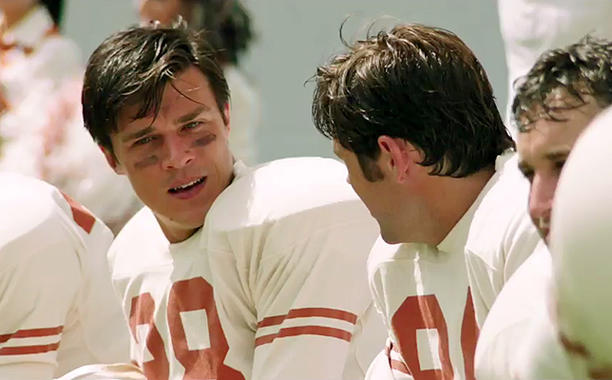
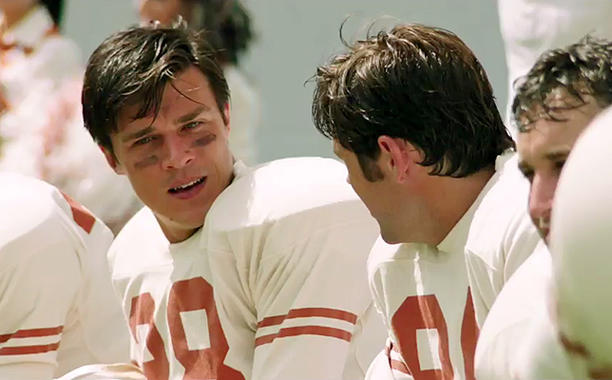
If I wrote this review the way writer-director Angelo Pizzo wrote the script for “My All American,” it would be something like this: I saw a movie. It was about football. Freddie Steinmark worked hard and inspired his team, but then got sick. It was sad.
Copyright 2015 Clarius Entertainment

Pizzo wrote two of the best sports films of all time, “Rudy” and “Hoosiers,” but here, in another real-life sports story, he has decided that the audience needs a kind of running commentary from every character to explain — instead of show — the audience what is going on. In an early scene, Steinmark’s mother (Robin Tunney) tells him that because he is smaller than his friends, he will have to work harder. Later, other characters tell us repeatedly what we should be able to see: that he works harder than everyone else, that he is religious, even that he is handsome. This is a movie where a coach actually says that Steinmark has courage and guts. The dialogue is so exposition-heavy that it is like sawing lumber.

It is good to see a biopic that does not rely on the usual scenes of the girlfriend complaining that the lead character does not spend enough time with her. But Steinmark is portrayed as such an all-around saint that he is bland, without any character beyond niceness and determination. All of the characterizations are paper-thin. It is as though everyone on the screen is just another color commentator, not a character.

Steinmark (Finn Wittrock of “The Big Short”) is the son of hard-working Catholics. His father has two jobs, security guard by day, cop at night, but is so dedicated to his son’s athletics that he never misses a practice or a game. When a teammate suggests that perhaps Steinmark’s father is living his own dreams of an athletic career through his son, Freddie says no and the subject never comes up again. Freddie wants to play for Notre Dame and then the Chicago Bears. But college coaches think he is too small — except for Darrell Royal (Aaron Eckhart) at the University of Texas, who recruits Steinmark and his best friend. Steinmark’s devoted girlfriend, Linda (Sarah Bolger, one of the adorable Irish girls from “In America”), is accepted to UT as well.

Steinmark is so remarkable (as everyone keeps telling us and telling us and telling us) that he is made first-string in his sophomore year. He leads the defense so successfully that the championship is within reach. And then he begins to have a problem with his leg.

There are very clumsy attempts to do what “Rudy” and “Hoosiers” did in creating a sense of time and place. Here, the references to the war in Vietnam (and the protests), the moon landing, long hair, and 60’s songs are jarring and haphazard. The absence of any person of color may be authentic as regards the team, but on the campus? In the hospital? It is so strange that it becomes a distraction. The framing story of an interview decades later with Royal adds nothing. The football scenes are capably staged, but do not move the story forward.

There are references to Steinmark’s faith — he goes to mass every day and we see him pray and encourage his friend to pray. But we never get a sense of what the faith means to him or how it helps him understand his illness. There is more drama and more character in a throwaway scene involving another player who loses his position than there is in the portrayal of Steinmark’s story.

And there is only the slightest reference to one of the most interesting parts of the story; the lack of treatment options for someone with cancer in 1969. Steinmark’s diagnosis came just before the United States made its first major commitment to a “war on cancer,” with federal funds being used for research. This is the kind of context that could have provided the story with the impact it fails to muster.

Parents should know that there is brief strong language and a brief view of a bare tush, as well as discussions of serious illness and a sad death.

Family discussion: Were you surprised by Bill’s reaction to being replaced? What was it about Steinmark that made him so important to his coach?

If you like this, try: “Rudy,” “Hoosiers,” and “The Express”
Related Tags:


Based on a true story Illness, Medicine, and Health Care Sports
Spotlight

Spotlight

Posted on November 12, 2015 at 5:30 pm

“Spotlight” is about the ultimate betrayal of trust from an institution that literally represented the Word of God to many people. And it is about whether we will continue to have institutions that serve the essential function of monitoring the gap between aspiration and actuality, between what people say they are and do and the reality.

Copyright Open Road Films 2015

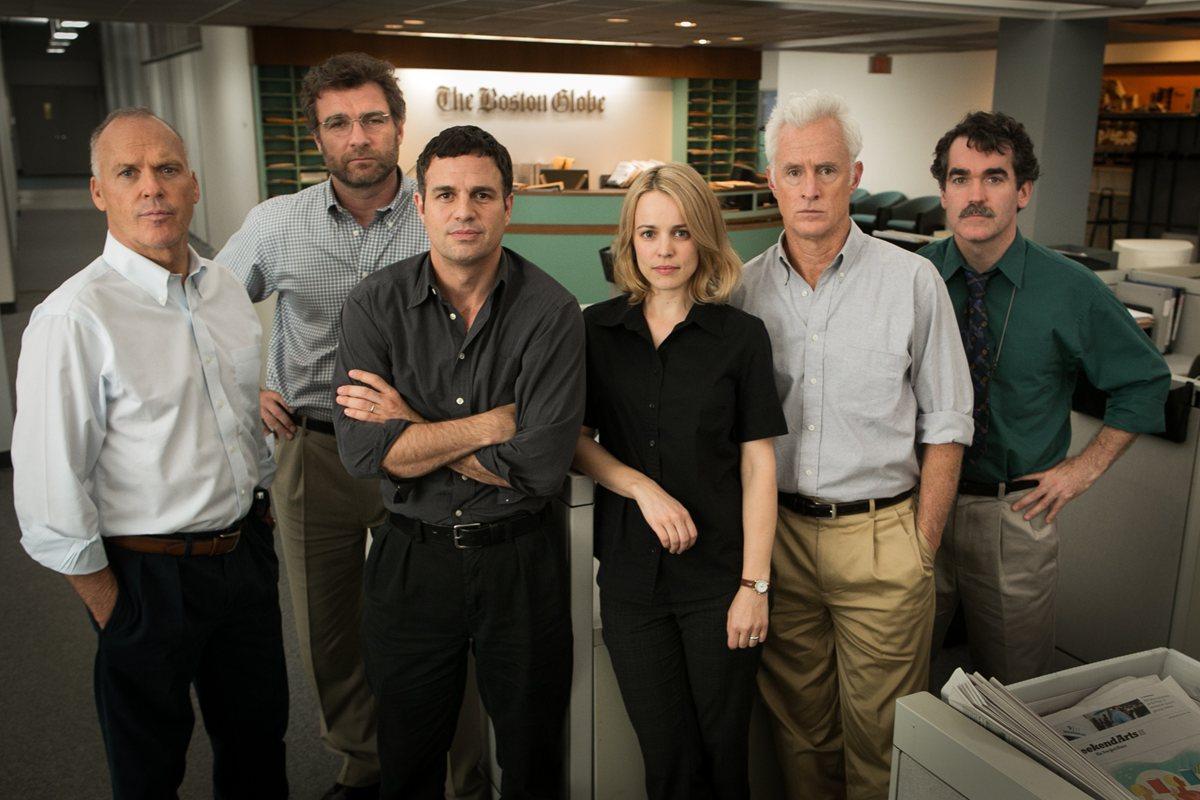
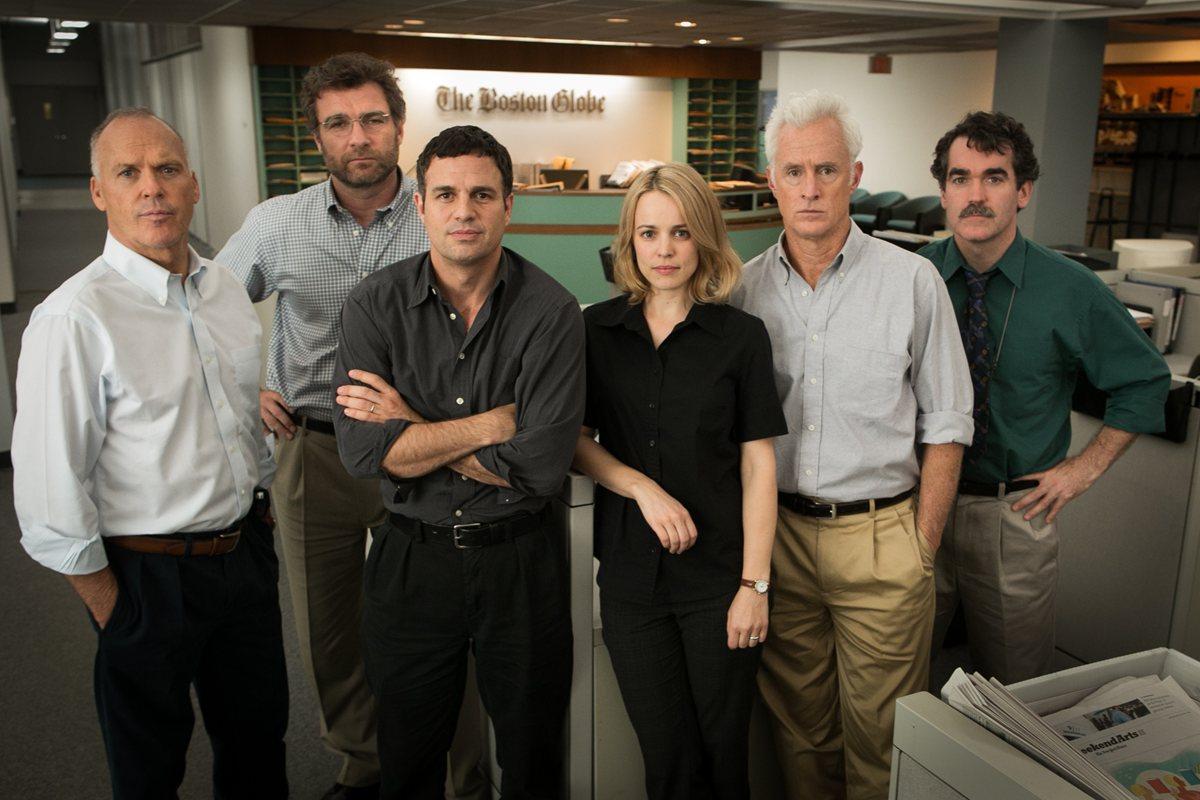
Spotlight is the name for the investigative group of journalists working for the Boston Globe. While their colleagues reported on stories that could be reported and written in days, the Spotlight group had the luxury and the responsibility of taking as much as a year to do the kind of in-depth original research necessary for more complex and difficult subjects.

The staff at Spotlight was let by Walter “Robby” Robinson (Michael Keaton) and included Mike Rezendes (Mark Ruffalo), Sacha Pfeiffer (Rachel McAdams), and Matt Carroll (Brian d’Arcy James).

Like most of the members of the Globe staff they were Boston born and bred, Red Sox fans to the end, and raised Catholic. They had just finished work on a long-term piece when their new editor arrived. He was not Boston born and bred, not a Sox fan, and not Catholic. And perhaps most important, he was not a Boston Globe lifer. He was Marty Baron (Liev Schreiber), most recently from Miami. He was an outsider in every way and they correctly suspected that the Globe was just a stop on his career trajectory. (He is now at the Washington Post.) They were not inclined to follow his idea of what stories they should cover.

But when he asked them about following up on a story about a priest who abused young boys, they could not come up with a reason not to other than it was too awful to imagine that it might be true. They begin to investigate. It turns out it was not one priest. It is a city-wide problem. A priest abuses children, is put on “medical leave” and transferred. The families of the boys are paid off and silenced. Then it happens again.

Director Tom McCarthy (“The Station Agent,” “Win Win”), writing with Josh Singer, really captures the culture of a newsroom, the stale coffee, the stale-er jokes, but the passionate curiosity that drives them all. This film will be compared to “All the President’s Men” because they are both true stories about young reporters getting huge stories everyone else missed. But the more important comparison is the way both movies capture the numbing work that goes into reporting. The doors knocked on. The doors slammed. And in this case, the nine years worth of diocese phone directories gone over, line by line (this was one of the last of the eras of off-line, analog document searches) to follow the “medical leave” priests took weeks of meticulous checking. It shows us reporting on the cusp of monumental technological change as well, when the paper makes the then-innovative decision to make the underlying documents available to readers online.

The reporters face enormous obstacles, starting with overcoming their own assumptions and then the powerful people who try to stop them. The church is an overwhelming force, politically and culturally. Do readers really want to know? Will the paper lose subscribers and advertisers?

There is no betrayal more devastating than to have the most trusted of institutions, the one most intimately involved in family joys and sorrows to be countenancing the abuse of those most deserving of its protection. But by the end of the film, that atrocity, already known to us, is not as troubling as the idea that news organizations may not be able to bring us the next one.

Parents should know that the theme of the movie is the investigation of widespread child sexual abuse and its cover-up, with sexual references, some graphic, and some strong language.

Family discussion: How did the arrival of an outsider affect the decision to do this story? Do today’s newspapers have the resources and support they need to do in-depth investigations like this one?

If you like this, try: “All the President’s Men” and “Truth” and the documentaries “Deliver Us from Evil” and “Twist of Faith”

Related Tags:


Based on a true story Drama Journalism

For Veteran’s Day: The Way We Get By

Posted on November 11, 2015 at 8:00 am

Director Aron Gaudet is the son of a “greeter,” one of the volunteers in Maine who make sure that every soldier coming through the airport gets a warm showing of appreciation. He told me, “We started seeing these parallels, too, all of these people going off to war are concerned about mortality and so are the older people who are greeting them.” This is a lovely film, and very appropriate for Veteran’s Day.

Related Tags:


Documentary Holidays War
Lost Preston Sturges Film: Hotel Haywire

Lost Preston Sturges Film: Hotel Haywire

Posted on November 10, 2015 at 3:17 pm

Copyright 1937 Paramount Pictures

A column by Michael Hiltzik in the LA Times about 700 “lost” Paramount films caught my attention. The first paragraph mentioned one of my favorite movies, “Alias Nick Beal,” with Ray Milland as Satan bargaining for the soul of a politician played by “Gone With the Wind’s” Thomas Mitchell. And then it mentioned a film I’d never heard of, written by one of my all-time favorite screenwriters (and later a director as well), Preston Sturges, a master of wisecracking screwball comedy (“The Lady Eve,” “Sullivan’s Travels,” “The Miracle of Morgan’s Creek”).

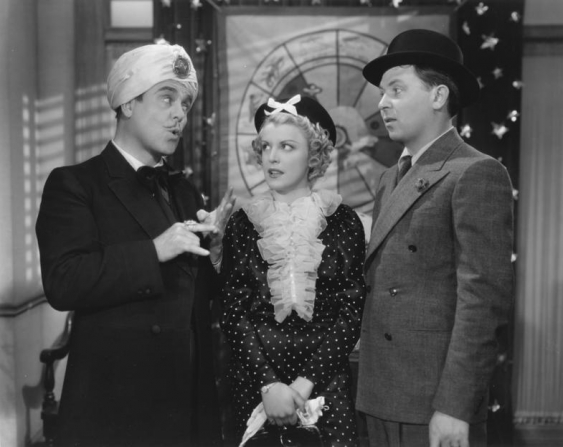
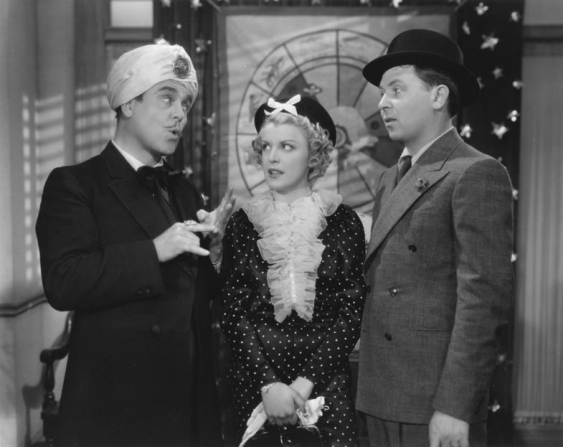
The film is “Hotel Haywire,” originally written for Burns and Allen, and then rewritten when they were not available. It was directed by Arthur Archainbaud, apparently his only credited film.

Copyright 1937 Paramount Pictures

Fortunately, I live just outside of Washington, DC, which means that the Library of Congress is practically my neighborhood library. I love their Motion Picture and Television Reading Room, which has the nicest and most knowledgeable staff any movie lover could ever hope for. They have been inestimably helpful to me many times. It took them about ten minutes to track down the film at their Culpepper, Virginia storage facility and arrange for it to be brought in for me to watch.

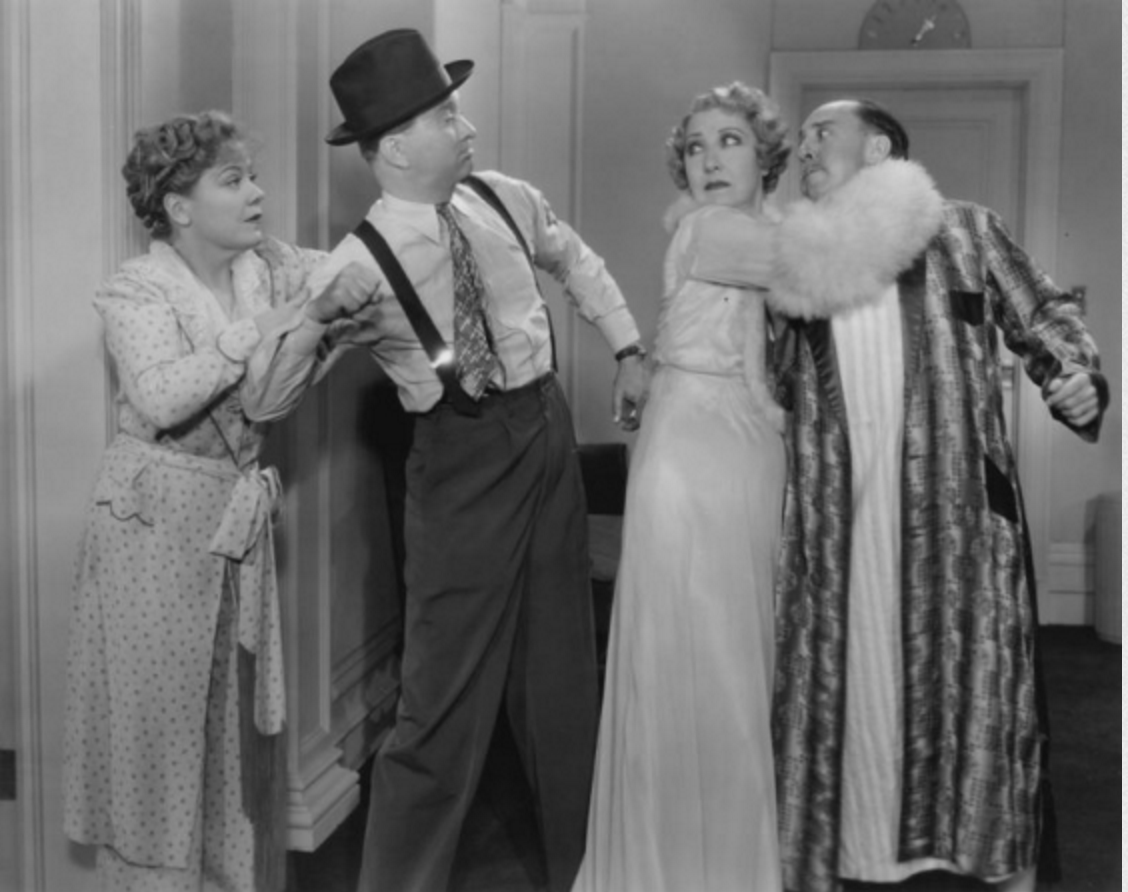
It’s not a classic, but it was a lot of fun, partly because it was a rare lead role for Spring Byington, who usually played the mother of the main character (“Little Women”).  In this, she plays the wife of a dentist (Lynne Overman) who is very caught up in spiritualism and horoscopes, as practiced by a charleton known as Dr. Zodiac Z. Zippe (Leo Carrillo). The dentist plays a prank on a friend by slipping a frilly camisole into his pocket, but the friend outsmarts him and puts it in the dentist’s pocket instead. When the wife finds it, instead of asking him about it she consults Dr. Zippe, who ends up advising both husband and wife in a manner that creates as much chaos as possible, especially after he hires some out-of-work vaudevillians as his “detectives.” Oh, and there’s also the dentist’s daughter, who wants to marry her boss’ son. And it all ends up in some door-slamming, who’s in what room shenanigans in a haywire hotel.

I hope this film, and the other 699 Hiltzik wrote about, will all be available soon, via streaming or DVD. Until then, we have the Library of Congress, and I will try them on another lost gem soon.

Related Tags:


Comedy Film History Neglected gem

This Year’s Best New Show: Crazy Ex-Girlfriend

Posted on November 9, 2015 at 3:23 pm

The only new show to make it to my DVR series list is “Crazy Ex-Girlfriend,” co-created by its sensationally talented star, Rachel Bloom. Each episode is a full-on original musical that takes place mostly inside the head of its slightly demented heroine, Rebecca, a Harvard and Yale-educated lawyer who walked away from her type-A career in a New York City law firm to move to West Covina, California, where her boyfriend from summer camp lives.

https://www.youtube.com/watch?v=-ctFmXGm_yE

It has a tremendous cast of singers and dancers, most with Broadway experience, including Donna Lynne Champlin, who plays Rebecca’s new friend, Paula, Santino Fontana (from the Broadway “Cinderella”) as a bartender who for some reason he cannot understand is drawn to Rebecca, and Vincent Rodriguez III as Josh, the object of Rebecca’s obsessional affection.

My favorite musical number so far is NSFW, the very funny “Sexy Getting Ready Song.” Here’s my runner-up, Rebecca’s boy band fantasy song, performed by four Joshes.

https://www.youtube.com/watch?v=4C5fHfG_ptE

And here’s an Astaire-and-Rogers themed song with Fontana.

The songs are by Fountains of Wayne’s Adam Schlesinger, who created the pitch perfect title number for “That Thing You Do” and the songs for the Drew Barrymore/Hugh Grant film “Words and Music.” They are funny and smart and earwormy in the nicest possible way. It’s on the CW Monday nights at 8/7 central and you can catch up on the previous episodes on Hulu.

Related Tags:


After the kids go to bed Comedy Television
THE MOVIE MOM® is a registered trademark of Nell Minow. Use of the mark without express consent from Nell Minow constitutes trademark infringement and unfair competition in violation of federal and state laws. All material © Nell Minow 1995-2026, all rights reserved, and no use or republication is permitted without explicit permission. This site hosts Nell Minow’s Movie Mom® archive, with material that originally appeared on Yahoo! Movies, Beliefnet, and other sources. Much of her new material can be found at Rogerebert.com, Huffington Post, and WheretoWatch. Her books include The Movie Mom’s Guide to Family Movies and 101 Must-See Movie Moments, and she can be heard each week on radio stations across the country.

Website Designed by Max LaZebnik