Spectre

Spectre

Posted on November 5, 2015 at 5:52 pm

B+
Lowest Recommended Age: High School
MPAA Rating: Rated PG-13 for intense sequences of action and violence, some disturbing images, sensuality and languag
Profanity: Some strong language
Alcohol/ Drugs: Drinking
Violence/ Scariness: Spy-style action violence with chases, shootouts, and explosions, characters injured and killed, torture, suicide
Diversity Issues: None
Date Released to Theaters: November 6, 2015
Date Released to DVD: February 8, 2016
Amazon.com ASIN: B018WXLFSM

Copyright MGM 2015
Copyright MGM 2015
I thought “Skyfall” was the best Bond film ever, from the Adele theme song to the storyline that literally brought Bond (Daniel Craig) home. “Spectre” picks up where “Skyfall” left off, M (Dame Judi Dench) dead, the headquarters destroyed, the future of the double-O program in jeopardy. If this chapter, reportedly Craig’s last as Bond, is not up to the “Skyfall” level, it is still a solid entry in this series, more than half a century since the elegantly attired agent with a license to kill first appeared on screen.

The opening scene is brilliantly staged by returning director Sam Mendes. It takes place in Mexico City, in the midst of the Day of the Dead celebration and parade. Skeletons and signifiers of mortality are everywhere. An masked man with a man bun (so he must be a bad guy) passes by. Another masked man seems to be paying attention only to the beautiful woman he is escorting, but we can tell by the elegantly tailored suit that this must be Bond and therefore he is paying attention to everything. Sure enough soon he is spying, shooting, and chasing in one bravura shot that takes him through the crowd and the parade and into a fight inside a swooping helicopter.

Great beginning! And then we go into the credit sequence, which is pretentious and silly, with a sub-par song from Sam Smith. Ah, well.

It continues along those lines, with some set pieces that are exactly what we want from a Bond film, but other elements that show the uneasy bridge the Broccoli family, which controls the franchise, is trying to develop between the late 20th century Bond (Grace Jones! Space! Denise Richards as a nuclear physicist named Christmas! Infomercial level product placement!) and the grittier, more down-to-earth geopolitics of the 21st century, whether on screen (the Bourne series) or in the news (9/11). The film raises the question both in its storyline and in its presentation about whether the era of the shaken-not-stirred martini drinker who never carries a suitcase but always seems to have a dinner jacket on hand is over.

The dinner jacket, the beautiful women who find Bond irresistible, the martini, the cool car, the exotic locations, and the guns and gadgets are all there. A nice twist is that the car was designed for another agent, so Bond has no idea what the various buttons do. And the new gadget actually assigned to him is below the technology level of Maxwell Smart’s shoe phone. The gadgets that matter here are lines of code, and in this movie they serve as the MacGuffin as well. All of that works, though there were some snickers in the crowd during a brief pause in the action where Bond and the new Bond Girl (Lea Seydoux) get all dressed up for dinner on a train. The cinematography by Hoyte Van Hoytema finds a nice consistency through all of the globe-hopping ports of call, with lots of white space around our increasingly isolated hero. Craig, as he has done in all of his Bond films, gives a performance of depth as well as charm. He faces some choices with moral complexity, especially when he meets with a former adversary, and it is intriguing to see how he thinks them through. The somber tone is Bourne-ish, but the storyline teeters too close to recent stories like the last “Mission Impossible” and even “Captain America: Winter Soldier.” The final resolution exemplifies what is best and worst about the film, taking the “Skyfall” revelations about his past further, but going completely overboard with a brilliant villainous strategist who puts way too much time into an elaborate trap. And an otherwise sensible Bond girl who picks a very bad moment to discuss the relationship.

“Bond will return,” we are reassured once again at the end of the film. And by then we’re already looking forward to the next reboot.

Parents should know that this film has extended and graphic scenes of action-style spy violence with many crashes, explosions, chases and shootouts. There is a suicide and and some torture, with characters injured and killed, as well as some strong language, some sexual references and situations, and alcohol.

Family discussion: Who should decide what information is available to government agencies? How did childhood trauma affect three of the main characters?

If you like this, try: “Skyfall” and some of the Sean Connery and Pierce Brosnan Bond films

Related Tags:


Action/Adventure DVD/Blu-Ray Pick of the Week Series/Sequel Spies
The Peanuts Movie

The Peanuts Movie

Posted on November 5, 2015 at 5:26 pm

B
Lowest Recommended Age: Kindergarten - 3rd Grade
MPAA Rating: G
Profanity: None
Alcohol/ Drugs: None
Violence/ Scariness: Some tense scenes of anxiety, hurt feelings, and shyness, some mild action scenes and peril (Snoopy’s flying ace battles)
Diversity Issues: None
Date Released to Theaters: November 6, 2015
Date Released to DVD: February 29, 2016
Amazon.com ASIN: B018WXLHVM

I admit that I approached this film with some of the same trepidation Charlie Brown approaches the football, knowing Lucy’s history of pulling it out of the way at the last second. I’m a fan of Charles Schultz’s original comic strip and fond of many of the animated specials and features that were careful to preserve the simplicity of his aesthetic. I was concerned that a more fully-animated version (in 3D!) would drown out the gentle storylines. But Schulz’s family has been careful to preserve his legacy. The script is co-written by his son and grandson and is timed to appear on the 65th anniversary of the strip and the 50th anniversary of the classic “Charlie Brown Christmas” special. And Blue Sky (which made the “Ice Age” and “Rio” movies) understands the material and its audiences — the older generations who are attached to the original version and today’s children, who are new to these characters.

The brightly colored, rounded figures were easier to get used to than I feared. The iconic details — Charlie Brown’s yellow shirt with the brown zigzag (it turns out he has a whole closetful) and wisps of hair are familiarly iconic. It’s not a period piece but there is a timeless quality. Phones are corded landlines. We never see a laptop and no one ever checks Google or GPS. Indeed, one of the most important items in the story is a pencil. It has glitter and a feather decorating it, but it also has the teeth marks of its sometimes nervous owner, and that is something you won’t find on a smartphone.

The movie does not commit any serious blunders. There are pleasant moments and welcome echoes of the past, but it does not justify its existence by adding anything of value to the canon already available. The first and best of the television specials, A Charlie Brown Christmas, is less than half an hour long, but it has more wit, charm, poignancy, than this feature film, and it includes one of the most beautiful holiday songs ever written, the piercingly bittersweet Christmastime is Here. In almost two hours, this film has time for just a snippet, to make room for inferior contemporary pop songs. A joke about “merch” seems ill-advised given the strip’s history of selling its characters for everything from insurance to toothbrushes.
The film begins promisingly, with Schroder playing the studio’s theme music on his piano and an immersive soft, gentle snowfall. It’s the most joyous day of the year — a snow day — and we meet the characters as they wake up and choose the winter activities they most enjoy. Charlie Brown decides it is a good time for him to try the kite again, figuring that the “kite-eating tree” will be out of commission in winter. It does not go well. Once school is back in session, a new student arrives, a girl with red hair, and Charlie Brown is smitten — and terrified. How can he impress her?

The Schulzes are true to the spirit of the original. We squirm with Charlie Brown as he agonizes over his insecurity, especially when he is faced with a dilemma at the school talent show and when he is awarded an honor it turns out he did not deserve. The sections with Snoopy’s Red Baron fantasy are of less interest and appeal and the 3D effects and the talents of top-tier musical stars (Trombone Shorty playing the “waa waas” for the adult voices and Kristen Chenoweth as Snoopy’s daring aviatrix love interest) are underused. The best use of this film is as an introduction to the classic television specials — and the original comic strips that inspired them.

Parents should know that this film includes some tense scenes of anxiety, hurt feelings, and shyness, and some mild action scenes and peril (Snoopy’s flying ace battles).

Family discussion: Which character is most like your friends? Which would you most want to be like? Why don’t we hear the grown-up voices?

If you like this, try: The Peanuts comic strip collections and the television specials.

Related Tags:


3D Animation Comic book/Comic Strip/Graphic Novel DVD/Blu-Ray Pick of the Week School Stories About Kids
Miss You Already

Miss You Already

Posted on November 5, 2015 at 5:22 pm

B
Lowest Recommended Age: Mature High Schooler
Profanity: Very strong and crude language
Alcohol/ Drugs: Drinking, drug references
Violence/ Scariness: Serious illness, sad death, some graphic and disturbing images
Diversity Issues: None
Date Released to Theaters: November 6, 2015

Copyright Lionsgate 2015
Friendship has the best aspects of romantic love and the best of family love, and the worst of both as well. Your friends as are close to you as anyone in the world, which means you can rely on them and they can rely on you, whether it’s telling you if your butt looks too fat in those jeans or you need someone to come pick you up because a date has gone horribly wrong. And it means that they can hurt you terribly, because they mean so much to you and because you trust them and because they know you so well.

And yet, while there are hundreds of thousands of movies about love and family, there are not very many great movies about friendship. “Miss You Already,” from director Catherine Hardwicke, is a worthy attempt, the story of two women who were friends since childhood, and whose friendship is nearly destroyed by the complications of grown-up life. Though it appears only once in the film, the title refers to a catchphrase the two women use to say goodbye, making fun of themselves for being so deeply in one another’s lives, but really meaning it, too.

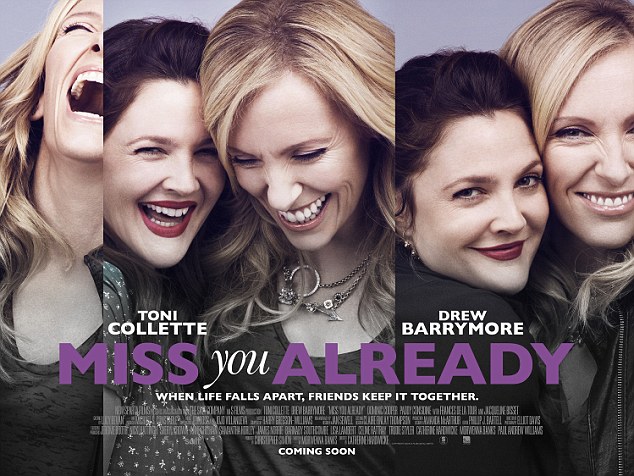
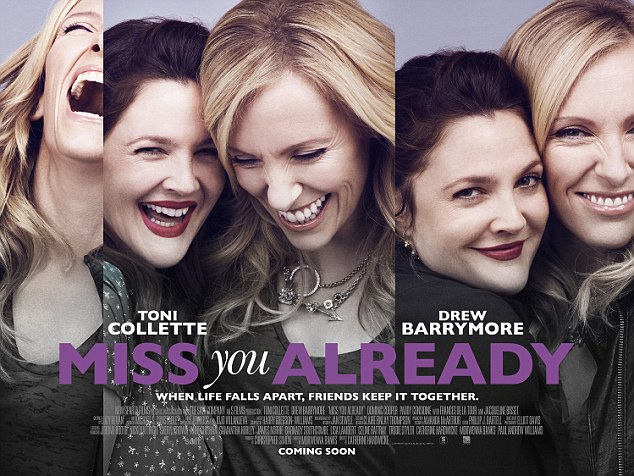
Drew Barrymore plays Jess, an American living in England and the more serious and responsible of the pair. Toni Collette is Milly, the wild party girl who improbably is living happily ever after with Kit (Dominic Cooper), the roadie who got her pregnant and then married her, started a successful business, and turned out to be a wonderful husband and father. They have darling children, a beautiful home, and satisfying careers and they are still mad for each other. Jess is happily married to Jago (Paddy Considine), though they do not have any money and are struggling with fertility problems. But they live on an adorable houseboat. It is one of the movie’s wisest choices that the husbands are not complaining (most of the time) or complained about. They are full partners to their wives and full partners in supporting the friendship.

Milly has always lived lightly, skimming along the top of life, still a party girl at heart. She loves her husband, children, and Jess, but she is admittedly superficial and vain. And then she gets a cancer diagnosis. Jess is happy to live up to the assigned tasks of “bringing treats and not being annoying” to help Milly through chemotherapy. And wig shopping (with the wonderful Frances de la Tour). And changing dressings. But she believes that Milly’s illness is so all-consuming that she cannot share what is going on in her life. And then Milly does something that creates the first serious breach in their relationship.

Yes, we’re in “Beaches” territory, so get out your handkerchiefs. Drew and Collette make a touching screen team, and Jacqueline Bisset, almost unrecognizable with platinum blonde hair, is a welcome antidote to over-sentimentality as Milly’s self-absorbed mother, a moderately successful actress. Hardwicke, who began her career as a production designer, has a superb eye and a great gift for using the settings to tell the story. If she cannot avoid the usual touchstones of women’s friendship movies (singing along to a favorite pop song), at least she changes it up a little — REM in a taxi instead of the usual Motown into a hairbrush. “Miss You Already” will make you want to call a friend you miss, and then bring her along to see it again.

Parents should know that this film includes very strong language, sexual references and situations, serious illness with some graphic images, a very sad death, a childbirth scene, alcohol and drug references.

Family discussion: What makes a great friendship? Ask family members about their most important friendships, how they met and their favorite moments.

If you like this, try: “50/50” and “Beaches”

Related Tags:


Drama Illness, Medicine, and Health Care Movies -- format

#Playlikeahero with GoldieBlox

Posted on November 5, 2015 at 8:00 am

From Goldieblox:

What if all the action heroes who saved the world, day in and day out… were girls?

Only 12% of protagonists in major Hollywood films are female. Even in the background, in crowded wide shots, women only make up about 17% of those shown in live action and animated movies. Among the highest grossing G-rated films of all time, female characters are outnumbered by male characters by three to one.

Move behind the camera and the numbers are sadly similar: in 2014, only 15% of films had female directors, 20% had female writers, and a mere 8% had female cinematographers.

50% of the population is female.

This is a problem.

We’re not here to produce the next blockbuster; we’re here to provide a role model in play. When the girls in your life pick up Ruby Rails, we want them to know that they can be a high-flying, fashion-loving programming extraordinaire too. We want them to feel like they can be a boxer, a secret agent, a dinosaur wrangler, or a fighter pilot.

Our girls deserve action heroes with flowing hair and combat boots. Our girls deserve to see themselves on-screen and calling the shots behind the scenes. Our girls deserve more.

Related Tags:


Elementary School Gender and Diversity Race and Diversity
Interview: “Chaplains” Director Martin Doblmeier

Interview: “Chaplains” Director Martin Doblmeier

Posted on November 3, 2015 at 11:15 pm

US Army Chaplain Paul Hurley, a Catholic priest, says mass for the troops at a Military base in Kabul, Afghanistan. Photo courtesy of Journey Films
Martin Doblmeier has made more than thirty movies about faith. The latest from his Journey Films is “Chaplains,” showing this month on PBS. It is a profound and moving documentary about chaplains of many different faiths in a variety of settings: war, business, an assisted living facility, prison, the US Senate, NASCAR, and a children’s hospital. It was George Washington himself who first asked for chaplains in the US military. The movie covers Army chaplains representing centuries of tradition as well as chaplains in new and developing roles. In an interview, Doblmeier talked about how the film came about and what chaplains bring to people literally dealing with life and death.

“We have been around this world now for about 30 years making films and I know a lot of chaplains. And I realized that there had not been any kind of significant film that talked about the work that they do. And they work so quietly, under the radar most of the times. And I just felt maybe we could do something that helps to raise the profile and bring some attention to who these people are and the great work that they do. So once we started to dig into it and we realized that it was something that was becoming more common across faith traditions. There certainly had been chaplains dating back to the fourth century. St. Martin of Tours was the one who actually begun what has now become the idea of chaplaincy and it’s been going on now quietly mostly in the military or in a hospital setting but over the last couple of generations has expanded now into the prisons. Even the corporate world is looking at it as an interesting model, that’s why we put Tyson’s in there. We had known about Tysons for many years actually. I keep notes in piles. The foundations liked this idea because it had something of positive value. And with their support we were able to get it up and get it going. For me I think it’s a really interesting storyline about people who want to live out a faith tradition in the 21st century in their particular place. And what a wonderful model for how not just to tolerate the faith tradition of others but actually to honor it, and engage with it and to see it as a way to sort of forming a sense of meaning in our lives.”

Congregational clergy spend almost all of their time with people who share their faith traditions and culture, but chaplains work with people who of all faiths and of no faith. “In a congregation really pretty much the language is common, the rituals are common, the practice is common, and people generally understand that the pyramid of structure is with the pastor or the Imam or the Rabbi being the person in charge of the spiritual growth of that particular community. It’s a totally different paradigm in chaplaincy, most often because they are working in secular settings, they don’t really have a place that you would consider to be a power position in those settings and so they are negotiating every day not only with the institution but how to deal with the individual that they come across. And it’s a very different way of being present in those kinds of environment than it would be in a congregation. I think it’s a wonderful model but it presents its own challenges. One of the things we wanted to bring out in the film is that you’re working in a spiritual realm, that it is very difficult, nearly impossible to somehow document the impact that the chaplain would have in a hospital setting or in a prison setting.” Because they are in secular settings, they constantly need to find ways to demonstrate their value in terms that the people responsible for those settings can understand. “There are implicit success points that you can look at but at the same time in institutions that are under a lot of pressure for accountability and quantifiable data to be able to say this person is actually contributing a lot to our overall mission here in the secular settings is a challenge. Chaplains don’t often have that kind of data. So there is a constant stance of — ‘Will I still have this job? Will I still be able to continue to perform this work after the next review happens?’ I had a real sense of admiration for them, the commitment that they have despite the fact that in many cases the roles that they play in the hospitals or in the prison settings are always being evaluated and reevaluated.”

The movie shows that the work of the chaplains often extends past the boundaries of the community they are serving. “For example in the police department my assumption was the police chaplains would be meeting with perpetrators or prisoners or people who have been arrested or incarcerated for whatever reason. In fact, more often than not the police chaplains were mostly ministering to the police department. And I find that to be the case in a lot of different ways. So in hospital settings the hospital chaplains often ministered to the patients and the patient’s families, the people involved but they also minister a lot and provides support, emotional support, spiritual support to the staff, to the doctors and the nurses. So they do provide this sort of wider setting of what’s going on and I think we tried to show that in each one of the different segments because I think there can be a lot of misunderstanding to what their role is but they continue to sort of be present and available to those people who need them, very different to the settings in the military.”

Copyright 2015 Journey Films
The chaplains in the films are less concerned with rituals and theology than being present in the lives of people who are struggling by showing their faith through compassion and understanding. They are not proselytizing or doing missionary work. “It was nice to be able to put some of the voices in of the soldiers were very young who said that they appreciated the chaplains even though sometimes they are not believers. The chaplains fulfill this unique role because if someone is having a lot of emotional issues in the military about what was happening they would feel more comfortable going to a chaplain because it is not documented in the same way as if you go to the military psychiatrist to speak to somebody about that. So there are a lot of nuances that creates this real need to be able to have chaplains available.”

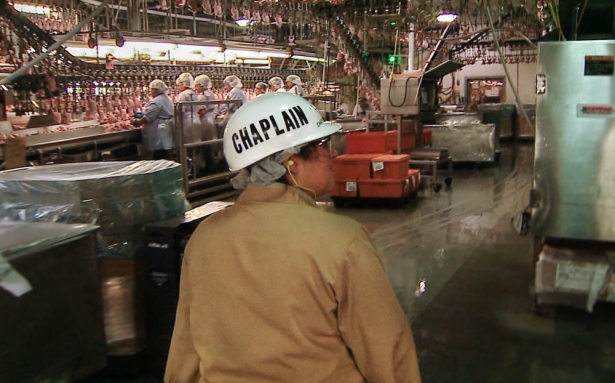
Perhaps the most unexpected setting in the film is Tyson’s Food. Doblmeier says that the success of this program, particularly in providing support for employees from a wide variety of ethnic and cultural backgrounds. “There are companies now that are providing chaplain services like you provide independent IT services. Corporations that have evangelical leadership feel as though it is important for them to be able to have access to chaplaincy. So that they can literally hire in through an agency chaplains to come in and serve their people. We wanted to do it because Tysons Foods is huge publicly traded company and it has not just a handful of chaplains to come in and sort of maybe address some of the spiritual needs. It has 120 full and part-time chaplains and has had them now for you while. So this is a genuine commitment on the part of this corporation. John Tyson is not an evangelical; he is an Episcopalian. He just feels as though this is a good thing for a company. And this is a publicly traded company which comes under a lot of scrutiny; all the dollars that are spent are scrutinized because there is shareholder and stakeholder interest but he still believes that the bottom line is best served by having a team of chaplains there.”

Doblmeier says that what chaplains can do is help people facing challenges like loss, risk, and illness with “a sense of meaning and purpose in their lives. And the role of the chaplain is again not to give them their own meaning and infuse them with the notion of their own spirituality and sacredness but to help the individual tap into innately what they believe is the source and meaning of life. That’s the kind of support that the person is really coming up for. Sometimes there is such a close link between the individual and the chaplain that the individual may start to choose openly, freely the spiritual path of a chaplain and that’s quite okay but a good chaplain doesn’t seek to bring that person into a fold, they seek to have that person find what’s going to really be substantive meaning in their own life. And sometimes it’s very brief. These hospital settings can be just a matter of days and so the skill you have to have is to have the ability to get a quick spiritual assessment. In other cases its long-term, that chaplain is in the prison setting is trying to help somebody who may never get out of that 5 x 8 prison cell that they live in. How do you find purpose and meaning in your life then? They are really to be present to the person to help that person discover or in some cases rediscover what gives them a sense of purpose after a loss, spiritual or emotional loss and then help them get them back on track.”

Related Tags:


Directors Documentary Interview Television
THE MOVIE MOM® is a registered trademark of Nell Minow. Use of the mark without express consent from Nell Minow constitutes trademark infringement and unfair competition in violation of federal and state laws. All material © Nell Minow 1995-2026, all rights reserved, and no use or republication is permitted without explicit permission. This site hosts Nell Minow’s Movie Mom® archive, with material that originally appeared on Yahoo! Movies, Beliefnet, and other sources. Much of her new material can be found at Rogerebert.com, Huffington Post, and WheretoWatch. Her books include The Movie Mom’s Guide to Family Movies and 101 Must-See Movie Moments, and she can be heard each week on radio stations across the country.

Website Designed by Max LaZebnik