Interview: David and Christi Eaton of “Hope Bridge”

Interview: David and Christi Eaton of “Hope Bridge”

Posted on June 29, 2015 at 3:02 pm

Copyright 2015 PureFlix
David and Christi Eaton wanted to help families devastated by suicide and those who struggle with thoughts of suicide. And so they wrote “Hope Bridge.” I spoke with them about how a busy couple with six children who had never written a movie before were inspired to create this film. “Once directly in our family and then once with some very close friends who lost their 20 year old son, we experienced suicide and felt like we really needed to do something about the issue. Because one of the things we noticed is, if somebody dies of a heart attack, cancer or something you know people come in droves. They come, they bring food, they talk. But when you lose someone by suicide you know people don’t know what to say. So they just avoid you altogether because they just don’t know what to say,” David said. “We really felt like we needed to do something about it. We didn’t know what we were going to do and then God kind of put on our hearts that a movie was really the way to do this. Because media is such a large platform. The problem is we barely went to movies. It’s really not a part of our repertoire. So you now so being called to make a movie was actually kind of a funny joke that God seemed to be playing on us. Ok how in the world do we do this?”

Christi added, “It helped us realize that that is what God was wanting us to do. Something that was along His line of work and not ours.” Five of their children were teenagers at the time and both David and Christi had demanding jobs. They had no time and no experience. But they were determined to do it. David continued: “So we started writing a script, and of course what do you do when you don’t know how to write a script? You go on the internet because everything is true on the internet. So we go on the internet and we discover the framework of how to write a script and within eight weeks we had our first script written. We wrote at night, on the weekends, we would go for a walk, whatever it took. The kids would walk by the dining room and be like, ‘What are you guys doing?’ and we’d say, ‘We’re writing a movie.” They just rolled their eyes and started laughing hysterically. Like ‘Yeah, good one.’ But we wrote a script and got done with that and it was another one of those ‘Ok ,now what? Now what do we do?'”

Christi explained what happened next. “With every step that we took, it just seemed like doors kept opening. God would say, ‘OK, well you’ve been obedient, so now we’re at the threshold of another door, and I’m going to show you this door, and you’re going to walk through it’ and we did. It just seems as if it all rolled out, but none of this would have happened unless we were living Romans 8:28, which is ‘All things work for good.’ Sometimes those things that work for good start out really bad but if we know that God’s got a purpose in this, we walk by faith in that. We walk the walk and talk the talk that God will use it for good and we are definitely proof of that.” It was going to cost half a million dollars to make the film, which seemed impossible, but they found many people eager to help support the film.

What was important to them was helping families start the difficult conversations about suicide. “People are starving for it they want to talk about it and we’re giving them a reason to,” David said. They were inspired by Betty Ford’s openness about addiction and the way it inspired more information and support by making addiction less shameful. They want this film to be a part of the same kind of openness about mental illness. “The brain is just another organ in the body,” David continued. “If someone died by heart attack it is very sudden, but it’s something we understand. When have an issue with the brain sometimes people are a little more apprehensive to talk about it. You don’t just go, ‘Well there is something wrong here so I’m going to go to the doctor.’ But that’s how it needs to be.” Christi talked about the problem of reducing the stigma and misunderstandings about suicide. “I suspect suicide is attributed to bullying or a past relationship gone bad or even that some people think suicide is a contagion. Everybody just sweeps everything under the rug and nobody talks about it when ultimately there is always a deeper-rooted issue and most of the time it is a mental illness. It is a disease of the mind. And nothing has been glamorized. Everything has been realistic. The emotions that you see in the movie are realistic. It is not a documentary of course it is a drama. However we wanted to make sure that we were steering people towards the right avenue of finding healing and finding hope whether they have been a contemplator, a survivor or just people that are just trying to understand the whole topic of suicide that have never been touched.” She said she was especially concerned about teenagers, who are particularly vulnerable. It is the third leading cause of death for 15-24-year olds and the second for college students. Overall, there is a suicide in America every sixteen minutes. Veterans are also especially vulnerable, with as many as 23 suicides each day. It is a problem that applies regardless of race, class, or gender. “So this nation has a problem that needs to be addressed. In order for that problem to be discovered there has to be communication and there has to be a large platform and I’m so grateful that God trusted us just enough to put that in a movie.”

David said that being more open with their own children has had an impact. “I know one of the things we’ve noticed is how quick our children are to reach out to others now. You know one of the things that we consistently talk about is how there are people struggling and there are friends of theirs, and friends of yours and friends of anybody’s that you might know that are struggling and sometimes we’re maybe afraid to reach out to them because we might offend them. So we have a close friend who was struggling with severe depression and one of the things he told us later on as he worked his way out of it was that people are afraid to offend but he said, ‘I wish people would have offended me because that would show me that they care.’ It’s really important and what we tell our kids is, ‘Reach out.’ Sometimes you have to ask a tough question. Are you thinking about hurting yourself? Have you considered suicide? Do you have a plan? You know it’s OK to ask these questions because we care. And it’s OK if you’re struggling yourself to say something is wrong. We’ve had one child who was bold enough to reach out to us and say, ‘Something’s not right. I don’t feel right.’ It’s been very liberating for our family.”

They have put together resources via social media and on a website and they personally read all the messages that come in. The response to the film has been very heartening. Christi said, “After a screening, we had a 16 year old, approach us bawling, just tears rolling down her face, mascara too. She was quite a sight but she said, ‘I do not have the words but only thing I could tell you was thank you for making this. I’m not alone.’ And of course I started crying. I mean that’s our whole purpose, that is God working for good and we saw it right before our faces and it is a miracle.”


Related Tags:


Interview Spiritual films
Max

Max

Posted on June 25, 2015 at 5:51 pm

Copyright 2015 Warner Brothers

“Max” is a good, old-fashioned story of a boy and a dog who mend each other’s broken hearts.  It is heartwarming without getting treacly, and frank without getting too disturbing.  And it has adventure, romance, loss, and something to say about what we should ask of ourselves and each other.  It is one of the best live action family films of the year.

Justin Wincott (a terrific Josh Wiggins) is an unhappy teenager who lives in Texas with his parents (Thomas Haden Church as Ray and Lauren Graham as Pamela).  His older brother Kyle (Robbie Amell of “The DUFF”) is a Marine in Afghanistan, working with a dog named Max, who protects the troops and sniffs out danger, locating hidden bombs and caches of weapons.  Justin won’t even stop playing a video game when Kyle is Skyping with his parents.  Kyle gently teases him for not coming to the computer screen to say hello.  “I’m just over here dealing with a minor insurgency.  He’s trying to save the whole universe.”

But Kyle is killed, and Max is severely traumatized.  The Wincotts are devastated, though proud of Kyle’s service for his country.  Ray, himself a wounded veteran, is stoic and firm in his beliefs about patriotism and manhood. Justin is angry, bitter, and hurt.  He is not interested in helping a damaged dog.  He does not know yet that the best way for him to heal his spirit is to find a way to help someone else.  He and Max share a great loss and need to learn how to process what they have experienced.

Kyle’s best friend, who served with him, was released early and goes to work for Ray.  And Justin has a best friend, Chuy (Dejon LaQuake), who has a spirited, brave cousin who loves dogs named Carmen (Mia Xitlali).  With Carmen’s help, Justin helps Max feel at home.  But as a Marine tells him, “These dogs were born to work. Take away that sense of purpose and they’re lost.”

Justin needed a sense of purpose, too.  He finds it when it turns out their town has some bad guys with guns and rottweilers.  Justin and his friends find out that Max’s sense of purpose means he will do anything to keep them safe.  Yakin keeps a lot of moving parts moving smoothly.  Justin’s relationship with his dad, with Max, with Carmen, and with the bad guys all come together as a part of his growing understanding of his own sense of purpose.

Parents should know that this film includes wartime violence, a sad death, dog fights, adults and children in peril, weapons dealers, brief strong language, and a teen kiss.

Family discussion: Why was it hard for Justin and his father to get along?  Why did Justin’s father wait to tell him the story of his wound?

If you like this, try: the “Lassie” movies and “Remember the Titans”

Related Tags:


Drama Family Issues Stories about Teens War
Big Game

Big Game

Posted on June 25, 2015 at 5:41 pm

Yes, it is basically “Die Hard” and “Under Siege” in the mountains of Finland, if Bruce Willis was a kid on a rite-of-passage solo hunting trip.  And instead of executive hostages in a big office building, the kid has to save the President of the United States, who has been ejected from Air Force One in some sort of attack we will learn more about later on.

So, the storyline is far from fresh.  But the location is, and it is excitingly filmed and engagingly performed.

Samuel L. Jackson plays President William Allen Moore, en route to a G8-style meeting when his Secret Service officer, Morris (Ray Stevenson) sends him out in a parachute pod to protect him from what appears to be an assassination or kidnap attempt, led by known terrorist-type bad guy and obvious mercenary sociopath Hazar (Mehmet Kurtulus).  Meanwhile, back in the Situation Room back home, the vice president (Victor Garber), the head of the CIA (Felicity Huffman), and a national security expert (James Broadbent) are trying to locate and rescue the President.

Copyright Big Zero Film Entertainment  2015
Copyright Big Zero Film Entertainment 2015

But you probably suspect that some of the people we are supposed to be trusting will turn out not to be trustworthy, and you are right.

Meanwhile, Oskari (the nicely underplaying Onni Tommila) in on his Finnish walkabout.  He is on his own in the wilderness with a bow and arrow, expected to bring home an impressive kill.  He is under a lot of pressure, because his father is a legendary hunter.  But the bow is nearly as big as he is and the hint his father gave him about where the best spot is to find his prey.  But his father’s idea of help was not what Oskari thought.  And the big game he found was a guy in a suit who is pretty big stuff in Washington but not so powerful away from home.

Writer/director (and Tommila’s uncle) Jalmari Helander knows Hollywood movies and matches the pacing and tone of the best of the genre.  There is nothing new in the twists of the plot, but the relationship between the canny President and the unruffled boy, each with different skills, and the action sequences that are unrealistic but fun keep things entertaining.

Parents should know that this film incudes extended action-style violence, characters injured and killed, themes of treason and assassination, some strong language, and potty humor.

Family discussion: How did Oskari feel when he saw what his father left for him? What was Oskari’s biggest challenge?

If you like this, try: “Masterminds” with Patrick Stewart

Related Tags:


Action/Adventure Stories About Kids
Infinitely Polar Bear

Infinitely Polar Bear

Posted on June 25, 2015 at 5:36 pm

B+
Lowest Recommended Age: High School
MPAA Rating: Rated R for language
Profanity: Very strong language
Alcohol/ Drugs: Drinking, smoking
Violence/ Scariness: Family tension
Diversity Issues: A theme of the movie
Date Released to Theaters: June 19, 2015
Date Released to DVD: January 4, 2016
Amazon.com ASIN: B016UTP3V0

“Infinitely Polar Bear” is the term a young girl uses in this film for bipolar disorder, the mental illness that her father struggled with as he cared for his daughters. It indicates that this sensitive, touching story reflects the perspective of the children who lived with him.

Writer/director Maya Forbes based the film on her family’s story, when she and her sister lived with their father near their school in Boston in the 1970’s so that their mother could attend an MBA program in New York.

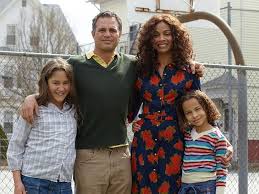
Because their father could not work, and because his wealthy family would not give them enough money to live on, the only way their mother could support them was to get a business degree, but she wanted the girls to stay in their home and school.  And so, Cam (Mark Ruffalo), who had been living alone, moves into the family apartment, and Maggie (Zoe Saldana) lives in New York during the week and comes home on weekends.  And the girls, Amelia (Imogene Wolodarsky, Forbes’ daughter) and Faith (Ashley Aufderheide) spend their weeks with a man who loves them very much but who fills the apartment with chaos and clutter, chain-smokes, drinks, and, worst of all, is SO embarrassing.

Copyright 2015 Sony Pictures Classics

There is something both perceptive in presenting embarrassment as their primary reaction.  Children naturally see the world in terms of how it affects them, and school-age children are first discovering the way that they are judged by their peers and are therefore excruciatingly sensitive to it, and can become near-frantic about blending in.  But it is reassuring as well.  The girls know that both of their parents love them very much.

Forbes presents the story with enormous insight and compassion for each member of the family.  The young actresses who play the two girls are wonderfully natural.  Saldana gives a performance of endless grace.  And Ruffalo manages to make Cam a complete and complex character, unlike the typical movie portrayal of mental illness as a bundle of cute quirks or sociopathic fury.  There is nothing as carelessly lofty as the Boston upper class.  While Cam knows their era is ending and would not want it to continue, it persists in his speech and carriage and in occasional flashes of a sense of entitlement.  He impulsively decides to take his daughters on a tour of his family’s mansion, even though it is now owned by someone else, who reasonably thinks that no one, even former owners, should be allowed to enter without an invitation.  He visits his grandmother, who still controls the family money, and has dinner with his parents (Keir Dullea and Beth Dixon, nailing the effete accents, snobbery, and helplessness).  He tinkers with a dozen projects and stays up all night creating a mermaid costume.  And he self-medicates with chain-smoking and constant sips of beer.  Ruffalo plays Cam not as a mentally ill man but as a man who has a mental illness, along with a lot of other qualities, including a deep love for his wife and children.

Parents should know that this film has very strong language, themes of mental illness, smoking, drinking, drugs, and family dysfunction.

Family discussion: Do you agree with the decision made by the parents about leaving the girls with Cam?  How have ideas about mental illness changed since the era of this film?  How does the writer/director, who based the story on her own life, feel about her parents?

If you like this, try: “Donnie Darko,” “A Beautiful Mind” and “Silver Linings Playbook”

Related Tags:


Based on a true story Disabilities and Different Abilities DVD/Blu-Ray Pick of the Week Family Issues
THE MOVIE MOM® is a registered trademark of Nell Minow. Use of the mark without express consent from Nell Minow constitutes trademark infringement and unfair competition in violation of federal and state laws. All material © Nell Minow 1995-2026, all rights reserved, and no use or republication is permitted without explicit permission. This site hosts Nell Minow’s Movie Mom® archive, with material that originally appeared on Yahoo! Movies, Beliefnet, and other sources. Much of her new material can be found at Rogerebert.com, Huffington Post, and WheretoWatch. Her books include The Movie Mom’s Guide to Family Movies and 101 Must-See Movie Moments, and she can be heard each week on radio stations across the country.

Website Designed by Max LaZebnik