The Sound of Music Celebrates its 50th Anniversary
Posted on March 9, 2015 at 8:00 am
A glorious new 50th anniversary Blu-Ray edition of Sound of Music is out this week, featuring commentary, behind the scenes footage, and all kinds of extras — sure to be one of your “favorite things.”
Contest: Win a Flintstones WWE DVD/Blu-Ray — Stone Age Smackdown!
Posted on March 8, 2015 at 11:07 am
When Fred Flintstone has an idea to make money that involves putting Barney in the ring with the Stone Age WWE all-stars, what can possibly go wrong? This week, we find out in The Flintstones & WWE: Stone Age Smackdown, featuring John Cenastone (John Cena), Rey Mysteriopal (Rey Mysterio) and even The Undertaker, along with Mr. McMagma (Vince McMahon), The Boulder Twins (Brie and Nikki Bella) Marble Henry (Mark Henry) and Daniel Bry-Rock (Daniel Bryan).
I have a copy to give away! Send me an email at moviemom@moviemom.com with Smackdown! in the subject line and tell me your favorite Flintstones character. Don’t forget your address! (US addresses only). I’ll pick a winner at random on March 12, 2015. Good luck!
Whether you consider him a hero or a traitor, it is well worth watching, and considering the fragile balance between privacy and national security — and who decides.
We mourn the loss of film visionary Albert Maysles, who with his brother David, showed us a new way to see film and a new way to see the world. They were the first Americans to create intimate, unstructured documentary storytelling without experts talking from behind their desks or extended narration. This is “direct cinema,” the distinctly American version of French “cinema verité.” The Maysles brothers were the first to make non-fiction feature films where the drama of human life unfolds as is, without scripts, sets, or narration. In part, this was due to their way of looking at the world, which was open-hearted and non-judgemental. But it was also due to changes in technology since the very earliest days of documentary. In 1960, he said, “With the equipment we have today, which is directly descended from the equipment we made; you could go beyond the illustrated lecture for the first time. These innovations made it possible to get what was happening so clearly and directly that the person viewing the film would feel as though he was actually present at those events. For the first time, it was possible for someone watching a documentary to feel as though he was standing in the shoes of the person he was seeing onscreen.”
Maysles’ subjects had lives that were in some ways ordinary, like those of us in the audience. Salesman was about door-to-door Bible salesmen. He said, “There are daily acts of generosity and kindness and love that should be represented on film.”
But he also made extraordinary films about extraordinary lives. Perhaps his most famous was Grey Gardens, about “Big Edie” and “Little Edie” Beale, relatives of Jacqueline Kennedy Onassis who continued to live in their crumbling East Hampton mansion with no money and very little contact with the outside world. The movie was later adapted into a hit Broadway musical and a movie with Drew Barrymore.
He filmed Janis Joplin, Jimi Hendrix, the Who, Otis Redding, and the Mamas and the Papas.
He filmed the Rolling Stones.
He filmed Paul McCartney.
He said,
As a documentarian I happily place my fate and faith in reality. It is my caretaker, the provider of subjects, themes, experiences – all endowed with the power of truth and the romance of discovery. And the closer I adhere to reality the more honest and authentic my tales. After all, the knowledge of the real world is exactly what we need to better understand and therefore possibly to love one another. It’s my way of making the world a better place.
Intense and graphic violence, characters injured and killed
Diversity Issues:
Diverse characters
Date Released to Theaters:
March 6, 2015
Date Released to DVD:
June 15, 2015
Amazon.com ASIN:
B00UC9SOKW
Copyright Sony 2015
So, basically, no one here saw “Terminator.” Or “Frankenstein.” But maybe they did see “Robocop?” Or “Short Circuit?”
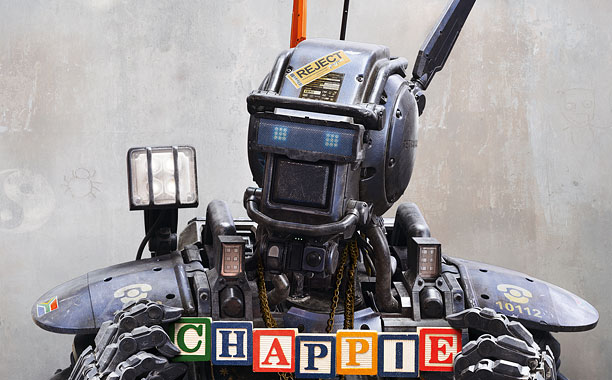
Writer/director Neill Blomkamp likes sci-fi allegories of social and political conflicts, as we saw in “District 9” and “Elysium.” Here he imagines that a couple of years from now South Africa will replace most of its front-line police force with robots from a government contractor. Efficient and just about unstoppable, they bring the crime rate down substantially. They are trusted by the law-abiding population and feared by the criminals. The CEO of the contractor is Michelle Bradley (Sigourney Weaver), who has turned down requests from two of her staff. Deon Wilson (Dev Patel) wants to develop artificial intelligence to see if he can create a form of mechanical consciousness. Counter to his Athenian dreams of a holistic robot spirit that can create poetry and assess the merits of works of art, there is the Spartan, Vincent Moore (Hugh Jackman), whose pet project is a super-powerful weapon called Moose that is all brawn and no brain. It operates entirely under human control, through a helmet that reads its operator’s thoughts. One dreams of heart and brains, one believes in brawn and firepower.
Michelle reminds them that she is CEO of a publicly traded weapons corporation. Her job is to provide powerful but obedient robot foot soldiers to the police force, not to explore existential questions or create military-force destructive capacity.
In brief opening scene set a year before the events of the film, a journalist explains, “Historically, when we look at evolution, it’s not surprising that Chappie’s left turn happened.” So we know from the beginning that Chappie will be a major turning point in human history. Then we go back to see how he is created, as Deon takes a discarded robot with an unreplaceable fused battery that has just five days before it will run down and brings the not-so-failsafe guard key card from the office to his apartment (where of course he has created a cute little wall-eyed home robot with decorative red glasses). He revs up on Redbull and slams down some bangin’ code to, you know, play God.
Just to make it clear, he introduces himself to the robot, who will be dubbed Chappie, as his maker. And just to show you how human sentient consciousness, at least as conceived by human screenwriters, will inevitably be, Chappie’s relationship to his creator is more conflicted than his relationship to the couple he sees as his mommy and daddy. These underground, off the grid, self-styled gangsta characters share the names of the performers who play the roles, Ninja and Yo-Landi (rappers from Die Antwoord) and “America” (Jose Pablo Cantillo), who live in an abandoned building covered with graffiti.
Chappie is caught in a tug of war between the idealistic Deon, who sees him as having infinite possibilities beyond the capacities of humans, and the gangstas, who see him as the key to bigger and better ways to create mayhem and steal cars and money. Deon makes him promise never to commit a crime. But Ninja covers him in bling and promises him a new body before the battery dies.
Blomkamp’s ambition is admirable and the broad scope of his imagination is impressive. The action scenes are vividly staged and the special effects are superb. It is Chappie’s movement that makes him seem human as much as his curiosity and spirit. seeing him gently stroke a dog’s back is so endearing we barely stop to consider whether his “hands” have the sensory capacity to “feel” the softness of the fur or the warmth underneath. When a human character transitions to robot form, the fact that his voice transitions as well makes no sense as a matter of mechanics, but this is more allegory than science. Unfortunately, the fact that the robot is more human than the humans is, to put it in computing terms, a bug, not a feature.
Parents should know that this film has constant very strong language and intense and graphic violence with some disturbing images and many characters injured and killed, as well as drinking, drugs, and brief nudity.
Family discussion: If you had the chance to upload your consciousness to a robot, would you do it? Could robot police ever work? How did Chappie’s innocence affect the people around him?
If you like this, try: “District 9” and “Elysium,” from the same director


 Much of the story is true. Maria was a postulant, sent by the convent to become a tutor for one of the ten (not seven) children of nobleman and Naval officer Georg Von Trapp. They got married, but it was seven years before the Nazis took over Austria. Maria always insisted, though, that Georg was not at all like the stern, humorless character of the early scenes. And they escaped by train, not by the mountains. A new book about the real story behind the family and the film is a lot of fun: The Sound of Music Story: How A Beguiling Young Novice, A Handsome Austrian Captain, and Ten Singing Von Trapp Children Inspired the Most Beloved Film of All Time
 , featuring John Cenastone (John Cena), Rey Mysteriopal (Rey Mysterio) and even The Undertaker, along with Mr. McMagma (Vince McMahon), The Boulder Twins (Brie and Nikki Bella) Marble Henry (Mark Henry) and Daniel Bry-Rock (Daniel Bryan).
  was about door-to-door Bible salesmen. He said, “There are daily acts of generosity and kindness and love that should be represented on film.”
 , about “Big Edie” and “Little Edie” Beale, relatives of Jacqueline Kennedy Onassis who continued to live in their crumbling East Hampton mansion with no money and very little contact with the outside world. The movie was later adapted into a hit Broadway musical and a movie with Drew Barrymore.