
Ender’s Game

Posted on November 1, 2013 at 6:35 pm

endersgame

Director Gavin Hood (“Tsotsi”) has skillfully adapted the Nebula and Hugo award-winning novel about a boy who leads an interplanetary battle against insect-like aliens, doing justice both to the fun of the sci-fi action and to the seriousness of the book’s themes.   The story has been adapted for film — Ender is several years older in the film than in the book and an extended and astonishingly prescient subplot about his siblings writing something resembling blogs and becoming highly influential political commentators has been dropped.  But it is very true to the spirit of the book and its characters and with special effects technology vastly beyond what was possible when the book was written, spectacularly realizes some of the book’s most thrillingly imaginative passages.

A memorable scene in Kevin Smith’s “Clerks” has its two slacker heroes arguing about one of the most rousing moments in the history of film, the destruction of the planet-destroying Death Star in the original “Star Wars.”  Randall points out that while the Jedi and the audience are cheering the explosion, they are overlooking the fact that the Death Star, still under construction, was not staffed with military but with independent contractors, who are at least arguably innocent bystanders in the conflict and unarmed.  In the middle of a raunchy comedy there is suddenly a more nuanced moral sensibility than is exhibited in the the usual big-budget sci-fi extravaganzas.

That is what makes the Ender’s Game series by Orson Scott Card so compelling.  The original book has been a worldwide best-seller for more than 20 years.  Like “Star Wars,” “The Matrix,” and other YA favorites, it is the story of a “chosen one” of extraordinary skill who takes on the oppressive and vastly powerful but corrupt enemy, and it is filled with exciting action.  But it also engages directly, thoughtfully, and sometimes provocatively with profound questions that are even more apt today than they were in the 1980’s: Should we sacrifice the interests of one person to benefit the rest of the world?   Should we stage a pre-emptive attack by an enemy that is not currently demonstrating aggressive behavior?  What is more important, the ability to win a battle or the ability to feel compassion or empathy?

The setting is at a time in the future when earth has successfully defended itself against an attack by an insect-like race of aliens called Formics and disparagingly referred to by humans as Buggers.  The effects of the war against the Formic were devastating, and the entire resources of the world have been turned to just one goal — seeing out the Formics and destroying them to make sure that they can never return to attack the humans.  They have determined that only a child has the reflexes, flexibility, and singleness of purpose to lead that attack.

All children are fitted to monitoring devices so that the military can see how they behave and find the likeliest candidates for military training.  Couples are strictly limited to no more than two children.  The Wiggins family is permitted a rare third because their son and daughter, while not suitable for training, show extraordinary ability.  The third is Ender Wiggins (“Hugo’s” Asa Butterfield in a considered performance of great dignity and focus), whose deliberate but savage attack on a school bully brings him to the attention of the commander in charge of training, Colonel Hyrum Graff (Harrison Ford, returning to space for the first time since the “Star Wars” trilogy).  Ender is brought to a space station for a series of training exercises called “games.”

A disagreement between Graff and Major Gwen Anderson (Viola Davis, once again speaking on behalf of humanity) is one of the film’s clearest statements of the moral conflict it lays out.  Anderson wants the training to do what is best for Ender.  Graff wants it to do what is best for humanity, and if that means inflicting the kind of trauma and encouraging the kind of brutality that will make Ender a better commander, he is willing to make that trade-off.  Of course it is out of the question to consult Ender or his parents.  Card wisely makes it clear that there are two questions here.  One is whether the ends ever justify the means.  The other is who should decide what ends or means to consider.

The games are fascinatingly constructed and the battles in the weightless chamber with freeze-ray weapons are absorbing and immersive.  It gets more exciting when a new teacher with a fabled history and an impressive Maori face tattoo (Ben Kingsley) takes over.  The climactic battle is as dramatic as we hope, but it is a remarkable twist and a surprising coda that bring depth and meaning to the story.


NOTE: In real life, author Card has demonstrated hateful homophobic bigotry that has led some people to call for a boycott of the film.  Here is my view: I believe that the principles of courage, integrity, compassion, empathy, and service to others that “Ender’s Game” promotes are essential values.  While I regret that the author’s ugly and bigoted statements show that he himself is still struggling to learn the lessons of his book, I agree with the poet Don Marquis that “an idea is not responsible for the people who believe in it.” The best of his vision should be shared with young people in the hopes that the next generation will transcend some of the biases of the previous ones.

Parents should know that this film includes extended sci-fi violence and peril with characters injured and killed, themes of interplanetary genocide, brief mild language, theme of child soldiers and moral conflicts, and bullies.

Family discussion: What does it mean to win “the right way”? Was Graff or Anderson right about the best way to treat Ender?

If you like this try: The book and its sequels by Orson Scott Card and the “Star Wars” movies starring Harrison Ford.

Related Tags:


Action/Adventure Based on a book Science-Fiction Stories about Teens

Time of Death — Showtime’s Brave New Series About Dying

Posted on November 1, 2013 at 3:31 pm

We pride ourselves — for better and worse — about being very open and modern in contemporary society.  Topics that were previously not spoken of in polite society are discussed openly — sex, money, race, politics, religion.  But the one thing we still do not talk about is death.

Showtime’s new series, “Time of Death,” premieres tonight, with stories of people in the last months, weeks, and moments of their lives. It is sad and it is painful. Sometimes it is raw and ugly and scary. But it is also moving. There are stories of the dying and their families finding forgiveness, meaning, and peace. There are moments of fear and also moments of courage and resilience. There is laughter and there are many tears. Above all, there are moments of absolute honesty. Watching this series will make you want to have some important conversations with your family and will give you a place to start.

Related Tags:


Documentary Television

About Time

Posted on October 31, 2013 at 6:00 pm

B+
Lowest Recommended Age: Mature High Schooler
MPAA Rating: Rated R for language and some sexual content
Profanity: Very strong and crude language
Alcohol/ Drugs: Drinking and substance abuse
Violence/ Scariness: Sad death, scary car crash
Diversity Issues: None
Date Released to Theaters: November 1, 2013
Date Released to DVD: February 3, 2014
Amazon.com ASIN: B00BEIYGK2

about-time1Richard Curtis perfected the art of the 21st century romantic comedy in “Four Weddings and a Funeral,” “Notting Hill,” and “Love Actually.”  They were witty and sophisticated and had posh British accents that made them seem twice as witty and sophisticated.  They were filled with of pretty people wearing pretty clothes in pretty settings, seasoned with self-deprecating humor, magnificent friendships, pop-y soundtracks, and happy ever after endings.  “About Time” has all of that, plus a twist.  I don’t mean the addition of a fantasy time travel element, thought that is something of a departure.  The real twist is that the important love story here is not between man and woman but between father and son.

Oh, there’s a romantic love story, of course, and it’s the part that’s featured on the poster.  Tim (Domhnall Gleeson, son of the Irish actor Brendan Gleeson and best known as one of the Weasley brothers in the “Harry Potter” films) lives in Cornwall with his family, a blissfully happy group that includes his slightly starchy mother (Lindsay Duncan), slightly dotty but impeccably dressed uncle (Richard Cordery), wild child of a sister (Lydia Wilson), and book-loving, family-loving dad (the indispensable Bill Nighy).  Dad explains to Tim that the men in their family have the ability to travel through time.  There are limits, of course.  Like “Quantum Leap,” he is limited to his own lifetime.  He can’t go back and meet Queen Victoria or ride a dinosaur.  And, as Tim will spend the rest of the movie discovering, while he can go back to correct a mistake, the ripple effect of even the tiniest change may have very big consequences that are not so easy to fix.

It may sound all very precious and cutesy, and it is, with Curtis’ trademark adorable eccentrics that are less adorable than he intended.  Even an English accent can only make up for so much.  Tim’s use of his time travel powers to make up for various gaffes is entertaining in a “Groundhog Day”-lite sort of way.  (There’s something rather meta about a feeling of deja vu in these repeated, slightly improved encounters.)  The romance between Tim and a pretty American named Mary (Rachel McAdams), while refreshingly free of the kinds of agonizingly silly misunderstandings that plague most romantic comedies, is on the bland side.  The first meeting with Mary’s parents is supposed to be awkward and funny, but it’s just awkward.  Things get more interesting later, as Tim and Mary get married and start a family.  The stakes are higher and the choices are more complex.

It is in the third act when things start to get interesting, because that is when the focus shifts to the father-son relationship.  Curtis, who says this is his last film, opens up his heart for a piercingly bittersweet engagement with the big questions of who we are, making peace with not being able to fix everything for everyone we love, and finding a way to make pain and loss deepen us.

Parents should know that this film includes sexual references, some explicit, and some sexual situations, very strong and crude language, car accident, and a sad death.

Family discussion: If you could go back in time, would you correct a mistake or take time to enjoy what already happened? Why did Kit Kat have such a hard time making good decisions? Was there anything her family should have done differently to help her?

If you like this, try: “Four Weddings and a Funeral” and “Love Actually” from the same writer/director and “Groundhog Day”

Related Tags:


Comedy Date movie Drama DVD/Blu-Ray Pick of the Week Family Issues Fantasy Romance

Free Birds

Posted on October 31, 2013 at 6:00 pm

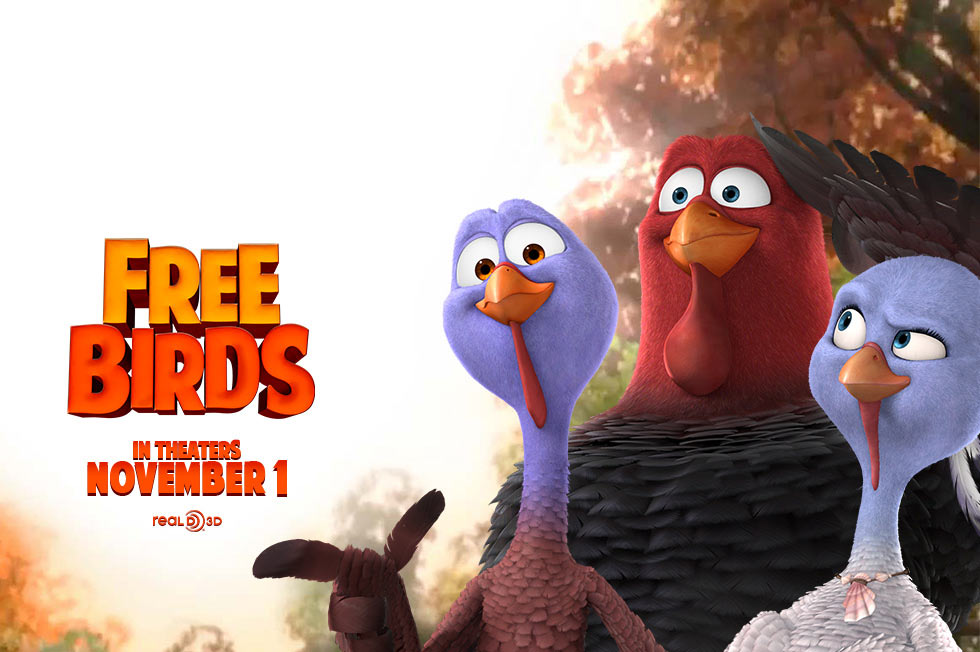
Free birds movieMaybe it’s just me, but I think this may be the worst idea for a movie intended for children I have heard since the one about the kid bank robber. Does anyone think it makes sense to horrify children just before Thanksgiving with a movie about two turkeys who want to go back in time to prevent centuries of turkeys being eaten to celebrate America’s oldest holiday? Will children who see this movie burst into tears at Grandma’s house and insist on eating pizza for Thanksgiving dinner?

Food is everyone’s favorite part of holidays, a turkey named Reggie (Owen Wilson) tells us, “unless you are the meal.” Reggis is something of a Chicken Little, telling the other turkeys that they are being raised for slaughter, but they do not believe him. They think that the farmer is their friend, and they envy the lucky birds he takes away from the flock because they think it is a special treat.  The President of the United States arrives at the turkey farm with his little daughter for the annual photo op “pardoning” ceremony.  As happens in real life (but at the White House) an especially handsome bird is presented to the President, who smiles for the cameras and sends it to a petting zoo while the rest of the flock is sent to the butcher.  The President’s daughter (Kaitlyn Maher) is a brat who is always obnoxiously throwing a tantrum to get her own way or bizarrely going to sleep on the spot (she might want to ask her pediatrician about narcolepsy at her next check-up). She likes the scrawny Reggie and insists that he not only be pardoned but that she get to keep him at Camp David as a pet.

Reggie is very happy, ordering pizza delivery and luxuriating in a terry cloth robe with the Presidential seal, until he meets another turkey named Jake (Woody Harrelson), who wants to go back in time to the first Thanksgiving, with the pilgrims and the Native Americans, to persuade them to start a different tradition by eating something other than turkey for dinner.  They end up in an egg-shaped time machine adorably voiced by George (“Star Trek”) Takei, and soon are back to the Plymouth Colony in 1621, where they have to rally the wild turkeys who are the ancestors of today’s highly cultivated birds.  The leader’s spirited daughter is Jenny (Amy Poehler), a practical-minded turkey who handles her lazy eye problem with aplomb.

Hiding somewhere inside the over-plotting, time-travel anomalies, inconsistent characterization and tone, and family-unfriendly themes of animal slaughter there are some brief moments of humor, but the premise is so ghastly that even that feels hollow.  It is supposed to be about sensitivity and empowerment but it comes across as callous and pushy.

Parents should know that sensitive viewers may be disturbed by the theme of killing turkeys to eat on Thanksgiving.  The movie includes cartoon-style peril and violence, some with guns, mostly comic but minor characters are injured and killed and there is a sad death of a parent who sacrifices himself.  There is brief crude humor including joke about developmental disabilities and mixed marriages.

Family discussion:  Why does Reggie question what is going on when the rest of the flock does not?  Why was it important to learn about Jake’s past?

If you like this, try: “Babe”


Related Tags:


3D Animation Comedy Fantasy Talking animals
THE MOVIE MOM® is a registered trademark of Nell Minow. Use of the mark without express consent from Nell Minow constitutes trademark infringement and unfair competition in violation of federal and state laws. All material © Nell Minow 1995-2026, all rights reserved, and no use or republication is permitted without explicit permission. This site hosts Nell Minow’s Movie Mom® archive, with material that originally appeared on Yahoo! Movies, Beliefnet, and other sources. Much of her new material can be found at Rogerebert.com, Huffington Post, and WheretoWatch. Her books include The Movie Mom’s Guide to Family Movies and 101 Must-See Movie Moments, and she can be heard each week on radio stations across the country.

Website Designed by Max LaZebnik