
Interview: George Nolfi of ‘The Adjustment Bureau’

Interview: George Nolfi of ‘The Adjustment Bureau’

Posted on March 2, 2011 at 8:00 am

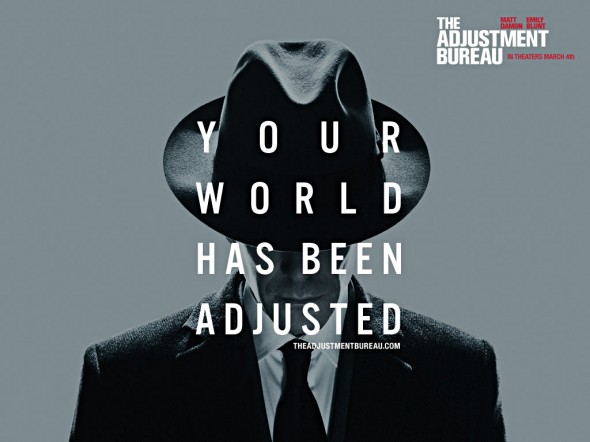
“The Adjustment Bureau” is the first great film of 2011, a big and hugely entertaining film that takes on big ideas — love, free will, destiny, God, and the meaning of life. I was lucky enough to speak with writer and first-time director George Nolfi about being inspired by a short story from Philip K. Dick.adjustment-bureau-poster-3.jpg
The movie is very different from “Adjustment Team,” the original story by Philip K. Dick. How did you approach adapting it for the screen?
The short story is just that, short. And it has a character at the center of it who is explicitly an everyman and so there isn’t much of a character to play there. It was going to need some adaptation one way or another. I was interested in a different thing than Philip K. Dick was. The story can be read from one angle was “Is this real or is this not real?” I wanted it to be — this thing happens and it spins the guy’s whole life on its head and all of his conceptions about the laws of physics and the universe are turned upside down. And he has to accept it because the evidence is just so overwhelming. What does that do to a person?
When my producing partner brought me the short story, I thought, what a great conception for a movie, the idea that fate is a group of people subtly pushing you back on plan. He also said, “You could do this as a love story. Your lead falls in love for the first time in his life and the adjuster comes along and says, ‘Sorry, there’s been a mistake. You weren’t even supposed to meet her.'” For whatever reason, my reaction to that was, “I think I know how to write that.” I didn’t know what I was going to put in the script but I thought the blending of genres would be fascinating and it would get me into territories of these much larger questions that every great system of thought — philosophical, literary, science-fiction, theological — this story would allow me to get there. There are not many stories that make big movies that take you to those questions.
It is unusual for a big-time movie with big-time movies stars to take on questions of life and fate and meaning and free will. I love the fact that it wasn’t focus-grouped away from engaging on those issues.
I optioned the rights and controlled them for six or seven years. I gave the script to Matt Damon and got some thoughts from him about his character. Neither of us thought his character was fully developed yet. I rewrote it to give his character more layers and more interesting things for him to play. And he said yes and we got it financed outside the studio system, from a group called MRC. When we then went to the studios we were able to say, “We have this movie and we have this movie star” and give them a fully-formed movie, so you don’t have this automatic development process where it’s nobody’s fault but things tend to get homogenized.
And Universal was really supportive, right from the beginning. They were on board with the notion of trying something that was really reaching. They were just like — let’s go for it. They thought people would leave the theater feeling satisfied even though we were blending genres. I had no interference while I was making the movie. In post-production they had just a few thoughts which in the Hollywood scheme of things would be considered minuscule. They had thoughts about the music but that was temp music anyway. I didn’t think the original ending worked and they agreed. So it was good people we were in business with and we were all pulling the same way. They were completely supportive of what we were trying to do, and so was Matt.
As a screenwriter, you’ve worked with directors but this is the first time you have directed. What did you learn from the directors you’ve observed?
I was on the set for all the movies I am credited on. And for “Oceans 12,” I knew I was basically going to be there the whole time. I said to Steven Soderbergh, “I’m interested in being director, are you cool with my occasionally ask you why you’re doing what you’re doing?” And he was extremely gracious to explain some of his thought processes about why he was choosing certain shots and so on. But the single biggest piece of advice he gave me that really stuck with me was, “In a perfect world you want to choose your shots and assemble to the movie so that the sound could go out and people could still follow the story.” That’s telling a story through pictures.
Clearly you listened to him! For a writer turned director, this is a very visual film. The effects are very significant and essential to the narrative.
As a writer making the leap to directing the first time, it was very important to me to make a film that was visually significant, to use visuals and music and sound as well as the performances of the cast to tell the story — those are the things you don’t have as a writer. I really wanted to do visual story-telling. I write scripts that are very visual but you can’t know until you try it whether it would come easily to me as a director, but I loved it.
I liked the idea that the Adjusters could do a lot of things but in a way the humans adjusted their options, too. They were nudging each other.
Thematically, I had this idea that the Chairman was limiting the Bureau in all kinds of different ways. That’s too many ripples so you have to go to a higher authority. Or you can’t go through that door unless you are wearing a hat. Or it’s raining out and water kind of blocks our ability. Those are foreshadowing the way that the Chairman will turn out to be supportive of free will.
And of love! It’s a very romantic movie.
I hope so! I hope you experienced it that way. I think it is.
And it is very spiritual, as well.
I wasn’t trying to make a religious film per se, but the most comprehensive attempts to make sense of the world are theological. In terms of fate and free will, that’s the oldest question human beings struggle with. It’s there in Gilgamesh and ancient Greece. Is it fate or do we have choices? There’s a reason for that. Human beings are questioning animals and we want to understand our existence.
Looked at in much less grand terms, most people have some sense that the person they turned out to be, the job they have, their moral code, their interests, their religion, were shaped by what country they were born in, what neighborhood they were born into, their family, their friends, their schools, their chance encounters have put them on a path. Even things considered more deeply personal choices like who your spouse is — you were introduced by friends or met at a wedding or you had mutual interests or whatever it is. So we have this sense that the course of our life is shaped by outside forces, whether a divine hand or your surrounding influences. But we also experience our lives as a series of choices. No religion has successfully answered that. We did an inter-faith screening with an audience of followers of Christianity, Judaism, and Islam, and we had a discussion with experts in all all three. They discussed faith and free will and pointed out to the audience that the importance of free will was found in all of them. They have to, in order to make sense of existence.

Related Tags:


Behind the Scenes Directors Interview Science-Fiction Spiritual films Writers

Burlesque

Posted on March 1, 2011 at 8:01 am

Somewhere on the continuum that connects “Showgirls,” “Glitter,” and drag shows is a place for “Burlesque,” a vanity project from producer Christina Aguilera for pop star and would-be actress Christina Aguilera. That doesn’t mean it isn’t entertaining. It just means it is not a good movie. It’s more hallucination than story, but hey, If you think of it as a slightly deranged long music video divathon it can be a lot of fun.

Aguilera plays Ally, a spunky small-town girl who buys a one-way ticket to Los Angeles and find a home at one of those only-in-movies places that is about to go broke but is always packed to capacity because it puts on big-budget musical numbers with expensive (if tiny) costumes and choreography. Oh, and at least one regular customer is a zillionaire (Eric Dane of “Grey’s Anatomy”).

She starts as a waitress under the direction of a friendly bartender (Cam Gigandet of the “Twilight” series, “Easy A”) and talks her way into getting hired as a dancer. The club is owned by Tess (Cher looking so diva-esque she might as well be a drag queen playing Cher) and her ex-husband Vince (Peter Gallagher, looking seedy). Vince wants Tess to take the generous offer from the zillionaire. Even though she really does not have another option (she doesn’t even try to find one), she just keeps on going, attaching bugle beads with a glue gun, counseling a girl with an unexpected pregnancy, and, of course not just creating all the musical numbers but belting out the only songs in the show that are not lip-synched.  

And then it turns out that little ex-waitress has what another character refers to as “mutant lungs.” It also turns out that not being good at blending in may be a problem in the chorus, but it’s part of what makes a star.

The story is dumb. The dialogue is intended to be sassy; it’s also dumb. Aguilera cannot act and Cher, who used to be able to (she was hilarious in her most recent film, “Stuck on You” in 2003), has two insurmountable obstacles: her face doesn’t move and her character is supposed to be both imperious and tenderhearted, savvy but clueless. However, Aguilera is indeed a star and the musical numbers are entertaining. They may be sadly chopped up by people who spend a lot of time choreographing dances and then think the audience can’t pay attention to more than one step at a time. But I appreciated the shout-outs to greats like Marilyn Monroe, Billie Holliday, Bob Fosse, and Madonna, and respect Aguilera’s respect for their traditions and for burlesque as well. It is still a lot of fun to see those bugle beads bounce.

Related Tags:


Drama Musical

Love and Other Drugs

Posted on February 28, 2011 at 8:00 am

A-
Lowest Recommended Age: Adult
MPAA Rating: Rated R for strong sexual content, nudity, pervasive language, and some drug material
Profanity: Extremely strong and crude language
Alcohol/ Drugs: Drinking (including drinking to deal with stress, drunkenness), drugs, marijuana
Violence/ Scariness: Tense confrontations, illness, brief violence
Diversity Issues: None
Date Released to Theaters: November 24, 2010
Date Released to DVD: March 1, 2011
Amazon.com ASIN: B004L3AR0K

“Love and Other Drugs” is the cure for the common movie, a smart, sexy, touching romance and a thoughtful exploration of a remarkable time that illuminates some of our most vital contemporary concerns.
“Ask your doctor about…” ads began appearing in magazines in the 1990’s. Before that, medication was a highly technical product requiring extensive medical expertise. But then pharmaceutical companies were allowed to advertise directly to consumers. This not coincidentally coincided with a flood of new drugs to make you not just get better but feel better, as in experience less anxiety and have a brighter outlook. Who wouldn’t want to ask their doctor about that?
And all of this not coincidentally coincided with the go-go years of pharmaceutical sales jobs. As the movie points out, this was the only entry level position in the world where you could begin by making six figures. It was like the California Gold Rush; an all’s fair era of claim-jumping and anything goes marketing tactics that included pens and opera tickets, lavish “medical conferences” at exotic beach and golf course resorts, generous “consulting fees” for doctors, beauty queen sale reps, and goodies for the medical staff. Anything to entice the people with the prescription pads to order up lots of Brand X instead of Brand Y.
Jamie (Jake Gyllenhaal) is his family’s embarrassing failure. Co-writer/director Edward Zwick (“thirtysomething,” “Now and Again,” “Glory”) brings in 70’s stars the late Jill Clayburgh and George Segal as his parents, a nice touch. His father and sister are doctors. His brother is a dot.com millionaire. He was fired from selling electronic equipment (a boombox playing “Two Princes” nails the era in a nanosecond) for having sex with his manager’s girlfriend. So he takes a job in drug sales at Pfizer, goes through training, and gets a job selling mood elevators in the Ohio River valley. He has a lot of competition from the Prozac guys, and then comes Viagra. Maggie (Anne Hathaway) is a free-spirited artist with early onset Parkinson’s who takes buses of elderly people to Canada to get affordable prescription drugs. She sizes him up immediately as someone who is constantly looking for meaningless sex “for an hour or two of relief from the pain of being you” because she feels the same way.
Meaningless sex works out fine for a while, but then of course it gets complicated as Maggie has to cope with Parkinson’s and Jamie learns more about the consequences of the drug marketing. We see less and less of their bodies and their sexual encounters as we see more about what is going on with them emotionally.
Both the relationship at the heart of the story and the environment around them are absorbing and insightful. Almost as an aside, we see the benefits of this category of drugs as a homeless man who dumpster dives for the rival Prozac Jamie throws away literally cleans up his act and applies for a job. In a very moving scene Maggie happens on a Parkinson’s support group. She is overjoyed with the connection she feels to the other patients (played by real people coping with Parkinson’s) while Jamie is daunted by a glimpse of the future from a caregiver.
On one level, it works as a story about the real leap of faith each of us goes through in entering into a long-term relationship — faith not just in the other person but in our own capacity for “in sickness and in health,” the terror of not being known, the greater terror of being known and being rejected. The health care issues are presented in an even-handed but very personal way, not just through Maggie’s experience but through the doctor character superbly played by the immeasurably gifted Hank Azaria. He shows us a man who has his own lapses but is terribly frustrated with a system that squeezes him on every side, compromising treatment. Gylenhaal and Hathaway (getting along much better then they did as unhappy spouses in “Brokeback Mountain”) give performances of wit, courage, grace, and generosity. RX prn.

(more…)

Related Tags:


Date movie Drama DVD/Blu-Ray Pick of the Week Inspired by a true story

Hall Pass

Posted on February 25, 2011 at 3:26 pm

Things have changed since the Farrelly Brothers smashed through boundaries and brought a new level of outrageous raunchiness to the screen with the box office smashes “Dumb and Dumber” and “There’s Something About Mary.” First, they inspired others like Judd Apatow and Jason Segal to go even further, so they are no longer at the top of the list for shock value. And second, they got older.

So their new movie does not try for anything as outrageous as the unforgettable hair gel or zipper scenes (though there is a return to a graphic intestinal distress moment). And instead of focusing on the excruciating humiliations of dating (“There’s Something About Mary”) or honeymoons (the remake of “The Heartbreak Kid”), they have moved on to the challenges of married life, or what Zorba the Greek called “Wife, children, house, everything. The full catastrophe.”

Rick (Owen Wilson) and his best friend Fred (“SNL’s” Jason Sudeikis) have jobs, wives, and mortgages in the suburbs of Providence. Rick, a realtor, and his wife Maggie (Jenna Fischer of “The Office”) have three children. Fred, an insurance agent, and his wife Grace (Christina Applegate) have none.

“All our wives’ dreams come true and ours don’t,” says Fred. For the men, it feels like it is all about sex. For the women, it feels more like romance. But everyone misses that feeling of being special.

The wives, frustrated and publicly humiliated by some very bad behavior by the men, give them a “hall pass,” a week off from marriage, with no restrictions. This is based on the recommendation of a friend (Joy Behar), who assures them it is “better than a slow boat to resentment.” Maggie takes her children to visit her family on Cape Cod, and Grace soon joins her, leaving the men behind to try to live out their fantasies of bedding babes non-stop like their friend Coakley (Richard Jenkins).

It turns out that they are more interested in eating themselves into a stupor at chain restaurants. And that, well, there’s no diplomatic way to say it. They just aren’t cool any more.

The more they try to be, the dorkier they become. Rick does not get a positive reaction to the pick-up lines he downloaded from the internet. When a very pretty Australian barrista tells Fred that the song she is listening to is from Snow Patrol, he thinks she is referring to the kiddie movie with Cuba Gooding, Jr. — “Snow Dogs.” When Rick tries to visit a massage parlor, it does not have a happy ending.

Meanwhile, on Cape Cod, Grace and Maggie have become friendly with a couple of nice guys who do think they are special.

The Farrelly brothers are going for situational rather than shock humor here, hitting singles rather than trying to bat one out of the park. That means there is less excruciating humiliation, but it also means less over-the-top, I-can’t-believe-what-I’m-seeing moments. The result is oddly toned down and sit-com-ish. It’s even more oddly and disturbingly misogynistic, a throwback to early 1960’s comedies like “How to Murder Your Wife” and “Boys’ Night Out” in its portrayal of perpetually childish men constantly chastened and terrified by scary mommies with daunting sexual demands. This is particularly disappointing for film-makers whose great strength has been their capable and good-hearted female characters. Like Fred and Rick, the Farrelly brothers here are off their game.

Parents should know that this movie has extremely raunchy and explicit humor including comic and very graphic male nudity, alcohol, strong language, and adultery.

Related Tags:


Comedy

Drive Angry

Posted on February 24, 2011 at 7:22 pm

The movie is called “Drive Angry.” It stars Nicolas Cage. It’s in 3D.

What more do you need to know?

Cage is such a fan of comic books he took his screen name from a comic book superhero and starred as “Ghost Rider.” Cage and co-writer/director Patrick Lussier have brought a stylish and mythic comic book sensibility to this story about a man determined to kill cult members who murdered his daughter and plan to kill her baby.

Cage plays John Milton (I did say mythic), a mysterious loner, who hitches a ride with Piper (Amber Heard, as terrific here as she was in “The Jones”), a waitress who just dumped her fiance and took his Dodge Charger, the one with the license plate that says DRV ANGRY. They go after Jonah King (Billy Burke, looking like a cross between Jim Jones and the Pick-Up Artist) and his Satan-worshiping followers, who are preparing to sacrifice Milton’s granddaughter under the full moon. And they are chased by cops following up on the trail of dead bodies they leave wherever they go and by a man in a suit who calls himself “the accountant” (William Fitchner, like a civilized Terminator with the nose of a bloodhound and the demeanor of an elegant viper). There’s a series of dust-ups and then the final confrontation/conflagration.

This is the kind of movie they used to show in drive-ins and clearly everyone in it is having a blast. It’s nicely twisted and even a little fierce, willing to take on some big questions that provide as much fuel for the story as the cars and carnage. The movie’s highlight is Fitchner, who can sniff the air or toss a coin with as much on-screen power as all the chases and shoot-outs.

Related Tags:


3D Action/Adventure Thriller
THE MOVIE MOM® is a registered trademark of Nell Minow. Use of the mark without express consent from Nell Minow constitutes trademark infringement and unfair competition in violation of federal and state laws. All material © Nell Minow 1995-2026, all rights reserved, and no use or republication is permitted without explicit permission. This site hosts Nell Minow’s Movie Mom® archive, with material that originally appeared on Yahoo! Movies, Beliefnet, and other sources. Much of her new material can be found at Rogerebert.com, Huffington Post, and WheretoWatch. Her books include The Movie Mom’s Guide to Family Movies and 101 Must-See Movie Moments, and she can be heard each week on radio stations across the country.

Website Designed by Max LaZebnik