Blessed is the Match: The Life and Death of Hannah Senesh
Posted on April 19, 2010 at 3:57 pm
B+
Lowest Recommended Age:
Middle School
MPAA Rating:
NR
Profanity:
None
Alcohol/ Drugs:
Mild
Violence/ Scariness:
Depiction of wartime and holocaust-related violence
Diversity Issues:
A theme of the movie
Date Released to Theaters:
2009
Date Released to DVD:
April 13, 2010
Amazon.com ASIN:
B00366E1AU
Blessed Is the Match: The Life and Death of Hannah Senesh is a documentary about a woman of incalculable courage and honor. Senesh, an idealist who hoped to help create a Jewish state in Israel, escaped from Hungary to what was then British-controlled Palestine. Instead of staying where she was safe, she joined a mission to rescue Jews in her home country, the only military rescue mission for Jews during the Holocaust. She parachuted behind enemy lines, was captured, tortured and ultimately executed by a Nazi firing squad. The documentary features those who knew her, including Israeli President Shimon Peres, who knew Senesh as a young pioneer in the 1940s, and two of her fellow parachutists, Reuven Dafni and Surika Braverman, along with renowned historian Sir Martin Gilbert.
Senesh is a national heroine in Israel, where her story and her poetry is well-known. Many synagogues around the world sing a hymn with lyrics from one of her poems:
My God, My God, I pray that these things never end,
The sand and the sea,
The rustle of the waters,
Lightning of the Heavens,
The prayer of Man.
This is the last poem she wrote:
Blessed is the match consumed in kindling flame.
Blessed is the flame that burns in the secret fastness of the heart.
Blessed is the heart with strength to stop its beating for honor’s sake.
Blessed is the match consumed in kindling flame.
Family movie night returns to NBC with Secrets of the Mountain, about an adventure that brings a family together in a search for hidden treasure, starring Barry Bostwick and Paige Turco.
Somewhere between the demands of her career, her ex’s wedding and her kids’ busy schedules, Dana James feels her tight-knit family starting to unravel. An unexpected offer to purchase her family’s mountain property sets up a weekend road trip. But when they arrive, they quickly learn that the mountain is much more than it seems. An ancient secret and a treacherous quest will test the family like never before. It’s an edge-of-the seat thriller that reminds us that when times are tough, families don’t run away from problems — they run back to each other.
Rated R for sexual content, some language, and drug use
Profanity:
Strong language
Alcohol/ Drugs:
Drinking, drug abuse by a teenager
Violence/ Scariness:
Shocking fatal car accident, sad death, themes of grief and loss, character in coma
Diversity Issues:
Diverse characters
Date Released to Theaters:
April 16, 2010
Two gifted young women whose best work will be in other films are the reason to see this one. Carey Mulligan, so enchanting in last year’s An Education, plays a pregnant teenager in “The Greatest,” written and directed by newcomer Shana Feste. Both show a great deal of promise in this sincere but uneven film.
Mulligan plays Rose, who has one perfect moment with Bennett (Aaron Johnson) before he is killed in a car accident. They were both seniors in high school who had watched each other and waited for glimpses of each other but hardly even spoken until the last day of school when finally they work up the nerve to speak to one another. And then, suddenly he is gone, and she is pregnant.
Bennett’s parents, already dealing with a lot of dysfunction, are devastated by the loss and driven apart by it, too. Allen (PIerce Brosnan), a professor of mathematics, is rational and keeps his feelings inside. Grace (Susan Sarandon), is emotional. In one shattering scene, she is in the bathtub and he hands her a bell to ring when she misses her son. She rings it immediately, insistently, harshly, making it clear that her pain is deep and permanent and cannot be confined. She is obsessed with the 17 minutes between the crash and his death. What was he thinking? What did he say? Did he suffer? But the only one who knows is the man from the other car, who is in a coma. Grace visits him, reading aloud, monitoring his care.
Rose, who has nowhere else to go, moves in with Bennett’s family. But it takes a while for each of them, grieving separately, to find a way to reconnect as a family.
Surprisingly, Feste is best with the older generation in the film. Brosnan and Sarandon are the real center of the story and their characters are the best defined and the most compelling. Johnny Simmons (“Jennifer’s Body”) and Mulligan do their best with roles that are both under- and over-written. Simmons is the younger brother, a recovering drug addict, whose primary job in the movie is to remind his parents every day that they are left with the troubled son instead of the one they were proud of. But he is stuck with a distracting sub-plot about a relationship with a girl (Zoe Kravitz) from his support group. The problem with Mulligan’s character is Feste’s view that in the midst of terrible grieving and dysfunction, the repository of all wisdom and imperishable goodness resides in a pregnant teenager with a disastrous home life but an adorable dimple. This leaves a blank space that unbalances an already-unwieldy story but leave us looking forward to seeing how Feste learns from this film do to better next time.
Sad offscreen death of a child, themes of grief and loss
Diversity Issues:
A theme of the movie, some racist remarks and behavior
Date Released to Theaters:
April 16, 2010
Think of it as the “Good News Bears.” This sweet, sometimes sugary film is based on a real-life Little League team from Monterrey, Mexico who came to the United States to play in the Little League World Series of 1957 and not only won every match but, well, you saw the title.
Jake T. Austin of “Wizards of Waverly Place” plays the baseball-mad Angel, who lives with his parents in a desperately poor community. He and his friends love to hear about pro games and players in America. They want to learn how to play but they do not even have a baseball, much less a playing field or a coach.
Angel finds a ball and then he finds a coach in Cesar Faz (Clifton Collins, Jr.), a factory worker who once worked with the St. Louis Cardinals. The boys make their own field. With the help of Coach Faz and inspiration from Padre Estaban (Cheech Marin, adding another to his list of screen roles as a priest), the boys become a team. When they get a chance to play in the Little League World Series, they each take only one change of underwear, carried in a brown paper bag. First, it’s all they have. But second, it never occurs to them that they will win, so they assume they will be home after the first game.
But they win. And they win again. A woman reporter (Emilie de Ravin, channeling all the girl reporter actresses of the 1930’s newspaper movies) reluctantly accepts the assignment, then is captivated by the courage and dedication of the team. As they rise through the ranks, they encounter racism, xenophobia, and just plain old hostility. But they hold on to their ideals — including refusing to play unless they can be led in prayer first (we find out why they are so partial to Psalm 108. They get help from some unexpected sources: a sympathetic diner owner (Frances Farmer), the reporter and a groundskeeper who once played in the Negro Leagues (a fine Louis Gossett, Jr.). And they keep winning.
It has a retro feel that has nothing to do with its 1957 setting, but like its pint-sized team (inches smaller and pounds lighter than its opponents), the movie has so much heart that it is easy to root for. Collins and Marin are engaging enough to give the predictable and light-weight script a little extra heft. If “The Perfect Game” is not the perfect movie, it is an enjoyable little fable that will be fun for Little Leaguers and their families.
Rated R for language, drug content, and some sexual humor
Profanity:
Very strong language
Alcohol/ Drugs:
Characters inadvertantly take hallucinogenics
Violence/ Scariness:
Comic peril, character apparently killed
Diversity Issues:
Diverse characters
Date Released to Theaters:
April 16, 2010
It feels like the world should come to a stop when someone dies, but unfortunately, it does not. And it feels like the confrontation with the eternal and the shock of grief should somehow make everyone behave, but unfortunately, it does not.
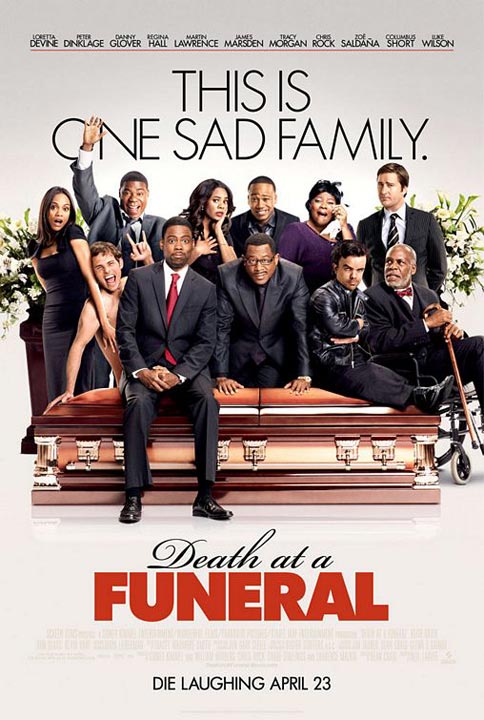
Fortunately, that can be funny, especially when it is happening to someone else. “Death at a Funeral” is a wild, door-slamming, poop-on-the-face, naked-guy-on-the-roof farce set at the funeral of a man whose family did not know him quite as well as they thought. Trying to stay on top of things is the oldest son of the dearly departed, Aaron (Chris Rock), a tax accountant and would-be novelist jealous of his best-selling author brother Ryan (Martin Lawrence). The funeral is at the home that Aaron shares with his wife (Regina Hall) and mother (Loretta Devine). Arriving for the funeral are Aaron’s cousin Elaine (Zoe Saldana of “Avatar”) and her nervous fiance Oscar (James Marsden) and brother Jeff (Columbus Short), family friends Derek (Luke Wilson) and Norman (Tracey Morgan), and cantankerous uncle Russell (Danny Glover). Meanwhile, the wrong body has been delivered by mistake and there is a man at the funeral no one knows, who keeps asking to talk to Aaron about something important.
It all moves along briskly and the juxtaposition of outrageous farce with the most serious of occasions sharpens what would otherwise be pedestrian slapstick. By far the most interesting aspect of the movie is that it is an almost shot-for-shot remake of a British film by the same name, made just three years ago. The two films even share one of the lead actors, Peter Dinklage as the interloper whose relationship with the deceased — and request for payment to keep that relationship quiet — creates a lot of upheaval. Taking a farce that appeared to rely on the understated, restrained British culture in the face of outlandish situations and transplanting it to a black family in Los Angeles demonstrates how much we bring our own expectations to a film.
Director Neil LaBute, best known for searing, disturbing, often-misogynistic plays and movies (“The Shape of Things,” “Your Friends and Neighbors”) lets his able cast run with the material. Marsden is particularly good as the nervous fiance who takes what he thinks is Valium to relax and ends up alternately — and simultaneously — ecstatic, terrified, and utterly dejected. Rock, often uncomfortable on screen, finds some dignity as well as humor in a mostly straight role. Saldana, trim as a greyhound in her LBD, has some great moments as she reassures her frantic fiance and tells off her father, brother, and would-be boyfriend. Hall is delicious as always as a devoted wife who really, really wants a baby — someone needs to give her a starring role. And Dinklage is simply a hoot, one of the most able actors in films today.