
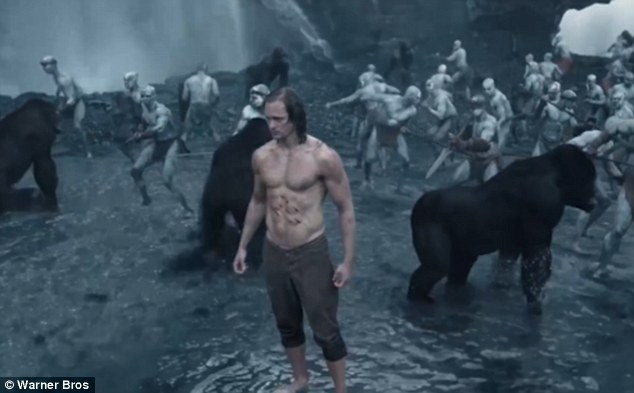
The Legend of Tarzan

The Legend of Tarzan

Posted on June 30, 2016 at 4:15 pm

B-
Lowest Recommended Age: Middle School
MPAA Rating: Rated PG-13 for sequences of action and violence, some sensuality and brief rude dialogue
Profanity: Some racist epithets and mild language
Alcohol/ Drugs: Some social drinking
Violence/ Scariness: Extended peril and violence, characters injured and killed, some disturbing and graphic images and scary animals
Diversity Issues: Historical abuse and enslavement
Date Released to Theaters: July 1, 2016

Copyright 2016 Warner Brothers
“The Legend of Tarzan” gets some things right. The swinging through the trees is exhilarating. Alexander Skarsgård (Tarzan/John) and Margot Robbie (Jane) are beautiful to look at, as is the African scenery. The CGI animals are pretty good. Thankfully, other than a few flashbacks, it avoids dwelling on the over-familiar origin story. And it is nice to see a shift from the colonialist perspective of some Tarzan stories to recognition of the real-life atrocities inflicted by Belgium’s King Leopold on the African natives, exploiting their resources and enslaving their people.

But there’s a lot the movie does not get right. It’s not terrible; it’s just oddly off, as though it was assembled by a committee that didn’t communicate with each other very well. The first problem is that Tarzan is depressed. I do not know why people seem to think that we somehow make classic literary characters more sophisticated or modern by making them depressed, but I’ve had enough of it. We’ve already had a depressed Batman and a depressed Superman this year. We don’t need a depressed Tarzan. Tarzan, now using his birth name of John Clayton, Lord Greystoke, is living in England when we first see him. Presented with an invitation to return to the Congo as the guest of King Leopold, he declines. Lifting a pinky as he sips from a porcelain teacup to demonstrate just how far he has come from running naked through the jungle, he explains simply, “It’s too hot.” He does not want to go back. But an American named George Washington Williams (played by Samuel L. Jackson and a toupee) persuades him to return, so he can investigate charges of abuse and enslavement. Jane is thrilled to return to Africa, and John reluctantly agrees to let her come along.

The invitation from the King was engineered by Leon Rom (Christoph Waltz, in his usual ultra-civil, ultra-evil mode). If he can deliver John to Chief Mbonga (a regal Djimon Hounsou) the chief will give him access to the diamond mines. When John escapes, Rom takes Jane and some of her tribal friends prisoner.

There’s an unfinished quality to the film. The tone shifts from a literally heavy-handed early image of a cruel hand wrapped in a rosary ripping a flower from its stem to some awkward and anachronistic attempts at humor (Samuel L. Jackson after a diplomatic speech: “And I thought the Civil War was long!”), and distracting random camera-swooping. But the real drag on the film’s momentum is Tarzan himself, who is so morose that the energy seeps out of the story. Reportedly, Skarsgård spent six months working out all day. He looks great, but to be honest he already looked great, and the fixation with male or female movie stars remaking their bodies for roles is barbaric. What needed the work was the script.

Parents should know that this film includes extended peril and violence, guns, spears, explosions, predator animals some disturbing images, characters injured and killed, some sexual references, and brief strong and racist language.

Family discussion: Why did John and Jane have different views about going back to Africa? How did John’s idea of honor change and why?

If you like this, try: the many other movie and television portrayals of Tarzan and the books by Edgar Rice Burroughs
Related Tags:


Action/Adventure Based on a book Movies -- format Remake
Alice Through the Looking Glass

Alice Through the Looking Glass

Posted on May 26, 2016 at 5:50 pm

Copyright 2016 Walt Disney Pictures

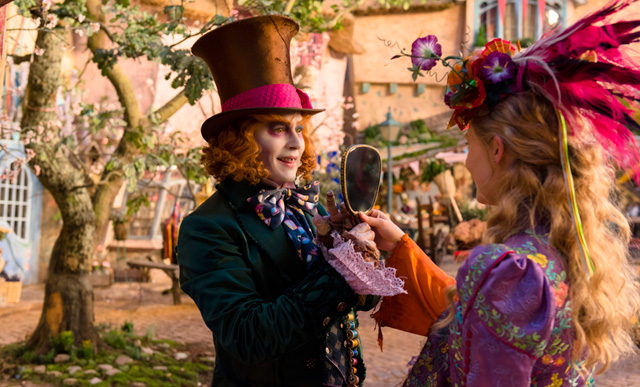
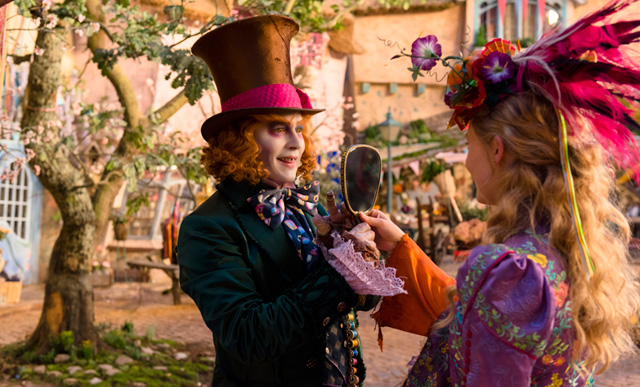
“Alice Through the Looking Glass” the movie has almost no relationship to Alice Through the Looking Glass, the book by Lewis Carroll in spirit, character, or storyline. That might possibly be all right if the spirit, character, or storyline were in any way worthwhile, but it is not. Gorgeous production design and some cool stunts do not make up for a story that begins as passable and ends as painful.

Tim Burton, who produced this one, previously gave us an “Alice in Wonderland” with an adult Alice (Mia Wasikowska) replacing the little girl of the story and spending way too much time in the above-ground “real” world as she attends a party, turns down a proposal of marriage from the odious Haimish (Leo Bill), and accepts instead the offer from his father to serve as crew on a merchant ship.

In “Looking Glass,” we first see Alice, now captain of the ship, in an exciting escape from pirates that show us her courage and love of adventure. But when the ship returns to port in London, she finds that Hamish’s father has died, leaving him in charge, and he refuses to let her go back to sea. In his home, she finds a mirror over a fireplace that is a portal back to Wonderland, led by the former caterpillar, now-butterfly (voice of of the much-missed Alan Rickman).

Having already imported the talking flowers, chess pieces, Tweedledum and Tweedledee, and the Jabberwocky from “Through the Looking Glass” into the first film, conflating the first story’s Queen of Hearts (the “Off with the head!” one) with the second story’s Red Queen (the chess one) this movie takes — but makes no use of — the first book’s characters like the Cheshire Cat and the White Rabbit, and then has a completely invented story about time travel.

This has many disagreeable aspects, but the worst is when it puts Sasha Baron Cohen as the embodiment of Time into a scene with Johnny Depp as the Mad Hatter and allows them to try to out-grotesque each other in a manner clearly intended to be charming. It is not.

Neither is the plot, which relies heavily on just the kind of treacly heartstrings-plucking backstories that Carroll would never have allowed, asking us to feel sympathy for outrageous behavior and affection for caricatures. The first film’s attempt to create a warm, devoted friendship between Alice and the Mad Hatter was rather ooky. In the sequel, we are asked to believe that she has returned to do whatever it takes to help him because they love each other so much.

To paraphrase the folks behind “Seinfeld,” in the Alice world, there should be no hugging and no apologizing — and no heartfelt professions of affection, especially when they are not in any way justified by the characters’ history with each other.

Alice is needed on the other side of the mirror because the Mad Hatter has found something that has convinced him that his family is still alive, and not killed by the Jabberwock as he had thought. Why is this so important? Is it because he misses them so? Not really. It is because he feels bad about his behavior and needs to see them again so he can be forgiven. The disconnect between the expressions of devotion and the narcissistic reality of behavior is disturbingly cynical. Alice decides the only way she can save his family is to go back in time to the Jabberwock battle, which means she has to retrieve the chronosphere from Time himself, and that leads to more time travel as she solves various not-very-mysterious mysteries and Time chases her to get it back. Not that any of it makes any sense, logically or emotionally.

The production design is imaginative and witty, but it is buried under a gormless, hyperactive mess of a film. The book is endlessly witty and imaginative and delightful with all kinds of wordplay, math puzzles, and chess references from Carroll (aka Charles Dodgson), a math professor.  The movie wastes all of that opportunity.  Look at the title — the movie should be about a reverse world, not a heist/time travel saga that only concludes you can’t change history.  If I had the chronosphere, I’d use it to go back to the moment I sat down to watch this movie so I could go home.

Parents should know that this film has extended fantasy peril with many disturbing images, discussion of loss of parents, brief image of someone dying, and bullying.

Family discussion: If you could go back in time, what time would you pick? Why did the Hatter and the White Queen have a hard time telling their families how they felt?

If you like this, try: the many other movie Alice stories including the Disney animated version and the Kate Beckinsale version of “Through the Looking Glass” and the books by Lewis Carroll

Related Tags:


3D Action/Adventure Based on a book Fantasy Remake Series/Sequel

Roots 2016 — Remake of the Classic Series Based on Alex Haley’s Book

Posted on May 25, 2016 at 3:03 pm

The 1977 television miniseries Roots, based on the book by Alex Haley, was one of the foremost cultural events of the decade, watched by millions and discussed by everyone. It followed the story of Haley’s family from the capture of his African ancestor, Kunta Kinte (Levar Burton), who was enslaved and brutally abused. For generations, the family struggles to stay together and to hold onto their culture and history.

A remake of the series begins on May 30, 2016, on the History Channel, and also on Lifetime and A&E. Levar Burton is one of the producers. The cast includes Forest Whitaker as Fiddler, Anna Paquin as Nancy Holt, Jonathan Rhys Meyers as Tom Lea, Anika Noni Rose as Kizzy, Tip “T.I.” Harris as Cyrus, Emayatzy Corinealdi as Belle, Matthew Goode as Dr. William Waller, Mekhi Phifer as Jerusalem, James Purefoy as John Waller, Laurence Fishburne as Alex Haley, and newcomers Regé-Jean Page as Chicken George and Malachi Kirby as Kunta Kinte.

https://www.youtube.com/watch?v=ZZwaqFhs9fo

According to the New York Times,

“I think we also think more in terms of the social violence of being separated from your entire genealogy in Africa.”

That is a rift “Roots” tries to highlight, with a new understanding about the real Kunta Kinte, now said to be an educated young man from a prominent, well-to-do family, who lived not in a remote village (as depicted in the 1977 version) but on the shore of a bustling trading post. “He spoke probably four languages,” Mr. Wolper said.

His characterization changed, too: While Mr. Burton’s is a headstrong naïf, the new Kunta is “a little tougher, a little edgier,” Mr. Wolper said, in what he hoped would be a more contemporary spin. Though one of the iconic images of the original was Mr. Burton in shackles, in promotions for this one — “focused thematically more on defiance, resistance and the ability to overcome the shackles of the body,” Mr. Wolper said — Kunta Kinte is shown breaking through his chains.

The new series reflects changes in culture and understanding since 1977, and, like the original, has some important context for contemporary conflicts. The older series is dated in terms of production values and perspective, but it is well worth re-visiting, in part to better understand what has and has not changed.

https://www.youtube.com/watch?v=EE0mOzkJWnM
Related Tags:


Based on a book Based on a true story Epic/Historical Remake Television

A Bigger Splash

Posted on May 12, 2016 at 5:23 pm

B+
Lowest Recommended Age: Adult
MPAA Rating: Rated R for graphic nudity, some strong sexual content, language and brief drug use
Profanity: Very strong and crude language
Alcohol/ Drugs: Drinking, smoking, drugs
Violence/ Scariness: Violence including homicide
Diversity Issues: Background of race and class issues
Date Released to Theaters: May 13, 2016

Where there is Eden, there is usually a serpent. In this case, it is literal and metaphoric, as Paul (Matthias Schoenaerts) and Marianne (Tilda Swinton) are blissfully happy in a lovely home with a pool on an exquisite island near Sicily. Occasionally they are confronted by local wildlife, including a couple of snakes. But mostly they lie naked outdoors, make love in the pool, and go swimming, slathering mud all over each other then sleeping as it dries. Both are recovering, which means both are vulnerable. Marianne is a rock star — in a flashback we see her on stage at an enormous arena with the crowd shrieking her name. She has had an operation on her vocal chords and must not speak at the risk of losing her voice entirely. Paul is a photographer and documentarian who has been to rehab for substance abuse and a suicide attempt. They are gentle and loving with each other.

And then the cell phone rings. It is Harry (Ralph Fiennes), Marianne’s former producer and lover, and he says he is landing on the island in five minutes and needs to be picked up. He arrives with a very young woman named Pen (Dakota Johnson) and it is clear that they are there to break things — to break the silence, to break hearts, to break the fragile peace Marianne and Paul have found when they left home to get away from people like Harry. “We’re hiding out,” Paul tells him. “Not from me!” Harry replies.

Harry is loud, carelessly arrogant, and needy. Some people are obnoxious because they do not know better; Harry knows and relishes it. He is the kind of guy to take up with a girl Pen’s age, but it turns out she is his recently discovered American daughter. Partly because he did not know he was her father until she was grown and partly because he lives in the space between outre and obscene. He literally pees on a grave. “Everyone’s obscene,” he says, “that’s the whole point.” He does not believe in limits, with one possible exception he claims to put on himself. After a lot of hinting from Harry, Marianne invites him and Pen to stay in the house they are renting.

“A Bigger Splash,” takes its title from a David Hockney swimming pool painting, is a remake of the 1969 Alain Delon film “La Piscine” (“Swimming Pool”). The characters experience need, fear, love, loss, and deception. They reflect the power and corruption of celebrity while around them we see glimpses of desperate refugees held in pens. Beautifully composed images show dreamlike settings, but there are intrusions within the pristine purity of the house: the shadow of an airplane about to land, a reptile on the table, some gauche visitors invited by Harry. “You’re not speaking, sweetheart,” he says to Marianne. “So I had to make other plans.” Small details are superbly chosen — a dress awkwardly worn in one scene turns up again later where it is more suitable, Harry’s story about producing a Rolling Stones song (with a fabulous dance), both Harry and Paul placing pills on Marianne’s tongue, a glint of gold and silver on her eyelids. It’s a mood piece, brilliantly performed, resonating like a bell that was rung days before.

Parents should know that this film includes very explicit nudity, sexual references and explicit situations, drinking, smoking, drugs, violence including homicide, and very strong language.

Family discussion: Why did Marianne invite Harry to say with her? Why did Pen lie?

If you like this, try: “Swimming Pool” and “Laurel Canyon”

Related Tags:


Drama Movies -- format Remake
THE MOVIE MOM® is a registered trademark of Nell Minow. Use of the mark without express consent from Nell Minow constitutes trademark infringement and unfair competition in violation of federal and state laws. All material © Nell Minow 1995-2026, all rights reserved, and no use or republication is permitted without explicit permission. This site hosts Nell Minow’s Movie Mom® archive, with material that originally appeared on Yahoo! Movies, Beliefnet, and other sources. Much of her new material can be found at Rogerebert.com, Huffington Post, and WheretoWatch. Her books include The Movie Mom’s Guide to Family Movies and 101 Must-See Movie Moments, and she can be heard each week on radio stations across the country.

Website Designed by Max LaZebnik