Rated PG-13 for sexual content, brief strong language, and some thematic material
Profanity:
Brief strong language
Alcohol/ Drugs:
Reference to a drunk driver and alcohol abuse
Violence/ Scariness:
Fatal car accident, sad death, scenes in hospital
Diversity Issues:
None
Date Released to Theaters:
February 11, 2022
Copyright 2021 ParamountShould a movie have a happy ending? We may guess that the teenage couple who debate this critical question in their very first conversation are destined for each other. We may guess which category this film falls in from the opening scene, a fatal car accident. We will see the story unfold back and forth between that night and 102 days earlier, so we can see how they met and fell in love and the events that led up to and followed the crash.
They meet when Skylar (Kyle Allen of “A Map of Tiny Perfect Things”) and Tessa (Joey King of “The Kissing Booth” movies) are entire audience for a French film called “Betty Blue.” Tessa is about to leave when she realizes that there are no subtitles. But he takes the seat next to her and offers to translate as he has seen it before and he speaks French.
They debate the value of a happy ending. As we will learn, Skylar has two loving parents he admires and is close to. He is an outstanding student and athlete and has been accepted at Brown. He believes in happy endings because the world has treated him kindly. Tessa, who lives with people who are not her parents and would rather interact with the world behind a camera, has experienced loss and she is determined to make sure she never risks feeling pain again. She cannot help falling in love with him, but cannot bring herself to say the words that come more easily to him.
Like “Ghost” and “Truly Madly Deeply,” this is a story of love and loss. Tessa is just fine at a remove from other people, taking photos and not talking to the adults she lives with. But Skylar is irresistible. Impossibly so, like beyond perfect, handsome, humble, funny, smart, and one hundred percent devoted and supportive even when she is challenging. But that’s almost okay because Allen has a lot of charm and carries it lightly and because it is depicting the heightened emotions of teenage first love. We can accept that we are seeing him through Tessa’s eyes.
King is transitioning smoothly into more grown-up roles and she is very appealing here, especially as we see Tessa’s relationship with Skylar evolve. We can see how desperately she wants to find connection and allow herself to be loved, even as it terrifies her. The movie is about 20 minutes too long, but so sweet it is hard to hold that against it.
Parents should know that this movie includes discussion of family loss, abandonment, and dysfunction including a mentally unstable parent, foster care, and divorce, brief strong language, and a teen sexual situation.
Family discussion: How do you decide when to protect yourself and when to make yourself vulnerable? Why was it important for Tessa to hear her own words?
If you like this, try: “Every Day,” “Before I Fell,” and, also starring Kyle Allen, “A Map of Tiny Perfect Things”
Rated R for some rear-end nudity, brief sex scenes, drug use and language
Profanity:
Strong language
Alcohol/ Drugs:
Alcohol and recreational drug use
Violence/ Scariness:
Punch
Diversity Issues:
None
Date Released to Theaters:
February 11, 2022
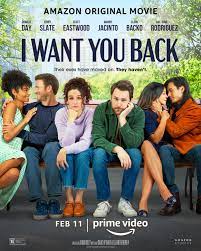
Copyright 2021 Amazon StudiosYes, the title song appears in the romantic comedy “I Want You Back” along with a bunch of other lively and well-chosen selections, but it might as well have included another classic hit single, “Breaking Up is Hard to Do.”
Two characters are devastated by being dumped by their significant others in the movie’s opening scenes. Emma (Jenny Slate) is at a restaurant with Noah (Scott Eastwood), her boyfriend of 18 months, who offers her some of his steak because he says she needs to get more iron. “Are you trying to be the nicest, sweetest, cutest boyfriend in the world?” she says lovingly. Nope, he’s about to tell her that he’s met someone else. Peter (Charlie Day) is attending a birthday party for the young son of friends when Anne (Gina Rodriguez) tells him that after six years together she wants to break up because she wants “a bigger life,” not “making salmon and watching ‘Dancing With the Stars,” which is what she says is all they ever do.
Emma and Peter work in the same office building and they meet when they are both sobbing in the stairwell. When they discover they are there for the same reason, they go off to get drunk and sing sad karaoke, including “Oughta Know.” They christen themselves the “Sadness Sisters” and after a couple of commiserating meetings and a lot of cyber-stalking of their exes’ social media, they hatch the kind of plan you only (I hope) see in rom-coms; they are each going to break up the new relationships of their former significant others. Emma will seduce Logan (Manny Jacinto of “The Good Place” and “Nine Perfect Strangers”), a middle school drama teacher and Peter will befriend Noah. And so, Emma volunteers to help out with Logan’s middle school production of “Little Shop of Horrors” and Peter hires Noah as a personal trainer.
Slate and Day are better known for more heightened comedic roles — and for their distinctive husky but sometimes squeaky voices. But here they are wonderfully warm and endearing as two good people who are very sad and a little lost. Plus, they get strong support from comedy all-stars Jacinto and Rodriguez, Eastwood is game, and we get to see Slate in a wild blonde wig singing “Suddenly Seymour.” The skillful and witty screenplay by Isaac Aptaker and Elizabeth Berger (“Love, Simon” and “This is Us”) makes them three-dimensional characters. As we see Emma interact with an unhappy 12 year old stagehand and Peter out at a club with Noah we have more reason to want them to find happiness than just seeing them mope in a bar about their break-ups. It also makes some of their antics a little less crazy. Slate and Day are an appealing couple and that puts the rom in the rom-com.
Parents should know that this movie has mature themes including sexual references, a proposed threesome, nudity, strong language, and alcohol and drug use.
Family discussion: Why do Peter and Emma see each other differently than Noah and Anne saw them? What bothered them the most about their breakups, their hurt pride, their fear of being alone, or their affection for the people who broke up with them?
If you like this, try: Another movie with a title taken from a song that is about two people who join forces after break-ups, “Addicted to Love”
Rated PG for some strong violence, thematic and suggestive material, and brief language
Profanity:
Brief strong language
Alcohol/ Drugs:
Alcohol
Violence/ Scariness:
Sword fights and battles, characters injured and killed
Diversity Issues:
A theme of the movie, but transphobic humor
Date Released to Theaters:
February 4, 2022
Date Released to DVD:
April 18, 2022
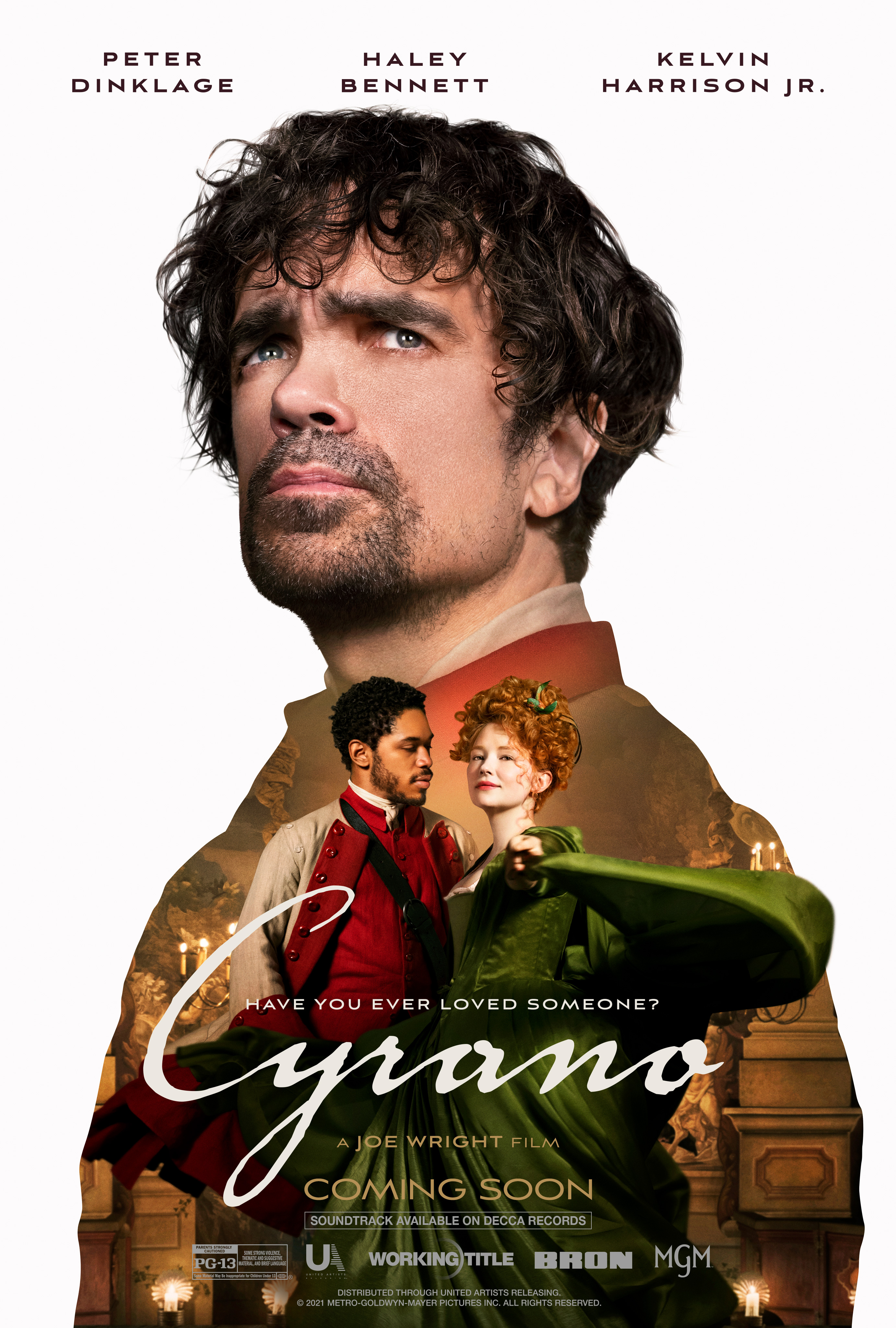
Copyright 2021 MGM“Cyrano” is a gorgeous film, a true labor of love. The basis, of course, is one of the great classic plays of all time, Edmond Rostand’s 1897 Cyrano de Bergerac, inspired by a real soldier/writer. Jose Ferrar won an Oscar for his performance as the title character in a 1950 film. The story of the man who cannot tell the woman he loves how he feels because of the way he looks has been adapted and rebooted many times, with probably the best known Steve Martin’s Roxanne and most recently set in a high school in “The Half of It.” Everyone can identify with a character who is afraid to approach the object of their affection and everyone would like to identify with a character whose wit is as ready and sharp as his sword. In the original and the Steve Martin version, the main character’s rapier-like comebacks to a thoughtless bully are a highlight.
In the original and “Roxanne,” the impediment is a nose so big that the Cyrano character believes no one can see him as a romantic partner. In this swooningly romantic new version, set, like the original, in the 17th century, the physical obstacle is size. Writer Erica Schmidt adapted the play as a musical to be performed on stage by her husband, actor Peter Dinklage (“Game of Thrones”) as Cyrano, and ravishingly lovely Haley Bennett as Roxanne. They play those parts in this film, directed by Bennett’s significant other, Joe Wright (“Atonement,” “Pride and Prejudice”)
Roxanne is loved by three men: Cyrano, the handsome but better-with-a-sword-than-with-poetic-love-letters Christian (Kelvin Harrison, Jr. of “Waves”), and the selfish, predatory De Guiche (Ben Mendelsohn). Cyrano has been her closest friend and confidant since childhood. De Guiche is pressuring her to marry him. Her maid reminds her that she has no money and no other options for supporting herself. But one night at the theater, she glimpses Christian, a newcomer to the military unit where Cyrano serves, and she loses her heart to him. Cyrano agrees to ghost-write love letters from Christian to Roxanne. He pretends it is to help the new recruit but in reality it is to have his one chance to tell the woman he loves how he feels, even if the letters are signed by someone else.
In a way, Schmidt is giving her words to the man he she loves so that we can see him the way she does, gallant, mordantly witty, a brilliant actor, and a person of deep and generous humanity. A scene where he is almost about to dare to hope that Roxanne will say she loves him, the emotions that flicker across his face as he is almost successful maintaining his composure is one of the most touching moments on screen this year.
With Schmidt and Wright creating the words and images for the people they love, in spectacularly beautiful costumes (Massimo Cantini Parrini and Jacqueline Durran) and settings (Sicily filling in as 17th century France) with music and even some dance numbers, the unabashed romanticism almost bursts out of the screen. Bennett makes a lovely Roxanne, clever and spirited but allowing her own romanticism to blind her to the love that is already hers. Mendelsohnn seems to specialize in bad guys these days, and this is another strong performance, De Guiche’s brutality glimpsed under a very thin veneer of suavity. Harrison makes a gallant Christian. But it is Dinklage who is in every way the heart of the story. Just as we get to see Cyrano finally use his own words under cover of darkness to play the part of the man whose outside matches his inside, in this film we get to see Dinklage take center stage, with a performance of heart-stopping vulnerability. Rostand would be proud, and so would the man who inspired the play that continues to capture us more than a hundred years later.
Parents should know that this film includes brief strong language, sexual references, sword fights, and battle scenes, with characters injured and killed.
Family discussion: Should Cyrano have told Roxanne how he felt? If so, when? Is there a time when you misjudged someone based on looks or when you were misjudged?
If you like this, try: “Roxanne” and the Ferrar and PBS versions of “Cyrano de Bergerac”
References to child abuse and injury, tragic death of parents, family conflicts
Diversity Issues:
Disabled character
Date Released to Theaters:
December 17, 2021
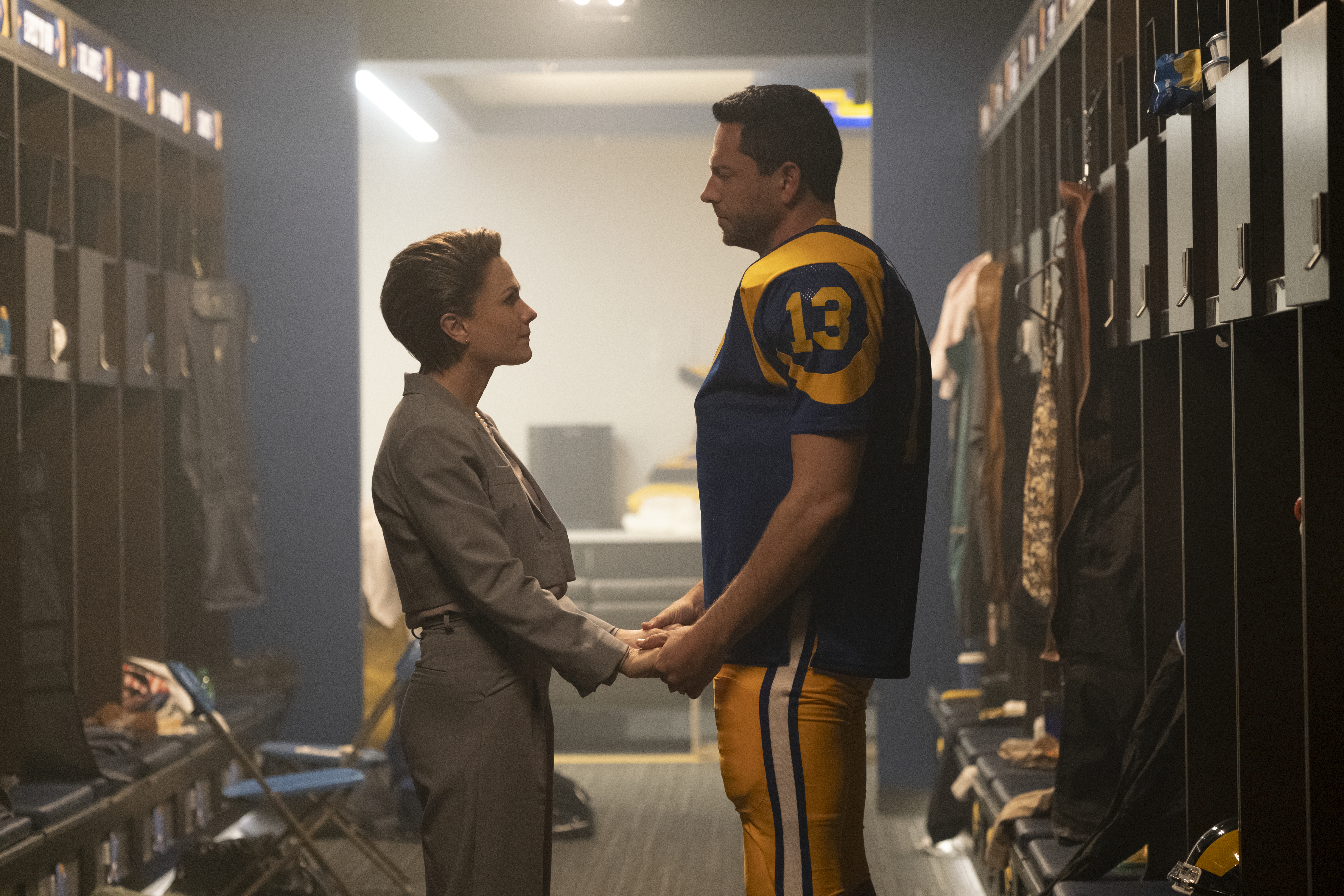
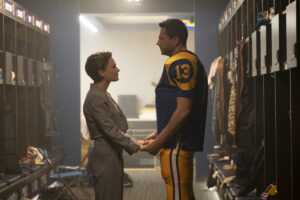
Anna Paquin as Brenda Warner and Zachary Levi as Kurt Warner in American Underdog: The Kurt Warner Story. Photo Credit: Michael KubeisyKurt Warner dreamed big. He tells us that from the time he was a young boy watching Joe Montana on television, he wanted to be an MVP quarterback in a team that won the Super Bowl. Perhaps as much of a long shot, when he was in college he fell in love with Brenda, a divorced mother of two children, one disabled, and decided he was going to make a life and a family with her. Sometimes life is even cornier than the movies, and then they go ahead and make a movie about it anyway.
If there was ever a story to show that the difference between winners and quitters is that winners keep going just one day longer, it is the story of NFL Hall of Famer Kurt Warner, who was not even drafted into the NFL after college. Even after the only job he could get was stocking the shelves of a big box store, he did not give up on his dream. He did become a Super Bowl MVP quarterback, and he did make a life with Brenda. And now he and Brenda have produced this movie about what happens when you don’t give up.
Okay, so it is corny, but sometimes corny is fine. So, yes, there will be a rousing locker-room pep talk (though perhaps not from the person you might guess), and yes, people will say things like, “If this is your dream, you have to fight for it,” and “By all accounts, my dream, my story, is impossible,” and “It doesn’t mean anything if you don’t have someone to share it with.” Of course they will, because those things are true. It helps a lot when the talents in front of the camera are MVPs, too, “Shazam’s” Zachary Levi as Kurt and Oscar-winner Anna Paquin as Brenda, with a fourth quarter appearance by Dennis Quaid as Dick Vermeil, who had his own roundabout career path and thus was especially understanding. Levi is an immediately likable presence and he makes Kurt’s dream aspirational, not arrogant or selfish. Paquin brings strength and vulnerability to Brenda, showing us her fear of opening up her heart after a painful divorce and the essential support she gets from her faith in God. They keep us rooting for Kurt because it is clear his dream is based on giving the best of what he has. With any luck, this movie will do for some in the audience what Joe Montana did for Kurt, and inspire another generation to dream big and refuse to quit.
Parents should know that this movie includes some mild language, references to child abuse, and tragic deaths of parents.
Family discussion: What makes sports stories so inspiring? Why did Kurt join the Arena league and what did he learn there? What did Brenda learn from Kurt’s response to Zach? What is your most impossible dream?
Rated PG-13 for some strong violence, strong language, thematic content, suggestive material and brief smoking
Profanity:
Strong and racist language
Alcohol/ Drugs:
Drinking, smoking, references to drugs
Violence/ Scariness:
Gang violence, knives, gun, characters injured and killed
Diversity Issues:
A theme of the movie
Date Released to Theaters:
December 10, 2021
Date Released to DVD:
March 21, 2022
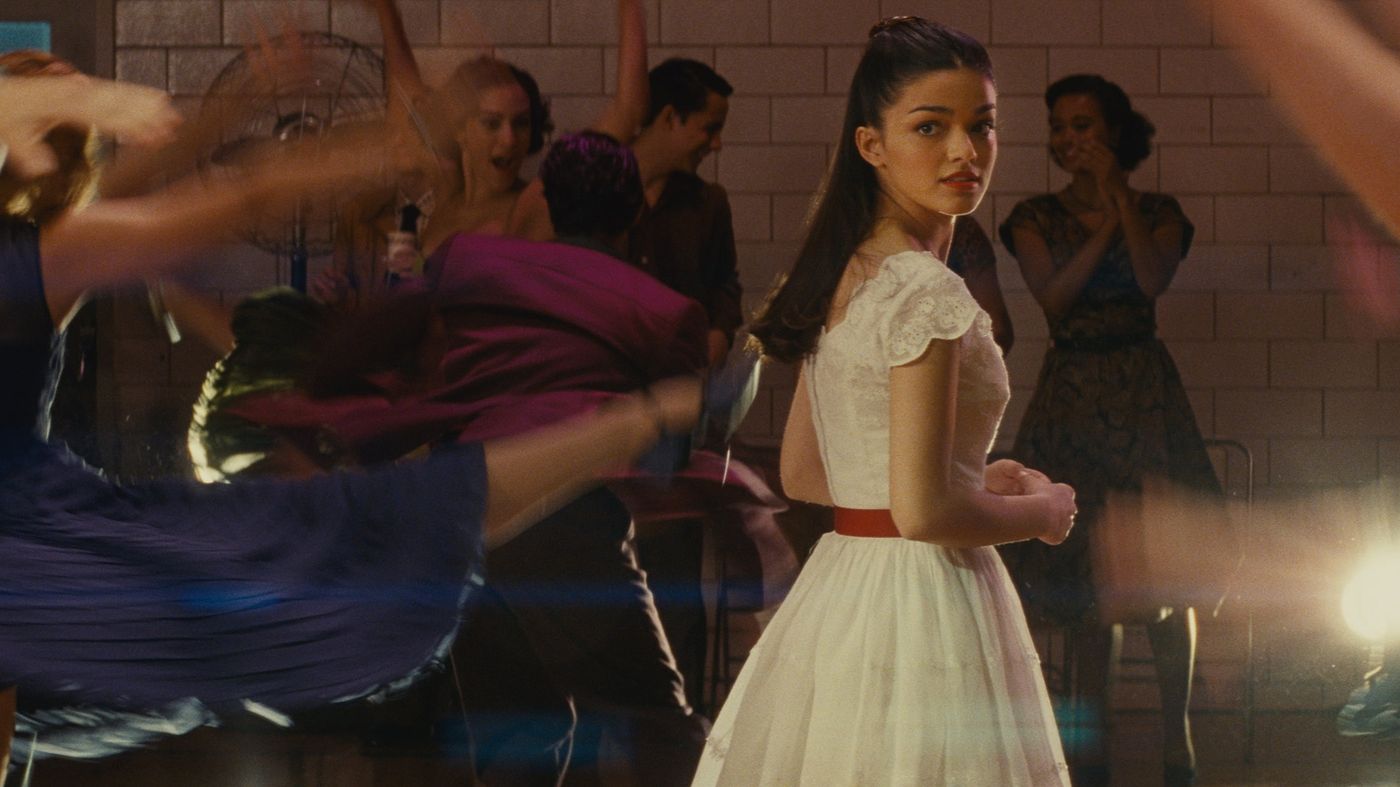
Why remake a 60-year-old movie that won ten Oscars and is still beloved, even while admitting its shortcomings and its being quaintly out of date on some of the issues it raises? Because Steven Spielberg and screenwriter Tony Kushner have taken the best from the original and made the essence of the story even more powerful and meaningful. “West Side Story,” the original itself a remake of Shakespeare’s “Romeo and Juliet,” itself a reworking of an Italian story that had at least three different versions before Romeo compared Juliet to the sun and Juliet asked what there was in a name. The themes of love, loss, fear, and anger will always inspire our stories, and the incomparable music by Leonard Bernstein, with lyrics by then then-25-year-old Stephen Sondheim, are as thrilling as ever in this new version.
Maybe there will be another remake 60 years from now, but it is hard to imagine it being better than this one. Spielberg’s gift for visual story-telling, with brilliant cinematography from Janusz Kaminski, production design from Adam Stockhausen, and editing by Sarah Broshar and Michael Kahn match and enhance the muscular electricity of the Bernstein score. There are star-making performances from the entire cast, especially Ariana DeBose as Anita, Mike Faist as Riff, and Rachel Zegler as Maria. Rita Moreno, who won an Oscar for her performance as Anita 60 years ago, all but steals the movie as Valentina, a new role, replacing Doc, the owner of the convenience store. In this version, she is his widow, their own marriage a symbol of what Tony and Maria aspire to.
Copyright 20th Century 2021
Kushner’s changes are subtle and judicious, making the story deeper and more urgent. The opening shots show us that the turf battle has already been lost. The wrecking ball is knocking everything down. The only home the Jets have ever known is being torn down “for slum clearance” to make way for a gentrification project that will include a high-end high-rise and the high-culture Lincoln Center for performing arts. When Anita sings in “America” about some day living in an apartment with a terrace, she is standing near a sign showing the glamorous building that will replace the town-down tenements.
The setting looks like a bombed-out war zone. This makes the the emotion more vivid and the stakes more concrete (in both senses of the word). When “West Side Story” was first written, juvenile delinquents were listed by a majority of Americans as one of their most important concerns, next to atomic weapons. In order to make the concerns of the gangs as visceral today, Kushner shows us why Riff and the Jets feel that everything is being taken from them. The detective tells them that all the white people in the community who were smart enough to get out are gone. They are, he says, “the last of the can’t make it out Caucasians.”
Everything that gave them a sense of power, belonging, and control (“little boy, you’re a man, little man, you’re a king”) is being reduced to rubble and replaced with spaces that would be alien to them even if they could afford them. There is dust everywhere, and everything is washed out, knocked down, and covered with grit. The Jets cannot fight City Hall. All they have left is their fury and what they use to assuage it — the feeling of brotherhood. They sing of the Jets as a family (“you’ve got brothers around; you’re a family man”) while Tony says he envies the Puerto Ricans’ strong, committed biological families. There is no one to take it out on but the newcomers who are even lower on the social hierarchy than they are, the Puerto Ricans. Riff says, “I wake up to everything I knew being sold or wrecked or being taken away by someone I don’t like.”
Their gang, the Sharks, is fueled by resentment at being treated like second-class Americans in their own country. And they, too, are worried about losing their sense of family. They want the opportunities available to white, native English-speaking Americans but they want to remain intact, insular, restricting their associations to those they can trust. Their internal conflict is shown in “America,” where the girls sing of what they can do and buy and the boys jeer at them for ignoring the bigotry they will face — while not being willing to go back to Puerto Rico.
Some changes reflect our more sensitive understanding of the very issues the original depicted. In this version, the Latinx characters are played by Latinx performers of different skin tones and no one wears brownface make-up. All of the performers do their own singing. In addition, the Spanish dialogue is not subtitled. Some gender/sexuality insults remain in the script but the character once derisively called “Anybody’s,” who we might now call non-binary, is portrayed with more depth. The dance numbers are less balletic, more a reflection of the energy of emotions the characters are feeling.
Kushner’s changes to the script are sometimes subtle but every one adds to the emotion and revelation of character. In this version, Tony has even more reason to be reconsidering his commitment to the Jets, and he has an example in Valentina, his employer and friend, of what is possible. The “Cool” song has much more of an impact here, sung by Tony to Riff when he discovers that Riff has bought a gun. “I Feel Pretty,” instead of a bridal shop, is sung in a department store, where Maria is an after-hours cleaner. The dance through the aspirational scenes of mannequins “enjoying” middle class life parallels the reference to the apartment with a terrace. And Tony takes Maria to see The Cloisters, a beautiful cathedral-like setting for “One Hand, One Heart” that evokes the timelessness of Romeo and Juliet.
This story is very much of its time but its themes, too, are timeless, and with this new version we can experience it with the deeper understanding of its themes, a new generation of performers making it as new to us as it is to them, and one nod to the past with Moreno reminding us that like the late Bernstein and Sondheim, brilliance is always forever renewing itself.
Parents should know that this movie includes strong language with some racist terms, sexual references and a non-explicit situation, drinking, smoking, references to drugs, and gang violence, with knives and a gun. Characters are injured and killed.
Family discussion: If the story took place today, who would be in the gangs and how would it be different? What do we learn from the “Office Krupke” song? Why do Riff and Tony see things differently? What advice would you give to Tony and Maria?
If you like this, try: the original 1961 film, “In the Heights,” the wonderful documentary about Rita Moreno, and “Romeo and Juliet”